

Many over-the-counter omega-3 supplements show measurable oxidation, and some surveys have found a substantial fraction of tested products exceeding voluntary limits. Oxidation in supplements degrades potency and, in oxidized-lipid forms, may carry its own physiological effects. Three actions matter most right now: require batch-level PV, AV, and TOTOX data from every supplier, tighten formulation and packaging controls, and tie release testing to a documented stability schedule rather than a single point-in-time certificate.
TL;DR:
- Over half of tested omega-3 supplements exceed voluntary oxidation limits, with fish oil capsules generally showing lower oxidation than bulk oils.
- Batch testing should include peroxide value, p-anisidine value, and TOTOX, with assay methods and storage conditions clearly documented for accurate monitoring.
- Controlling oxidation relies on ingredient sourcing, packaging, antioxidant pairing, and stability testing, not just relying on marketing or packaging labels.
- Human trial data may be unreliable if the tested oils' oxidation state isn't disclosed, as oxidized oils can negatively affect health outcomes.
- Implementing systematic COA tracking, stability schedules, and formulation discipline through dedicated platforms improves oxidation management during product development.
Table of Contents
- How Lipid Oxidation Actually Progresses in a Supplement
- Measuring Oxidation: PV, AV, and TOTOX Explained
- What the Survey Data Says About Omega-3 Quality
- What Human and Animal Evidence Actually Shows
- Formulation and Packaging Controls That Actually Reduce Oxidation
- What Every COA and Trial Report Should Actually Disclose
- How a Formulation Platform Operationalizes Oxidation Control
- What Formulators Should Actually Do With This
- Manage Oxidation Risk Without Rebuilding Your Workflow From Scratch
- Sources
How Lipid Oxidation Actually Progresses in a Supplement
Oxidation in omega-3 oils follows a predictable three-stage chain reaction, and knowing where a batch sits on that chain tells you what to measure and what to fix. The process starts at initiation, when a fatty acid loses a hydrogen atom to heat, light, or a trace metal ion, creating a free radical. That radical reacts with oxygen during propagation, generating lipid hydroperoxides, the primary oxidation products. Hydroperoxides are unstable and break down into secondary products, including aldehydes such as 4-hydroxyhexenal (HHE), 4-hydroxynonenal (HNE), and malondialdehyde (MDA), compounds with documented biological reactivity in cell and animal studies.
This two-tier structure explains why a single test never tells the whole story. A fish oil can have low peroxide value yet already be breaking down into secondary aldehydes, or the reverse: fresh hydroperoxides forming faster than they decompose. Either snapshot alone misses the trajectory.
A handful of drivers push this chain forward, and formulators can control most of them:
- Oxygen exposure, from headspace air in bottles or a puncture in blister packaging.
- Light, particularly UV wavelengths, which accelerates radical formation in clear packaging.
- Heat, including warehouse storage and mail-order transit through summer.
- Trace metals such as iron and copper, often introduced through mineral co-ingredients or processing equipment, which catalyze radical formation.
- Water activity, since even encapsulated oils absorb ambient moisture that speeds hydrolysis and oxidation.
- Pro-oxidant co-ingredients, including certain vitamin C and iron forms that can flip from protective to reactive depending on their chemical form and the surrounding matrix, a point research on chemical form and co-ingredient behavior makes clear.
Understanding this pathway is what separates a formulator who reacts to a failed COA from one who designs the product to never fail it. Mechanistic clarity here directly shapes how ingredient functionality drives formulation choices later in development.
Measuring Oxidation: PV, AV, and TOTOX Explained
Peroxide value (PV) measures primary oxidation, the hydroperoxides formed early in the chain reaction, typically expressed in milliequivalents of oxygen per kilogram of oil (meq O2/kg). P-anisidine value (AV) measures secondary oxidation, the aldehydes left behind after hydroperoxides decompose, and it's unitless by convention. Neither number alone tells you enough, which is why the industry leans on TOTOX (total oxidation), calculated as 2×PV + AV. TOTOX weights primary oxidation twice because hydroperoxides continue degrading into more aldehydes even after the sample is tested, giving a rough forward-looking estimate rather than a static readout.
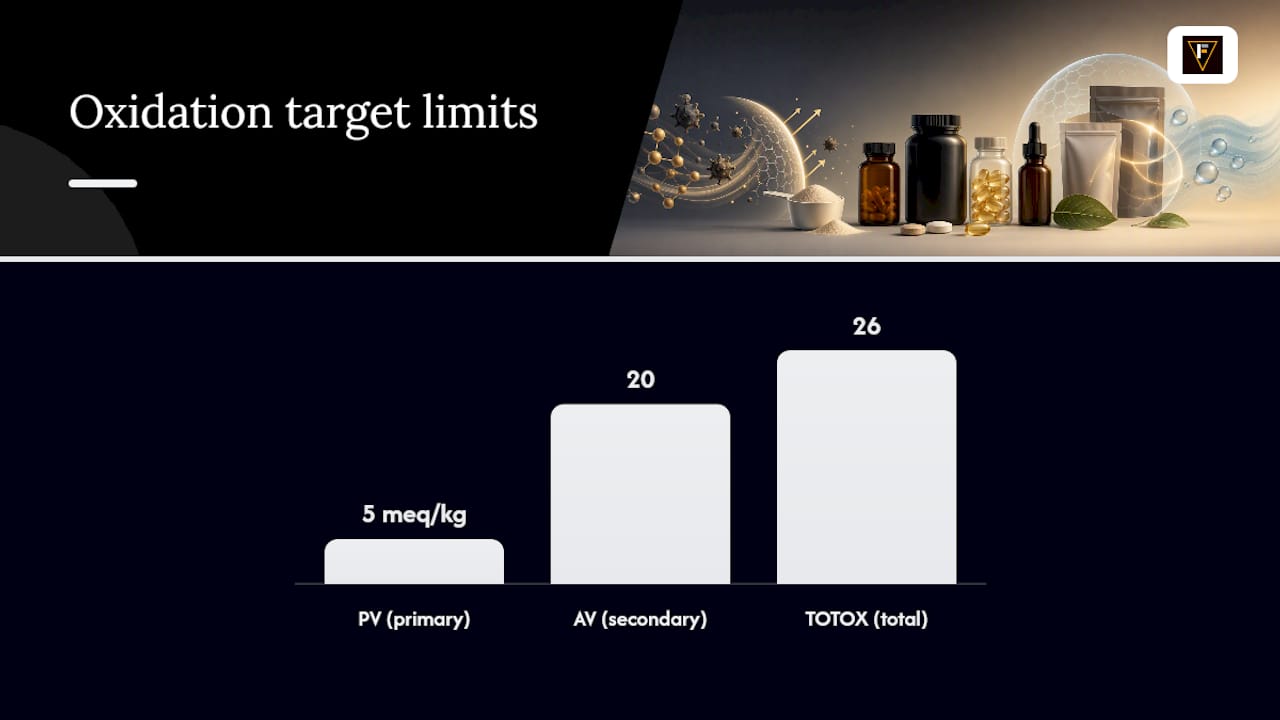
Voluntary guidance in the marine oils sector generally targets PV under 5 meq O2/kg, AV under 20, and TOTOX under 26, though these are industry consensus figures rather than binding regulatory thresholds. A 2013 review by Albert and colleagues found that clinical trials using marine omega-3 oils have rarely reported PV or AV at all, which means a meaningful share of the efficacy and safety literature was generated without knowing whether the test oil was fresh or already degraded.
Assay procedures matter as much as the numbers themselves. The American Oil Chemists' Society (AOCS) publishes the standard reference methods, typically Cd 8b-90 for peroxide value and Cd 18-90 for p-anisidide value, and any COA that reports PV or AV without naming the assay method should raise a flag. Method drift between labs is common enough that comparing results across suppliers without confirming identical AOCS protocols is close to meaningless.
Lab handling practices for oxidation testing:
- Minimize time-to-analysis. Oil sitting in an open vial at room temperature keeps oxidizing during the wait for testing, skewing results upward.
- Use nitrogen (N2) blanketing during sample handling and storage to prevent atmospheric oxygen from continuing the reaction mid-analysis.
- Store samples refrigerated between collection and testing, and log the storage duration on the report.
- Run duplicate or triplicate assays per batch; a single-point PV reading hides variability that a formulator needs to see.
- Require the COA to state batch ID, assay date, and method alongside the PV/AV/TOTOX figures, not just the final numbers.
Pro Tip: Ask suppliers for the time gap between sample extraction and PV/AV testing. A COA that doesn't disclose this is often hiding a delay long enough to inflate the numbers you're trying to verify.
What the Survey Data Says About Omega-3 Quality
The scale of the problem is well documented across multiple independent surveys, and the pattern holds across markets. A widely cited analysis of North American over-the-counter n-3 products found that around half of tested items exceeded voluntary recommended oxidation limits for at least one marker. A separate Scientific Reports survey of fish oil supplements in New Zealand found even starker numbers: 83% exceeded peroxide value recommendations, and half exceeded TOTOX limits, with many products also failing to deliver the EPA and DHA content stated on the label.
More recent testing out of George Washington University reinforced the pattern, finding that a large share of popular fish oil supplements tested may not be fresh enough to deliver the benefits consumers expect.
Across the surveys reviewed, reported exceedance rates for at least one oxidation marker vary widely depending on specific market, product category, and assay protocol used.
Formulation and delivery form explain a meaningful chunk of that spread. Products that were:
- Encapsulated and unflavored consistently showed significantly lower secondary oxidation and TOTOX values than bulk or flavored oils.
- Bulk liquid oils sold by the bottle showed more variable and often higher oxidation, likely tied to repeated headspace exposure each time the bottle opens.
- Flavored or children's formulations trended toward higher oxidation markers, possibly linked to added masking agents or lower-grade base oils used to control cost.
None of this means every capsule on a shelf is degraded. It means oxidative state varies enough by product type and manufacturing choice that assuming freshness from packaging or price is a bad bet. Sampling protocol, lab method, and geographic sourcing all add noise to the reported rates, which is exactly why a single retail spot-check should never substitute for a batch-specific COA.
What Human and Animal Evidence Actually Shows
The human evidence on oxidized omega-3 supplements is thinner than the prevalence data would suggest it should be, and that gap is itself a finding worth taking seriously. A randomized controlled trial comparing low-oxidation and highly oxidized fish oil supplements in women found that the low-oxidation group saw reductions in triglycerides and cholesterol, while the highly oxidized group showed a negative effect on cholesterol. That's a real signal that oxidative state can shift physiological outcomes, but the trial was short-term and limited in scope, so it doesn't settle the question of long-term risk.
Animal and mechanistic research fills in some of the plausibility gap. Secondary oxidation products like HNE and MDA are established in toxicology literature as reactive compounds capable of forming protein and DNA adducts, with documented links to oxidative stress markers and tissue damage in animal models. That mechanistic plausibility is why researchers treat elevated secondary oxidation as a legitimate concern rather than a purely cosmetic quality issue, even where long-term human outcome data is sparse.
The bigger problem may be structural: most human trials testing omega-3 efficacy simply never report the oxidative state of the oil they used. As Albert and colleagues noted in their review, this absence makes it nearly impossible to know whether a null or positive trial result reflects the biology of omega-3s themselves or the condition of the specific oil tested. A trial using a highly oxidized product and one using a fresh product could report opposite outcomes for reasons that have nothing to do with the omega-3 hypothesis being tested.
There's also a cautionary lesson from the antioxidant supplement literature that's worth carrying into any oxidation-control strategy. A large systematic review covering 78 randomized trials and nearly 297,000 participants found that high-dose single-agent antioxidants like beta-carotene, vitamin E, and vitamin A did not reduce mortality, and in some analyses slightly increased it. Whole-food antioxidant networks behave differently from isolated high-dose supplements, a distinction Harvard Health has also flagged. Reaching for a fortified antioxidant blend as a blanket fix for oxidation risk isn't supported by that evidence.
Formulation and Packaging Controls That Actually Reduce Oxidation
Controlling oxidation starts before the oil ever reaches a capsule, and the choices made at each stage compound.
- Vet raw oil suppliers on age and refinement, not just price. Ask for the crude oil's harvest date and refining timeline; oil that sat in bulk storage for months before molecular distillation carries a higher starting oxidation load no matter how good the finishing process is.
- Screen for trace metals in the raw material. Iron and copper contamination, often from processing equipment, catalyzes oxidation long after the oil leaves the refinery. A metals panel on incoming lots is cheap insurance against a much larger stability problem later.
- Choose mineral co-ingredient forms deliberately. Chelated or bio-organic mineral forms reduce metal-catalyzed oxidation compared to inorganic salts in multivitamin-omega blends, and this decision belongs in the ingredient functionality review at the formulation stage, not as an afterthought.
- Match antioxidant chemistry to the matrix. Tocopherols, rosemary extract, and ascorbyl palmitate all behave differently depending on the surrounding fat and moisture profile. Ascorbic acid paired with iron can act as a pro-oxidant instead of a protectant, so pairing decisions need chemistry review, not habit.
- Favor encapsulated, unflavored delivery over bulk liquid. Survey data consistently shows lower secondary oxidation in encapsulated unflavored products, largely because encapsulation limits repeated oxygen exposure that bulk bottles suffer with every use.
- Use oxygen scavengers and nitrogen flushing during packaging. Both reduce headspace oxygen at the point of sealing, slowing the propagation stage before the product ever reaches a shelf.
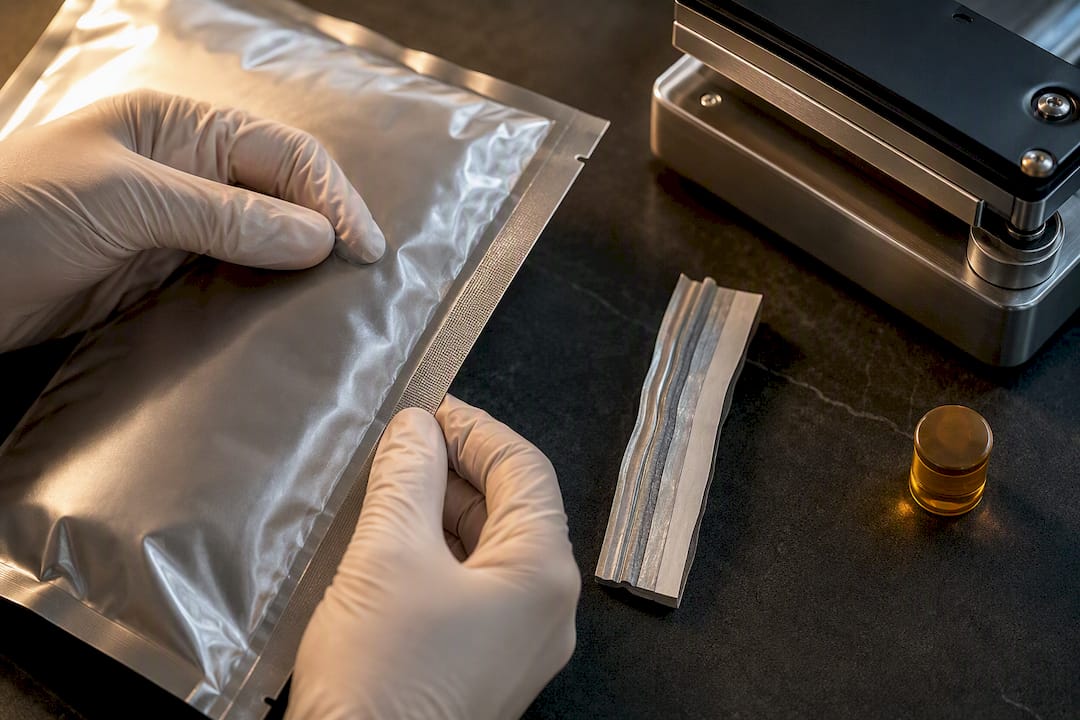
- Specify barrier packaging over clear, permeable containers. Amber glass, foil blister packs, or opaque HDPE bottles cut both light and oxygen transmission compared to clear PET.
- Build a stability testing schedule into the production plan, not just a release test. A single COA at manufacture tells you nothing about how the product ages over its stated shelf life.
Pro Tip: If your formulation includes both omega-3 oil and an iron-containing mineral blend, run an accelerated stability test with the full formula together, not the oil alone. Co-ingredient interactions often show oxidation effects the isolated oil never would.
Packaging and formulation decisions like these are also where a formulation safety testing framework earns its place in the workflow. Treating stability as a design input rather than a pass/fail gate at the end catches problems while they're still cheap to fix.
What Every COA and Trial Report Should Actually Disclose
A COA that lists only "meets specification" without numbers is not a quality document. It's a liability waiting to be discovered.
At minimum, a usable COA for an omega-3 raw material or finished product should state:
- PV, AV, and calculated TOTOX values, with units specified.
- The AOCS (or equivalent standardized) assay method used for each figure.
- The assay date and the batch or lot identification number.
- Storage conditions and elapsed time between sampling and testing.
Stability testing should sample at three minimum timepoints: at manufacture, at the midpoint of the stated shelf life, and at end-of-shelf-life under labeled storage conditions. Acceptance criteria should be set against the voluntary industry thresholds (PV under 5, AV under 20, TOTOX under 26) and documented as a pass/fail gate at each timepoint, not just at release.
| Testing checkpoint | What to verify | Who owns the check |
|---|---|---|
| Raw material intake | Supplier COA with PV/AV/TOTOX, assay method, and metals panel | Formulator / QC |
| Manufacture release | Finished-batch PV/AV/TOTOX, batch ID, assay date | Manufacturer / QC |
| Mid-shelf-life | Repeat PV/AV/TOTOX under labeled storage conditions | Brand / third-party lab |
| End-of-shelf-life | Final PV/AV/TOTOX against acceptance criteria | Brand / third-party lab |
Journals and trialists working with marine oils should treat oxidative-state disclosure the same way they treat dosage disclosure: a study reporting omega-3 outcomes without PV and AV values for the test oil is missing a variable that can flip the result. Building this expectation into submission checklists, and into internal compliance workflows, closes a gap the literature has tolerated for over a decade.
How a Formulation Platform Operationalizes Oxidation Control
Most of what reduces oxidation risk isn't exotic chemistry. It's discipline: tracking supplier COAs, scheduling stability checkpoints, and keeping formulation decisions tied to documented evidence instead of habit. That discipline is exactly what breaks down in spreadsheets and email chains as a brand scales past its first few SKUs.
A formulation platform can build that discipline into the product development workflow itself. Formulation templates flag ingredient interactions, including the mineral and antioxidant pairing risks covered earlier, before a formula reaches prototyping. The platform's 8-phase development path ties supplier documentation and stability planning to specific phases rather than leaving them as a final compliance scramble before launch. Compliance guidance covering regulatory requirements sits alongside the formulation tools, so labeling and testing expectations stay visible during formulation, not discovered after manufacturing is already booked.
For a formulator managing multiple omega-3 SKUs across suppliers, that means COA tracking and stability scheduling live in the same system as the formula itself, instead of scattered across supplier PDFs and separate lab reports.
What Formulators Should Actually Do With This
The oxidation problem in omega-3 supplements isn't a mystery. It's a discipline gap. Test every batch for PV, AV, and TOTOX before it enters formulation, not after a customer complaint. Fix the formulation and packaging variables you actually control, mineral form, antioxidant chemistry, encapsulation, barrier packaging, before chasing exotic stabilizer additives. Then label and report honestly: put the assay method on the COA, and if you're running or publishing a trial with marine oil, disclose the oxidative state of the material you tested.
The research community should push harder on that last point. Trial registries and journals reviewing omega-3 studies ought to require PV/AV disclosure as a condition of publication, the way they already require dosage and sourcing details. Until that's standard practice, a meaningful share of the efficacy literature will keep carrying an unmeasured variable.
If your team needs a structured way to build these checks into formulation from day one, that's precisely the gap Formlypro's workflow tools were built to close.
— Ben
Manage Oxidation Risk Without Rebuilding Your Workflow From Scratch
Some platforms provide supplement brands a system for parts of oxidation control that usually live in disconnected spreadsheets and supplier emails: formulation templates that flag ingredient interaction risks, a structured path for scheduling stability checkpoints, and compliance guidance built into the same workflow used to develop the formula.
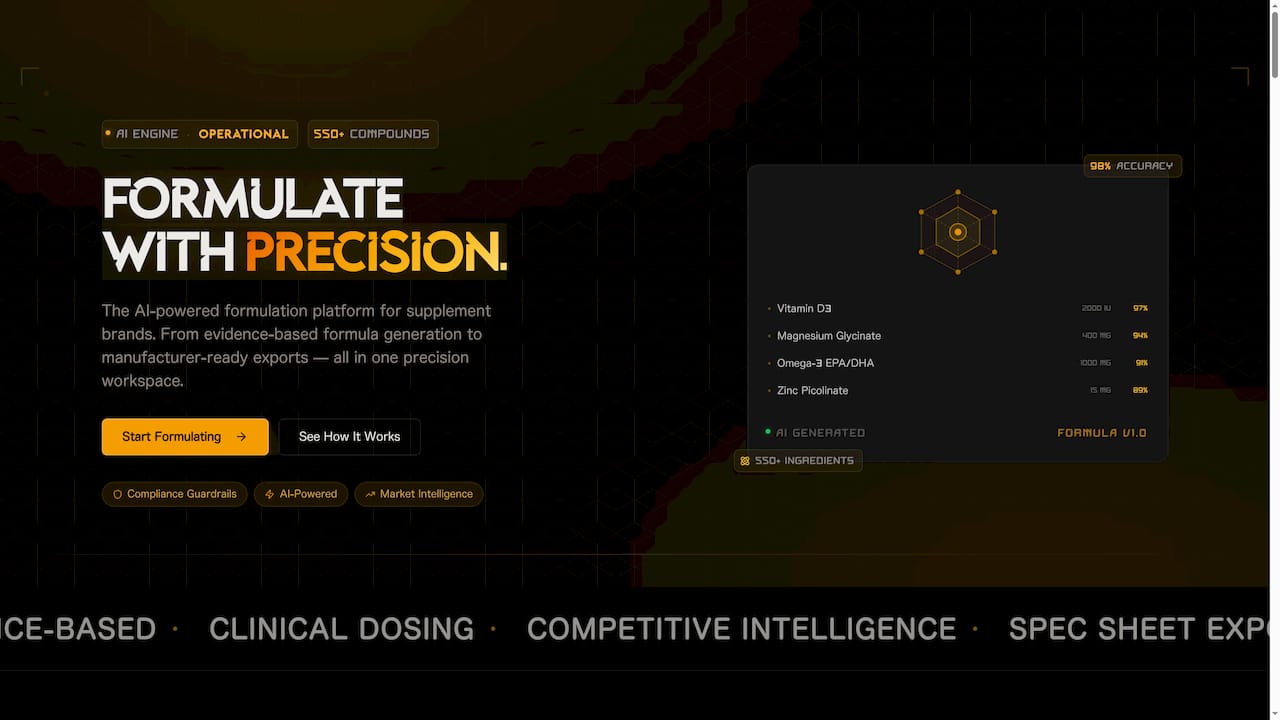
A practical use case: a brand launching an omega-3 softgel line can track supplier COAs alongside its formulation record, plan stability testing timepoints against its product development schedule, and generate manufacturer-ready exports once the formula and packaging are finalized, including custom packaging mockups through AI mockup design tools. Rather than chasing PV/AV numbers across separate lab reports and supplier PDFs, the documentation lives next to the formula it belongs to.
Start a project on Formlypro to see how COA tracking, stability planning, and compliance checklists fit into your next omega-3 formulation.