

TL;DR:
- Effective competitor tracking involves continuous monitoring of rivals' public activities to gain strategic insights. It enables early identification of market gaps, accelerates decision-making, and supports proactive risk management. Implementing a structured system with clear scope, regular cadence, and synthesis enhances competitive advantage.
Competitor tracking is the systematic process of monitoring rivals' public activities to generate strategic insights that drive better business decisions. Sales teams face competitors in 68% of deals, yet average competitive preparedness in B2B companies sits at just 3.8 out of 10. That gap is where deals are lost, pricing mistakes happen, and product launches land flat. Understanding why competitor tracking is crucial means recognizing it as a continuous intelligence discipline, not a one-time research project. The industry term for this practice is competitive intelligence, and the brands that treat it as a core function consistently outmaneuver those that treat it as an afterthought.
Why competitor tracking is crucial for strategic advantage
Competitor tracking gives businesses a real-time view of the market forces shaping their category. Without it, you are making pricing, product, and messaging decisions based on assumptions rather than evidence.
It reveals market gaps before competitors fill them
The most direct benefit of tracking competitors is spotting what they are not doing. When you map a rival's product lineup, messaging, and customer reviews systematically, patterns emerge. You see the customer complaints they are ignoring, the price points they have abandoned, and the audience segments they have left underserved. Those gaps are your entry points.
Competitor research advantages compound over time. The longer you track, the more context you build, and the faster you can interpret new signals. A brand that has monitored a rival for six months recognizes a pricing shift as a margin play. A brand seeing it for the first time just sees a number change.
It accelerates decision-making across the business
Speed is a direct output of good competitive intelligence. Organizations using generative AI for competitive analysis report deal cycle reductions of 30–50%. That is not a marginal improvement. It means your sales team closes faster, your marketing team responds to rival campaigns within days instead of weeks, and leadership makes resource calls with current data.
Real-time alerts from tools like Visualping notify teams the moment a competitor changes a pricing page, updates a product description, or launches a new landing page. That immediacy converts raw monitoring into a genuine speed advantage.
It supports proactive risk management
The importance of competitor analysis becomes clearest when a rival makes a sudden move. A competitor drops prices by 20%, launches a feature you have been building for six months, or secures a high-profile partnership. Without a monitoring system in place, you find out from a customer who is already reconsidering their contract.
With continuous tracking, you see the signals before the move lands. Job postings reveal hiring priorities. Website changes signal product direction. Press releases telegraph partnerships. Each signal alone is weak. Together, they form a picture that lets you act before you are forced to react.
Pro Tip: Set up keyword alerts for your top three competitors' brand names combined with terms like "pricing," "launch," and "partnership." You will catch strategic signals weeks before they become public news.
Continuous monitoring vs. periodic competitor analysis
Most businesses treat competitor analysis as a quarterly or annual exercise. That approach is structurally broken, and the data proves it.
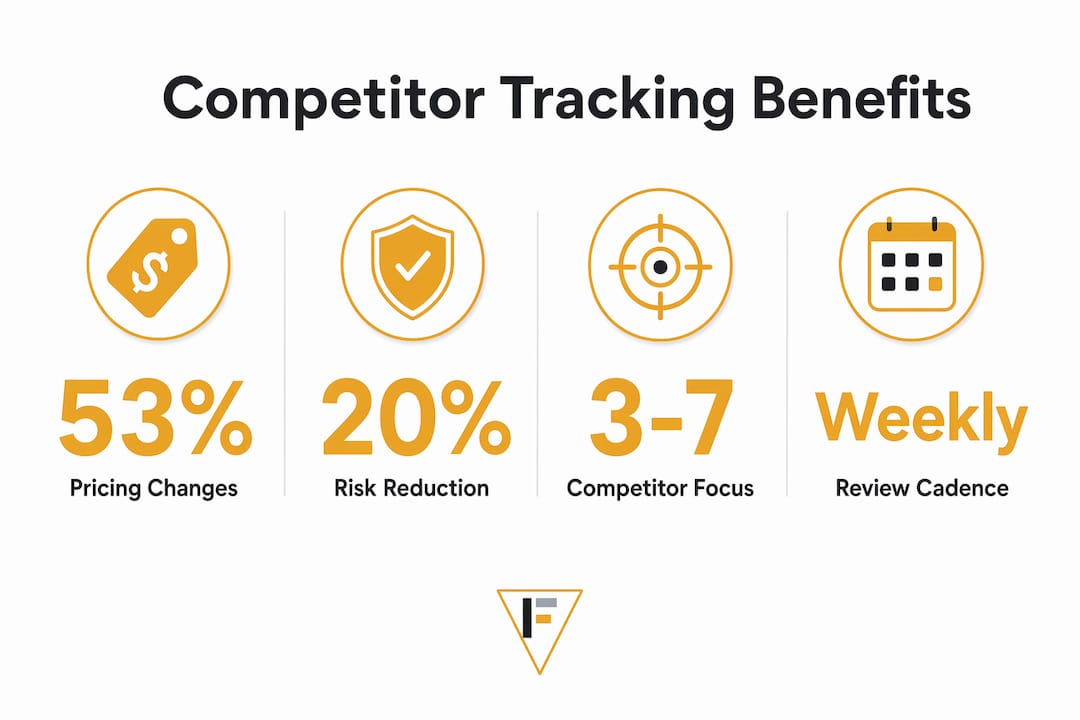
Pricing pages for SaaS products change about 39% per month, and e-commerce pricing pages change 53% per month. An annual review captures a single frame of a movie that has been running all year. By the time your team reviews it, the intelligence is stale and the decisions it informs are already behind the market.
Why consistency beats perfection
Inconsistency is the most common failure mode in competitor tracking programs. A mediocre system checked weekly outperforms a sophisticated setup reviewed quarterly. Intelligence has a half-life. The longer it sits unreviewed, the less useful it becomes for current decisions.
Think of continuous monitoring as a security camera rather than a photograph. A photograph shows you one moment. A security camera shows you patterns, sequences, and changes over time. Competitive intelligence decays rapidly without ongoing monitoring, and that decay costs you the context needed to interpret new signals correctly.
Nearly 80% of companies adjust pricing at least once per year, and many do it multiple times. Annual competitive reviews cannot keep pace with that frequency. They leave your team operating on outdated assumptions about where competitors are positioned on price.
| Approach | Frequency | Key Risk | Best For |
|---|---|---|---|
| Periodic analysis | Quarterly or annually | Stale intelligence, missed moves | Initial market research only |
| Continuous monitoring | Weekly or real-time | Data overload without synthesis | Active competitive markets |
| Hybrid model | Weekly alerts, monthly synthesis | Requires clear ownership | Most mid-market businesses |
Pro Tip: Build a monthly competitive brief. Pull weekly alerts into a single document, note what changed, explain why it matters, and recommend one action. Fifteen minutes of synthesis per week prevents hours of catch-up later.
What are the most common competitor tracking mistakes?
Knowing why competitor analysis matters is only half the equation. The other half is avoiding the traps that make tracking programs collapse under their own weight.
- Monitoring too many competitors. Mid-market teams perform best tracking 3–7 direct competitors plus a small bench of secondary players. Beyond that, the volume of signals exceeds any team's capacity to interpret them. More data does not mean better intelligence.
- Collecting data without synthesizing it. Raw data is not intelligence. A pricing change is a data point. Understanding why it happened, what it signals about the competitor's strategy, and what your team should do next is intelligence. Without that synthesis layer, monitoring produces noise, not insight.
- No assigned ownership. Competitor tracking programs that belong to everyone belong to no one. Without a single accountable owner, whether that is a product marketing manager or a competitive intelligence lead, insights pile up unread and alerts go unactioned.
- Ignoring context. A competitor launching a new feature is not inherently threatening. Context determines significance. If that feature targets a segment you do not serve, it is irrelevant. If it targets your core customer, it is urgent. Tracking without context produces anxiety, not strategy.
The fix for all of these is the same: narrow your scope, assign ownership, and build a synthesis process that converts signals into recommended actions on a regular cadence.
How to build a competitor tracking system that actually works
A functional competitor tracking system has four components: the right tools, a clear scope, a consistent cadence, and an owner who synthesizes signals into decisions.
Step 1: select your monitoring tools
Start with automated website change detection. Visualping monitors competitor pages and sends alerts when content changes. For broader signal capture, integrate sales intelligence platforms that surface news, funding rounds, and executive moves. For product brands, tracking formulation changes, packaging updates, and retail placement shifts requires category-specific tools. Formlypro's competitor analysis module tracks which products are selling in your category and what formulations rival brands are using, giving product teams intelligence that generic web monitoring cannot provide.
Step 2: define your competitor scope
Choose 3–7 direct competitors as your primary tracking targets. Add a secondary bench of 3–5 emerging or adjacent players you check monthly rather than weekly. This scope keeps your signal volume manageable and your team focused on the rivals who actually affect your deals and positioning.

Step 3: establish a weekly cadence
Weekly reviews are the minimum viable frequency for active competitive markets. Set a recurring 30-minute block to review alerts, note changes, and flag anything requiring action. Route pricing changes to sales leadership, product updates to your development team, and messaging shifts to marketing. Each signal should have a clear destination and a clear owner.
Step 4: integrate insights with broader market data
Competitor signals are most useful when combined with consumer insights in marketing strategy and product analytics. A competitor dropping a product line means little in isolation. Combined with rising customer demand data in that category, it signals a gap you can move into quickly. Product analytics for smarter decisions amplifies the value of every competitive signal you collect.
| Tool Type | Primary Use | Best For |
|---|---|---|
| Website change detection (Visualping) | Pricing and content monitoring | SaaS, e-commerce, DTC brands |
| Sales intelligence platforms | News, funding, executive moves | B2B sales teams |
| Category-specific tools (Formlypro) | Formulation and product tracking | CPG, beauty, wellness brands |
| Social listening tools | Brand sentiment and campaign tracking | Marketing and brand teams |
Generative AI integration is accelerating this entire process. AI can scan hundreds of competitor signals in minutes, flag the most significant changes, and draft preliminary analysis for your team to review. For brands scaling their competitive intelligence function, AI is now the difference between a program that informs decisions and one that drowns teams in unread alerts.
Key takeaways
Competitor tracking delivers its full value only when it combines consistent monitoring, disciplined scope, and a synthesis process that converts raw signals into clear decisions.
| Point | Details |
|---|---|
| Consistency beats frequency | A mediocre system reviewed weekly outperforms a sophisticated one checked quarterly due to intelligence decay. |
| Narrow your scope | Track 3–7 direct competitors to avoid data overload and keep insights actionable. |
| Synthesis is non-negotiable | Raw alerts are not intelligence; assign an owner to interpret signals and recommend actions. |
| Continuous monitoring wins | Pricing pages change up to 53% monthly, making annual reviews structurally obsolete. |
| Integrate with broader data | Competitor signals gain full meaning when combined with consumer insights and product analytics. |
The uncomfortable truth about competitor tracking
Most brands I have worked with treat competitor tracking as a defensive exercise. They monitor rivals to avoid being surprised. That framing is too small.
The brands that extract the most value from competitive intelligence use it offensively. They track competitors to find the moves their rivals are not making. They look for the customer segments being ignored, the price points being vacated, and the product claims going unmade. That is where the real opportunity lives.
I have also seen the failure mode up close. Teams that obsess over competitors lose sight of their own customers. Competitive intelligence must serve as a decision-support tool, not a distraction from your own roadmap. The goal is not to copy rivals faster. The goal is to understand the market well enough to make better original decisions.
The brands winning right now are not the ones with the most competitor data. They are the ones with the clearest synthesis process. They know what changed, why it matters, and what they are going to do about it before the week is out. That is the standard worth building toward.
For product brands specifically, tracking formulations, ingredient trends, and retail positioning is where industry trends in product development intersect with competitive intelligence in the most concrete way. The brands that track both dimensions simultaneously are the ones that launch products the market actually wants.
— Ben
How Formlypro turns competitor insights into product strategy
Competitor tracking without a system to act on what you find is just surveillance. Formlypro connects competitive intelligence directly to product decisions.
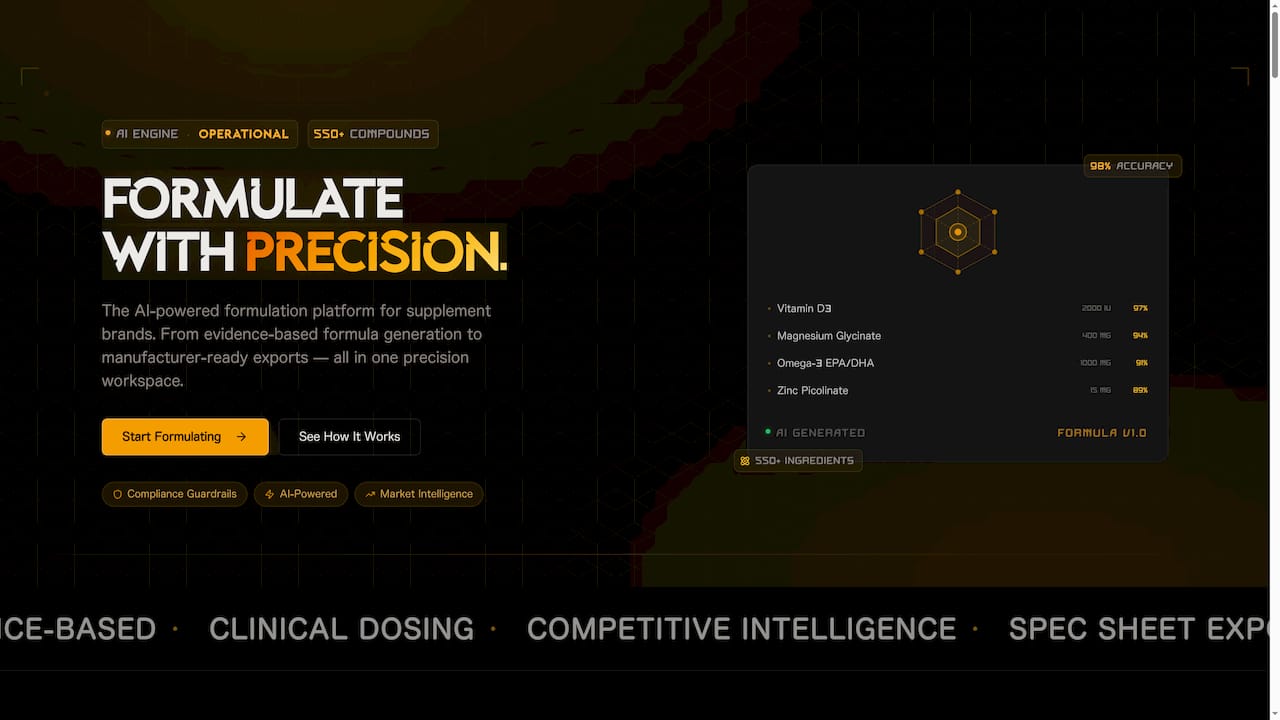
Formlypro's competitor analysis module shows you which products are selling in your category and exactly what formulations rival brands are using. That intelligence feeds directly into your formulation planning, pricing strategy, and market positioning. The platform's 8-phase product development plan takes you from initial market research through compliance and production, with competitive analytics built into every stage. If you are building a product brand and want to move from reactive observation to a structured competitive advantage, explore Formlypro's tools and see how competitor intelligence becomes a product strategy asset.
FAQ
What is competitor tracking in business?
Competitor tracking is the systematic monitoring of rivals' public activities, including pricing, product launches, and messaging, to generate strategic insights. The formal industry term for this practice is competitive intelligence.
How often should you monitor competitors?
Weekly monitoring is the minimum effective frequency for active markets. Pricing pages change 39–53% monthly, making anything less frequent too slow to catch meaningful shifts.
How many competitors should a business track?
Focus on 3–7 direct competitors as primary targets, with a secondary bench of 3–5 players reviewed monthly. Tracking more than that creates data overload without improving decision quality.
What is the difference between competitor tracking and competitive intelligence?
Competitor tracking is the data collection process. Competitive intelligence is what you produce when you synthesize that data into interpreted insights with recommended actions. Tracking without synthesis produces data, not intelligence.
How does AI improve competitor tracking?
Generative AI applied to competitive analysis can reduce deal cycles by 30–50% by processing large volumes of competitor signals faster than manual review and surfacing the most strategically significant changes for human interpretation.