

TL;DR:
- Compliance failures often stem from lack of clear, step-by-step processes rather than intentional neglect.
- Brands must keep detailed substantiation files, review marketing and labels, and monitor social media content.
- Regular updates, cross-functional collaboration, and documented procedures help prevent regulatory violations.
Missing a single disclosure, skipping a substantiation file, or letting an influencer post go live without a clear "#ad" tag can trigger a warning letter that derails your entire launch timeline. For consumer goods brands, compliance failures rarely happen because teams don't care. They happen because no one handed them a clear, sequential process. This guide gives you exactly that: a practical, stage-by-stage compliance checklist built for brand managers and entrepreneurs who are moving fast and cannot afford expensive regulatory setbacks. You will walk away with the tools, steps, and documentation habits that protect your brand from ideation to post-market.
Table of Contents
- Understanding the compliance landscape for brands
- What you need before starting: tools, documents, and resources
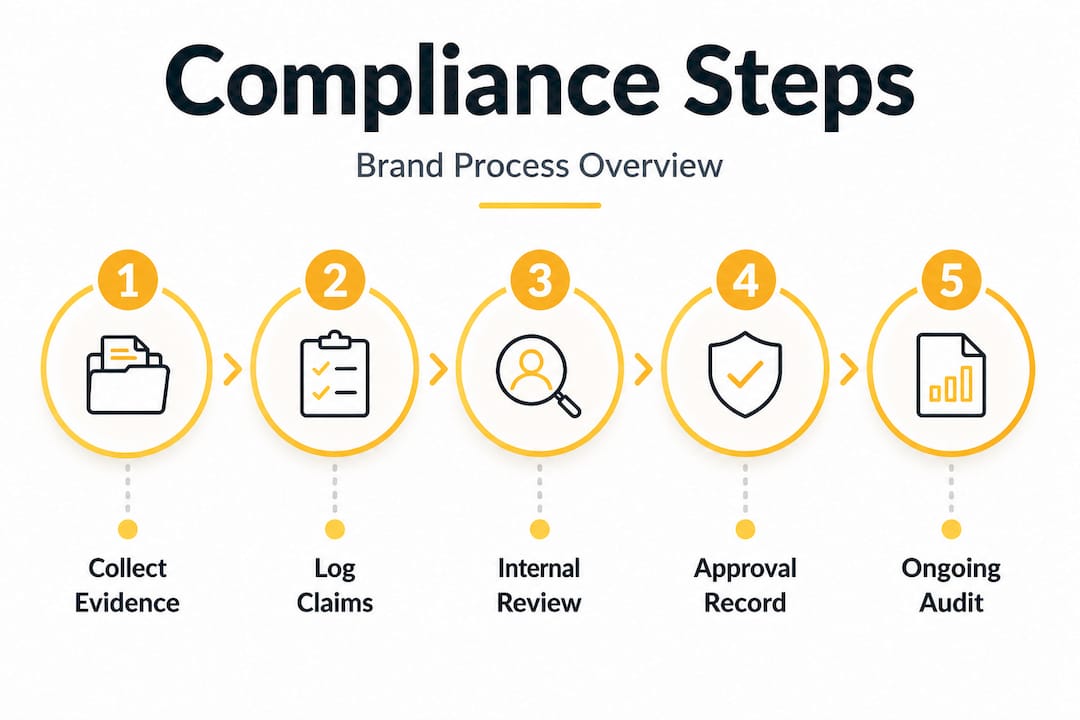
- Step-by-step compliance checklist for brands
- Troubleshooting and common pitfalls in compliance
- Verifying and documenting your compliance process
- Why most brand compliance efforts fail before they begin
- Simplify your brand's compliance with smart solutions
- Frequently asked questions
Key Takeaways
| Point | Details |
|---|---|
| Map compliance risks | Start with a clear understanding of regulatory requirements for your category. |
| Document everything | Keep thorough substantiation and marketing files to prove compliance. |
| Don’t skip disclosures | Ensure influencer and marketing claims are always clearly disclosed and truthful. |
| Review and audit regularly | Schedule periodic reviews to adapt to evolving regulations and stay audit ready. |
Understanding the compliance landscape for brands
Before you write a single claim or design a label, you need to understand who is watching and what they expect. The two primary regulators for consumer product brands in the United States are the FTC (Federal Trade Commission) and the FDA (Food and Drug Administration). Their rules apply whether you sell on your own website, through retail, or exclusively via social media.
The FTC governs how you advertise and market your product. Their baseline standard is clear: advertising claims must be truthful and backed by competent scientific evidence before they go live, with mandatory disclosures for paid endorsements and no deceptive practices. Crucially, brands are liable for the content their influencers post. If your influencer calls your supplement "clinically proven to burn fat" without adequate substantiation, that is your problem, not theirs.
The FDA governs product safety, ingredient legality, and label claims. For food, supplements, and personal care products, the rules around structure-function claims, disease claims, and ingredient disclosures are strict and frequently updated. Understanding consumer goods compliance standards across both agencies is not optional. It is the foundation every other step in this guide is built on.
Here is a quick comparison of the two primary regulatory bodies to keep on hand:
| Regulator | Primary focus | Key risk areas |
|---|---|---|
| FTC | Advertising, marketing, endorsements | Unsubstantiated claims, deceptive ads, influencer disclosures |
| FDA | Product safety, labeling, ingredients | Disease claims, misbranded labels, unapproved ingredients |
The most frequent compliance failures across consumer brands fall into three categories:
- Health and performance claims without adequate scientific backing
- Influencer marketing posts missing required disclosures like "#ad" or "#sponsored"
- Packaging and labeling that includes implied disease claims or incomplete ingredient panels
These are not edge cases. They are the most common triggers for warning letters and enforcement actions, which is why every step in this checklist addresses at least one of them.
What you need before starting: tools, documents, and resources
With a clear picture of the rules, let us gather everything you need before tackling compliance tasks. Walking into a compliance review without your materials ready is like going into a product pitch without a sell sheet. You will lose time and credibility.
Documentation you must have ready:
- Substantiation files for every product claim (study abstracts, clinical data, RCTs)
- Draft label and claims copy for regulatory review
- Ingredient safety data and supplier certifications
- Prior marketing materials, including influencer briefs and social post drafts
- Any previous regulatory correspondence (warning letters, retailer compliance requests)
The team you need at the table:
- Legal counsel familiar with FTC and FDA requirements
- Regulatory affairs specialist for label and claims review
- Marketing lead who owns all advertising and influencer relationships
- R&D or formulation team for ingredient-level substantiation
- QA team for testing protocols and documentation sign-off
Time-saving tools and platforms:
Digital compliance platforms are no longer optional for scaling brands. Manual tracking through spreadsheets breaks down the moment your product line expands or regulations shift. Updated regulatory databases, automated claim-flagging tools, and integrated regulatory checklist essentials are now standard practice for brands that want to move fast without making costly errors.
One area that catches many brands off guard: the FTC's substantiation standard is higher than most marketing teams expect. Health claims require RCTs or meta-analyses for backing, and AI-generated testimonials now require disclosure per 2025 FTC precedents. On the FDA side, the agency issued 28 warning letters in 2025 specifically targeting social media disease claims. That is nearly one every two weeks. Understanding the importance of compliance at this level of specificity is what separates brands that scale from brands that stall.

Pro Tip: Build your substantiation file before you finalize any claim, not after. Retrofitting evidence to support marketing copy is both harder and legally riskier than building the claim from the evidence up.
Step-by-step compliance checklist for brands
Equipped with your materials and team, follow this stepwise checklist to ensure end-to-end compliance. This is the operational core of the guide. Work through each step in order, because each stage builds on the one before it.
-
Conduct a formulation and safety review. Every ingredient must be permitted for use in your product category, at the concentration you are using, in the markets you plan to sell in. Your R&D and regulatory teams sign off here. Document every decision.
-
Build your claims substantiation file. For each claim on your label or in your marketing, identify the specific scientific evidence supporting it. General wellness claims require competent and reliable evidence. Health-specific claims require more rigorous support. The FTC's standard is clear: claims must be substantiated before dissemination, not after.
-
Complete a label review. Your label must include required elements for your product category. For supplements, that means a Supplement Facts panel, health claim qualifiers (the FDA disclaimer), net quantity, and manufacturer information. For personal care and cosmetics, ingredient lists must follow INCI naming conventions. Review your label against current cosmetic formulation compliance requirements to catch anything before printing.
-
Run a marketing and advertising audit. Review all consumer-facing copy. Flag every claim that could be interpreted as a disease claim, an implied drug claim, or an unsupported performance claim. Get legal eyes on your copy before any paid distribution.
-
Establish influencer and affiliate compliance protocols. Before any partner publishes a post, they must have a signed brief that specifies what they can and cannot say, and requires clear disclosures on every piece of sponsored content. Brief them on your claims boundaries. Log every agreement.
-
Review packaging for distribution compliance. Different retailers and distribution channels have specific requirements beyond FDA minimums. Club store formats, e-commerce, and international sales each add their own layers. Confirm storage requirements are clearly labeled and that packaging meets the requirements for every channel you use. Guidance on compliance in product development outlines many of these channel-specific requirements in detail.
-
Set up a post-market monitoring process. Compliance does not end at launch. Monitor your reviews, social posts, and any user-generated content that tags your brand. If consumers or influencers make claims about your product that you have not substantiated, you may inherit regulatory liability for that content.
"Brands must ensure advertising claims are truthful, substantiated by competent scientific evidence before dissemination, with clear disclosures for endorsements and no deceptive practices. Brands are liable for influencer content." — FTC Advertising and Marketing Basics
Pro Tip: Create a single shared "claims log" document that tracks every approved claim, the evidence tied to it, who approved it, and the date. This single document can save you weeks of work during a retailer audit or regulatory inquiry.
Troubleshooting and common pitfalls in compliance
Even with a checklist, common mistakes can cause brands to fall short. The brands that struggle most with compliance are rarely the ones that ignore the rules. They are the ones who think they have handled it when they have not.
Here are the most frequent pitfalls and what to do about them:
-
Claiming more than your evidence supports. This is the most common violation. A study on one ingredient at a specific dose does not automatically validate a claim for your finished product at a different dose. Match claims to what your actual substantiation file supports, not to what your study's abstract headline says.
-
Missing or unclear social media disclosures. "#ad" and "#sponsored" tags must be clear and conspicuous. Buried hashtags at the end of a long caption do not meet the FTC standard. Review every influencer post before it goes live, and conduct spot checks after publication.
-
Using outdated claim templates. Regulatory rules evolve. A label template or influencer brief created in 2022 may no longer meet 2026 standards. Outdated templates are one of the easiest errors to avoid and one of the most common culprits in enforcement actions.
-
Assuming influencers know the rules. They mostly do not. Brands are liable for influencer content and are responsible for ensuring all content meets FTC standards. Brief your influencers explicitly. Do not assume they have read the FTC's guidance documents.
-
Ignoring packaging updates when regulations change. When the FDA updates requirements, your old packaging becomes non-compliant. Build a label review trigger into your regulatory calendar so that any regulatory update prompts an automatic packaging check. For detailed guidance, packaging compliance tips provide a solid framework for keeping your physical product current.
Pro Tip: Assign one person on your team the role of "compliance owner" for influencer content. Their job is to review every sponsored post before it publishes, confirm disclosures are visible, and log the review. This single accountability step prevents most influencer-related violations.
Verifying and documenting your compliance process
The final step is to ensure your compliance efforts are both trackable and defensible should you face regulatory scrutiny. Doing the work is not enough. You need proof that you did it, and that proof must be organized enough to produce quickly.
Best practices for building a defensible compliance record:
-
Maintain a centralized substantiation library. Every claim in your catalog must link to a corresponding substantiation file. Keep this library in a shared, version-controlled folder. Outdated documents should be archived, not deleted.
-
Use version control on all claims and marketing materials. Every time a label or piece of copy changes, log the version, the reason for the change, and who approved it. If a regulator asks why your label changed between 2024 and 2026, you need a clear, documented answer.
-
Document training for every team member and influencer partner. Keep records of when employees completed compliance training and what that training covered. For influencers, retain signed briefs, approval records, and a screenshot of the live post with visible disclosures.
-
Set a recurring compliance calendar. Schedule quarterly internal audits of your live marketing materials and annual full-cycle compliance reviews. Add triggers for immediate review when regulations change, new product lines launch, or you enter a new retail channel.
As the FTC makes clear, brands must provide substantiation files and document their review steps for all claims and marketing. A retailer audit or regulatory inquiry can arrive with very little warning. Your documentation is your first and best line of defense.
Why most brand compliance efforts fail before they begin
Here is the honest truth that most compliance guides skip: the process fails long before a warning letter arrives. It fails in the meeting where marketing says "we will clean up the claims later" or where a founder assumes that because competitors are making similar claims, those claims must be fine.
The single biggest misconception is that compliance is a legal department task. It is not. It is a cross-functional operational process that needs to be built into every stage of product development, from the first ingredient decision to the final influencer post. When compliance is treated as a sign-off step at the end of a launch timeline, you are already setting yourself up for failure.
The second major trap is underestimating the specificity of substantiation requirements. FTC standards require RCTs or meta-analyses for health-related claims. That means a single pilot study or a supplier's white paper is not enough. Many brands discover this only after they have already printed packaging and run paid ads.
The third trap is treating compliance as a one-time project. Regulations in 2026 are not what they were in 2022. AI-generated testimonials now carry specific disclosure obligations. Social media platform policies have tightened. The FTC's enforcement posture has shifted. Brands that reviewed their compliance materials two years ago and have not revisited them since are likely operating with outdated practices right now.
If you are in health and beauty brand development, the regulatory expectations are especially dynamic. The most compliance-resilient brands treat regulatory review as a standing agenda item, not a one-time deliverable.
Simplify your brand's compliance with smart solutions
Managing compliance across formulation, labeling, marketing, and influencer content is genuinely complex. The brands that handle it best are the ones that stop trying to track it all manually and start using systems designed for the job.
FormlyPro is built specifically for consumer goods brands navigating exactly this challenge. The platform walks you through an 8-phase product development process that embeds compliance at every stage, from initial formulation research through to packaging and production. You get built-in compliance guidance, competitor analysis, market research, and an AI-powered mockup designer that keeps your packaging aligned with current regulatory requirements. Whether you are launching your first product or managing a growing portfolio, FormlyPro gives your team the structure to move fast without cutting corners on compliance. Start with the right foundation and build a brand that regulators and retailers can trust.
Frequently asked questions
What documents should I keep to prove compliance?
Maintain substantiation files, claim reviews, marketing approval records, and documented proof of influencer disclosures. Brands must provide substantiation files and document review steps for all claims and marketing materials at any point during a regulatory inquiry.
How often should compliance materials be updated?
Review all compliance documentation after any regulatory change and conduct a full audit at minimum once per year. If you launch new products or enter new markets, trigger an immediate review rather than waiting for your scheduled cycle.
Are brands responsible for mistakes influencers make in sponsored posts?
Yes. Brands are liable for influencer content and must ensure all sponsored posts meet FTC disclosure and truthfulness standards. Ignorance of what an influencer posted is not a legal defense.
What's new for compliance with AI-generated testimonials in 2026?
AI-generated testimonials must be disclosed and backed by adequate substantiation per 2025 FTC guidance. AI-generated testimonials require disclosure and cannot be presented as organic consumer reviews without clearly indicating their AI-generated nature.