

TL;DR:
- Surfactants are essential excipients that modify surface chemistry to improve drug solubility, stability, and delivery. Their selection depends on properties like charge, HLB, and CMC, which influence formulation performance and safety. Early and thorough characterization ensures optimal excipient choice and regulatory compliance.
Surfactants are amphiphilic excipients that reduce surface and interfacial tension, enabling emulsification, solubilization, wetting, and stabilization across virtually every pharmaceutical dosage form. Understanding what is the surfactant role in formulation is not optional for a formulator — it is the foundation of rational excipient selection. The moment you add a surfactant above its Critical Micelle Concentration (CMC), you are no longer just adjusting surface chemistry; you are reshaping the thermodynamic environment your API lives in.
The primary functional consequences for formulators:
- Solubilization and bioavailability: Micelle formation above the CMC sequesters poorly soluble actives, raising apparent solubility and improving oral or parenteral bioavailability.
- Emulsion and suspension stability: Surfactants adsorb at oil-water interfaces, reducing interfacial tension and providing a mechanical barrier against droplet coalescence or particle aggregation.
- Wetting of solid dosage forms: Even sub-CMC concentrations accelerate tablet disintegration and granule wetting by lowering the contact angle between liquid and solid surfaces.
- Interfacial protection for biologics: Nonionic surfactants like Polysorbate 80 (Tween 80) compete with protein molecules at air-water and container interfaces, reducing adsorption-driven aggregation.
- Penetration and membrane transport modulation: At higher concentrations, surfactants can transiently disrupt epithelial barriers, increasing permeability in ways that may or may not be intended.
Global surfactant consumption has been reported historically at approximately 18,000 kilotons per annum across personal care, household, and pharmaceutical sectors — a scale that reflects how deeply embedded these molecules are in modern product development. The HLB (Hydrophile-Lipophile Balance) system and CMC measurement remain the two most-used quantitative anchors for selection, with USP monographs and FDA excipient guidance providing the regulatory framework for pharmaceutical use.
Table of Contents
- What does a surfactant actually do at the molecular level?
- How are surfactants classified, and which ones matter in pharma?
- Which physicochemical properties predict surfactant performance?
- What are the primary functions of surfactants in pharmaceutical products?
- How do surfactants affect API bioperformance, stability, and safety?
- How do you choose the right surfactant for your formulation?
- What analytical methods confirm surfactant behavior in your formulation?
- What formulation pitfalls should you watch for?
- What are the U.S. regulatory and safety requirements for surfactant use?
- Are biosurfactants ready for pharmaceutical use?
- Key Takeaways
- The case for treating surfactant selection as a formulation-defining decision
- Formlypro accelerates surfactant screening and formulation tracking
- Useful sources for formulators
What does a surfactant actually do at the molecular level?
A surfactant molecule is defined by its dual architecture: a polar, water-compatible head group and a nonpolar, oil-compatible tail. This amphiphilicity drives spontaneous adsorption at interfaces, whether liquid-liquid (oil-water), liquid-air, or liquid-solid. The head group anchors toward the aqueous phase; the tail orients toward the nonpolar phase or air. The result is a packed molecular film at the interface that directly lowers interfacial tension.
The thermodynamic driver is captured conceptually by the Gibbs adsorption isotherm: as surfactant concentration increases, more molecules populate the interface, and surface tension drops. This continues until the interface is saturated. At that saturation point — the CMC — additional surfactant molecules no longer go to the interface. Instead, they self-assemble into micelles: spherical or cylindrical aggregates with hydrophobic cores and hydrophilic shells.
The CMC is the formulation inflection point. Below it, a surfactant primarily wets surfaces and lowers interfacial tension. Above it, micelles form and solubilization capacity increases sharply. Designing a formulation without knowing the CMC of your chosen surfactant — and where your intended concentration sits relative to it — is designing blind.
Above the CMC, micelle formation enables sequestration of poorly soluble actives within the hydrophobic core, which is the mechanism behind micellar solubilization. The CMC itself is not fixed: pH, temperature, ionic strength, and co-excipients all shift it. A surfactant that behaves predictably in a buffered aqueous system at 25°C may behave quite differently in a formulation containing salts, co-solvents, or polymers at 40°C.
How are surfactants classified, and which ones matter in pharma?
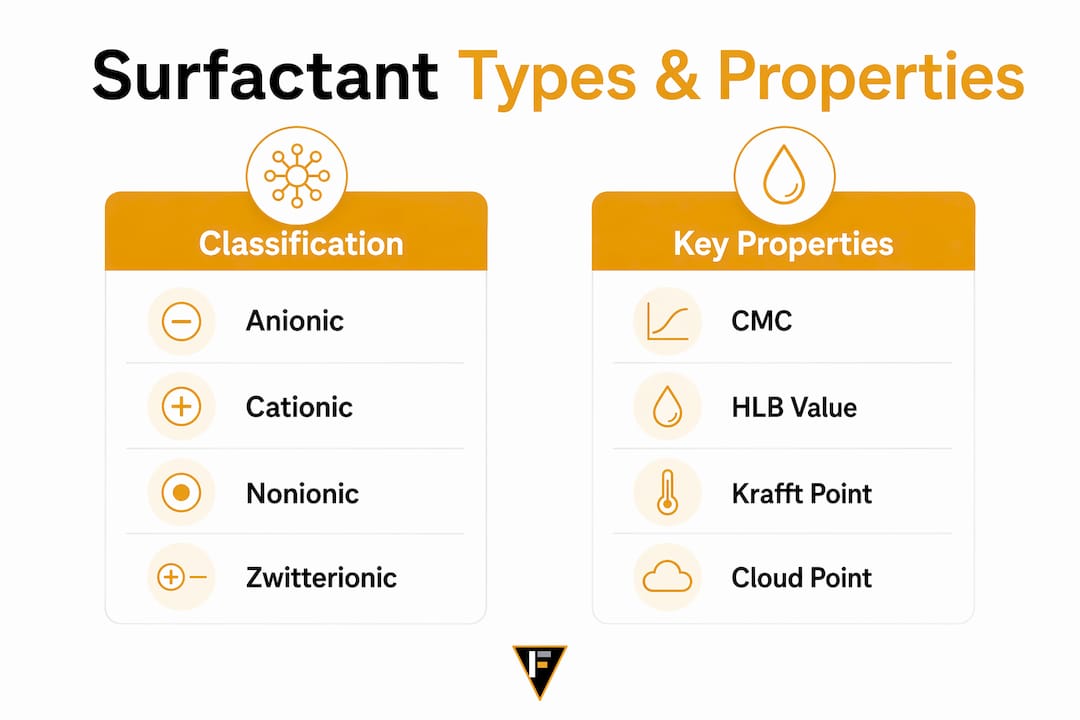
Surfactants are classified into four primary types based on the charge of the polar head group: anionic, cationic, nonionic, and zwitterionic. Charge is not just a chemical descriptor — it determines compatibility with APIs, excipients, and biological membranes, and it directly affects toxicity profile and route suitability.

| Class | Key Pharmaceutical Examples | Typical Uses | Safety / Regulatory Note |
|---|---|---|---|
| Anionic | Sodium lauryl sulfate (SLS / SDS) | Tablet wetting agent, dissolution enhancement, skin cleansing | Irritant at higher concentrations; USP monograph available; avoid parenteral and ophthalmic routes |
| Nonionic | Polysorbate 80 (Tween 80), Polysorbate 20 (Tween 20), Cremophor EL (polyoxyl castor oil), PEG-40 hydrogenated castor oil | Parenteral solubilization, protein stabilization, oral and topical emulsification | Generally lower toxicity; preferred for parenteral and protein formulations; FDA/USP monographs available |
| Nonionic | PEG-based surfactants (e.g., PEG-40 hydrogenated castor oil) | Injectable vehicles, ophthalmic drops, oral liquids | Check for PEG hypersensitivity; Cremophor EL associated with hypersensitivity reactions in parenteral use |
| Zwitterionic | Lecithin (phosphatidylcholine) | Liposomes, emulsions, parenteral lipid systems | Excellent biocompatibility; used in parenteral nutrition and liposomal drug delivery; NF/USP listed |
| Cationic | Benzalkonium chloride, cetrimonium bromide | Antimicrobial preservatives, conditioning agents | Membrane-active; incompatible with anionic surfactants; avoid in parenteral; irritation risk at higher concentrations |
A few use-case notes worth internalizing:
- Nonionic surfactants dominate protein and parenteral formulations because they are less likely to interact electrostatically with charged protein surfaces, reducing unfolding and aggregation risk.
- Lecithin occupies a unique position as both a surfactant and a structural lipid component in liposomal and lipid nanoparticle systems, where it contributes to bilayer integrity rather than just interfacial tension reduction.
- Cationics serve dual roles in topical and mucosal formulations — antimicrobial preservation and conditioning — but their membrane-disrupting activity demands careful concentration control and route justification.
Which physicochemical properties predict surfactant performance?
HLB: the emulsifier selection tool
The Hydrophile-Lipophile Balance (HLB) system assigns a numerical value (0–20) to a surfactant based on the relative proportion of its hydrophilic and lipophilic portions. Values below 6 favor water-in-oil (W/O) emulsification; values of 8–18 favor oil-in-water (O/W) emulsification. The practical utility is in matching the surfactant's HLB to the required HLB of the oil phase.
| HLB Range | Expected Emulsion Type | Formulation Caveat |
|---|---|---|
| 1–6 | W/O emulsifier | Low aqueous solubility; suited for ointments, creams |
| 8 | Wetting agent / intermediate | Poor emulsifier alone; useful in blends |
| 10–15 | O/W emulsifier | Most pharmaceutical emulsions; check cloud point |
| — | Solubilizer / detergent | High aqueous solubility; micelle-dominant behavior |
HLB is semi-empirical, and real-world performance must be validated. Electrolytes compress the HLB effective range for ionic surfactants; temperature shifts nonionic surfactant behavior significantly; co-excipients like glycols or alcohols alter the effective HLB of a blend. Use HLB to shortlist candidates, not to finalize selection.
Krafft point and cloud point
The Krafft point is the temperature below which an ionic surfactant's solubility drops sharply and micelle formation is suppressed. Formulating below the Krafft point means your surfactant is not performing as intended. For SLS, the Krafft point is well below typical processing temperatures, but for some longer-chain ionic surfactants, it is a real storage and cold-chain concern.
The cloud point applies to nonionic surfactants. As temperature rises, the ethylene oxide head groups dehydrate, reducing water solubility until the surfactant phase-separates at the cloud point. For Polysorbate 80, the cloud point is well above typical pharmaceutical storage temperatures, but for shorter-chain PEG surfactants, it can fall within the 40–60°C range relevant to accelerated stability testing.
Temperature, pH, and ionic strength all shift these critical points, which is why formulation screening conditions must mirror the intended product environment.
Interfacial rheology and film strength
For protein and biopharmaceutical formulations, the mechanical properties of the interfacial film matter as much as the equilibrium surface tension. A surfactant that rapidly adsorbs and forms a viscoelastic film at the air-water interface provides better protection against agitation-induced aggregation than one that adsorbs slowly or forms a weak film. Polysorbate 20 and Polysorbate 80 differ in their interfacial rheology profiles, which partly explains why the choice between them in a monoclonal antibody formulation is not arbitrary.
What are the primary functions of surfactants in pharmaceutical products?
The roles of surfactants in products span a wider range than most formulators initially appreciate. Each function operates through a distinct mechanism, and in a real formulation, several functions often operate simultaneously.
- Emulsification: Surfactants stabilize oil-water interfaces in creams, lotions, and injectable emulsions. Lecithin-stabilized lipid emulsions for parenteral nutrition are a classic example where interfacial film strength and biocompatibility both matter.
- Wetting: SLS at sub-CMC concentrations in tablet formulations reduces the contact angle between dissolution medium and hydrophobic drug particles, accelerating disintegration and dissolution without requiring micellar solubilization.
- Micellar solubilization: Cremophor EL (polyoxyl castor oil) is used in parenteral formulations of poorly water-soluble drugs precisely because its micelles can solubilize large quantities of lipophilic actives — though at the cost of hypersensitivity risk that requires premedication protocols in clinical settings.
- Suspension stabilization: Controlled flocculation using surfactants at specific concentrations produces suspensions that settle slowly and redisperse easily, which is the target behavior for oral and topical suspensions. More detail on suspension stabilization techniques is worth reviewing alongside this section.
- Foaming and anti-foaming: Surfactants generate foam in oral liquids and topical cleansers (a consumer-perceived quality signal), but in manufacturing, foam control is often the priority — requiring anti-foam agents or surfactant blends that suppress rather than generate foam.
- Penetration enhancement: At concentrations above the CMC, surfactants like SLS transiently disrupt stratum corneum lipid organization, increasing dermal penetration of co-formulated actives. This is useful for transdermal delivery but demands careful toxicology justification.
Pro Tip: When using a surfactant primarily for solubilization, run preservative efficacy testing at the intended surfactant concentration before finalizing the formula. Micelles sequester hydrophobic preservatives like methylparaben or benzyl alcohol, reducing their free (active) concentration in the aqueous phase. A formulation that passes preservative efficacy at the bench without surfactant can fail after the surfactant is added — even if the total preservative concentration is unchanged.
How do surfactants affect API bioperformance, stability, and safety?
Surfactants alter thermodynamic activity, dissolution rate, disintegration, and membrane transport in ways that can exceed intended outcomes. The solubilization effect is the most familiar: by incorporating an API into micelles, a surfactant raises apparent solubility and can dramatically improve oral bioavailability for BCS Class II and IV compounds. But apparent solubility and thermodynamic activity move in opposite directions. A drug sequestered in micelles has lower thermodynamic activity than the same drug in a saturated solution, which can reduce the driving force for membrane permeation even as total dissolved concentration rises.
For biologics, the interaction is more nuanced. Proteins compete with surfactants for adsorption at interfaces. When a nonionic surfactant like Polysorbate 20 is present at sufficient concentration, it preferentially occupies the air-water interface, reducing the amount of protein that adsorbs and subsequently unfolds or aggregates. This is the mechanistic basis for including Polysorbate 20 or Polysorbate 80 in monoclonal antibody formulations. The protective effect depends on maintaining surfactant concentration above a threshold relative to the protein concentration and the available interfacial area — which changes during shipping, freeze-thaw cycling, and agitation.
Surfactant inclusion in a biologic formulation is not a set-and-forget decision. Polysorbates degrade via oxidation and hydrolysis during storage, generating fatty acid and polyethylene glycol degradation products that can themselves trigger protein aggregation or particle formation. Monitoring surfactant concentration and degradation products throughout the product shelf life is now considered standard practice in biopharmaceutical development.
Failure modes worth knowing:
- Preservative sequestration: As noted above, micelles bind hydrophobic preservatives, reducing antimicrobial efficacy. This is a documented failure mode in multidose aqueous formulations.
- Polymer incompatibilities: Cationic surfactants can interact with anionic polymers like carbomers or carrageenan, causing viscosity loss or precipitation.
- Salt-induced phase separation: High ionic strength can salt out nonionic surfactants or shift the cloud point into the processing temperature range.
- Increased epithelial permeability: At concentrations that disrupt membrane integrity, surfactants can increase systemic exposure of co-formulated actives beyond the intended therapeutic window. Understanding how solubility affects formulation outcomes is directly relevant here.
How do you choose the right surfactant for your formulation?
Selection is a decision sequence, not a single lookup. Work through these steps before committing to a candidate:
- Define route and exposure constraints. Parenteral, ophthalmic, and inhalation routes carry the strictest safety requirements. Topical and oral routes allow broader surfactant options but still require route-specific toxicology data. Route determines which surfactant classes are even on the table.
- Shortlist by charge compatibility and HLB target. Match the surfactant class to the API's charge and the formulation's pH. Anionic surfactants are incompatible with cationic APIs; cationics are incompatible with anionic polymers. Then use HLB to narrow the emulsifier candidates for the oil phase in question.
- Check CMC and effective concentration window. Your intended surfactant concentration should be above the CMC if solubilization is the goal, or below it if wetting is the primary function. Know the CMC in your formulation matrix, not just in pure water.
- Run compatibility screens. Test the shortlisted surfactant against the API, preservatives, polymers, and salts at the intended pH and temperature range. Look for precipitation, viscosity changes, and color shifts.
- Verify regulatory and monograph status. Check the FDA Inactive Ingredients Database for route-specific precedent concentrations, relevant USP/NF monographs, and GRAS status where applicable. For novel surfactants or high-concentration uses, a formal toxicology review is required.
Before starting lab work, collect this minimum dataset for each candidate:
- HLB value and target HLB of the oil phase (for emulsions)
- CMC in the intended aqueous matrix (not just water)
- Krafft point (ionic surfactants) or cloud point (nonionics) relative to processing and storage temperatures
- Known toxicology flags: irritancy, genotoxicity, sensitization data
- Regulatory status: USP/NF monograph, FDA Inactive Ingredients Database entry, or prior approval history
Pro Tip: For excipient selection decisions, the excipient selection workflow matters as much as the individual excipient data. Document your rationale for each candidate at the screening stage — regulatory reviewers will ask for it.
What analytical methods confirm surfactant behavior in your formulation?
Characterization is where selection hypotheses get tested. The core methods:
Tensiometry measures surface or interfacial tension directly. A Wilhelmy plate or du Noüy ring setup gives equilibrium surface tension as a function of concentration, from which the CMC can be determined as the inflection point in the tension-vs-log-concentration curve. Pendant drop tensiometry is preferred for interfacial tension measurements at oil-water interfaces and for dynamic adsorption kinetics.
Dynamic Light Scattering (DLS) sizes micelles and colloidal particles in the nanometer range. Use it to confirm micelle formation above the CMC, to track particle size distribution in emulsions and nanosuspensions, and to detect aggregation during stability stress testing. A stable size distribution with low polydispersity index (PDI) across temperature and time is the acceptance criterion for colloidal stability.
Zeta potential quantifies the electrostatic charge at the particle surface. Values beyond ±30 mV generally indicate sufficient electrostatic repulsion to resist aggregation, though this threshold is system-dependent. Zeta potential is particularly informative for ionically stabilized suspensions and for detecting charge neutralization when incompatible excipients are introduced.
Interfacial rheology measures the viscoelastic properties of the adsorbed surfactant film at the oil-water or air-water interface. Oscillatory interfacial rheology distinguishes between elastic (film-forming) and viscous (fluid) interfacial behavior — a distinction that predicts long-term emulsion stability better than equilibrium surface tension alone.
Cloud point determination for nonionic surfactants: prepare a series of surfactant solutions at the intended concentration in the formulation matrix, heat slowly, and record the temperature at which turbidity appears. Run this in the presence of all co-excipients, not just in water, since salts and polymers shift the cloud point substantially.
For CMC determination, a concentration series spanning at least two orders of magnitude around the expected CMC is standard. Surface tension, conductivity (for ionic surfactants), or fluorescence probe methods all work; the key is temperature control to ±0.5°C and equilibration time before each measurement. Micelle formation and surfactant behavior depend on multiple variables, so screening conditions must mirror the final product environment.
What formulation pitfalls should you watch for?
Most surfactant-related failures in development are predictable. The list below covers the ones that consume the most time when they are caught late:
- Preservative inactivation: Micelle sequestration of hydrophobic preservatives is the most common surfactant-related failure in multidose aqueous products. Run preservative efficacy testing (USP <51>) at the final surfactant concentration, not in a surfactant-free control.
- Adsorption to container surfaces: Polysorbate 80 and Polysorbate 20 can adsorb to silicone tubing, stoppers, and certain plastic containers, reducing the effective concentration in the product. Measure surfactant concentration in the final container, not just in the bulk.
- Assay interference: Surfactants at high concentrations can interfere with UV absorbance assays, HPLC peak shape, and protein quantification methods (e.g., BCA assay). If your assay reads differently in the presence of surfactant, validate the method with the surfactant present.
- Unexpected flocculation or deflocculation: Adding a surfactant to a suspension can shift the system from deflocculated to flocculated (or vice versa) depending on concentration and charge interactions. Always characterize zeta potential and sedimentation behavior after surfactant addition.
- Temperature-related phase separation: Nonionic surfactants above their cloud point phase-separate, and ionic surfactants below their Krafft point lose solubility. Both scenarios produce visible turbidity or precipitation that can be mistaken for API instability.
Pro Tip: If preservative efficacy fails after surfactant addition, the first corrective action is to reduce surfactant concentration to below the CMC — not to increase preservative concentration. Adding more preservative into a micellar system often just adds more sequestered preservative, not more free active preservative.
Pro Tip: At scale-up, the order of addition matters more than most bench protocols acknowledge. Adding surfactant to the aqueous phase before the oil phase (for emulsions) or before the API (for solubilization) generally produces more reproducible results than reverse addition. Document the order of addition explicitly in your manufacturing record.
What are the U.S. regulatory and safety requirements for surfactant use?
The FDA Inactive Ingredients Database is the first stop for any surfactant being considered for a new drug product. It lists approved excipients by route of administration with maximum concentration precedents from previously approved products. A concentration within the database range for the intended route is the lowest-risk regulatory path; concentrations above precedent require additional justification.
USP/NF monographs for surfactants like Polysorbate 80, Polysorbate 20, Sodium Lauryl Sulfate, and Lecithin specify identity, purity, and assay requirements. Meeting monograph specifications is a baseline expectation, not a ceiling for safety evaluation.
Route-specific caution is non-negotiable. A surfactant acceptable in an oral tablet at 1% w/w may require a full safety bridging study at the same concentration in a parenteral product. Parenteral surfactants must meet sterility and endotoxin requirements; ophthalmic surfactants must be non-irritating at the concentration used; inhaled surfactants face pulmonary toxicology scrutiny that oral or topical use does not trigger. Never transfer a safety assumption across routes without explicit data.
Safety checklist for U.S. formulators:
- Acceptable daily exposure (ADE): Calculate the ADE for the surfactant at the intended dose and frequency. Compare against published toxicology data or established ADEs in the literature.
- Irritancy data: Required for topical, mucosal, and ophthalmic routes. Primary skin irritation and eye irritation studies (or literature equivalents) should be available for the surfactant at the intended concentration.
- Genotoxicity flags: Check Ames test and in vitro clastogenicity data. Most well-established pharmaceutical surfactants have clean genotoxicity profiles, but novel or biosurfactant candidates may not.
- Hypersensitivity and sensitization: Cremophor EL and some PEG-based surfactants carry documented hypersensitivity risk in parenteral use. Polysorbate 80 has been associated with hypersensitivity reactions in certain patient populations. Document the risk and mitigation strategy.
- When to seek additional toxicology review: Novel surfactants, concentrations above FDA precedent, new routes, or pediatric populations all trigger the need for formal toxicology assessment. Reviewing safety margin considerations in formulation is a useful starting point for structuring that assessment.
This article provides general scientific information for formulation professionals and does not constitute regulatory or legal advice. Confirm current guidance with the FDA, relevant USP monographs, or a qualified regulatory professional for your specific product.
Are biosurfactants ready for pharmaceutical use?
The industry trend toward biodegradable and renewable surfactants is real and accelerating. Formulators are evaluating biosurfactants (rhamnolipids, sophorolipids, mannosylerythritol lipids) and sugar-based surfactants (alkyl polyglucosides, sucrose esters) for pharmaceutical and personal care applications, driven by sustainability commitments, green chemistry frameworks, and growing regulatory and consumer pressure on synthetic surfactant use.
| Attribute | Biosurfactants / Sugar-Based | Conventional Synthetic |
|---|---|---|
| Biodegradability | High; rapid environmental breakdown | Variable; some persistent in environment |
| Supply consistency | Variable; fermentation batch-to-batch variation | High; established petrochemical supply chains |
| Regulatory data availability | Limited for pharmaceutical routes; growing for topical/personal care | Extensive; USP/NF monographs, FDA precedent |
| Cost | Higher; fermentation and purification costs | Lower at scale |
| Performance consistency | Adequate for many applications; less characterized at extremes | Well-characterized across pH, temperature, ionic strength |
| Sustainability profile | Strong; renewable feedstocks, lower carbon footprint | Weaker; petrochemical-derived |
Peer-reviewed evidence supports biosurfactant substitution in topical and personal care formulations where performance requirements are less stringent and regulatory pathways are more flexible. For pharmaceutical-grade parenteral or ophthalmic applications, the regulatory data package required for a novel biosurfactant is substantial, and supply chain variability remains a real concern for commercial manufacturing. Sustainable biosurfactant applications in adjacent industries offer useful performance benchmarks, but pharmaceutical formulators should not assume that personal care precedent transfers directly to drug product use without route-specific safety data.
The practical position for most pharmaceutical development teams in 2026: biosurfactants are worth screening in early development, particularly for topical and oral formulations, but conventional nonionic surfactants with established regulatory histories remain the lower-risk choice for parenteral and biologic applications until the safety and supply data mature. Biodegradable surfactant options are advancing, and tracking the literature is worthwhile as part of a modern formulation strategy.
Key Takeaways
Surfactants are indispensable in pharmaceutical formulation, but their effects on solubilization, stability, bioperformance, and safety require systematic selection, characterization, and monitoring at every stage of development.
| Point | Details |
|---|---|
| Define function and route first | The intended functional role and administration route determine which surfactant classes are viable before any other screening begins. |
| Screen by charge, HLB, and CMC | Match charge to API and excipient compatibility, use HLB to shortlist emulsifiers, and confirm CMC in the formulation matrix, not in pure water. |
| Test preservative compatibility | Run USP <51> preservative efficacy testing at the final surfactant concentration; micelle sequestration routinely reduces free preservative below effective levels. |
| Verify temperature behavior | Confirm Krafft point (ionic) or cloud point (nonionic) against processing and storage temperatures using the actual formulation matrix. |
| Use Formlypro to organize the workflow | Formlypro's 8-phase formulation platform centralizes excipient data, HLB/CMC references, compatibility tracking, and compliance checks in one system, reducing the risk of missing a critical screening step. |
The case for treating surfactant selection as a formulation-defining decision
Most development teams treat surfactant selection as a late-stage detail — something to finalize after the API concentration, pH, and primary excipients are locked. That sequencing is backwards, and it costs time.
Surfactant choice shapes the thermodynamic environment of the entire formulation. It affects how the API distributes between micellar and aqueous phases, how preservatives partition, how the product behaves under temperature stress, and how the regulatory package gets built. A surfactant selected primarily for its solubilization capacity can undermine preservative efficacy, shift the cloud point into the stability testing range, or introduce a hypersensitivity risk that requires clinical risk mitigation. Discovering any of those interactions after the formulation is otherwise finalized means going back to the beginning of compatibility screening.
The smarter approach: run a small factorial screen early — surface tension, DLS, and preservative efficacy at two or three surfactant concentrations spanning the CMC — before committing to a candidate. That screen takes days, not weeks, and it surfaces the most common failure modes before they become development delays. Pair that with a documented rationale for the selected class and concentration, and the regulatory submission becomes straightforward rather than reactive.
One more thing worth saying plainly: the HLB system is useful, but it is a starting point, not a verdict. Real formulations contain salts, polymers, co-solvents, and APIs that shift surfactant behavior in ways the HLB number does not predict. Validate in the matrix. Always.
Formlypro accelerates surfactant screening and formulation tracking
Surfactant selection involves more moving parts than most formulators want to manage in a spreadsheet: HLB targets, CMC ranges, cloud and Krafft points, preservative compatibility flags, route-specific regulatory limits, and stability test results across multiple candidates. Formlypro's formulation platform centralizes all of it.
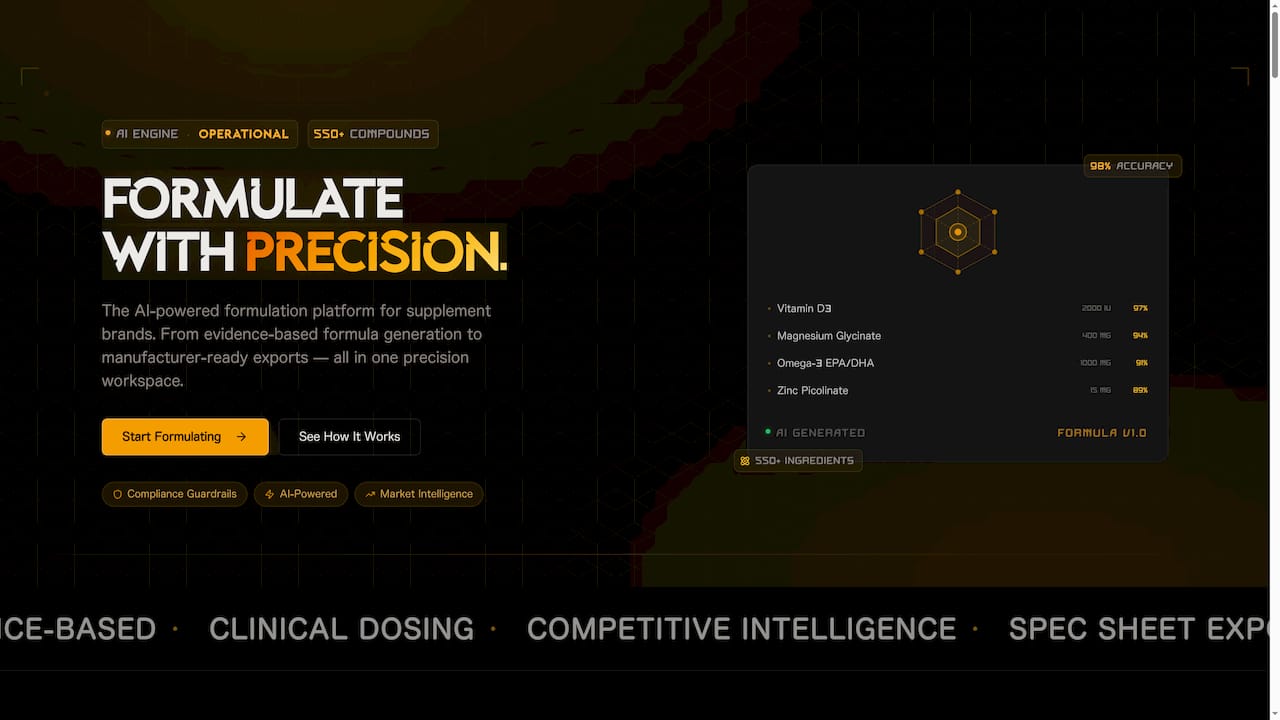
The platform's 8-phase development workflow guides teams from initial excipient screening through compatibility testing, prototype stability, compliance review, and production readiness. For surfactant selection specifically, that means organized excipient data with HLB and CMC references, compatibility tracking against your API and preservative system, and built-in regulatory checks against FDA and USP precedent for your intended route. A team screening Polysorbate 80 versus Polysorbate 20 for a parenteral protein formulation, for example, can track surface tension data, DLS results, and preservative efficacy outcomes in one place, with compliance flags surfaced automatically rather than caught in a late-stage review.
If your team is working through surfactant selection for a new product, start with Formlypro to structure the screening process and keep the regulatory documentation current from day one.
Useful sources for formulators
The references below are drawn from peer-reviewed literature, regulatory guidance, and accessible primers. For new formulators, the suggested reading order is: start with the PMC comprehensive review (1), then the surfactant-drug interactions overview (2), then the PharmaTutor applications overview (3) for practical pharmaceutical context, followed by regulatory resources as needed.
- Comprehensive Review on Applications of Surfactants — PMC: Broad coverage of surfactant types, mechanisms, and pharmaceutical applications; a strong starting point for understanding the full functional scope.
- A Recent Overview of Surfactant-Drug Interactions — PMC: Covers classification, CMC, micellization, and interaction mechanisms with APIs and biologics; directly relevant to selection and bioperformance sections.
- Surfactants and Its Application in Pharmaceuticals — PharmaTutor: Practical overview of surfactant roles across dosage forms, with notes on preservative interactions and formulation pitfalls.
- Surfactants: Role in Pharmaceutical Formulation — DOI 10.9734: Focused review on compatibility and application across pharmaceutical dosage forms; useful for understanding formulation-specific tradeoffs.
- Surfactants in Household and Personal Care Formulations — IntechOpen: Covers environmental dependencies (temperature, pH, ionic strength) and market-scale context; useful for understanding real-world performance variation.
- De Gruyter Review on Biodegradable Surfactants — 2025: Current review of biosurfactant and sugar-based surfactant options; essential reading for sustainability-focused formulation decisions.
- Surfactant — Wikipedia: Accessible primer on amphiphilicity, classification, and basic mechanisms; useful for onboarding team members new to surfactant chemistry.
- FDA Inactive Ingredients Database (accessdata.fda.gov): Route-specific precedent concentrations for approved excipients; the first regulatory lookup for any surfactant candidate.
- USP/NF Monographs (usp.org): Identity, purity, and assay specifications for Polysorbate 20, Polysorbate 80, Sodium Lauryl Sulfate, Lecithin, and other pharmaceutical surfactants.
- ICH Q8(R2) Pharmaceutical Development Guideline: Framework for excipient justification and formulation development documentation; relevant for building the regulatory rationale for surfactant selection.
- The Role of Peer-Reviewed Research in Formulation — Formlypro Blog: Practical guidance on integrating literature into formulation decisions; useful for teams building evidence-based excipient rationales.