

TL;DR:
- Peer-reviewed research ensures that formulation methods are validated and suitable for regulatory approval.
- Scientists use peer-reviewed evidence to select ingredients, design experiments, and define robust development frameworks.
Peer-reviewed research is the primary quality filter in formulation science, ensuring that every published finding has survived independent expert scrutiny before it informs a product decision. The role of peer-reviewed research in formulation extends well beyond academic credibility. It determines which experimental methods get replicated, which ingredient combinations earn regulatory acceptance, and which design frameworks get adopted at scale. 70–80% of Quality by Design studies in pharmaceutical formulation use Design of Experiments as a core tool, a statistic that reflects how deeply peer-reviewed evidence shapes practical formulation workflows. Regulatory agencies now accept literature-based submissions using peer-reviewed data to fulfill safety and efficacy endpoints, reducing the need for redundant trials. That shift alone signals how central validated literature has become to the entire product development lifecycle.
How does peer-reviewed research improve experimental rigor in formulation?
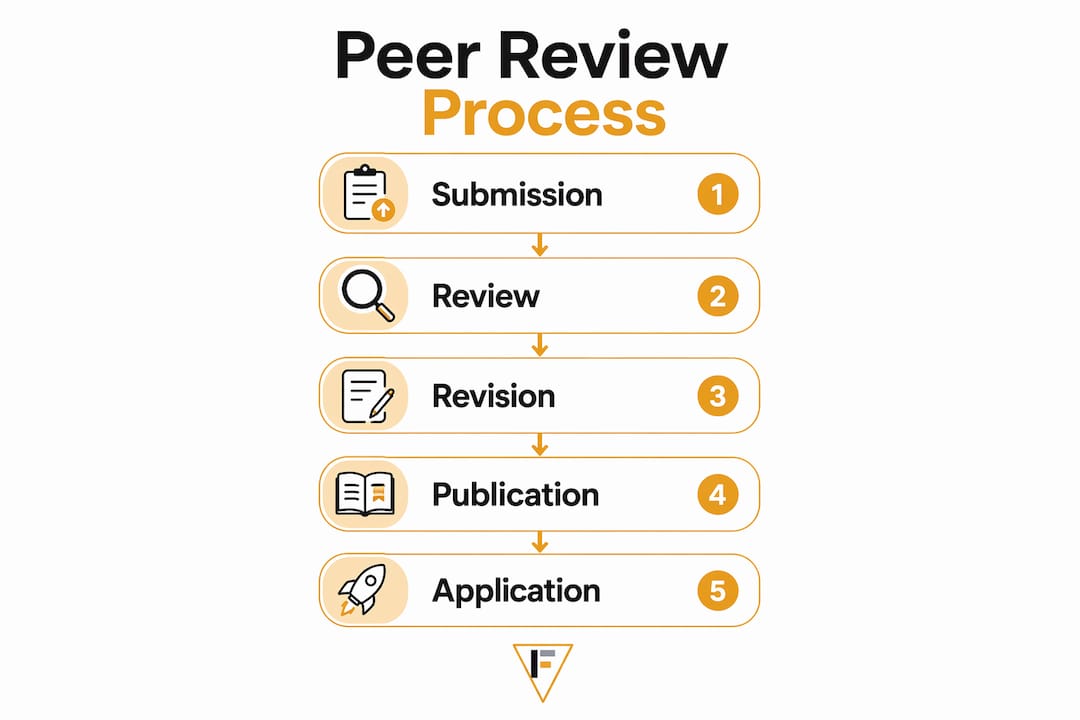
Peer review filters out flawed methodologies before they enter the scientific record. Reviewers assess whether a study's experimental design is sound, whether the statistical analysis supports the conclusions, and whether the results are reproducible. A formulation study that skips proper controls or misreports variance gets caught at this stage, not after it has influenced a production batch.
The iterative revision process is where most of the quality improvement actually happens. Reviewers request clarification on sample sizes, challenge assumptions about excipient behavior, and flag inconsistencies between raw data and reported outcomes. Authors who respond thoroughly and professionally produce stronger manuscripts. Author responsiveness and professionalism in addressing reviewer comments directly affect reviewer tolerance and manuscript acceptance rates.
Manuscripts receiving more rigorous, evidence-based reviewer comments and demanding revisions often achieve higher citation impact after publication. That correlation is not accidental. Harder reviews produce more reliable studies, and more reliable studies get cited by other formulation scientists building on that foundation.
Quality by Design principles depend on this foundation. QbD frameworks require formulation scientists to define a design space, identify critical quality attributes, and validate process parameters. All of that work draws on peer-reviewed evidence to justify the choices made. Without a credible literature base, QbD becomes guesswork dressed up as methodology.
Pro Tip: When evaluating a peer-reviewed study for formulation use, check the revision history if the journal publishes it. Studies with multiple substantive revision rounds tend to have stronger methodology than those accepted with minimal changes.
Key practices that peer review enforces in formulation research:
- Verification of analytical method suitability for the formulation matrix
- Confirmation that statistical models match the experimental design
- Assessment of whether conclusions are supported by the data presented
- Evaluation of reproducibility across different labs or batches
- Scrutiny of excipient interactions and their mechanistic explanations
What is the significance of peer-reviewed literature in regulatory submissions?
Regulatory agencies have formalized the use of peer-reviewed literature as a legitimate data source for drug and product approvals. Literature-based submissions allow sponsors to use publicly available peer-reviewed data to fulfill efficacy and safety endpoints, reducing the need for redundant clinical trials. This is a significant shift in how formulation development timelines are structured.
The practical benefit is real. A formulation team working on a well-characterized active ingredient can pull from existing peer-reviewed toxicology and pharmacokinetic studies rather than repeating every experiment from scratch. Shorter approval timelines follow directly from this approach, provided the literature is selected and presented correctly.
The criteria for a successful literature-based submission are specific:
- The peer-reviewed studies cited must directly address the indication and population in the submission.
- The data must meet the same evidentiary standards as proprietary trial data.
- Any gaps in the literature must be identified and addressed, not ignored.
- The submission must align precisely with the relevant regulatory guidance documents.
- Nonclinical toxicology gaps can be filled with published data, but the studies must match the product's specific formulation and route of administration.
Literature-based submissions can fill gaps in proprietary datasets, including nonclinical toxicology, but must align precisely with regulatory standards to avoid rejection. That precision requirement is where many submissions fail. Selecting a study that is close but not exact creates a gap that reviewers will identify. The importance of peer-reviewed studies in this context is not just about having citations. It is about having the right citations, matched to the right endpoints, with the right methodology.
Formulation scientists who understand why clinical data supports formulation claims gain a real advantage in structuring submissions that hold up under regulatory scrutiny.
How do reviewer dynamics shape published formulation research?
Reviewer disagreement is normal, and editorial decisions integrate differing expert judgments as a process of adjudication under uncertainty. Two reviewers can read the same formulation study and reach opposite conclusions about its novelty or methodological soundness. That disagreement does not mean the process is broken. It reflects the genuine complexity of evaluating scientific work.
Editors resolve these conflicts by weighing the specificity and evidence quality of each reviewer's critique. A reviewer who says "the dissolution data is unconvincing" carries less weight than one who says "the dissolution method does not account for pH shift in the intestinal segment, which affects the active's solubility profile." Specificity signals expertise, and editors recognize the difference.
"High-quality peer review involves moving beyond abstract critiques to actionable, fair, evidence-based feedback that effectively improves scientific rigor." — Defining high-quality peer review
The stages of reviewer expectations shift across revision rounds. Initial reviews focus on fundamental validity: is the research question worth answering, and is the design capable of answering it? Later rounds focus on whether the authors have addressed prior concerns fully and honestly. Reviewers in later rounds are less tolerant of evasive responses and more focused on whether the manuscript has actually improved.
Key factors that influence editorial outcomes in formulation research:
- Specificity of reviewer critiques versus vague or subjective objections
- Author professionalism and completeness in revision letters
- Consistency between reviewer recommendations and the manuscript's final claims
- Editor's assessment of the study's contribution to the existing formulation literature
- Whether conflicting reviewer opinions reflect genuine scientific disagreement or different standards
The impact of peer review on formulation research quality is cumulative. Each revision round removes a layer of ambiguity, and the published version reflects that accumulated scrutiny.
How should formulation scientists apply peer-reviewed findings with QbD and DoE?
Peer-reviewed literature should not be used as plug-and-play. Formulation scientists must integrate published findings within Quality by Design and Design of Experiments frameworks, enabling lifecycle management of design space and product quality rather than direct transplantation of another study's results.

QbD-based development improves formulation robustness, efficiency, and regulatory flexibility more effectively than traditional end-product testing approaches. The reason is structural. QbD requires you to understand why a formulation works, not just confirm that it does. Peer-reviewed DoE studies provide the factorial data and response surface models that make that understanding possible.
| Approach | How peer-reviewed research applies | Key limitation |
|---|---|---|
| Traditional end-product testing | Literature used to select test parameters | Does not define design space |
| QbD with DoE | Literature informs factor selection and design space boundaries | Requires adaptation to specific product |
| Lifecycle management | Ongoing literature review updates design space | Demands continuous monitoring of new publications |
45–60% of QbD studies establish a formal design space for robustness and compliance. That figure shows how many formulation teams are using peer-reviewed evidence not just to inform decisions but to define the boundaries within which their process must operate.
The most common pitfall is treating a published design space as transferable. A DoE study on a tablet formulation using one grade of microcrystalline cellulose does not automatically apply to a different grade, even from the same supplier. Particle size distribution, moisture content, and compressibility all vary. Formulation scientists who avoid these common pitfalls treat peer-reviewed results as a starting hypothesis, not a final answer.
Pro Tip: When using a published DoE study to inform your own design space, map the critical material attributes from the source study against your own raw material specifications before adopting any factor ranges.
What I've learned about using peer review as a formulation tool
The formulation scientists I respect most treat peer-reviewed literature as a conversation, not a rulebook. They read critically, adapt selectively, and push back on findings that do not hold up under scrutiny. That posture is harder than it sounds when you are under pressure to move a product forward quickly.
The biggest mistake I see is treating a high-impact journal citation as automatic validation. Impact factor measures how often a journal's papers get cited. It does not measure whether a specific study's methodology is applicable to your formulation. A paper published in a top-tier pharmaceutical journal can still use an excipient grade you do not have access to, or a processing condition your equipment cannot replicate.
The peer review process itself is also worth engaging with directly, not just consuming. Submitting your own formulation research, responding to reviewers professionally, and reading the revision letters of published studies when journals make them available all sharpen your ability to evaluate literature critically. Secure research portals in biotech increasingly support this kind of transparent review access, which benefits the entire field.
Peer review is the critical gatekeeper ensuring that formulation findings withstand independent validation, especially amid the proliferation of AI-generated studies. That context matters in 2026. The volume of published content has increased sharply, and not all of it has received the same level of scrutiny. Knowing how to identify a rigorously reviewed study is now a core professional skill, not a nice-to-have.
— Ben
Formlypro and research-backed formulation development
Formulation professionals who want to build products on validated science need more than a literature database. They need a system that connects peer-reviewed evidence to every phase of product development, from ingredient selection through compliance and production.

Formlypro is built for exactly that workflow. The platform's 8-phase development plan takes a formulation from ideation through prototyping, compliance, and production, with market and competitive analytics integrated at each stage. Formulation teams can access research-backed ingredient guidance, track regulatory requirements, and use the AI-powered packaging mockup designer to bring a product to market without switching between disconnected tools. For professionals who take peer-reviewed evidence seriously, Formlypro's formulation platform provides the structure to apply that evidence at every decision point.
Key takeaways
Peer-reviewed research is the foundation of credible formulation science because it verifies methodology, supports regulatory submissions, and defines the evidence base for QbD and DoE frameworks.
| Point | Details |
|---|---|
| Peer review filters methodology | Reviewers catch flawed designs before they enter the scientific record and influence production decisions. |
| Regulatory submissions use literature | Agencies accept peer-reviewed data to fill safety and efficacy gaps, reducing redundant trial requirements. |
| QbD and DoE depend on validated evidence | 70–80% of QbD formulation studies use DoE, with 45–60% establishing a formal design space from literature. |
| Reviewer dynamics shape outcomes | Editorial decisions integrate conflicting expert opinions, making author professionalism a real factor in publication success. |
| Literature requires adaptation | Published findings are starting hypotheses, not transferable results. Always map source study conditions to your own specifications. |
FAQ
What is the role of peer-reviewed research in formulation?
Peer-reviewed research provides independently validated evidence that formulation scientists use to select ingredients, design experiments, and support regulatory submissions. It is the primary mechanism for verifying that a study's methodology and conclusions are sound before they influence product development.
Is peer-reviewed research essential for regulatory approval?
Regulatory agencies accept peer-reviewed literature as a legitimate data source for drug and product submissions, allowing teams to fill safety and efficacy data gaps without repeating every trial. The literature must align precisely with the submission's indication and regulatory standards to be accepted.
How does peer review influence QbD and DoE in formulation?
Peer-reviewed DoE studies inform factor selection, response surface modeling, and design space boundaries within QbD frameworks. Formulation scientists use this literature as a starting point, then adapt findings to their specific raw material grades and processing conditions.
What makes peer reviewer feedback high quality?
High-quality peer review feedback is specific, evidence-based, and actionable, distinguishing objective methodological critiques from subjective opinions. Vague objections carry less editorial weight than critiques tied to specific data gaps or methodological flaws.
How should formulation scientists evaluate peer-reviewed studies critically?
Formulation scientists should check whether the excipient grades, equipment parameters, and analytical methods in a published study match their own conditions before adopting any findings. A study's journal impact factor does not confirm that its specific methodology applies to a different product or process.