

Go-to-market timing is the deliberate calibration of when you introduce a product based on internal readiness, market conditions, and competitive pressure. If you're staring at a launch date right now, here's the fast version: go if your non-negotiable gates are clear and delay costs exceed the risk of shipping imperfect, wait if a regulatory window, budget cycle, or unresolved reliability issue makes early launch reckless, and phased if you have partial readiness and can de-risk with a waitlist or soft release before full rollout.
Three signals should drive that call before anything else: whether your buyer's budget cycle is even open, whether a regulatory or compliance window is fixed and non-negotiable, and whether your internal stakeholders (sales, support, ops) are actually aligned on the plan. Miss any of those and the "right" launch date stops mattering.
Here's a four-item gut check. If you can answer yes to all four, you're probably closer to go than you think:
- Product reliability holds under real usage load, not just staging tests.
- Sales and support teams have completed enablement, not just received a deck.
- No fixed regulatory, seasonal, or budget-cycle deadline argues for delay.
- You have a named owner accountable for the go/no-go call.
Pro Tip: Score each of the four items 1 to 5 instead of yes/no. A total under 12 usually means "wait" or "phased," not "go."
Roughly B2B launches follow a 10 to 14 day sequencing cadence to fight attention decay, with waitlists opening three to four weeks ahead of a major release. That cadence only works if the underlying readiness call was made correctly first.
Key Takeaways
Go-to-market timing works best when treated as a scored risk-allocation decision, not a calendar default, because readiness thresholds and delay costs determine outcomes more than launch speed does.
| Point | Details |
|---|---|
| Timing is a decision, not a date | Score readiness thresholds, delay cost, and early-launch downside before picking go, wait, or phased. |
| Four gates are non-negotiable | Product reliability, sales enablement, compliance sign-off, and support staffing must clear before full launch. |
| Classify your quadrant honestly | Antagonistic, flexible, inflexible, and synergistic situations each call for a different launch tactic. |
| Re-score weekly near launch | Readiness and competitive pressure shift fast in the final month before a planned date. |
| Sync sales and marketing to readiness | Full campaign spend should activate only after sales enablement clears its own threshold. |
Primary Sources and Further Reading
- Timing legitimacy (Journal of Marketing) — the academic decision-tree model behind the four timing archetypes.
- Flowjam launch playbook — the 10 to 14 day multi-spike sequencing model.
- Product Marketing Alliance visual guide — continuous market-monitoring tactics for launch teams.
Table of Contents
- What Is Go-to-Market Timing, Exactly?
- Why Does Timing Matter So Much for Product Launches?
- What Internal and External Factors Determine Launch Timing?
- What Are the Four Go-to-Market Timing Archetypes?
- How Do You Score a Go/Wait/Phased Launch Decision?
- What Belongs on a Go/No-Go Readiness Checklist?
- How Do You Turn Timing Decisions Into a Launch Calendar?
- What Timing Mistakes Do Teams Keep Making?
- Which Metrics Should Drive and Validate Timing Decisions?
- What Does Research Say About Timing Legitimacy?
- How Do Demand Signals Show You're Ready to Launch?
- How Do Economic and Geopolitical Shifts Affect Launch Timing?
- How Should Sales and Marketing Timing Sync With Product Launch?
- A Practitioner's Take on Managing Timing as Discipline
- Ready to Time Your Next Launch With Confidence?
- Frequently Asked Questions
- Sources
What Is Go-to-Market Timing, Exactly?
Go-to-market timing is the decision variable inside your broader GTM strategy that sets sequencing: which window you launch into, how fast you scale after that, and which audiences see the product first. It is not the same thing as launch speed, and it is not the same thing as your calendar. Confusing the three is one of the most common reasons launches misfire.
Speed measures how fast you can execute once a date is set. Timing measures whether that date is the right one in the first place. A team can execute a launch flawlessly in record time and still lose, because the market, the budget cycle, or the regulatory environment wasn't ready to receive it. Scheduling is the mechanical act of putting dates on a calendar; timing is the strategic judgment that decides which dates deserve to be there. And a roadmap is broader still, covering the sequence of features and releases over quarters, while timing zeroes in on the specific go/no-go moment for one product or feature.
Here's how the four concepts actually differ in practice:
- GTM strategy — the full plan: positioning, pricing, channels, messaging, and audience segmentation.
- Timing — the strategic call on when to enter, tied to readiness and market conditions, not just ambition.
- Speed — how quickly the team executes once the launch decision is locked.
- Schedule — the literal dates and dependencies, usually shown as a go-to-market timeline or roadmap that cross-functional teams use to track deadlines.
Consider the same supplement product launched two different ways. In a B2B version sold to retail buyers, launching in October means missing the January budget-reset window, forcing a six-month wait regardless of product readiness. In a consumer version sold direct-to-shopper, launching the same product in October actually captures the holiday wellness gifting surge, when search interest in immune and sleep support supplements climbs sharply. Same formulation, same team, opposite timing logic, because the buyer's calendar is the variable that matters, not the calendar on the wall.
Regulatory readiness deserves its own line of scrutiny here too, especially for supplement and wellness brands navigating FDA labeling requirements or state-level restrictions. A regulatory framework for product launches that isn't finalized can turn a "go" decision into a costly recall six weeks later.
Why Does Timing Matter So Much for Product Launches?
Bad timing doesn't just delay revenue. It compounds into pipeline distortion, inflated acquisition costs, and stakeholder trust that's hard to rebuild once burned. A launch pushed into a market that isn't ready generates weak early signal, and that weak signal then poisons every internal forecast built on top of it.
Timing is frequently the least systematically managed variable in go-to-market planning, which is remarkable given how much it affects outcomes. Most teams default to "as soon as possible" instead of asking whether "as soon as possible" is actually the highest-confidence window.
The business impacts of bad timing show up in predictable places:
- Pipeline distortion — sales forecasts built on a rushed launch overstate near-term revenue and understate the ramp time buyers actually need.
- Higher customer acquisition cost — marketing spends to attract buyers who aren't budget-ready yet, burning cash for weak conversion.
- Slower adoption curves — early adopters who hit friction during a premature launch rarely come back for round two.
- Regulatory exposure — launching before compliance sign-off risks fines, forced relabeling, or a public recall.
- Missed seasonality — a consumer product that ships after the seasonal window closes waits, often a full year, for the next shot.
There's also a slower, quieter cost: stakeholder trust. Sales teams that get burned by a launch date that slips twice start discounting the next launch announcement before it even happens. Investors and boards notice the same pattern. Timing failures rarely stay contained to one launch; they erode the credibility of every future one.
What Internal and External Factors Determine Launch Timing?
Timing decisions split cleanly into two buckets: what your organization controls, and what the market controls regardless of your preparation. Weighing them correctly is the whole skill.
Internal readiness factors are the ones your team can directly move:
- Product reliability — uptime, error rates, and load performance under real usage, not staging conditions.
- Sales enablement — percentage of the sales team certified on messaging, objection handling, and pricing.
- Support capacity — staffing levels and documented escalation paths for day-one volume spikes.
- Onboarding flow — completion rates and time-to-first-value for early users in a beta or soft release.
- Operational scale — manufacturing, fulfillment, or infrastructure capacity to handle demand beyond the pilot group.
External market readiness factors sit largely outside your control, but they're measurable if you're watching:
- Seasonality — search trend spikes and historical demand curves for your category.
- Budget cycles — B2B buyers often start evaluating in Q3 to spend against budgets that open in Q1, and Tuesday through Thursday outreach outperforms Monday or Friday pushes.
- Competitive moves — analyst coverage, job postings for competitor go-to-market roles, and product hints in competitor release notes.
- Regulatory windows — fixed compliance deadlines or approval cycles that cannot be negotiated around.
- Technology infrastructure — whether the platforms, APIs, or distribution channels your launch depends on are stable and available.
Each factor has a cheap, early signal worth tracking before it becomes a crisis. Uptime and error-rate dashboards catch product readiness slippage weeks before a customer does. Enablement completion percentages catch a sales team that's nodding along in training but not actually ready. Search trend spikes and competitor hiring patterns catch external shifts before a press release confirms them.
Pro Tip: Watch analyst briefing requests and competitor job postings for go-to-market or launch-manager roles. Both tend to spike 60 to 90 days before a competitor's own launch, giving you an early warning most teams never check.
Weighting the two buckets isn't 50/50. Internal factors are gating; if your product isn't reliable, no amount of external market timing matters. External factors are modifying; they shift a "go" decision by weeks or months, but they rarely override a hard internal blocker. Treat internal readiness as the floor and external timing as the fine-tuning on top of it.
What Are the Four Go-to-Market Timing Archetypes?
Researchers studying technology launches classify timing situations along two axes: how much coordination the firm has achieved internally, and how willing stakeholders (buyers, partners, regulators) are to change their behavior to accept the product. Cross those axes and you get four distinct timing scenarios: antagonistic, flexible, inflexible, and synergistic.

Antagonistic timing happens when firm coordination is low and stakeholder willingness to change is also low. Think of an early augmented-reality wearable launched before either the hardware or the buying public was ready. Google Glass fits this pattern: the technology was ambitious, but retail buyers, privacy norms, and everyday use cases weren't aligned with what the product demanded of them. The lesson isn't that the product was bad; it's that neither side of the equation was prepared to meet the other.
Flexible timing occurs when the firm is well-coordinated but stakeholders still need convincing. A wearable company with strong internal readiness that still faces a market unsure about a new product category sits here. The corrective move is education-heavy marketing and staged rollouts that let skepticism erode gradually rather than trying to force adoption in one push.
Inflexible timing flips it: stakeholders are ready and eager, but the firm's own coordination lags. This is common when demand outpaces manufacturing or compliance sign-off. The tempting mistake is launching anyway to catch the wave; the better move is a phased or limited release that captures early demand without overpromising on scale.
Synergistic timing is the target state: firm coordination and stakeholder willingness are both high. Fitbit's early wearable launches landed closer to this quadrant, entering a market already primed by quantified-self trends and a public that had started tracking steps on phones. Ray-Ban Meta Smart Glasses arrived years after Google Glass, into a market that had already absorbed smart-wearable norms and where Meta had distribution and brand trust Google Glass lacked at the time. Same product category, very different quadrant.
| Archetype | Firm coordination | Stakeholder willingness | Move toward synergy |
|---|---|---|---|
| Antagonistic | Low | Low | Delay and rebuild both sides before committing a date |
| Flexible | High | Low | Invest in education and staged demand-building |
| Inflexible | Low | High | Launch a limited or phased release to capture demand safely |
| Synergistic | High | High | Execute the full launch on the planned timeline |
Misclassifying your quadrant is expensive. A team that mistakes inflexible for synergistic launches at full scale, then discovers its supply chain or compliance process can't support the demand it just courted. Run the stakeholder-willingness assessment honestly before assuming you're in the best-case quadrant.
How Do You Score a Go/Wait/Phased Launch Decision?
Turning timing into a defensible decision means scoring it, not gut-checking it. Four dimensions matter most: readiness thresholds, delay cost, early-launch downside, and competitive pressure.
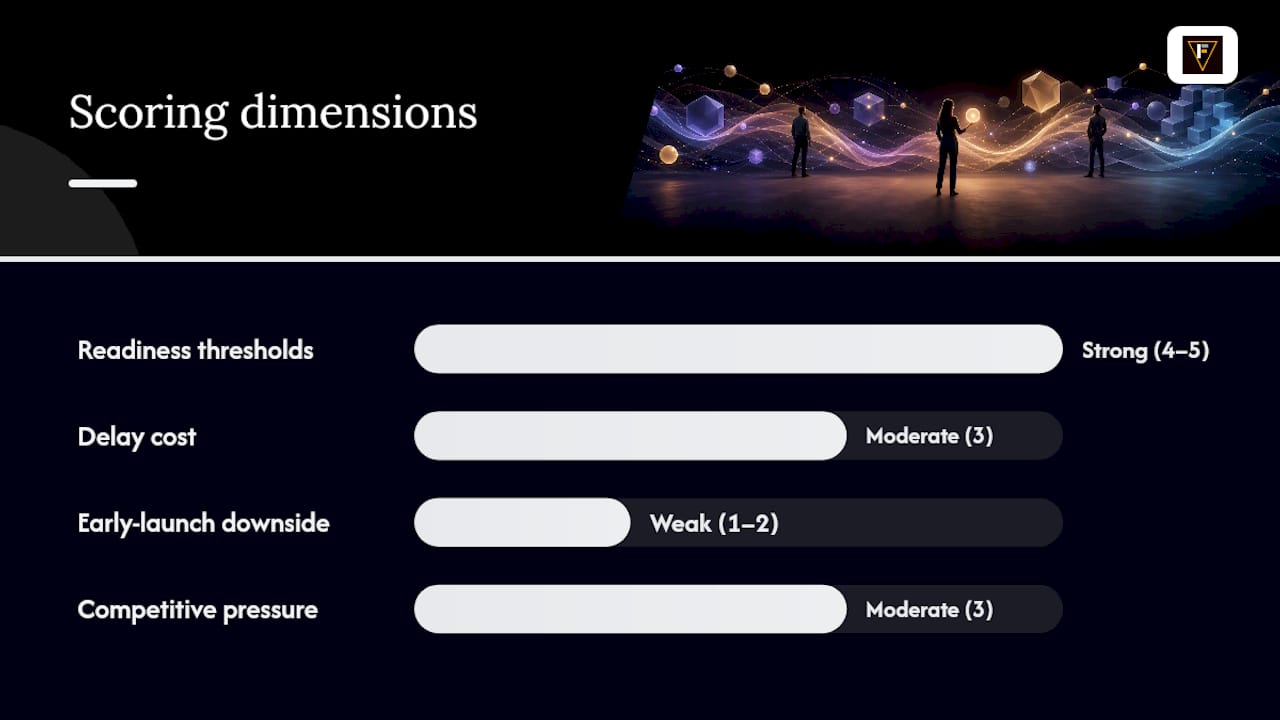
Readiness thresholds ask whether your non-negotiable gates (reliability, enablement, compliance) are met. Delay cost quantifies what you lose by waiting: missed seasonality, competitor advantage, team morale. Early-launch downside measures the risk of shipping before you're fully ready: support overload, churn from a rough first experience, reputational damage. Competitive pressure captures how urgently a rival's move forces your hand.
Score each dimension 1 to 5, then read the combined pattern:
| Dimension | Score 1-2 (weak signal) | Score 3 (moderate) | Score 4-5 (strong signal) |
|---|---|---|---|
| Readiness thresholds | Major gates unmet | Most gates met, one open item | All gates cleared and verified |
| Delay cost | Minimal loss from waiting | Moderate seasonal or budget cost | Missing this window costs a full cycle |
| Early-launch downside | High risk of visible failure | Manageable risk with a soft release | Low risk even at full scale |
| Competitive pressure | No rival activity | Some analyst or hiring signals | Confirmed competitor launch imminent |
Read the pattern, not any single number. High readiness plus high delay cost plus low early-launch downside points to go. Low readiness plus low delay cost points to wait. Low readiness plus high delay cost, where the downside of launching rough is manageable, points to phased: get something in front of a limited audience while you finish the rest.
The process itself runs in five steps:
- Define thresholds before you gather any signals, so the scoring isn't retrofitted to justify a date someone already picked.
- Gather signals across all four dimensions using the internal and external factors covered earlier: uptime data, enablement completion, search trends, competitor intelligence.
- Score each dimension with the team members who actually own that data, not just the launch lead guessing.
- Decide go, wait, or phased based on the combined pattern, documenting the reasoning, not just the verdict.
- Assign an owner and set trigger reviews so the decision gets revisited if a key signal changes before the launch date.
Governance matters here as much as the math. One person, usually the product marketing lead or head of product, should own the final call, with input from sales, support, and compliance. Weekly trigger reviews in the run-up to launch catch a slipping readiness gate before it becomes a launch-day surprise. Continuous market monitoring through sales debriefs, analyst briefings, and social listening keeps the scoring current instead of stale.
Pro Tip: Re-score weekly starting four weeks out from a tentative launch date, not just once at kickoff. Readiness and competitive pressure both shift fast in the final month, and a score from six weeks ago is often already wrong.
What Belongs on a Go/No-Go Readiness Checklist?
A readiness checklist only works if it's non-negotiable. Soft language like "ideally the support team is trained" invites teams to launch anyway. Hard gates don't.
Here are the gates that should block a launch outright if unmet:
- Product reliability confirmed under real usage load, with error rates below an agreed threshold.
- Onboarding flow tested with real users, not just internal QA, showing acceptable time-to-first-value.
- Support staffing sized for projected day-one volume, with escalation paths documented.
- Compliance sign-off completed, including labeling and any category-specific regulatory review.
- Sales enablement completion above an agreed percentage, verified through certification, not attendance.
- Monitoring dashboards live, with a documented rollback plan if early metrics fall outside range.
Scaling the sales team deserves its own timing logic, distinct from the product gates above. The sales learning curve framework breaks this into three stages: initiation, where founders or a small team sell directly to learn what resonates; transition, where the process becomes repeatable enough to document; and execution, where a larger team scales what's proven to work. Hiring a full sales team before reaching the transition stage almost always wastes payroll on people executing a process that doesn't exist yet.
How conservative your thresholds should be depends on downside risk. A supplement brand facing FDA scrutiny needs stricter compliance gates than a low-risk consumer gadget, because the cost of getting it wrong (a recall, a warning letter) dwarfs the cost of a two-week delay. Set thresholds proportional to what a miss actually costs you, not to some universal launch-readiness template.
Document every gate outcome as you clear it, not retroactively. A dated record showing when compliance signed off, when enablement hit its completion threshold, and who approved the final go call protects the team if a post-launch issue triggers a review. The new product launch workflow that brand managers use to coordinate these handoffs works best when each gate has a name attached to its approval, not just a checkbox.
How Do You Turn Timing Decisions Into a Launch Calendar?
Once the go/wait/phased call is made, it needs to become dates on a calendar, not just a verdict in a meeting.
A phased-release plan typically runs through four stages:
- Tease — a short signal to your audience seven to ten days before the next phase, building anticipation without over-committing.
- Waitlist — opened three to four weeks ahead for a major release, capturing demand and giving you a real readiness signal before full launch.
- Soft release — a limited rollout to a subset of users or accounts, catching operational issues before they hit full volume.
- Full release — the broad launch, timed against whatever budget cycle, seasonal window, or competitive pressure your scoring identified.
At each milestone, someone needs to check a specific trigger and sign off before the next phase opens. Support load and error rates get checked before moving from soft release to full release. Enablement completion gets checked before sales starts active outbound. Waitlist conversion rate gets checked before committing the final launch date, since a weak waitlist signal is a cheap warning that a bigger audience won't respond either.
A practical timeline example: if your decision-framework score lands at "phased" with a moderate delay cost, schedule the soft release six weeks before the target budget window opens, giving three weeks for iteration before the full release. If the score lands at "go" outright, compress that to a 10 to 14 day multi-spike sequence anchored by a single demo video reused across every channel, rather than drafting new creative for each touchpoint.
Day-of-week matters more than most teams assume. B2B announcements land better Tuesday through Thursday, when professional audiences are actively working through email and LinkedIn, while consumer launches tend to perform better clustered around weekends or the start of a seasonal shopping window. Templates and timeline structures for mapping this out are covered in a broader new product workflow guide built for teams juggling multiple simultaneous launches.
What Timing Mistakes Do Teams Keep Making?
Three short case patterns capture most of the recurring errors.
The consumer AR misstep: Google Glass launched into a market where the underlying technology was compelling, but privacy norms, price point, and social acceptance hadn't caught up. The team treated "the hardware works" as the readiness signal, ignoring that stakeholder willingness to change (wearing a camera on your face in public) was nowhere near ready. Lesson: product-ready and market-ready are two separate gates, not one.
The consumer wearable comparison: Fitbit entered a market already primed by the quantified-self movement, while Ray-Ban Meta Smart Glasses arrived years after Google Glass into a public that had absorbed smart-wearable norms and a distribution partner with existing trust. Both succeeded partly because the timing gap let stakeholder willingness catch up to the technology. Lesson: sometimes the right move is patience, not innovation speed.
The B2B budget-cycle miss: a launch scheduled for October in a category where buyers commit budget in January burns marketing spend generating interest nobody can act on for months. Lesson: check the buyer's fiscal calendar before the launch calendar, every time.
Common mistakes worth naming directly:
- Launching because the product feels "ready," without checking whether the market or budget cycle is ready too.
- Ignoring stakeholder timing norms, like assuming enthusiasm in a demo equals readiness to buy.
- Treating speed as the objective instead of asking whether this is the highest-confidence window to enter.
The corrective action in each case is the same: run the readiness scoring before locking a date, and treat a strong internal signal as necessary but never sufficient on its own.
Which Metrics Should Drive and Validate Timing Decisions?
Timing decisions need a measurement plan attached, or the whole framework becomes guesswork dressed up as rigor.
Before launch, watch pipeline health, sales enablement completion percentage, and waitlist conversion rate as early readiness signals. During launch, watch engagement spikes, conversion rate against the waitlist baseline, and support ticket volume against your staffed capacity. After launch, watch retention curves, customer acquisition cost trends, and Net Promoter Score to see whether the timing call actually held up.
Set explicit thresholds that reopen the timing decision rather than letting metrics drift unexamined. If waitlist conversion comes in well below your modeled rate, that's a signal to slow the full release, not a footnote to ignore. If support ticket volume during a soft release exceeds staffed capacity by a wide margin, that's a trigger to pause before scaling, not push through.
Short feedback loops matter more than perfect data. A quick A/B test on messaging during a soft release, or a limited geographic rollout before a national one, de-risks the timing call cheaper than any amount of pre-launch analysis. Market research methods that validate demand before committing capital apply just as well to timing validation after launch begins.
What Does Research Say About Timing Legitimacy?
Academic research frames timing as a question of legitimacy: does your launch align with the timing norms your stakeholders actually expect? The Journal of Marketing study on timing legitimacy formalizes the four-quadrant model covered earlier and provides a managerial decision tree to operationalize it.
The decision tree runs in three steps. First, assess coordination: is your organization internally aligned on the launch plan, or are product, sales, and support still working from different assumptions? Second, test stakeholder willingness to change: are buyers, partners, or regulators actually ready to adopt what you're offering, or does the offer ask for behavior change they haven't signaled readiness for? Third, choose the tactic that fits your quadrant: preannouncement and waitlists for flexible situations, education campaigns for antagonistic ones, or a straight wait if neither side is ready.
Interview questions worth running with key stakeholders before setting a date:
- What would make you delay adopting this product even if it worked perfectly on day one?
- Which budget cycle or approval process governs your decision to buy or adopt something like this?
- What similar products have you seen fail, and what timing signal did they miss?
- Who else needs to sign off before you can commit, and what's their timeline?
- What would need to be true for you to say yes today versus in six months?
Running even three of these with a handful of real prospects surfaces more timing intelligence than most internal planning meetings. The product launch playbook built around this research reinforces the same point: timing decisions improve when they're based on stakeholder input, not internal assumption.
How Do Demand Signals Show You're Ready to Launch?
Search trend data is one of the cheapest, fastest signals available. A sustained rise in category-related search volume, ahead of any marketing push from you, suggests organic demand building independent of your own efforts. A flat or declining trend suggests the market hasn't caught up yet, regardless of how ready your product is.
Waitlist sign-up velocity tells you something search data can't: whether people are willing to commit attention, not just curiosity. A waitlist that fills fast in the first 48 hours and then plateaus is a different signal than one that grows steadily over three weeks; the first suggests a narrow but passionate audience, the second suggests broader, more durable demand.
Customer advisory boards and beta cohorts offer qualitative readiness signals that numbers alone miss. If beta users are actively asking when the full version ships, that's a stronger readiness indicator than a survey score. If they're still asking clarifying questions about what the product even does, you're not as close to synergistic timing as the internal team might believe.
Sales debrief patterns matter too. If your sales team keeps hearing the same objection across independent conversations ("we'd need this integrated with X before we could commit"), that's a demand signal telling you exactly what gate still needs closing before a full launch makes sense. Weight qualitative signals from real conversations at least as heavily as quantitative dashboards, since the dashboards often lag behind what your team is already hearing.
How Do Economic and Geopolitical Shifts Affect Launch Timing?
Macro conditions reshape buyer behavior in ways that override even a well-scored internal readiness check. Tightened corporate budgets during an economic slowdown push B2B buyers toward longer approval cycles and more conservative purchasing, which can turn a normally reliable Q3 outreach window into a much slower conversion path.
Currency volatility and tariff changes hit product categories with import-dependent supply chains especially hard, and a launch priced before a tariff shift can arrive with margins that no longer work. Supply chain disruption tied to geopolitical events can also delay manufacturing or compliance timelines that were baked into an earlier launch calendar, forcing a phased rollout even when demand signals look strong.
Regulatory shifts tied to political change deserve particular attention for supplement and wellness brands. A change in FDA enforcement priorities or state-level labeling law can turn a compliance gate that was cleared six months ago into an open question again. Building a buffer into your regulatory readiness gate, rather than treating compliance sign-off as a one-time event, protects against this kind of drift.
None of this means waiting indefinitely for perfect macro conditions, since that window rarely arrives. It means building enough flexibility into your phased-release plan that a shifting economic signal triggers a scoring re-check rather than catching the team off guard three weeks before a hard launch date.
How Should Sales and Marketing Timing Sync With Product Launch?
A launch date that marketing hits but sales isn't ready for creates exactly the pipeline distortion covered earlier: interest generated with nowhere productive to go. The fix is treating sales enablement completion as a hard gate on the marketing calendar, not a parallel workstream that catches up eventually.
Campaign timing should mirror the phased-release structure. Teaser content goes out as the waitlist opens, giving marketing something concrete to promote. Case studies and demo content roll out during the soft release, once there's real usage to reference instead of speculative claims. Full-scale campaign spend activates only once sales enablement has cleared its threshold, so the leads marketing generates land with reps who can actually close them.
Cross-functional alignment between product, marketing, and sales works best when it's built into the readiness scoring itself, not treated as a separate coordination exercise. If sales enablement is lagging, that should show up directly in your readiness-threshold score, pulling the verdict toward wait or phased rather than letting marketing launch its campaign on schedule anyway.
For regulated categories, marketing claims need the same compliance sign-off as the product itself before any campaign goes live. A healthcare marketing workflow built around regulatory timing windows shows how tightly channel-level campaign scheduling should track compliance gates in categories where a premature claim carries real legal risk.
A Practitioner's Take on Managing Timing as Discipline
Most teams treat launch timing as a scheduling problem when it's actually a risk-allocation problem. The question isn't "how fast can we get this out the door." It's "which window gives us the highest odds of success relative to what we lose by waiting." Teams that internalize that distinction stop defaulting to the earliest possible date and start defaulting to the best-scored one.
If you take one practice from this framework, make it this: name a single owner for the go/no-go call, and run a short weekly trigger review in the month before launch. Readiness signals shift fast in that final stretch, and a scoring session from six weeks out is stale by the time it matters.
Formlypro's own workflow for supplement and wellness brands builds this discipline into the product development process itself: compliance gates, formulation readiness, and market research all feed into the same 8-phase pipeline, so the go/no-go decision isn't reconstructed from scratch at the eleventh hour.
Ready to Time Your Next Launch With Confidence?
Getting timing right takes more than a gut check on launch day. It takes compliance clarity, real competitor intelligence, and formulation work that's actually ready before you commit to a date. Formlypro's platform builds those readiness gates directly into an 8-phase product development workflow, covering FDA and DSHEA compliance guidance, competitor formulation analysis, and market research designed for supplement and wellness brands making exactly this kind of call.
If you're weighing a go, wait, or phased decision on your next launch, explore Formlypro's platform to see how research-backed formulation tools and pipeline planning can tighten your readiness thresholds before the date gets locked in.
Frequently Asked Questions
What is go-to-market timing in simple terms? Go-to-market timing is the strategic decision of when to launch a product based on internal readiness (product, sales, support) and external market conditions (budget cycles, seasonality, competitive pressure), rather than simply how fast the team can execute.
How is go-to-market timing different from a launch schedule? A schedule is the literal set of dates and dependencies on a roadmap. Timing is the judgment call about whether those dates represent the highest-confidence window to enter the market, which the schedule then reflects.
What's the best time to launch a product? There's no universal answer. B2B products generally do best when timed to open budget cycles, often starting outreach in Q3 for Q1 budget decisions, while consumer products often align with seasonal demand spikes. The right window depends on your specific readiness score and buyer calendar.
How do you determine launch timing if internal teams disagree? Use a scoring matrix across readiness thresholds, delay cost, early-launch downside, and competitive pressure, then let one named owner make the final go/wait/phased call based on the combined score rather than the loudest opinion in the room.
Why does go-to-market timing matter more than launch speed? Speed only measures execution once a date is picked. Timing determines whether that date was the right one, and a fast launch into an unready market still produces weak adoption, pipeline distortion, and higher customer acquisition costs.
Sources
- Timing legitimacy: Identifying the optimal moment to launch technology in the market (Journal of Marketing)
- Launching a product: timing, roles, and product launch checklist