

Startup product development is the process of moving an idea from raw hypothesis to market-ready product through a series of learning experiments, each designed to confirm or kill a core assumption before you spend serious money. The stages run: ideation → validation → definition → prototype/MVP → build → launch → post-launch iteration. The success criterion that actually matters is behavioral evidence of willingness to pay and repeatable usage, not user enthusiasm or survey scores. According to CB Insights-style analyses, many startup failures trace back to poor product-market fit, which means most founders lose not because they built badly, but because they built the wrong thing.
That distinction separates startup product development from enterprise product processes. A large company executes against a known spec with a known customer. A startup, by contrast, is still searching for a viable business model. Every stage should produce binary evidence: proceed or stop. The Lean Startup's build-measure-learn loop and the Stage-Gate model's go/no-go decision points both exist for this reason.
- Ideation: Define the problem and the target user.
- Validation: Confirm the problem is real and people will pay to solve it.
- Definition: Scope the product to its minimum viable form.
- Prototype/MVP: Build the smallest version that tests your riskiest assumption.
- Build: Develop the full first version based on validated learning.
- Launch: Release to real users with a measurable go-to-market plan.
- Post-launch iteration: Use behavioral data to improve, scale, or pivot.
Key Takeaways
Startup product development succeeds when founders treat every stage as a learning experiment with a defined kill condition, validate willingness to pay before building, and use the right framework for their product type and stage.
| Point | Details |
|---|---|
| Validate before building | Many startup failures trace back to poor product-market fit; run smoke tests before writing code. |
| Match framework to stage | Use Lean for discovery, Design Thinking for UX-heavy products, Stage-Gate for regulated builds, Agile for development sprints. |
| MVP acceptance criteria | Hit 40% activation, 20% 7-day retention, and at least one real payment before expanding scope. |
| Timeline and cost reality | U.S. supplement/wellness products typically cost $25,000 to launch; SaaS MVPs run $15,000–$200,000 depending on complexity. |
| Formlypro for supplement founders | Formlypro's 8-phase workflow covers formulation, FDA/DSHEA compliance, market research, and packaging from a single subscription platform. |
Table of Contents
- What does startup product development look like stage by stage?
- Which frameworks actually work for startup product development?
- How do you build a prototype and MVP that actually prove something?
- Who do you need on the team, and when should you hire vs. outsource?
- What does startup product development actually cost in the U.S.?
- What kills startups during product development, and how do you avoid it?
- Are you actually ready to launch? A checklist and measurement plan
- The one discipline most founders skip
- Formlypro gives supplement and wellness founders a faster path from idea to shelf
- Sources
What does startup product development look like stage by stage?
Product development covers the full journey from initial idea through design, development, and commercialization. For startups, each stage has a specific artifact you should produce before moving forward. Skipping artifacts is how founders convince themselves they've validated something they haven't.
Stage 1: Ideation and problem discovery (weeks 1–4)
Start with the problem, not the solution. Interview a number of people in your target segment. You're listening for frequency ("this happens every week"), intensity ("I've tried three other things"), and failed workarounds ("I built a spreadsheet for this"). The artifact here is a problem statement with a named customer segment and evidence of pain.
Digital example: A founder notices that freelance designers lose 4–6 hours per week chasing invoice payments. Fifteen interviews confirm the pattern. Artifact: a one-page problem brief with direct quotes.
Supplement example: A wellness founder observes that gym-goers in their network can't find a clean pre-workout without artificial sweeteners. Interviews reveal a consistent complaint about ingredient transparency. Artifact: a problem brief plus a list of the top five competing products and their label claims.
Stage 2: Market validation (weeks 3–8)
Validation is not asking people if they'd use your product. It's finding evidence they'll pay. Run a smoke test: a landing page with a price point and a "buy now" button that captures emails or pre-orders. If a very small percentage of visitors click through, the signal is weak. Artifact: conversion data, a list of early adopters, and a validated price hypothesis.
The HubSpot startup product development guide frames this stage as the critical decision gate: if you can't show demand evidence here, you don't proceed to building.
Stage 3: Product definition and scope (weeks 6–10)
Write a one-page product brief: the core user story, the three features that solve the validated problem, and a list of everything you're not building in version one. This is where scope discipline saves you months. Artifact: a prioritized feature list, a user story map, and a go/no-go gate checklist.
Stage 4: Design and prototyping (weeks 8–14)
Build a clickable prototype before writing a single line of production code. Tools like Figma let a designer produce a realistic mockup in days. For physical products, a rough 3D-printed model or a hand-assembled sample serves the same purpose. The goal is to put something in front of users that feels real enough to generate behavioral reactions, not just opinions.
Design thinking, as developed by IDEO, centers this stage on empathy: observe users interacting with the prototype, note where they hesitate, and redesign before committing to production. Artifact: a tested prototype with annotated user-session notes.

Stage 5: MVP development (months 2–5)
The MVP is not a beta version of your full product. It's the smallest build that tests your riskiest assumption. For a SaaS tool, that might be a single workflow with no dashboard. For a supplement, it might be a small paid pilot run of 100–500 units to validate manufacturing costs and real purchase behavior before a larger production commitment, as Shopify's product development guide describes.
Artifact: a working MVP with defined acceptance criteria (activation rate, conversion to paid, 7-day retention).
Stage 6: User testing and iteration (months 4–7)
Put the MVP in front of real users who pay or commit. Track behavior, not feedback forms. A user who says "I love it" but doesn't return after day 3 is a weak signal. A user who logs in four times in the first week and refers a colleague is the signal you're looking for. Iterate in short sprints, fixing the highest-friction points first.

Stage 7: Launch (months 5–8)
Launch is not a single event. It's a controlled release with a measurable go-to-market hypothesis. Define your launch channel, your target acquisition cost, and the metric that tells you the channel is working. Artifact: a launch brief, a channel plan, and a 30-day KPI dashboard.
Stage 8: Post-launch optimization (months 6–18+)
The startup product lifecycle research suggests that achieving product-market fit typically takes 3–18+ months depending on product complexity. Post-launch work is not maintenance; it's the second round of learning. Use cohort analysis to understand retention, run A/B tests on onboarding, and revisit your pricing model with real revenue data.
Which frameworks actually work for startup product development?
Founders often pick one framework and apply it everywhere. The better move is to match the framework to the stage and product type.
Lean Startup
Best for: early discovery and validation, any product type. The build-measure-learn loop compresses the time between hypothesis and evidence. You're not building a product yet; you're running experiments. Use Lean when you're still uncertain whether the problem is worth solving.
Design Thinking (IDEO)
Best for: products where user experience drives adoption, especially consumer apps, wellness products, and anything with a complex onboarding flow. Design thinking starts with deep user research and moves through ideation, prototyping, and testing before committing to a solution. Use it when you need to understand why users behave the way they do, not just that they do.
Stage-Gate
Best for: capital-intensive hardware, regulated products, and supplement/wellness brands. Each gate requires specific, measurable evidence before you spend the next tranche of money. For supplements, gate criteria should include regulatory feasibility checks, sample lab analysis, and manufacturer qualification before scaling, per the HubSpot guide. Stage-Gate slows you down on purpose, which is exactly right when a mistake costs $50,000 in tooling or a failed FDA review.
Agile
Best for: software execution once scope is defined. Agile principles support iterative delivery and continuous feedback cycles, making them the right cadence for development sprints after your MVP scope is locked. Don't use Agile for discovery; it assumes you already know what to build.
Mixing frameworks is the real skill. Use Lean for discovery, Design Thinking for UX-heavy products, Stage-Gate for regulated or capital-intensive builds, and Agile for development execution. A supplement startup might run Lean experiments to validate demand, use Stage-Gate gates for manufacturing and compliance decisions, and switch to Agile sprints for their e-commerce build.
| Framework | Best stage | Speed | Evidence type | Best-fit product |
|---|---|---|---|---|
| Lean Startup | Discovery/validation | Fast | Behavioral (clicks, signups, payments) | Any early-stage product |
| Design Thinking | Discovery/definition | Moderate | Qualitative (observation, interviews) | Consumer apps, UX-driven products |
| Stage-Gate | Definition through launch | Slower | Milestone-based (lab results, gate criteria) | Hardware, supplements, regulated products |
| Agile | Build/iteration | Fast | Velocity, sprint output | Software/SaaS after scope is defined |
How do you build a prototype and MVP that actually prove something?
Most founders build too much too soon. The prototype's job is to generate a reaction; the MVP's job is to generate a decision. They're different tools.
Prototype types
- Sketches and wireframes: Paper or Balsamiq mockups for internal alignment. Takes hours, costs nothing, surfaces disagreements early.
- Clickable mockups: Figma or InVision prototypes that simulate user flows without code. Use these before any engineering work begins.
- Concierge/manual prototypes: You deliver the service manually to simulate what the software would do. Dropbox famously validated demand with a video before writing a line of code.
- Functional prototypes: A working but rough version of one feature. Use when the technical feasibility is the riskiest assumption.
- Single-feature MVPs: A live product with one core workflow. Everything else is stripped out.
For physical and supplement products, MVP development at the prototype stage often means a hand-assembled sample or a small production run, not a polished retail-ready product.
MVP acceptance criteria checklist
Before you call your MVP "done," it should meet these behavioral thresholds:
- Activation: At least 40% of new users complete the core action within their first session.
- 7-day retention: At least 20% of activated users return within 7 days without a prompt.
- Conversion to paid: Some free users convert when presented with a paid offer.
- Willingness to pay: At least one user has paid real money, not just said they would.
- Qualitative signal: You can describe, in one sentence, why your best users keep coming back.
Validation methods
- Qualitative interviews: 5–8 users, 30 minutes each, focused on behavior ("walk me through the last time you dealt with this problem") rather than opinions ("would you use this?").
- Guerrilla testing: Put a prototype in front of strangers in a coffee shop or a relevant online community. Watch where they get stuck.
- Paid landing pages: Run $200–$500 in paid traffic to a landing page with a price point. Measure click-through on the buy button.
- Smoke tests: Announce a product that doesn't exist yet. Measure signups. If fewer than 5% of visitors sign up, reconsider the offer.
- Small paid pilots: For physical products, sell 50–100 units at full price before manufacturing at scale.
The key distinction is behavioral versus opinion data. Someone telling you they'd pay $49/month is an opinion. Someone entering their credit card is behavior.
Pro Tip: To measure willingness to pay without a finished product, set up a Stripe payment link at your target price point and send it to your 10 most enthusiastic early contacts. The number who click through and enter payment details is a more honest signal than any survey.
Who do you need on the team, and when should you hire vs. outsource?
The right team structure depends on your stage, not your ambition.
Roles by phase
Ideation and validation (0–3 people):
- Founder handles customer discovery, problem framing, and early prototyping.
- One generalist designer or a no-code builder covers early mockups.
- No engineers yet. Seriously.
Definition and MVP (3–7 people):
- Product manager or founder-as-PM owns the roadmap and acceptance criteria.
- UX/UI designer builds and tests prototypes.
- One or two engineers build the MVP.
- For supplement products: a regulatory/compliance specialist or consultant joins here, before formulation is finalized.
Build and launch (5–10 people):
- Growth or marketing lead joins to own the go-to-market plan.
- QA engineer or dedicated tester joins before launch.
- Customer support function (can be founder-led initially).
Hire vs. outsource decision rules
Outsource when the work is time-bounded, well-defined, and not core to your learning. Design sprints, initial engineering scaffolding, and regulatory consulting are good outsource candidates early on. Hire when the role requires ongoing context, iteration speed, or proprietary knowledge.
The trigger for your first engineering hire is when you've validated demand and your outsourced team's handoff friction is slowing iteration. The trigger for your first designer hire is when user experience is the primary reason users churn or convert.
Vendor red flags
- No IP ownership clause in the contract — walk away.
- No references from a client in your product category.
- Opaque pricing with no milestone-based deliverables.
- Refuses to share source files, design assets, or code repositories.
- Can't explain how they'd handle a pivot mid-engagement.
What does startup product development actually cost in the U.S.?
Timelines and costs vary widely, but founders consistently underestimate both. The table below reflects typical U.S. ranges for early-stage products.
The startup product development lifecycle research places ideation and validation at weeks to a few months, MVP development at 2–4 months, and product-market fit at 3–18+ months depending on complexity.
Main cost drivers
- Engineering hours: The single largest cost for software products. Offshore teams cost 40–60% less but add coordination overhead.
- Manufacturing tooling: For physical products, injection molds alone can run $5,000–$50,000.
- Lab analysis and regulatory testing: For supplements, third-party lab testing, certificate of analysis (COA) work, and DSHEA compliance review add $3,000–$15,000 before your first batch.
- Design and UX: A solid UX engagement for a consumer app runs $8,000–$30,000 depending on scope.
- Pre-launch marketing: Paid acquisition tests, influencer seeding, and email list building typically cost $5,000–$25,000 before launch day.
Minimum runway recommendation: Raise or reserve enough capital to cover 18 months of operating costs at your current burn rate. Pre-seed rounds in the U.S. typically range from $250,000 to $1,000,000 and are usually raised after validation evidence exists. Seed rounds ($1M–$3M) follow a working MVP with early traction metrics.
What kills startups during product development, and how do you avoid it?
The failure modes are well-documented. The hard part is recognizing them while you're inside them.
-
Skipping validation: Building for months before talking to customers. The fix is a two-week discovery sprint before any design or engineering work begins. The cost of skipping it is typically 3–6 months of wasted build time.
-
Poor unit economics: Acquiring customers for more than they're worth. Founders often discover this after launch when CAC exceeds LTV by 3x. The mitigation is modeling unit economics on paper before building, using real price points from your smoke tests.
-
Overbuilding the MVP: Shipping a product with 12 features when 2 would have tested the core assumption. Every extra feature adds weeks to the build and obscures which feature actually drives retention. Cut to the bone.
-
Wrong hire at the wrong time: Hiring a VP of Sales before you have a repeatable sales process, or a senior engineer before you've validated what to build. Both are expensive mistakes that take 6–12 months to unwind.
-
Ignoring retention signals: Celebrating new user signups while 80% of users churn after day 7. Retention is the leading indicator of product-market fit. If users don't come back, more acquisition spending just accelerates the burn.
-
Regulatory blind spots (supplement/wellness): Launching a supplement without a proper DSHEA compliance review or without third-party lab verification. The cost is a product recall or an FDA warning letter. The fix is a regulatory compliance checklist built into your Stage-Gate criteria before manufacturing begins.
The Crevio analysis reinforces the core lesson: startups fail by starting with building. Discovery and validation first, always.
Are you actually ready to launch? A checklist and measurement plan
Launch readiness is not a feeling. It's a checklist.
Launch readiness checklist
- Tech: Core user flow works end-to-end with no critical bugs. Payment processing is live and tested. Error monitoring (Sentry, Datadog) is active.
- Operations: Fulfillment or delivery process is documented and tested. Customer support channel is live (even if it's just a founder inbox).
- Marketing: Landing page is live with clear value proposition and pricing. At least one acquisition channel is set up and funded for the first 30 days.
- Payments and legal: Terms of service and privacy policy are published. Payment processor is compliant with U.S. requirements. For supplements: FDA and DSHEA compliance documentation is complete, label claims are reviewed, and a COA is on file.
- Customer support: FAQ or help doc covers the top five user questions. A response SLA is defined (even "within 24 hours" is enough at launch).
Post-launch KPIs
- Activation rate: % of new users who complete the core action in session one. Target: 40%+.
- 7-day retention: % of activated users who return within 7 days. Target: 20%+.
- 30-day retention: % of users still active at day 30. Target: 10%+ for consumer, 25%+ for B2B SaaS.
- Conversion to paid: % of free/trial users who convert. Target: 2–5% for freemium, 15–25% for free trial.
- CAC vs. LTV: Customer acquisition cost should be less than one-third of lifetime value within 12 months.
- Churn rate: Monthly churn above 10% for SaaS is a retention problem, not an acquisition problem.
Prioritization: your first three post-launch experiments
Use a simple impact-vs.-effort quadrant. High impact, low effort goes first. For most early-stage products, the first three experiments should target:
- Onboarding friction (high impact, low effort): simplify the first-session flow to improve activation.
- Retention trigger (high impact, moderate effort): identify the action that correlates with 30-day retention and build a prompt that drives users toward it faster.
- Pricing test (high impact, low effort): test one price increase of 20–30% on new signups. Most founders undercharge by a significant margin.
The one discipline most founders skip
The founders who build well share one habit: they treat every stage as a falsifiable experiment, not a project milestone. The difference sounds subtle but changes everything about how you allocate time and money.
Most product development advice focuses on what to build. The harder and more valuable question is what to stop building. Every stage should have a kill condition: a specific, measurable outcome that, if not met, means you stop and reconsider. Not "we'll see how it goes." A number. A behavior. A date.
The founders who skip this discipline end up in the most common and expensive trap in early-stage product work: sunk-cost escalation. They've spent four months building, so they keep building. They've hired two engineers, so they keep the engineers busy. The Teacode analysis frames it clearly: each stage should confirm or kill assumptions rather than execute a known spec. That's not a philosophy; it's a survival rule.
One actionable rule worth keeping: validate revenue behavior before hiring your first engineer. Not "people said they'd pay." Actual payment, even a $1 deposit, even a pre-order. If you can't get that, you don't have a product problem yet. You have a demand problem, and no amount of engineering solves that.
Formlypro gives supplement and wellness founders a faster path from idea to shelf
If you're building a supplement or wellness product, the process described in this article gets significantly more complex at the formulation, compliance, and manufacturing stages. Formlypro is built specifically for that complexity.
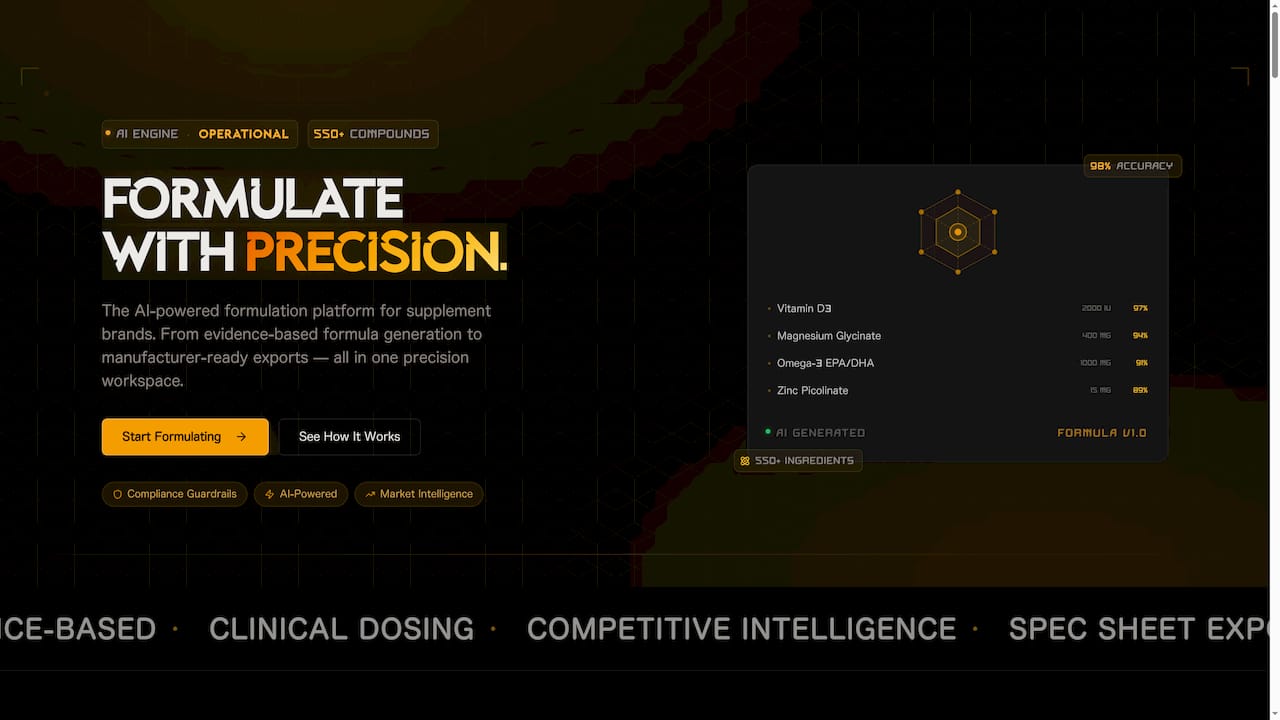
Formlypro's platform walks supplement founders through an 8-phase product development workflow, from ideation through formulation, compliance, and production-ready packaging. The formulation engine generates research-backed ingredient combinations, flags FDA and DSHEA compliance issues before they become problems, and exports manufacturer-ready documentation so you're not starting from scratch with every supplier conversation. The built-in market research and competitor analysis tools show you what's selling and what's in competing formulas, and the AI mockup designer lets you prototype custom packaging without a design agency. Plans are subscription-based with tiered monthly pricing and add-ons for advanced reports and extra formulation credits.
If you are at the validation or definition stage and building in the supplement or wellness space, start with Formlypro to compress the time between concept and a compliant, market-ready formula.
Sources
- Product development overview — Coursera
- Startup product development guide — HubSpot
- Agile principles — Agile Manifesto
- Design thinking — Interaction Design Foundation
- New product development guide: The 8-step process — Shopify
- Startup product development in 2026 — Crevio