

TL;DR:
- A structured, tiered product launch workflow aligns teams, timelines, and deliverables across all phases to ensure successful market entry.
- Effective launches depend on clear ownership, real-time coordination, and post-launch review cycles that foster continuous improvement.
A new product launch workflow is a coordinated, tiered process that aligns teams, timelines, and deliverables across pre-launch, launch execution, and post-launch phases to maximize market impact and minimize risk. Without a structured approach, 45% of product launches face delays of at least one month. That statistic reflects a systemic problem: most teams treat launches as a sprint when they are actually a relay race requiring precise handoffs between Product, Marketing, Sales, Compliance, and Customer Success. This guide breaks down the product launch process phase by phase, with the tools, tiers, and tactics that separate launches that land from launches that stall.

What are the essential stages of a new product launch workflow?
The product launch workflow divides into three phases, each with distinct timing, owners, and deliverables. Skipping or compressing any phase is the single most common cause of launch-day chaos.
Phase 1: Pre-launch (4 to 6 weeks out)
The pre-launch phase is where the foundation is built. According to a structured launch framework, this phase covers goal setting, tier assignment, messaging development, and asset creation. Every deliverable produced here feeds directly into launch execution, so gaps at this stage multiply downstream.
- Define success metrics and assign a launch tier (Tier 1, 2, or 3) based on business impact.
- Draft a positioning brief that all teams use as the single source of truth for messaging.
- Build the cross-functional launch plan with clear owners, deadlines, and a RACI chart.
- Create all required assets: landing pages, email sequences, sales decks, battlecards, and FAQs.
- Complete internal readiness reviews, including support training and sales enablement certification.
Phase 2: Launch execution (launch day through launch week)
Launch execution is the shortest phase but the highest-stakes one. The team shifts from building to coordinating. Go/no-go decisions happen here, feature enablement is confirmed, and real-time monitoring begins the moment the product goes live.
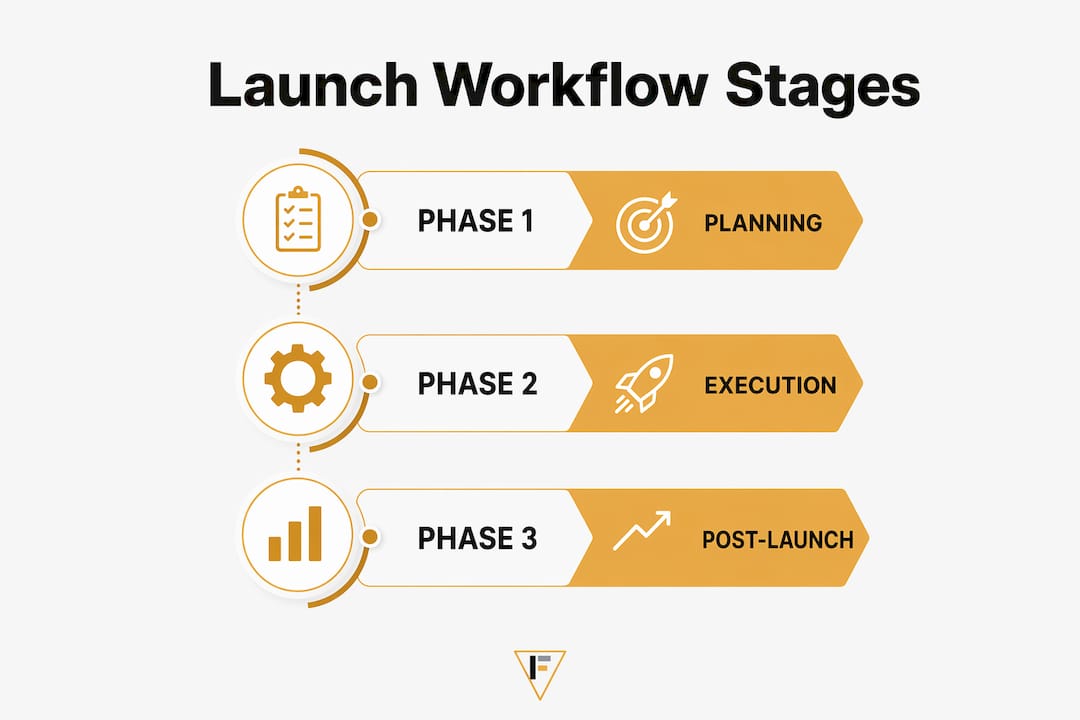
Phase 3: Post-launch (30 to 90 days)
Post-launch discovery sustains adoption far beyond the initial traffic spike. This phase covers feedback collection from Sales and Customer Success, iteration on messaging and product, and structured retrospectives at the 30-day and 90-day marks. Teams that skip this phase leave adoption gains on the table.
How do launch tiers shape the workflow and timelines?
Launch tiering is the most underused tool in a brand manager's product launch checklist. Not every release deserves the same runway, the same asset set, or the same cross-functional coordination. Tiering forces that prioritization decision upfront.
| Launch tier | Business impact | Minimum runway | Key activities |
|---|---|---|---|
| Tier 1 | Major product or new market entry | 8 to 12 weeks | Sales certification, analyst briefings, PR, full asset suite |
| Tier 2 | Notable feature or expansion | 4 to 6 weeks | Updated messaging, targeted campaigns, enablement updates |
| Tier 3 | Minor update or bug fix | 1 to 2 weeks | Release notes, in-app messaging, brief internal announcement |
Tier 1 launches require 8 to 12 weeks because time-intensive tasks like sales enablement certification and analyst briefings cannot be compressed without sacrificing quality or increasing cost. Tier 2 launches fit a 4 to 6 week window when messaging is already established and the change is additive rather than transformational. Tier 3 launches can ship in 1 to 2 weeks, but only when the scope is genuinely narrow.
The most common mistake is treating a Tier 1 launch like a Tier 2. A new product entering a competitive market needs analyst briefings, media outreach, and a fully certified sales team. Cutting that runway to six weeks means your sales team is selling a product they do not fully understand on day one.
Pro Tip: Assign the launch tier during the first planning meeting, not after assets are already in production. Changing a Tier 2 to a Tier 1 mid-cycle is one of the fastest ways to blow your timeline and your budget.
What tools and deliverables does an effective product launch need?
The right deliverables, owned by the right people, are what separate a living workflow from a static checklist. Every asset in a product launch workflow should trace back to the positioning brief.
Core deliverables by phase:
- Positioning brief: the central alignment artifact that defines the audience, the problem, the solution, and the key differentiators
- Cross-functional launch plan: a shared document with task owners, due dates, and a RACI chart covering every team
- Landing page and in-app messaging: the customer-facing proof points that must match the positioning brief exactly
- Sales battlecards and demo scripts: tools that let Sales articulate value without improvising
- Email campaigns and FAQs: assets that handle objections before they reach the sales call
- Press kit and media outreach materials: required for Tier 1 launches targeting earned media
Coordinated asset preparation means all stakeholders access a single source of truth, which reduces the misalignment that causes last-minute rewrites and approval delays.
Coordination tools and methods:
The meeting structure matters as much as the tools. Replacing 60-minute status meetings with 15-minute daily syncs improves launch velocity by keeping blockers visible without consuming the team's production time. The daily sync agenda is simple: what shipped yesterday, what ships today, and what is blocked.
Connected workflows with role-based approvals reduce bottlenecks and miscommunication more effectively than any single tool. Platforms that provide real-time task tracking and approval routing keep the launch plan from becoming a document that nobody updates.
Pro Tip: Build your launch plan in a tool that sends automatic reminders when deadlines are approaching. Manual follow-up on 40-plus tasks across six teams is where launch managers burn out and things fall through the cracks.
How do you execute launch day and maintain momentum post-launch?
Launch day execution is a coordination exercise, not a creative one. Every decision should already be made. The team's job on launch day is to confirm, communicate, and monitor.
- Send the internal launch announcement to all teams before the product goes live externally.
- Confirm feature enablement is complete and all customer-facing assets are live and accurate.
- Distribute customer communications: email, in-app messages, and social posts go out on schedule.
- Brief PR contacts and media partners if the launch is Tier 1.
- Assign a metric owner for each key performance indicator: activation rate, conversion rate, and support ticket volume.
- Run a 15-minute status sync at the start and end of launch day to surface blockers immediately.
Hard gates for product reliability and support readiness prevent late-stage surprises. Using only three status values near launch, "ready," "blocked," or "not started," forces honest reporting and exposes hidden delays before they become public failures.
Within the first 72 hours, collect structured feedback from Sales and Customer Success. These teams hear the unfiltered customer reaction before it shows up in analytics. Their input is the fastest signal you have for whether your messaging is landing or missing.
Post-launch momentum requires deliberate effort. In-app nudges, follow-up email sequences, and educational webinars extend the activation window well beyond launch day. Sustained post-launch iteration based on early user activation data is the activity with the highest long-term impact on adoption. Schedule a 30-day retrospective to evaluate what worked, and a 90-day review to assess whether the launch met its original success metrics.
Pro Tip: Assign one person to own the post-launch feedback loop. Without a named owner, the retrospective gets deprioritized and the lessons from each launch never make it into the next one.
For brands building physical products, integrating regulatory compliance early into the pre-launch phase prevents the most expensive delays. Compliance reviews that happen after assets are built require full rewrites. Compliance reviews that happen during positioning development cost almost nothing.
Key takeaways
A successful new product launch workflow requires tiered planning, cross-functional alignment, and a structured post-launch review cycle to convert launch-day traffic into sustained adoption.
| Point | Details |
|---|---|
| Tier your launches | Assign Tier 1, 2, or 3 at the first planning meeting to set the right runway and resource level. |
| Build around the positioning brief | Every asset, from landing pages to battlecards, must trace back to one shared source of truth. |
| Replace long meetings with daily syncs | Fifteen-minute daily standups keep blockers visible and protect production time across all teams. |
| Use hard gates near launch | Limit status values to "ready," "blocked," or "not started" to surface hidden delays before go-live. |
| Own the post-launch loop | Assign a named owner for the 30-day and 90-day retrospectives to capture lessons and improve the next launch. |
Why most launches fail in the handoff, not the planning
The launches I have seen fall apart rarely fail because the product was bad or the market was wrong. They fail in the handoff. Someone assumed another team had the battlecards. The compliance review happened after the landing page was already live. The sales team got the product brief three days before launch and winged the first ten demos.
The conventional wisdom says you need a better checklist. I disagree. Checklists are necessary but not sufficient. What you actually need is a workflow where every task has one owner, every approval has a deadline, and every team can see the same real-time status. A product launch plan as a living workflow rather than a static document is the shift that changes outcomes.
The tiering system changed how I think about resource allocation. Before I started using formal tiers, every launch felt equally urgent, which meant every launch got the same frantic energy and the same incomplete preparation. Tiering forces the honest conversation: is this a Tier 1 or are we just excited about it? That question alone has saved more launch timelines than any tool I have used.
Post-launch is where I see the biggest gap between teams that grow and teams that plateau. The 30-day retrospective is not a formality. It is the mechanism that turns a one-time launch into a repeatable process. Teams that skip it are essentially starting from scratch every time.
Treat the workflow as a living process. Update it after every launch. The version you use for your tenth launch should look nothing like the version you used for your first.
— Ben
Take your product launch further with Formlypro
Brand managers and entrepreneurs building physical products face a layer of complexity that software launches do not. Formulation, compliance, packaging, and production all have to converge on the same timeline.
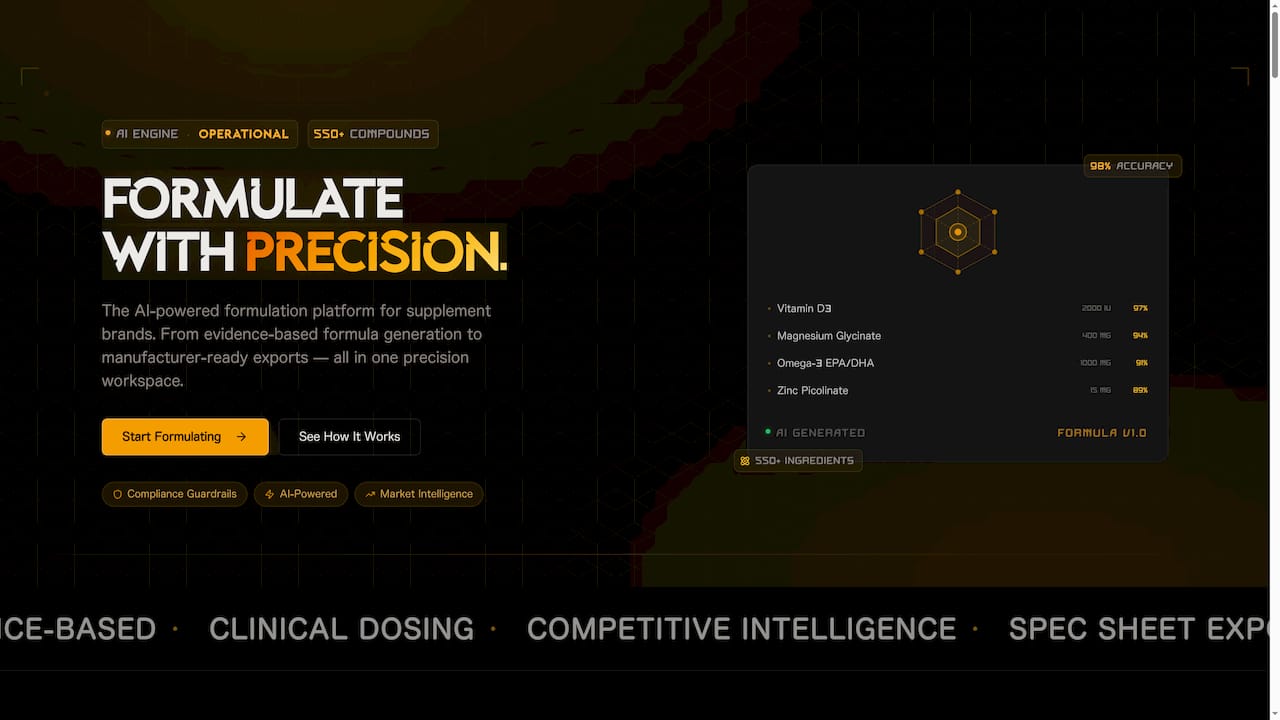
Formlypro is built for exactly that challenge. The platform guides you through an 8-phase product development workflow covering ideation, formulation, market research, compliance, and production. Built-in competitor analysis shows you what is selling and what competitors are putting in their formulations. The AI Mockup designer lets you create custom packaging without a separate design agency. If you are ready to take a new product from concept to shelf with a structured, research-backed process, explore Formlypro and see how the platform fits your launch timeline.
FAQ
What is a new product launch workflow?
A new product launch workflow is a structured, tiered process that coordinates all cross-functional teams across pre-launch, launch execution, and post-launch phases. It defines task owners, timelines, deliverables, and success metrics to reduce delays and align the entire organization around a single launch plan.
How long does a product launch workflow take?
Timeline depends on launch tier. Tier 1 launches require 8 to 12 weeks, Tier 2 launches need 4 to 6 weeks, and Tier 3 launches can ship in 1 to 2 weeks. Post-launch evaluation runs for 30 to 90 days after go-live.
What is the most important deliverable in a product launch checklist?
The positioning brief is the central alignment artifact for any product launch. It defines the audience, the problem, the solution, and the key differentiators, and every other asset from landing pages to sales decks should be built from it.
How do you maintain momentum after launch day?
Sustained post-launch activity including in-app nudges, follow-up email sequences, and educational webinars extends user activation beyond the initial spike. Structured retrospectives at 30 and 90 days convert early feedback into product and messaging improvements.
What is the difference between a product launch checklist and a product launch workflow?
A product launch checklist is a static list of tasks. A product launch workflow is a connected system with role-based approvals and real-time tracking that reduces bottlenecks and keeps all teams aligned throughout the launch cycle.