

TL;DR:
- In 2026, product workflows are AI-integrated, phased processes emphasizing compliance, decision quality, and iteration. Key tools include Ipsos Product Studio, Atlassian's Product Collection, and Claude Code, which enhance testing, prioritization, and prototyping across stages. Embedding compliance early and treating each phase as complete ensure faster, more effective product launches.
A new product workflow in 2026 is a structured, AI-powered sequence of phases that takes a product from raw idea to market-ready launch while keeping compliance and positioning built in from day one. The old model of linear development followed by a compliance scramble at the end is gone. Today, tools like Atlassian's Product Collection, Ipsos Product Studio, and Claude Code sit inside the workflow itself, not beside it. This article walks you through the exact phases, tools, and decisions that define an efficient 2026 product development process, so you can move faster without cutting corners.
What are the essential tools for a new product workflow in 2026?
The technology stack you choose before you write a single brief determines how much friction you carry through every phase. AI-powered workflows now depend on agentic and autonomous systems that handle complex tasks with minimal human intervention. That shift means your tool selection is a strategic decision, not an IT checkbox.
The core stack for a product workflow in 2026 breaks into three layers:
- Research and testing: Ipsos Product Studio tests over 10,000 products yearly and delivers 35% faster development timelines compared to traditional methods. That speed comes from accessing millions of respondents globally and returning performance results within hours, not weeks.
- Prioritization and delivery: Atlassian's Product Collection unifies Jira Product Discovery, Rovo AI, and analytics integrations like Pendo to improve decision quality over information-gathering speed. The system captures feedback, prioritizes with AI, and connects strategy directly to delivery.
- Design and prototyping: Claude Code lets designers build interactive products without deep engineering skills. Workflow stages include planning, building an MVP, iterating, and deploying with interactive feedback loops at each step.
| Tool | Primary role | Key advantage |
|---|---|---|
| Ipsos Product Studio | Consumer testing | Results in hours, not weeks |
| Atlassian Product Collection | Prioritization and delivery | AI-driven decision quality |
| Claude Code | Design and prototyping | MVP builds without deep engineering |
| Pendo | Analytics and feedback | Real-time user behavior data |
Prerequisites matter as much as tools. Cross-functional teams need to be assembled before phase one begins. Compliance stakeholders belong in the room at scoping, not at sign-off. Data infrastructure, including a shared feedback repository and a defined KPI set, must exist before you start generating insights you cannot act on.
Pro Tip: Map your data infrastructure before selecting tools. A prioritization platform like Atlassian's Product Collection only delivers value if the feedback flowing into it is clean, tagged, and centralized from the start.

How to execute each phase of a phased product launch workflow
The 7D AI Product Launch Framework defines seven sequential phases: Discover, Define, Design, Develop, Deliver, Distribute, and Determine. AI enhances every single one, which means the quality of your output scales with how deliberately you apply it at each step.
-
Discover. Use AI to analyze market gaps, competitor positioning, and customer sentiment simultaneously. Tools like Rovo AI surface patterns across thousands of data points in the time it used to take to read a single research report. Define your target customer problem before moving forward.
-
Define. Translate discovery insights into a product brief with measurable success criteria. Embed compliance requirements here, not later. Regulatory teams should review the brief before design begins, because changes at this stage cost hours while changes at production cost months.
-
Design. Claude Code and similar AI-assisted tools let designers prototype interactive experiences rapidly. The goal is a testable artifact, not a polished product. Frequent testing at this stage reveals usability and reliability issues before they become manufacturing problems.
-
Develop. Build against the defined brief with continuous integration of feedback from design testing. Jira Product Discovery keeps engineering, design, and product aligned on priorities in real time. Avoid scope creep by requiring written justification for any feature added after the brief is locked.
-
Deliver. SaaS product launches typically follow structured phases spanning 8 to 12 weeks with designated owners for every deliverable. Assign launch tiers, define go or no-go criteria, and run a pre-launch compliance audit before any public release.
-
Distribute. AI-generated content tools accelerate channel-specific messaging. Pendo dashboards track adoption in real time so you can adjust distribution tactics within days of launch, not quarters.
-
Determine. Measure against the KPIs defined in phase two. Use anomaly detection to flag underperformance early. Feed findings back into the Discover phase for the next product cycle.
Pro Tip: Treat the Determine phase as the first step of your next product cycle, not the last step of this one. Teams that close the feedback loop consistently outperform those that treat post-launch measurement as a formality.
What compliance best practices belong inside the workflow?
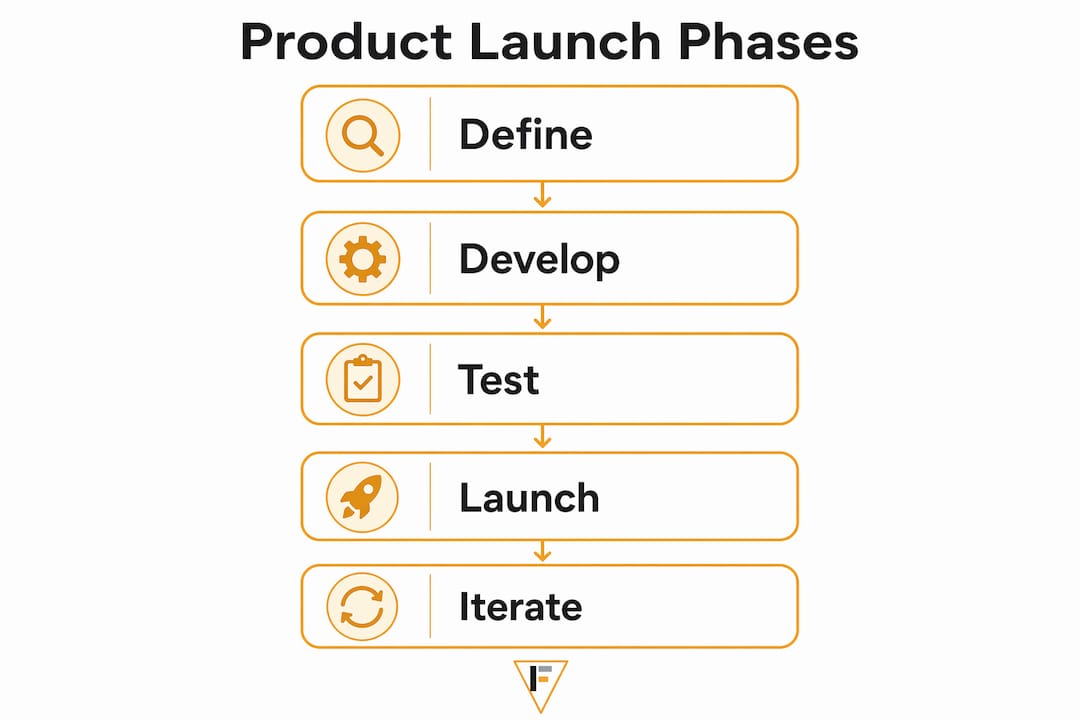
Compliance is a competitive advantage when it is embedded in the workflow from scoping. It becomes a liability when it is treated as a final gate. Involving regulatory teams early in product scoping prevents costly redesigns and aligns R&D with commercial realities. This is especially true in health, beauty, and consumer goods, where ingredient restrictions, labeling requirements, and safety testing windows are non-negotiable.
The practical steps for embedding compliance into your product development process look like this:
- Assign a compliance owner at the project kickoff, not at pre-launch review.
- Build a compliance checklist into the Define phase brief so every design decision is made with regulatory constraints visible.
- Run a mid-development compliance audit at the transition from Design to Develop. Catching issues here is dramatically cheaper than catching them at Deliver.
- Document all protocol decisions, including the rationale for ingredient or feature choices, so audits and reformulations have a clear record to work from.
- Use agile policy adjustment cycles so that regulatory updates during development are absorbed without derailing the timeline.
Common pitfalls to avoid include treating compliance as a single sign-off event, failing to document decision rationale, and excluding regulatory stakeholders from design reviews. Protocol documentation covering checklists, compliance criteria, and decision frameworks must accompany every development phase to prevent costly misalignments in fast-paced workflows.
For consumer goods brands specifically, the regulatory frameworks governing labeling, claims, and ingredient safety vary by market. Building a market-specific compliance matrix into your Define phase brief is the single most effective way to avoid late-stage reformulation.
How does AI-driven decision making optimize workflow outcomes?
The defining shift in product workflow best practices for 2026 is the move from speed to judgment. Gathering information faster is no longer the constraint. Making better decisions with the information you have is. Superior workflows shift focus from collecting data quickly to making high-quality, evidence-backed decisions at each stage.
Atlassian's Product Collection demonstrates this in practice. Rovo AI does not just surface feedback. It prioritizes it against strategic goals, flags contradictions between customer requests and product direction, and connects individual decisions to delivery timelines. Pendo adds behavioral analytics so that post-launch iteration is driven by what users actually do, not what they say in surveys.
The practical applications of AI-driven decision making across a product workflow include:
- Feedback analysis: Natural language processing tools categorize and weight thousands of customer responses in minutes, surfacing the signals that matter.
- Predictive modeling: AI models built on historical launch data can flag which features correlate with adoption and which correlate with churn before you build them.
- Anomaly detection: Real-time dashboards identify underperformance within days of launch, enabling rapid course correction rather than quarterly post-mortems.
- Launch messaging optimization: AI tools test headline and positioning variants against audience segments before launch, reducing the guesswork in go-to-market copy.
| Decision type | Traditional approach | AI-enhanced approach |
|---|---|---|
| Feature prioritization | Stakeholder votes | Rovo AI weighted scoring |
| Launch timing | Calendar-based | Predictive readiness modeling |
| Post-launch iteration | Quarterly review | Real-time anomaly detection |
| Messaging optimization | A/B testing post-launch | Pre-launch variant modeling |
The result is not just faster launches. It is launches that perform better because every decision from scoping to distribution was made with better information.
What are the most common workflow challenges in 2026?
The most frequent failure mode in a 2026 product development process is not a technology gap. It is a process gap disguised as a speed problem. Teams rush phases, skip documentation, and treat cross-functional alignment as optional when timelines compress. Rushing for speed without iterative validation leads to over-optimization mistakes that require expensive corrections later.
The challenges that appear most consistently across product teams include:
- Skipping protocol documentation: When decisions are not recorded, reformulations and audits become guesswork. Every phase needs a written record of what was decided and why.
- Fragmented cross-functional collaboration: Design, engineering, compliance, and marketing working in separate tools with separate timelines creates misalignment that compounds at launch.
- Over-indexing on speed: AI tools accelerate execution, but they do not replace the judgment required to know when a phase is genuinely complete versus when it feels complete.
- Late compliance integration: Treating regulatory review as a final gate rather than a continuous input is the single most common cause of launch delays in health and consumer goods categories.
Pro Tip: Run a weekly cross-functional sync that includes at least one compliance stakeholder from the Define phase onward. The cost is one hour per week. The savings are measured in months of avoided rework.
Continuous iteration is the antidote to most of these challenges. Successful products in 2026 rely on prototyping, testing, and iterative improvement rather than a straight line from idea to launch. Build review gates into your project board, assign owners to every deliverable, and measure impact from day one rather than waiting for a post-launch retrospective.
Key takeaways
A new product workflow in 2026 succeeds when AI tools, compliance integration, and phased decision-making operate as a single connected system rather than separate workstreams.
| Point | Details |
|---|---|
| AI is inside the workflow | Tools like Product Studio and Rovo AI belong in every phase, not just research. |
| Compliance starts at scoping | Regulatory teams must review the product brief before design begins to prevent costly redesigns. |
| Decision quality beats speed | Atlassian's Product Collection shifts focus from gathering data fast to making better decisions with it. |
| Documentation prevents rework | Protocol records covering compliance criteria and decision rationale are non-negotiable in fast-paced workflows. |
| Iteration is the process | Continuous prototyping and testing, not a linear path, defines successful 2026 product development. |
What I've learned about workflows that actually ship
After watching dozens of product teams build and rebuild their processes, the pattern that separates successful launches from stalled ones is almost never the tool stack. It is the discipline to treat each phase as genuinely complete before moving to the next one.
The 7D framework is a good structure. Product Collection is a good platform. But I have seen teams with both still ship broken products because they used the framework as a checklist rather than a thinking system. The Discover phase is not done when you have data. It is done when you have a clearly articulated problem worth solving. The Define phase is not done when you have a brief. It is done when compliance, engineering, and marketing have all signed off on the same document.
The compliance piece is where I see the most consistent underestimation. Brands in health and beauty categories especially treat regulatory review as a final hurdle rather than a design input. The brands that win treat their compliance workflow as a source of product differentiation. Knowing your formulation is clean before your competitor's is not just a legal advantage. It is a marketing one.
The other thing worth saying plainly: AI does not make product decisions for you. It makes the information available to make better ones. The teams that get the most from tools like Rovo AI and Pendo are the ones that already had clear decision criteria before they turned the tools on. If your team cannot agree on what a successful launch looks like before you start, no AI platform will resolve that disagreement for you.
Build the process first. Then let the tools accelerate it.
— Ben
How Formlypro supports your product workflow from day one
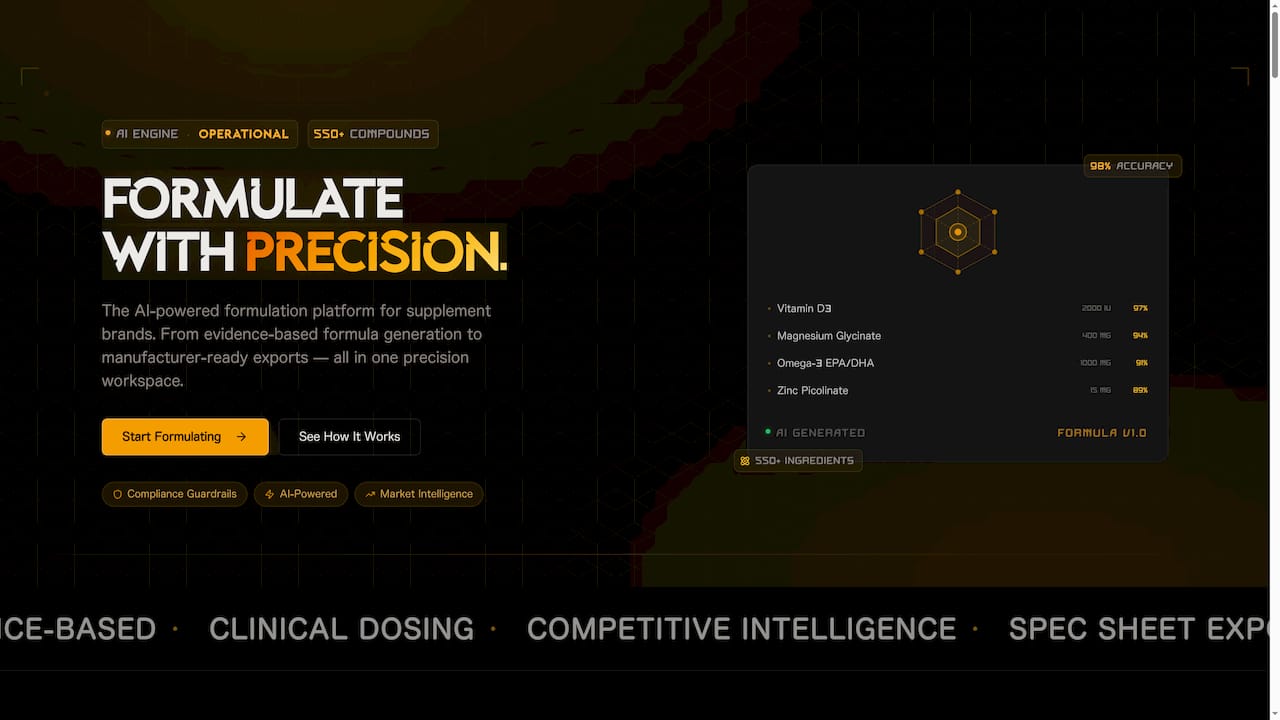
Formlypro is built specifically for brands that need more than a project management tool. The platform covers the full 8-phase product development process, from ideation and market research through formulation, prototyping, compliance, and production. Every subscription tier includes competitor analysis showing which products are selling and what formulations those brands are using, so your positioning decisions are grounded in real market data.
The compliance guidance inside Formlypro is not a checklist you manage manually. It is integrated into the workflow so that regulatory requirements surface at the right phase, not after you have already committed to a formulation. The AI Mockup designer in the packaging section lets you create custom packaging without a separate design agency. If you are building a product in 2026 and want a workflow that connects research, formulation, compliance, and launch in one place, explore Formlypro and see which tier fits your stage.
FAQ
What is a new product workflow in 2026?
A new product workflow in 2026 is a structured, phased process that integrates AI tools, compliance checks, and market research from ideation through launch. The 7D framework (Discover, Define, Design, Develop, Deliver, Distribute, Determine) is the most widely referenced structure for this process.
How long does a structured product launch take?
SaaS and consumer product launches following structured phase workflows typically span 8 to 12 weeks from pre-launch preparation to post-launch measurement, with designated owners for each deliverable at every stage.
When should compliance be integrated into the product workflow?
Compliance belongs in the Define phase, before design begins. Involving regulatory teams at scoping prevents costly redesigns and aligns R&D with commercial realities, particularly in health, beauty, and consumer goods categories.
Which AI tools are most useful for product workflow management?
Atlassian's Product Collection (including Rovo AI and Jira Product Discovery), Ipsos Product Studio, Claude Code, and Pendo each serve distinct roles across prioritization, testing, prototyping, and post-launch analytics.
What is the biggest mistake teams make in product workflows?
Skipping protocol documentation and integrating compliance too late are the two most consistent failure points. Both create expensive rework that structured phase gates and early regulatory involvement can prevent entirely.