

TL;DR:
- Regulatory issues often cause consumer product launch failures more than product flaws or market fit. Understanding layered legal frameworks in the US and EU and building proper compliance processes are essential for successful market entry. Balancing rigid rules with judgment-based decisions, supported by thorough documentation, helps brands navigate complex regulatory environments effectively.
A surprisingly common reason promising consumer products fail at launch has nothing to do with the formula, the packaging, or even the market fit. The problem is regulatory. Founders invest months building the perfect product, then discover their label claims are unsubstantiated, their ingredient list violates agency rules, or their EU market entry is blocked for missing conformity documentation. Explaining regulatory frameworks clearly is not an academic exercise. It is a core business skill that separates brands that launch clean from brands that launch, then scramble. This guide breaks down the structure of US and EU compliance obligations, what they mean for your marketing claims, and how to build processes that hold up under real scrutiny.
Table of Contents
- How regulatory frameworks shape consumer product compliance
- Navigating legal and marketing compliance for consumer product claims
- Comparing US and EU regulatory approaches for consumer product launches
- Implementing a practical compliance framework for market success
- Why mastering regulatory frameworks requires balancing rules and judgment
- Streamline your product launch with FormlyPro's compliance platform
- Frequently asked questions
Key Takeaways
| Point | Details |
|---|---|
| Understand regulatory structure | Successful compliance starts by knowing how statutes empower agencies to create binding rules in your markets. |
| Substantiate marketing claims | Always gather competent evidence for product claims before publication to avoid FTC enforcement risks. |
| Compare US and EU systems | Global product launches require balancing US statutes and EPA-like agencies with EU conformity assessments and markings. |
| Build governance frameworks | Operationalize compliance through clear roles, reporting calendars, and documentation aligned with regulatory expectations. |
| Balance rules and judgment | Blend principles-based approaches with bright-line rules to innovate confidently without compromising compliance. |
How regulatory frameworks shape consumer product compliance
To grasp regulatory frameworks, it helps to understand their structural foundation across key jurisdictions. A regulatory framework is not a single document or rule. It is a layered system where legislatures pass statutes, agencies convert those statutes into enforceable regulations, and enforcement actions interpret how rules apply in practice.
In the US, regulatory frameworks for consumer products flow from an enabling statute that gives an agency the authority to write detailed regulations carrying legal force. Congress creates the FDA, the FTC, and the CPSC with specific mandates. Each agency then writes its own rules, guidance documents, and enforcement policies under those mandates. The result is a multi-layer system where your product may simultaneously need to satisfy FDA labeling regulations, FTC advertising rules, and state-level consumer protection statutes.
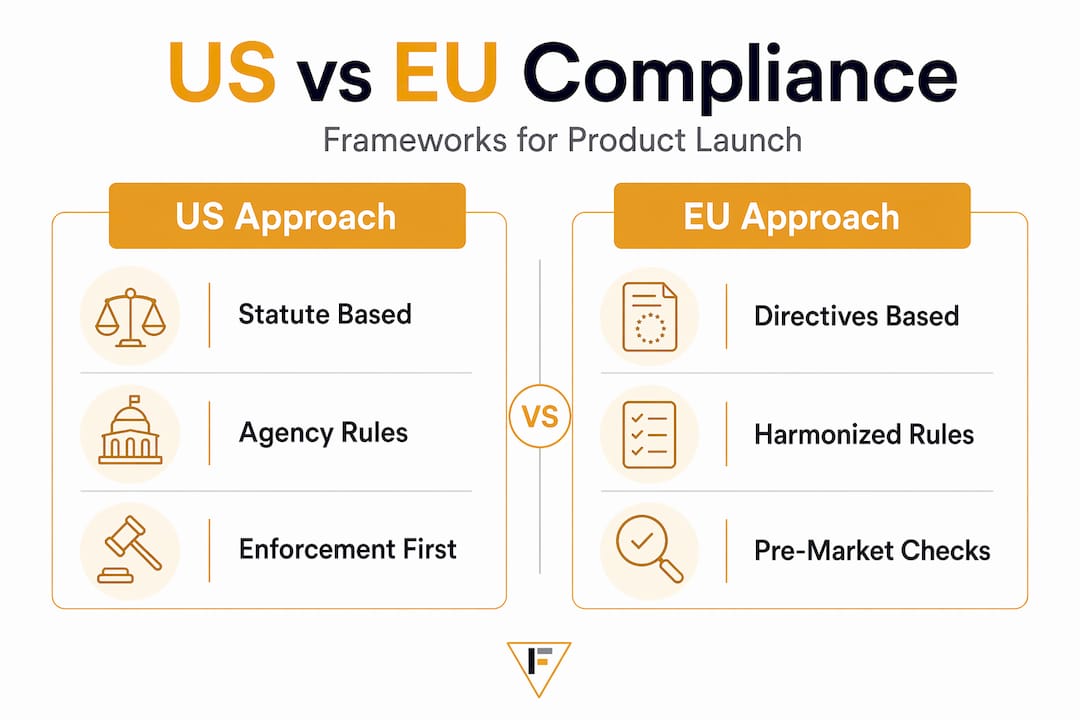
The EU operates differently but is equally layered. EU product market access requires compliance with the EU's "new legislative framework" conformity regime, where products must meet all relevant conformity requirements before CE marking applies, and only when sector-specific legislation actually mandates it. Many brands assume CE marking is a universal requirement. It is not. What is universal is the obligation to meet applicable directives before you put anything on the EU market.
Key structural elements of most regulatory frameworks include:
- Enabling legislation: The statute that defines an agency's mandate and scope
- Primary regulations: Legally binding rules created through formal rulemaking
- Guidance documents: Non-binding interpretations of how agencies will apply their rules in practice
- Enforcement actions: Decisions that signal how broadly rules are interpreted in real cases
- Technical standards: Referenced specifications that define how compliance is demonstrated
"The distinction between a binding regulation and a non-binding guidance document matters enormously. Ignoring guidance does not mean ignoring law, but it does mean accepting enforcement risk when your approach differs from what the regulator expects."
Pro Tip: When auditing your compliance obligations, build a three-column tracker: the statute, the regulation, and the relevant guidance document for each product category. Most brands only track one layer and miss critical requirements sitting in guidance.
Navigating the intersection of these layers is not optional for brands targeting US and EU markets simultaneously. A practical health and beauty compliance guide helps you identify which agencies touch your specific product category, and a solid understanding of consumer goods compliance standards keeps you from applying the wrong framework entirely.
Navigating legal and marketing compliance for consumer product claims
Understanding regulatory foundations is critical, but equally important is how these rules govern your product's market messaging. This is where many brands make their costliest mistakes. They build a strong product, write compelling claims, and assume the evidence will catch up later. It will not.

The FTC's advertising substantiation doctrine requires marketers to have a reasonable basis of competent and reliable evidence for objective claims before those claims go live. Not after your product gains traction. Not after a complaint surfaces. Before. The FTC also evaluates the entire net impression of an ad, including imagery, headlines, and implied meaning, not just the literal text of each sentence. A before-and-after photo can constitute an efficacy claim even without a single word of copy making that promise explicitly.
Here is what "competent and reliable evidence" actually means in practice:
- For health and efficacy claims: Randomized controlled human clinical trials, peer-reviewed research, or established scientific consensus
- For general performance claims: Reliable testing, consumer surveys with sound methodology, or expert opinion from qualified professionals
- For comparative claims: Head-to-head testing under conditions that actually reflect real-world use
One of the most effective tools compliance-savvy brands treat as a standard artifact is a claim-evidence matrix: a structured document mapping every objective claim in your marketing to the specific study, test, or data point substantiating it. Build this before you write copy, not after your marketing team has already fallen in love with a tagline that has no backing.
Unsubstantiated claims carry real consequences. FTC enforcement actions can result in consent orders requiring you to withdraw claims, pay fines, or submit to ongoing monitoring for years. The reputational cost of a public enforcement action often exceeds the financial penalty.
Pro Tip: Run every draft of your marketing copy through a claim-audit process. Flag every word that implies measurement, comparison, or health benefit. Each flag needs a corresponding evidence entry in your matrix before that copy publishes.
Your regulatory compliance checklist should include a marketing sign-off step that ties directly to your evidence documentation. And if your product's formula is still evolving, your product compliance formulation process needs to stay synchronized with your claims, because changing an ingredient can invalidate the evidence behind a claim you are already running.
Comparing US and EU regulatory approaches for consumer product launches
To apply compliance effectively, grasp how these major markets differ yet share core principles. Brands launching in both markets quickly discover that what passes in the US does not automatically pass in the EU, and vice versa. Understanding those differences up front is far cheaper than discovering them after you have printed 50,000 units.
| Dimension | US approach | EU approach |
|---|---|---|
| Legal foundation | Enabling statutes, agency rulemaking | EU directives and regulations, new legislative framework |
| Product approval | Generally post-market enforcement | Pre-market conformity assessment for many categories |
| Marketing claims | FTC substantiation, pre-existing evidence required | Sector-specific rules, national enforcement variation |
| Conformity marking | Not typically required | CE marking when mandated by sector legislation |
| Technical documentation | Varies by agency and product class | Required and retained for authorized representative review |
| Enforcement model | Agency-initiated actions, civil penalties | Market surveillance authorities, product withdrawal powers |
The US system relies heavily on enabling statutes and agency rulemaking with enforcement actions setting practical precedent. The EU system demands documented conformity before market access, with EU products required to comply with all sector-specific regulations before any conformity marking is applied.
What the two systems share is equally important: both require documented evidence, both assign liability to the brand placing products on the market, and both have enforcement mechanisms with real teeth. Neither market tolerates the "figure it out after launch" approach.
For global brands, the practical implication is that compliance planning needs to happen in parallel across jurisdictions, not sequentially. Waiting to solve US compliance before addressing EU requirements costs you months and often forces reformulation. A coordinated review of product compliance standards from day one protects your timeline. Understanding industry compliance standards across both markets lets you identify where requirements overlap and where they genuinely conflict, so you can make intelligent tradeoffs early.
Implementing a practical compliance framework for market success
With frameworks understood, you can now build practical governance systems for sustained compliance and competitive positioning. Knowing what regulators require is one thing. Building internal systems that actually deliver that compliance consistently is another.
Here is a practical sequence for structuring compliance governance within your brand:
- Map your regulatory obligations by product and market. List every applicable statute, regulation, and guidance document. Do not assume a single agency owns your product category.
- Assign clear ownership. Every compliance obligation needs a named accountable person, not a team or a department. Shared ownership is often no ownership.
- Build your evidence library before launch. Gather substantiation documentation, safety data, ingredient certifications, and testing results ahead of any marketing activity.
- Create a reporting calendar. Know your labeling review dates, testing renewal intervals, and any post-market monitoring obligations. A regulatory reporting framework must emphasize data collection, reporting deadlines, and mandated formats to actually function under audit conditions.
- Establish an audit trail for judgment calls. When you apply principles-based judgment rather than a bright-line rule, document your reasoning, the evidence you considered, and who approved the decision.
- Run quarterly compliance reviews. Regulations change. Your product's claims, formula, and markets may also change. Your compliance documentation needs to keep pace.
"An authoritative compliance framework is not a binder on a shelf. It is a governance framework with clear roles, active monitoring, and consistent fulfillment of obligations. The difference between the two is visible the moment a regulator asks a question."
One underappreciated skill in building these systems is mapping where judgment-based principles end and bright-line rules begin. Some regulations give you flexibility to apply professional judgment. Others are non-negotiable. Applying judgment where a rule is rigid, or over-documenting where a rule is clear, wastes resources and creates confusion.
Pro Tip: When onboarding a new product line, run a "compliance kickoff" meeting with your formulation, marketing, and operations leads before any creative or development work begins. Decisions made in that meeting will cost far less to implement than corrections made at the finish line.
Your product development compliance guide can anchor this process, and exploring compliance automation benefits shows how the right tools reduce the manual overhead that often causes teams to let documentation slip.
Why mastering regulatory frameworks requires balancing rules and judgment
Here is something most compliance guides will not tell you directly: rigid rule-following alone does not make a brand compliant. It makes a brand reactive.
The brands that navigate regulatory environments most effectively are not the ones with the thickest policy binders. They are the ones that understand where the rules are inflexible and where the rules invite judgment, and they build decision-making cultures capable of handling both. Effective regulatory regimes use hybrid models of high-level principles supported by targeted, non-negotiable rules. The principles give innovation room to breathe. The hard rules prevent the kind of shortcuts that end careers and brands.
The problem is that most consumer product brands approach compliance as purely rules-based because that feels safer. Check the box, file the form, move on. But regulations like the FTC's substantiation doctrine or the EU's conformity assessment requirements are inherently judgment-based at their core. They require you to assess what "reasonable" evidence looks like, what a "net impression" communicates, whether your technical documentation is "adequate." These are not yes/no answers.
What protects you in that space is documentation of your reasoning, not just your conclusion. Regulators who audit judgment-based decisions care deeply about the quality of your decision process. A brand that can show it weighed the evidence, consulted the right expertise, and made a defensible call is in a fundamentally stronger position than one that made the same call without any paper trail.
Engaging with regulators proactively is also underused by brands in this space. Pre-submission meetings with the FDA, for example, or engaging with a notified body in the EU before you finalize technical documentation, can clarify expectations before you commit resources. Most agencies have formal channels for this kind of dialogue. Most brands never use them.
Your regulatory compliance checklist should reflect this balance: hard rules tracked as pass/fail, judgment-based requirements tracked with documented rationale. That distinction alone elevates your compliance posture significantly.
Streamline your product launch with FormlyPro's compliance platform
Putting all of these frameworks into practice requires more than knowledge. It requires systems that keep your evidence organized, your claims substantiated, and your regulatory obligations tracked without pulling your team away from building great products.

FormlyPro is built specifically for consumer product brands navigating exactly this complexity. The platform walks you through an 8-phase product development plan from initial ideation through formulation, compliance, and production, embedding regulatory guidance at every stage. It includes a built-in compliance module that tracks obligations by market, a claim-evidence management system that prevents unsubstantiated marketing from reaching launch, and market research tools that let you see what competitors are selling and how they are positioning their products. The AI-powered packaging designer even lets you visualize compliant labeling before you go to print. If you are building a consumer product for the US or EU market, FormlyPro turns regulatory complexity into a manageable, step-by-step process.
Frequently asked questions
What is the difference between a regulatory statute and a regulation?
A statute is a law passed by a legislature that sets broad mandates, while regulations are detailed rules created by agencies under statutory authority to enforce those laws. Congress delegates authority to agencies, which then write the specific, binding regulations that brands must follow.
When is CE marking required for products in the EU?
CE marking is required only when sector-specific EU legislation mandates conformity marking, and it applies after a product has met all relevant regulatory requirements. Product marking such as CE is not a universal EU requirement. Its necessity depends on your product's category and the applicable directives.
What does the FTC require for marketing claims substantiation?
The FTC requires marketers to have competent and reliable evidence supporting any objective claims before those claims are published, not after complaints arise. The FTC's substantiation doctrine scrutinizes the full net impression of an ad, not just its literal text, including imagery and implied meaning.
How can brands balance principles-based and rules-based regulation?
Brands succeed by mapping which obligations require rigid rule-following and which invite judgment, then documenting their reasoning carefully for the latter. Hybrid models pairing principles with targeted non-negotiable rules give brands innovation room without sacrificing legal certainty.