

Formulation is the single biggest cost lever most product founders underestimate. Before you spend a dollar on marketing or hire your first employee, the formulation path you choose determines your R&D budget, your compliance obligations, your time to launch, and how much cash you tie up in inventory. It touches every major cost category at once.
Here is what formulation actually drives in your startup budget:
- R&D and development costs: Custom formulation runs tens of thousands of dollars or more per SKU, including pilot runs and stability testing. Private label starts at a lower five-figure cost.
- Raw materials: Ingredient selection determines your cost of goods at the unit level, and premium or novel ingredients can multiply that figure.
- Pilot runs and testing: Pilot runs cost several thousand dollars and may or may not be credited toward your first production order.
- Stability testing: $3,000 to $8,000 per product, required before you can make any shelf-life claim.
- Regulatory compliance: Safety substantiation runs $300 to $2,000 per formula under MoCRA, and ongoing label and claim review costs $2,000 to $12,000 annually for a small brand.
- Packaging: Dosage form and delivery mechanism directly determine container type, fill complexity, and per-unit packaging cost.
- Intellectual property: Custom formulation can create ownable IP, but only if your manufacturer contract explicitly says so in writing.
Formulation is not an isolated R&D decision. It is a system-level choice that sets your financial trajectory from day one.
How startup cost structure actually works for product founders
Every product startup carries two distinct layers of cost: what you spend to build the product, and what you spend to run the business. Getting those two layers confused is one of the most common reasons early-stage founders run out of runway before they hit meaningful revenue.

Cost structure refers to the mix of fixed and variable costs that make up your total spending, and how those costs behave as your volume changes. For a formulation-driven startup, this structure is unusually front-loaded. You pay to develop, test, and validate a formula before a single unit ships. That upfront spend does not scale with sales, but it absolutely affects your pricing, your margins, and how long your capital lasts.
Formulation decisions sit at the center of this structure because they determine both the magnitude and the timing of your costs. A founder who chooses a complex custom formula with a novel ingredient commits to a longer development timeline, higher compliance costs, and a larger minimum order quantity, all before knowing whether the market will respond. A founder who starts with a private label formula trades differentiation for speed and lower upfront spend. Neither choice is wrong, but each one reshapes the entire cost model.

Your cost structure also affects how fast you can make decisions. A startup with high fixed costs and a long development cycle has less room to pivot than one with a lean, variable cost model. Understanding where formulation sits in that structure gives you the ability to plan rather than react.
How to classify formulation costs in your startup budget
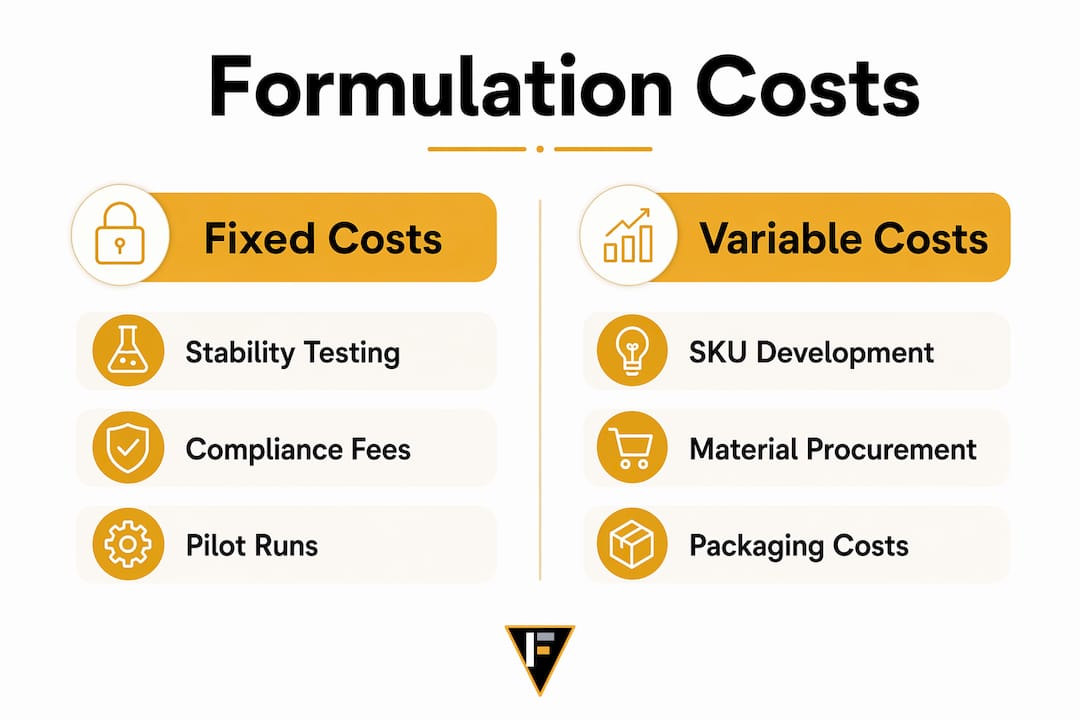
Startup costs fall into two broad categories, and formulation expenses appear in both. Knowing which bucket a cost belongs to changes how you plan for it, how you account for it, and how it affects your pricing.
One-time (non-recurring) costs are paid once to get the product to market:
- Custom formulation development typically runs $20,000 to $40,000 or more depending on complexity.
- Prototype samples can cost hundreds to a few thousand dollars per revision round, with two to three rounds typical.
- Pilot runs cost $5,000 to $15,000 and may sometimes be credited against your first production order.
- Stability testing costs $3,000 to $8,000 per product.
- Initial regulatory review and label compliance cost $2,000 to $12,000 annually for a small brand.
Recurring costs continue as long as you sell the product:
- Raw material purchases (scales with every production run)
- Ongoing label and claim review costs $2,000 to $12,000 annually for a small brand.
- Reformulation or line extension development when you add SKUs
- Revalidation testing when ingredients or suppliers change
The fixed versus variable distinction matters just as much. Your stability testing fee is fixed regardless of how many units you sell. Your raw material cost is variable, rising and falling with production volume. Founders who treat all formulation costs as fixed miss the fact that ingredient costs compound with every reorder, and founders who treat them all as variable miss the upfront capital commitment entirely.
SKU count multiplies everything. Each additional formula variant adds its own development, testing, and compliance costs. A brand launching three flavors of the same product does not pay three times the development cost, but it does pay three times the stability testing and three times the label review fees.
COGS versus OPEX: where formulation costs actually land
The accounting distinction between cost of goods sold (COGS) and operating expenses (OPEX) is not just a bookkeeping detail. It determines how your margins look, how investors read your financials, and how you price for profitability.
COGS covers the direct costs of producing each unit: raw materials, excipients, manufacturing labor, filling, and primary packaging. Every ingredient in your formula flows through COGS. If you reformulate to add a premium active ingredient, your COGS per unit rises immediately, and your gross margin compresses unless you raise the price.
OPEX covers the costs of running the business that are not tied directly to production: R&D, regulatory compliance, marketing, and general administration. Most formulation development costs land here before the product launches. The R&D process, stability testing, and regulatory review are OPEX items, not COGS, because they happen before any unit is produced for sale.
Here is where it gets complicated for founders:
- Raw materials and manufacturing: COGS
- Custom formulation R&D and scientist fees: OPEX (pre-launch)
- Stability testing: OPEX (pre-launch), then COGS-adjacent once in production
- Ongoing label and claim compliance: OPEX (recurring)
- Packaging design and tooling: OPEX (one-time), then COGS per unit
- Pilot run costs: OPEX if not credited; COGS if absorbed into first production order
The timing of when you recognize these costs matters for your financial model. A founder who books all formulation development as a lump OPEX hit in month one will show a very different income statement than one who amortizes it across the first production run. Neither approach is wrong, but you need to choose deliberately and apply it consistently.
Formulation choices also shift the balance between COGS and OPEX over time. A brand that starts with private label carries almost no OPEX in development but pays a higher per-unit COGS because the manufacturer builds their margin into the formula. A brand that invests in custom formulation carries heavy OPEX upfront but can achieve gross margins of 55–75% once the development cost is recovered.
Formulation as a systemic cost driver: what the research shows
The research on formulation economics is unambiguous: the path you choose does not just affect your R&D line. It reshapes your entire financial structure.
A study published in PubMed found that integrating formulation development with real-time manufacturing and clinical testing generated after-tax financial benefits of $230.5 million to $290.1 million per approved drug in the pharmaceutical context. The mechanism is timing: faster formulation cycles shorten the gap between investment and revenue. For a startup, the same principle applies at a much smaller scale. Every week of formulation delay is a week of burn without sales.
On the manufacturing side, process-level formulation decisions carry real capital implications. Research from MIT found that continuous manufacturing reduces capital expenditures by 20–76% and operating expenditures by 9–40% compared to batch manufacturing, depending on drug loading and ingredient cost. Most supplement and consumer product startups are not choosing between batch and continuous manufacturing, but the underlying principle holds: how you design the production process at the formulation stage determines your cost structure downstream.
Compliance costs are where founders most consistently underbudget. The FDA charges no filing fees for structure/function claim notifications or label review, but the vendor, lab, and legal time to support those filings is real money. A small brand with a handful of SKUs should budget $2,000 to $12,000 annually for label and claim review. If you want to make a strong efficacy claim that existing published science does not already support, you are looking at funding a clinical study, which runs $50,000 to $250,000 or more. That is not a compliance cost. That is a capital allocation decision.
Statistic callout: Safety substantiation under MoCRA runs $300 to $2,000 per formula. A brand with 10 SKUs can spend $3,000 to $20,000 on substantiation alone, more than on every other compliance line combined.
Inventory risk is the third systemic impact most founders miss. Your formulation complexity determines your minimum order quantity. A custom formula with a novel delivery mechanism typically requires higher MOQs than a standard capsule. That means more cash tied up in inventory before you have validated demand. If the product does not sell, that inventory is a sunk cost, and the formulation decision that drove the MOQ is the root cause.
Pro Tip: Plan stability testing as a go/no-go milestone, not a background task. Link the 3-month accelerated results to your launch decision gate so you are not burning cash on production prep while waiting on data that could change your formula.
Understanding how formulation decisions drive compliance obligations is one of the most underdiscussed aspects of startup cost planning in the supplement and consumer health space.
Practical strategies for managing formulation costs as a founder
The most expensive mistake in formulation is not choosing the wrong formula. It is choosing the right formula at the wrong stage of your business. Here is how to think about cost management across the formulation lifecycle.
Match your formulation path to your validation stage
Private label costs $5,000 to $15,000 to start and gets you to market in 8–14 weeks. Custom formulation costs $20,000 to $40,000 or more and takes 4–8 months. If you have not yet validated that customers will pay for your product, starting with private label is not a compromise. It is the financially rational choice. Use early revenue to fund the custom development that actually differentiates your brand.
The supplement formulation path you choose has downstream effects on FDA notification timelines and claim substantiation costs that most founders do not price in until they are already committed.
Budget non-recurring and recurring costs separately
Treat your development spend as a recoverable investment, not a production cost. If your non-recurring formulation costs total $30,000 and you plan to recover them over your first 3,000 units, that adds $10 per unit to your effective cost during the recovery phase. Your pricing needs to account for that, even though your ongoing COGS per unit will be lower once the development is paid back.
Recurring compliance costs belong in your per-SKU margin model from day one. A label review that costs $350–$1,500 per SKU repeats every time you reformulate or add a claim. Build it into your unit economics the same way you build in raw material costs.
Negotiate pilot run terms before you commit
Pilot runs cost $5,000 to $15,000. Some manufacturers credit that amount against your first full production order. Others charge it as a separate, non-recoverable fee. That distinction can represent a material difference in your early cash position. Get the crediting terms in writing before you sign anything, and treat a manufacturer who refuses to discuss it as a negotiating signal.
For detailed guidance on supplement compliance processes and what to expect at each stage, industry resources can help you map the timeline before you commit to a manufacturer.
Control SKU count aggressively in year one
Every additional SKU multiplies your stability testing, label review, and compliance costs. A three-flavor launch does not cost three times as much as a single SKU, but it costs meaningfully more. Launch one SKU, validate it, then expand. The brands that run into cash flow problems in year two are often the ones that launched four SKUs simultaneously and underestimated the recurring compliance and reformulation costs that followed.
Use formulation complexity as a pricing input, not an afterthought
If your formula requires a novel ingredient, you may owe the FDA a New Dietary Ingredient (NDI) notification at least 75 days before you sell. Preparing the safety dossier typically runs $25,000 to $150,000 or more. That is not a compliance line item. It is a capital commitment that delays your revenue by at least 75 days and requires a go/no-go decision before you source the ingredient. Most growing brands stick to well-established ingredients and reserve NDI spend for a genuine differentiator with a clear commercial case.
The cost-saving tactics that actually work in formulation almost always come down to sequencing decisions correctly, not cutting corners on quality.
How Formlypro helps you plan formulation costs from the start
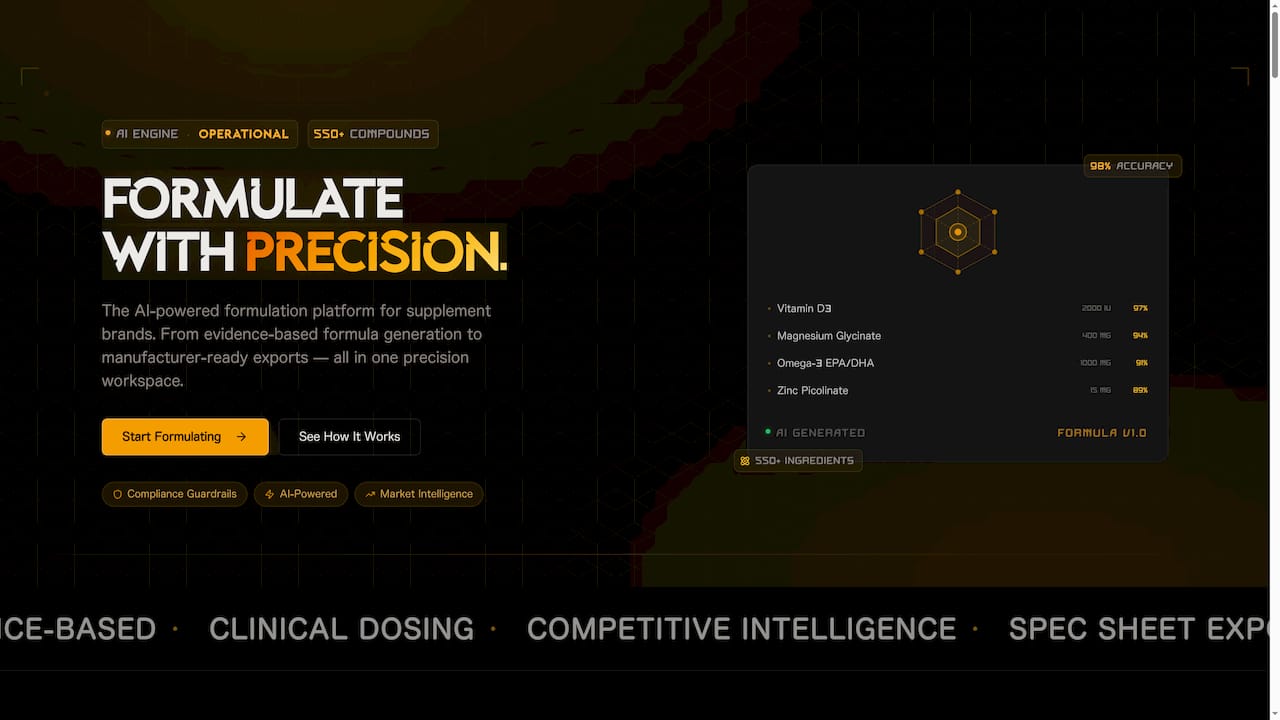
Formlypro is built for exactly this problem. The platform walks you through an 8-phase product development process, from ideation through formulation, prototyping, compliance, and production, with market research and competitive analytics integrated at every stage. You are not guessing at ingredient costs or compliance requirements. You are working from a structured plan that accounts for the financial implications of each formulation decision before you commit to it.
The built-in compliance guidance covers FDA notification timelines, claim substantiation requirements, and label review checkpoints, so you can budget those costs accurately rather than discovering them after you have already printed packaging. The AI-powered packaging mockup designer lets you prototype your visual identity alongside your formula, keeping both cost streams visible at the same time.
For founders who want to understand their formulation costs before they spend a dollar on development, Formlypro gives you the structure to plan it right from day one.
Key Takeaways
Formulation is a systemic cost driver that shapes R&D, compliance, inventory, and launch timing simultaneously. Founders who plan it as an isolated expense consistently underbudget and underperform.
| Point | Details |
|---|---|
| Formulation sets your cost structure | The path you choose (private label vs. custom) determines upfront spend, timeline, and per-unit COGS from the start. |
| Custom development costs $20,000–$40,000+ | That figure includes R&D, pilot runs, and stability testing, and must be recovered through pricing over time. |
| Compliance scales with SKUs and claims | Annual label and claim review costs $2,000–$12,000 for a small brand, and rises with every new formula or claim added. |
| Pilot run terms are negotiable | Pilot runs cost $5,000–$15,000; whether that amount credits toward your first production order depends entirely on your contract. |
| Match formulation complexity to your stage | Validate demand with private label first, then fund custom development with early revenue to reduce capital risk. |