

TL;DR:
- Cross-functional collaboration aligns specialists early in product development, preventing costly reformulations and compliance issues.
- Building a clear shared outcome, appointing a dedicated decision-maker, and using a central system ensure smooth coordination.
Cross-functional team collaboration is the intentional process of aligning specialists from formulation, compliance, manufacturing, marketing, and sales around a single product outcome so decisions are made once, early, and with full context. For supplement and wellness brands, that alignment is the difference between a clean launch and a costly reformulation. A regulatory officer who reviews a formula at ideation, rather than after pilot batches are run, can flag a DSHEA-prohibited claim before it's printed on 10,000 labels.
Table of Contents
- What is cross-functional team collaboration, and why does it matter for supplement brands?
- Who should sit on your supplement product team?
- How do you set up cross-functional collaboration on a product project?
- What leadership style makes cross-functional teams actually work?
- How should collaboration map to each phase of product development?
- Which tools support cross-functional collaboration for supplement brands?
- How do you measure whether collaboration is improving product outcomes?
- What are the most common cross-functional pitfalls, and how do you fix them?
- How does early cross-functional review prevent costly rework?
- How to communicate effectively across supplement development functions
- Best practices for knowledge sharing and documentation
- How to onboard new team members to cross-functional workflows
- How to drive innovation through collective problem-solving
- Key Takeaways
- The part most teams skip until it's too late
- Formlypro brings your cross-functional workflow into one place
- Authoritative sources and further reading
What is cross-functional team collaboration, and why does it matter for supplement brands?
The benefits are concrete. When diverse expertise is brought together early, supplement brands avoid the most expensive failure modes: late-stage compliance reworks, packaging reprints, and manufacturer rejections. According to Deloitte research, 73% of digitally maturing companies create environments that actively support cross-functional teams, a figure that illustrates organizational support correlates with team success.
Key benefits for supplement and wellness brands:
- Compliance caught early: Regulatory review at ideation prevents reformulation after pilot batches.
- Faster time-to-market: Parallel workstreams in formulation, sourcing, and marketing compress the product timeline.
- Better market fit: Marketing and sales input during formula development keeps positioning grounded in real demand.
- Cost avoidance: Early cross-functional review prevents downstream rejection for noncompliance or commercial misalignment.
- Reduced recall risk: QA and manufacturing involvement before production sampling catches ingredient or stability issues before they scale.
Cross-functional teams also allow brands to test and adapt faster in a market where consumer trends and FDA guidance both shift quickly.
Who should sit on your supplement product team?
Build the roster around the product's risk profile, not org chart convenience. These are the core roles and their remit:
| Role | Remit | Join at |
|---|---|---|
| Product Manager | Owns the project brief, timeline, and decision log | Ideation |
| Formulator / Chemist | Designs the formula, selects ingredients, manages stability | Ideation |
| Regulatory / Compliance | Reviews claims, DSHEA alignment, label requirements | Ideation |
| Quality Assurance | Sets testing standards, approves CoAs, manages spec sheets | Formulation |
| Sourcing / Procurement | Qualifies suppliers, manages lead times and cost | Formulation |
| Supply / Manufacturing | Reviews manufacturability, batch feasibility, MOQs | Prototyping |
| Marketing | Validates positioning, messaging, and consumer demand | Market Research |
| Sales | Confirms channel fit and retailer requirements | Market Research |
| External Lab / Manufacturer | Provides third-party testing and production feedback | Compliance Review |
Regulatory and compliance must join at ideation, not after the formula is locked. Marketing can consult earlier than most PMs expect: a positioning gap discovered at launch is far more expensive than one caught during formula development. Fractional contributors (external labs, contract manufacturers) can be brought in at defined phase gates rather than maintained as standing members.
How do you set up cross-functional collaboration on a product project?
A repeatable setup takes less than a day and prevents months of confusion.
- Define the shared outcome. Write one sentence: "Launch a compliant [product name] formula by [date] that hits [target margin] and passes [specific certifications]." Everyone signs off on it.
- Appoint a project owner. One person holds the decision log and is accountable for phase gates. This is not a committee role.
- Build a RACI. Clarify authority up front using a RACI matrix so contributors aren't pulled by competing priorities. Document it before kickoff, not after the first conflict.
- Set milestones and gating criteria. Define what "done" looks like at each phase. Compliance signoff must precede pilot batch. Marketing brief must precede packaging design.
- Establish meeting cadence: kickoff (full team), weekly sync (PM + active phase leads), cross-functional design reviews (formula + compliance + marketing), compliance checkpoints (regulatory + QA + PM).
Shared artifact checklist (your single source of truth):
- Formula specification sheet (versioned)
- Compliance file (claims review, DSHEA notes, label draft)
- Packaging mockups (linked to formula version)
- Vendor status tracker (supplier qualification, lead times)
- Test reports and CoAs (third-party and in-house)
What leadership style makes cross-functional teams actually work?
Cross-functional team leads succeed through persuasion and coaching, not command, because they rarely hold direct authority over every member. A formulator reports to R&D. A compliance officer reports to legal. The PM's leverage is influence, not org chart position.

Practically, that means setting outcomes ("compliant formula by Q3") rather than task lists, mediating trade-offs between functions rather than picking sides, and creating space for disagreement without blame.
Shared language is non-negotiable. A lack of shared definitions between functions is a leading cause of misalignment. Build a short glossary: what does "launch-ready" mean? What is "finished formula" versus "prototype"? What counts as a compliance signoff? Write it down and put it in the project brief.
Pro Tip: Align incentives early. If your formulator's performance review rewards speed and your compliance officer's rewards zero violations, they will conflict on every deadline. A shared team milestone, visible to both managers, reduces that friction without a policy change.
How should collaboration map to each phase of product development?
Formlypro's 8-phase development workflow gives a natural structure for cross-functional checkpoints.
| Phase | Primary Stakeholders | Gate Criteria Before Advancing |
|---|---|---|
| 1. Ideation | PM, Formulator, Regulatory | Concept brief approved; claims reviewed for DSHEA compliance |
| 2. Formulation | Formulator, QA, Sourcing | Formula spec locked; ingredients sourced and qualified |
| 3. Prototyping | Formulator, Manufacturing, QA | Prototype batch produced; initial stability data collected |
| 4. Market Research | Marketing, Sales, PM | Consumer validation complete; positioning brief finalized |
| 5. Compliance Review | Regulatory, QA, PM | Label reviewed; all claims substantiated; compliance checklist signed off |
| 6. Production Sampling | Manufacturing, QA, Sourcing | Pilot batch passes spec; CoAs received |
| 7. Packaging | Marketing, PM, Regulatory | Final artwork approved; label compliant with FDA requirements |
| 8. Launch | All functions | Launch readiness review complete; retailer and channel requirements met |
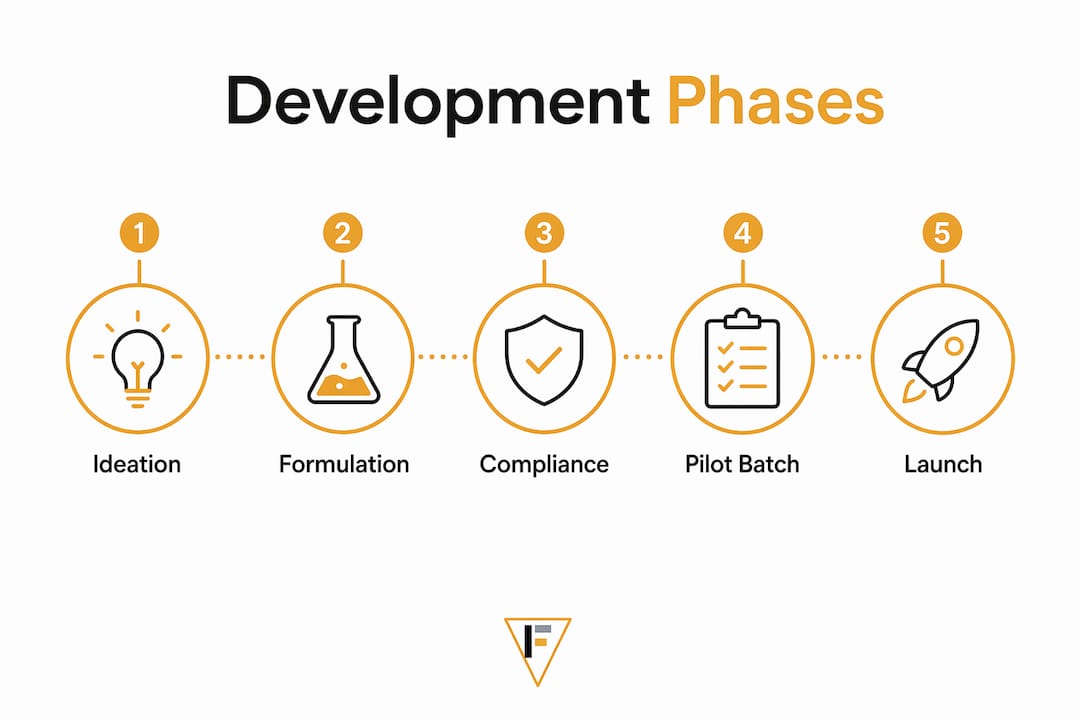
No phase advances without its gate criteria met. Compliance review before pilot batch is the single most valuable rule in this table.
Which tools support cross-functional collaboration for supplement brands?
Tool categories to build into your stack:
- Centralized project hub: One place for the formula spec, compliance file, packaging assets, and vendor tracker. Without it, handoff rot causes version-control errors and manufacturing delays.
- AI formulation engine: Generates research-backed formula drafts that compliance and marketing can review in the same workflow.
- Regulatory and claims tracker: Flags DSHEA issues, tracks label versions, and stores substantiation documents.
- Vendor and QA portal: Manages supplier qualification, CoA uploads, and batch records.
- Packaging mockup tool: Connects formula version to label design so changes propagate correctly.
- Communication layer: Async channels tied to project phases, not general chat rooms.
The integration principle: every AI formulation output should be reviewable by compliance and marketing in the same system, not exported to a separate email thread. Versioned artifacts with audit trails are what make compliance documentation defensible.
How do you measure whether collaboration is improving product outcomes?
Track these KPIs:
- Time-to-market per product (target: reduce cycle time phase over phase)
- Compliance reworks per product (target: zero after pilot batch)
- Issues caught before pilot batch (target: 100% of compliance flags)
- Launch success rate (actual sales vs. forecast at 90 days)
- Cycle time per phase (identify which phase consistently runs long)
Weekly: time-to-market progress, open blockers, phase gate status. Monthly: rework count, launch success rate, cost-of-quality trends. Surface blockers for leadership in a single-row dashboard: phase, owner, blocker, days delayed. That format takes 30 seconds to read and forces accountability without a long meeting.
What are the most common cross-functional pitfalls, and how do you fix them?
- Silo behavior: Functions optimize for their own metrics. Fix: shared milestone with a team-level KPI visible to all functional managers.
- Authority confusion: Two people think they own the same decision. Fix: implement a RACI before kickoff; document it in the project brief.
- Version rot: Multiple formula or label versions circulating by email. Fix: single source of truth with version control; no approvals outside the central system.
- Misaligned incentives: Speed vs. compliance tension. Fix: shared milestone dates that both functions are accountable to.
- Communication gaps: Compliance finds an issue after marketing has briefed retailers. Fix: compliance checkpoint at phase 5, mandatory before any external communication.
7-day remediation sprint:
- Day 1: Audit current artifacts. Identify how many versions of the formula spec exist.
- Day 2: Designate one owner per artifact and archive all others.
- Day 3: Build or update the RACI. Get functional manager sign-off.
- Day 4: Schedule the next compliance checkpoint within the week.
- Day 5: Run a 30-minute team sync to align on the shared outcome statement.
- Day 6: Publish the phase gate criteria to the full team.
- Day 7: Review open blockers and assign owners with deadlines.
How does early cross-functional review prevent costly rework?
A mid-size supplement brand was six weeks into formula development for a new cognitive support product when the PM brought the compliance officer in for a routine check. The formula included a botanical extract with a structure-function claim the marketing team had already drafted for the product page.
The compliance officer flagged the claim as requiring substantiation under DSHEA that the brand did not yet have. Marketing had also briefed two retail buyers on the positioning. Without the cross-functional review, the brand would have proceeded to pilot batch, printed preliminary packaging, and then faced a full reformulation or claim removal at launch.
Formlypro's 8-phase workflow operationalizes exactly this: compliance review is a named phase with a gate, not an afterthought. The platform's compliance tracker and versioned formula exports mean the regulatory officer reviews the same document the formulator is working in, not a PDF from last Tuesday.
How to communicate effectively across supplement development functions
The core problem in cross-functional communication is that each function speaks a different dialect. Formulators talk about bioavailability and excipients. Marketing talks about hero claims and consumer personas. Compliance talks about substantiation and label real estate. None of these vocabularies are wrong; they just don't translate automatically.
Three techniques that work: First, run a 15-minute "translation check" at each phase gate where the PM reads the phase summary aloud and each function confirms their interpretation matches. Second, use written async updates for complex technical decisions so people can process before responding. Third, keep meeting agendas phase-specific: a formulation review is not the place to debate packaging copy.
Best practices for knowledge sharing and documentation
Documentation fails when it lives in one person's head or one person's inbox. The fix is structural: every decision, every version, every approval goes into the central project system the same day it happens.
Practical standards: name files with version numbers and dates (Formula_v3_2026-03-15, not "Final_FINAL"). Archive superseded versions rather than deleting them. Write a one-paragraph decision log entry for every gate approval, noting who approved, what was reviewed, and what was deferred. That log becomes your audit trail if an FDA question arises later.
Pro Tip: Run a monthly "knowledge gap" check: ask each function what they wish the other functions understood about their work. The answers surface the glossary terms you haven't defined yet.
How to onboard new team members to cross-functional workflows
New members fail in cross-functional teams for one reason: they don't know the shared outcome, the decision rights, or the artifact system. Onboarding should cover all three in the first session.
A 90-minute onboarding covers: the product brief and shared outcome statement, the RACI (their role and who they escalate to), a walkthrough of the central project system, and the phase gate criteria for the current phase. Assign a "buddy" from a different function so the new member builds one cross-functional relationship immediately. Don't wait for the next full-team meeting to integrate them.
How to drive innovation through collective problem-solving
Cross-functional teams generate better solutions than single-function teams because diverse perspectives challenge assumptions that any one function would take for granted. A formulator assumes a certain delivery format is standard. A manufacturing contact knows it adds three weeks to lead time. A marketing person knows consumers in the target segment actively dislike that format. None of them would surface the problem alone.
Structured problem-solving sessions work better than open brainstorms for supplement development. Present the constraint (cost, compliance, timeline), give each function five minutes to write their perspective independently, then share and build. This prevents the loudest voice from anchoring the group and surfaces the formulator's technical constraints alongside the compliance officer's regulatory limits at the same time.
Key Takeaways
Cross-functional team collaboration in supplement development works when compliance, formulation, and marketing are aligned at ideation, not after pilot batches are run.
| Point | Details |
|---|---|
| Align at ideation | Bring regulatory and compliance into the team at phase 1, before the formula is locked. |
| Use a RACI and gate criteria | Document decision rights and phase gate criteria before kickoff to prevent authority confusion. |
| Single source of truth | Version-controlled artifacts in one central system prevent handoff rot and compliance errors. |
| Measure rework and cycle time | Track compliance reworks per product and cycle time per phase weekly to catch process failures early. |
| Digitally maturing companies support cross-functional teams | Deloitte research found that 73% of digitally maturing companies create environments to support cross-functional teams, much higher than early-stage firms. |
The part most teams skip until it's too late
Most supplement brands understand the idea of cross-functional collaboration. What they underestimate is how early "early" actually needs to be. The instinct is to involve compliance and manufacturing once the formula is "good enough to show them." That instinct is expensive.
The brands that consistently launch on time and on spec treat the compliance officer and the manufacturer contact as co-authors of the formula, not reviewers of it. That shift in framing changes everything: the compliance officer flags a claim issue at week two instead of week twelve, and the manufacturer flags a mixing incompatibility before the prototype is even ordered.
The other thing teams skip: the shared language work. It takes two hours to build a glossary and define "done" at each phase. It saves weeks of misaligned effort. If you take one thing from this article, make it that.
Formlypro brings your cross-functional workflow into one place
Running a supplement brand means coordinating formulators, compliance officers, manufacturers, and marketing teams across a product lifecycle that has real regulatory stakes. Formlypro is built for exactly that: an 8-phase product development workflow that maps compliance checkpoints, AI-backed formulation, market research, and packaging design into a single platform your whole team works from.
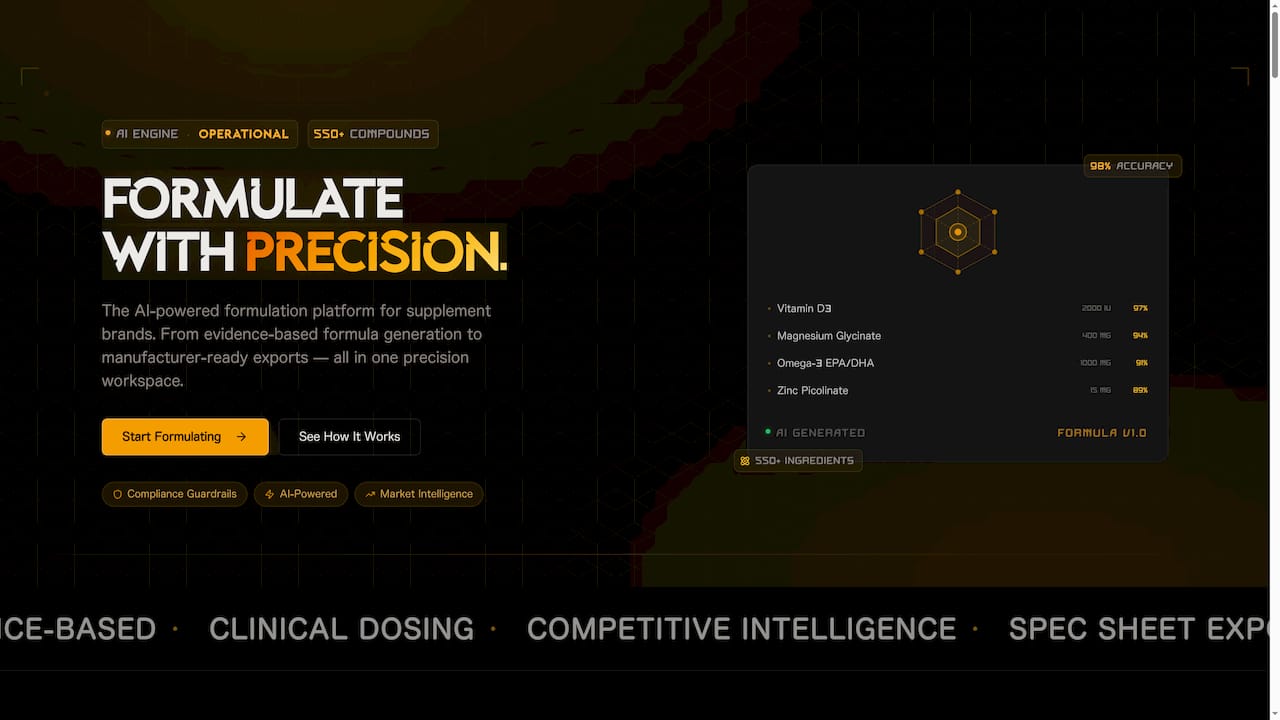
The platform's compliance tracker keeps your regulatory documents versioned and reviewable. The AI formulation engine generates research-backed formulas that compliance and marketing can review in the same system. The packaging mockup designer connects label design to formula version so changes propagate correctly. Every artifact your cross-functional team needs lives in one place, with audit trails that hold up to FDA scrutiny.
If you're building a new product or trying to fix a broken development process, start with Formlypro and see how the 8-phase workflow maps to your team's current gaps.
Authoritative sources and further reading
- FDA Dietary Supplements Guidance — primary source for DSHEA requirements, label claims, and supplement regulation in the U.S.
- USP Dietary Supplement Compendium — quality standards for ingredients and finished products.
- Formlypro: compliance requirements for health and wellness brands — category-specific requirements across supplement types.
- Formlypro: regulatory frameworks for product launch success — context on when to consult a regulatory specialist.
- HBR: How to Manage a Cross-Functional Team — leadership and management guidance for cross-functional PMs.
When to consult a specialist: If your product makes a disease claim, contains a novel ingredient, or is subject to a warning letter, consult a regulatory attorney or DSHEA specialist before finalizing the formula or label. General platform guidance does not substitute for legal counsel on your specific product.