

Business case development is the structured process of documenting why an initiative deserves funding and how it will deliver measurable value. The immediate purpose is twofold: win approval from decision makers, and set the baseline you'll use to manage delivery and judge success afterward. A workable business case typically covers:
- The problem or opportunity driving the request
- The options considered, including doing nothing
- Costs and expected benefits
- Key risks and how you'll manage them
- A realistic timeline
- The criteria decision makers will use to approve or reject it
Key Takeaways
A proportionate business case documents the problem, options, costs, benefits, risks, and timeline clearly enough for decision makers to approve it and later evaluate it against the original plan.
| Point | Details |
|---|---|
| Match effort to decision size | Use a short outline for small decisions and a full case with financial modeling for major investments. |
| Lead with the summary | Write a one-page management summary stating the problem, recommendation, and cost before the full body. |
| Compare real alternatives | Include the 'do nothing' option and document risk and feasibility for each choice considered. |
| Budget non-cash costs | Account for staff time and temporary infrastructure, which are commonly left out and cause shortfalls. |
| Build the case as a process | Run workshops with finance, delivery, and stakeholders instead of drafting the case alone. |
Table of Contents
- Why Organizations Build Business Cases
- When Do You Actually Need a Business Case?
- What Goes Into a Business Case?
- How Do You Write a Business Case Step by Step?
- What Mistakes Sink a Business Case?
- What I've Learned Running Business Case Workshops
- Frequently Asked Questions
- Sources
Why Organizations Build Business Cases
A business case forces evidence-based trade-offs instead of gut-feel decisions. When you write down costs, benefits, and alternatives side by side, weak proposals tend to expose themselves before they reach a boardroom. That's the real value: it's a filter, not just paperwork.
It also creates a delivery baseline. Once a case is approved, everyone can measure actual spend and actual timelines against what was promised. A well-written case forces clear assumptions and sets a baseline for scope, costs, and timelines, which is exactly what stops a project from quietly drifting off track three months in.
Beyond approval, a solid case helps you:
- Secure funding by showing return relative to cost
- Reduce scope creep by defining what's in and out from day one
- Enable honest post-approval evaluation against original goals
- Align stakeholders who might otherwise assume different definitions of success
Pro Tip: Match the depth of your case to the size of the decision. A small tooling purchase doesn't need the same rigor as a complex, multi-year product launch, and over-building a case for a small decision just slows everyone down.
When Do You Actually Need a Business Case?
Most business cases start during a project's concept or initiation phase, before real spending begins. The IIBA notes that a business case is typically initiated early to provide evidence and rationale for decisions throughout the project's life, not just at the funding gate.
How much detail you need depends on:
- Investment size — larger spend justifies deeper financial modeling
- Strategic importance — anything tied to core positioning or compliance deserves more scrutiny
- Procurement or regulatory triggers — some purchases legally require documented justification
A quick internal check might only need a one-page outline. A capital investment or new product line usually needs a full case with options appraisal and financial projections.
What Goes Into a Business Case?
Every business case needs a management summary at the top, roughly half a page, stating the problem, the recommended option, the cost, the expected benefit, and the approval being requested. Decision makers often read only this page, so it has to stand on its own.
Below that summary, the body should include:
- Background and problem statement — what's broken or what opportunity is being missed
- Objectives — written as SMART goals, since Harvard Business Impact Education recommends specific, measurable objectives to make the case easier to assess
- Scope — explicitly stating what's included and excluded
- Options appraisal — a comparison of realistic alternatives, including the 'do nothing' option, since business case development evaluates alternatives with feasibility, assumptions, and risk documented for each
- Recommended solution — the option you're backing, and why it beat the alternatives
- Financial analysis — cost estimates and, where your organization uses investment appraisal, metrics like Net Present Value or Internal Rate of Return
- Risks and mitigations — named risks with owners, not a generic risk paragraph
- Dependencies and resource assumptions — including staff time, not just cash
- Milestones and timeline — dated checkpoints, not just a start and end date
- Governance and sign-off criteria — who approves what, and at which stage
- Evaluation plan — how you'll measure whether the benefits actually showed up
For structure, the Five Case Model (strategic, economic, commercial, financial, management) is a widely used framework, particularly in public-sector business case development, because it forces a holistic, value-for-money view rather than a narrow financial pitch.
Appendices should hold the detail the main body doesn't need: itemized budgets, a documented assumptions log, and a stakeholder map showing who's affected and who needs to sign off. Label every assumption clearly, especially cost and benefit assumptions, so reviewers can challenge specific numbers rather than the whole document.
Statistic Callout: A concise executive summary paired with SMART objectives measurably improves how quickly decision makers can assess and approve a case, since vague goals force reviewers to ask clarifying questions before they can commit to a decision. If your regulatory or compliance dependencies are complex, an ingredients risk assessment checklist can help you document those dependencies with enough specificity to survive a reviewer's questions.
How Do You Write a Business Case Step by Step?
A business case is a thinking process first and a writing exercise second. Government Five Case Model guidance stresses that engaging multiple disciplines during development produces stronger cases than one person writing alone at a desk. Here's a sequence that works for most projects:
- Frame the strategic problem. Define what's broken or what opportunity exists, and confirm it aligns with organizational priorities. Involve the senior responsible owner (SRO) early.
- Scope and shortlist options. Generate a realistic list of alternatives, including doing nothing, and cut it down to two or three worth detailed analysis.
- Run a detailed options appraisal. Compare shortlisted options against cost, benefit, risk, and strategic fit. Bring in a business analyst here if you have one.
- Build the financial model. Estimate costs and benefits for the preferred option, and run sensitivity tests on your riskiest assumptions. Finance should review this before it goes further.
- Plan risks and resources. Identify named risks, mitigations, dependencies, and staffing needs, including non-cash resource time.
- Draft the case and hold a review workshop. Circulate a draft, then get stakeholders in a room to challenge assumptions before it's finalized.
- Write the executive summary and submit for approval. Keep it to one page, lead with the recommendation, and attach supporting detail as appendices.
- Monitor after approval. Track actual costs, timelines, and benefits against the case, and update it if major assumptions shift.
Pro Tip: Run a facilitated workshop before you finalize the draft, not after. Getting finance, delivery, and key stakeholders to challenge assumptions in one session catches disagreements early and cuts the rework that usually follows a case built in isolation.
If your project involves new product development, a regulatory compliance checklist can help you populate the dependencies and risk sections with real, specific items instead of placeholder language.

What Mistakes Sink a Business Case?
The most common failure is over-detailing implementation while under-detailing the decision itself. IIBA guidance recommends giving reviewers enough detail to approve without burying them in execution minutiae, which confuses more than it clarifies.
Other frequent gaps: forgetting non-cash costs like existing staff hours for testing or training, and skipping temporary infrastructure needed during testing phases, both of which cause budget shortfalls later. Weak options appraisal (comparing your favorite option against a strawman) and vague benefit measures round out the list.
- Cut implementation detail that belongs in a project plan, not a business case
- List non-cash resources explicitly, including staff time and temporary systems
- Compare genuinely competitive options, not one real option and two throwaways
- Define benefits in measurable terms before submission, not after
Pro Tip: If a reviewer could ask "compared to what?" and your case doesn't answer clearly, your options appraisal isn't finished yet.
What I've Learned Running Business Case Workshops
Facilitated sessions consistently beat solo drafting. A case written by one person in isolation tends to have blind spots that surface only when finance, delivery, and stakeholders sit down together. Reviewers approving a case usually want the same three things: a clear recommendation, honest risk disclosure, and numbers they can trust because the assumptions behind them are visible.
Frequently Asked Questions
What is business case development in simple terms? It's the process of documenting why a project deserves funding, comparing it against alternatives, and setting the cost, benefit, and timeline baseline you'll manage delivery against.
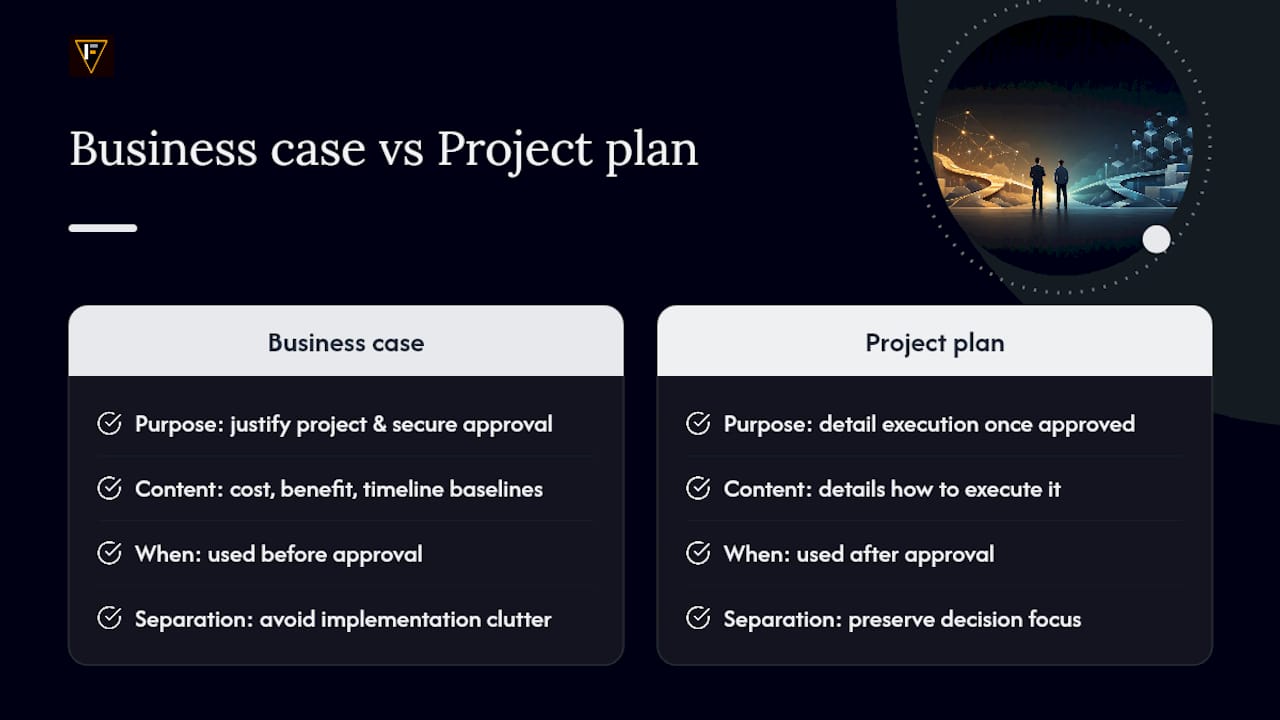
What's the difference between a business case and a project plan? A business case justifies whether to do the project and secures approval. A project plan details how to execute it once approved. Keeping them separate prevents implementation detail from cluttering the approval decision.
Do I need financial metrics like NPV or IRR in every business case? Only if your organization uses formal investment appraisal. Guidance from the UK government's project business case framework notes NPV and IRR apply where investment appraisal is standard practice, not universally.
How long should a business case be? As long as the decision requires and no longer. A small internal decision might fit on one or two pages; a major capital investment often runs several pages plus appendices for budgets and assumptions.
What happens after a business case is approved? Delivery begins against the baseline set in the case, and progress gets tracked against the original cost, timeline, and benefit assumptions. If you're tracking product outcomes specifically, tools built for product analytics can help confirm whether projected benefits actually materialized. For supplement and wellness brands building the evidence base behind a new product case, from formulation credibility to compliance groundwork, Formlypro's research and compliance tools can shorten the time it takes to gather the data a strong case needs.
Sources
- 10.7 Business Cases | IIBA®
- Guidance on developing business cases for projects and programmes
- Guide to developing the Project Business Case
- How to write a business case
- How to write a great business case — Harvard Business Impact Education