

TL;DR:
- An ingredients risk assessment checklist systematically evaluates microbiological, chemical, allergenic, fraud, origin, and compliance risks before an ingredient enters a product. It should be embedded early in supplier approval, reviewed annually or after key changes, and supported by specific evidence like COAs and audit reports. A dynamic, ownership-driven approach ensures ongoing accuracy, protecting product integrity and regulatory compliance.
An ingredients risk assessment checklist is a structured evaluation tool that systematically examines potential hazards across microbiological, chemical, allergenic, fraud-related, and supply chain dimensions before an ingredient enters your product. Unlike a basic food safety checklist, a well-built assessment framework forces you to quantify risk across 6 core dimensions simultaneously, including microbiological safety, chemical residues, allergen status, food fraud vulnerability, country of origin risks, and functional compliance. Templates like the Novi AMS Ingredient Risk Assessment and frameworks from Evidash demonstrate that this multi-dimensional approach is the industry standard for defining supplier approval status and testing frequency. For food manufacturers and QA specialists, this checklist is not a compliance formality. It is the primary mechanism for protecting product integrity and preventing costly recalls.
1. What core risk factors must every ingredients risk assessment checklist cover?
A defensible ingredient safety evaluation starts with six non-negotiable risk categories. Skipping any one of them creates a blind spot that regulators, auditors, or a product recall will eventually expose.
Microbiological hazards are the starting point for any food ingredient assessment. The checklist must ask whether the ingredient supports pathogen growth, what the contamination risk is during processing and storage, and whether the supplier has validated kill-step controls. High-water-activity ingredients like fruit purees, dairy derivatives, and plant-based proteins carry significantly higher microbiological risk than dry, low-moisture materials.
Chemical hazards cover pesticide residues, heavy metals, processing contaminants, and naturally occurring toxins such as aflatoxins or ochratoxin A. Your checklist must specify maximum residue limits (MRLs) aligned with FDA, EFSA, or the relevant regulatory body for your market, and require certificate of analysis (COA) data confirming compliance.
Allergen risks require both ingredient-level declaration review and cross-contact potential assessment at the supplier facility. The checklist must capture whether the ingredient contains or is manufactured on shared lines with the 9 major allergens recognized by the FDA, including sesame, which became a mandatory declaration in 2023.

Food fraud and substitution vulnerability is the category most QA teams underweight. High-value, low-volume ingredients such as saffron, manuka honey, and cold-pressed oils present greater fraud vulnerability and require prioritized audit focus rather than uniform treatment across all inputs.
Country of origin and logistical risks account for geopolitical instability, import restrictions, and transit contamination potential. An ingredient sourced from a single country with known supply disruptions scores higher risk and demands a secondary supplier qualification.
Functional and legality compliance closes the loop by confirming the ingredient is approved for its intended use, at its intended level, in the target market. This includes novel food status, GRAS determinations, and any use-level restrictions under 21 CFR or equivalent regulations.
Pro Tip: When scoring risk across these six categories, weight allergen and microbiological scores more heavily for ready-to-eat products. A medium fraud score on a commodity ingredient matters less than a medium allergen score on a product consumed without further heat treatment.
2. How to structure and integrate a checklist into supplier approval workflows
Embedding the food ingredient assessment into supplier approval from day one prevents the most expensive problem in food manufacturing: discovering a risk after scale-up. Best practice requires checkpoints at five distinct stages: strategic framing, due diligence, formulation design, manufacturing validation, and governance review.
- Strategic framing. Before any supplier is contacted, the checklist defines the risk profile the ingredient category is expected to carry. This sets the minimum documentation requirements and testing expectations before sourcing begins.
- Due diligence. The supplier completes a questionnaire aligned to the checklist categories. QA reviews COAs, third-party audit reports, and any history of regulatory action or recall involvement.
- Formulation design. The checklist informs how the ingredient interacts with other components. A high-moisture ingredient combined with a pH-neutral matrix, for example, elevates microbiological risk at the formulation level, not just the ingredient level.
- Manufacturing validation. Risk scores from the checklist directly determine the testing regime at incoming goods inspection. A high-risk ingredient requires identity testing, microbiological testing, and residue screening. A low-risk ingredient may require COA review only.
- Governance review. Approved supplier status is formally documented, with the checklist score determining audit frequency. High-risk suppliers are audited annually; lower-risk suppliers may qualify for a 24-month cycle.
Pro Tip: Treat the checklist score as a living parameter in your supplier record, not a one-time gate. Link it directly to your approved supplier list so that any score change automatically triggers a review of audit frequency and testing requirements.
Integrating the checklist into your ingredient sourcing process at the strategic framing stage eliminates the reactive reformulation that costs manufacturers weeks of lost production time.
3. Comparing approaches: traditional vs. advanced fraud vulnerability assessments
Static scoring models assign a single fraud risk number to an ingredient and rarely revisit it. Advanced vulnerability assessments, by contrast, evaluate 8 distinct criteria including market price volatility, history of adulteration, supply chain complexity, detectability, economic impact, supplier transparency, technical documentation quality, and mitigation controls already in place.
The practical difference is significant. A traditional checklist might flag olive oil as "medium fraud risk" and stop there. An advanced assessment would note that extra virgin olive oil has a documented history of adulteration with cheaper oils, that authenticity testing via nuclear magnetic resonance (NMR) spectroscopy is available and cost-effective, and that the economic incentive for fraud increases sharply when olive harvests are poor. That analysis produces a specific mitigation action: require NMR-verified COAs from suppliers during years of documented supply shortage.
| Evaluation criterion | Traditional approach | Advanced approach |
|---|---|---|
| Price volatility | Noted as a risk factor | Triggers dynamic reassessment when commodity prices spike |
| History of adulteration | Binary yes/no flag | Weighted score with specific adulterant identification |
| Detectability | Not assessed | Determines which testing method is specified in the checklist |
| Mitigation controls | Generic audit requirement | Specific authenticity test method and frequency defined |
| Supplier transparency | COA required | COA plus third-party verification and traceability documentation |
Effective risk assessments establish documented safety profiles rather than defaulting to outright rejection. The goal is to define the conditions under which an ingredient is acceptable, not simply to block it from use.
4. Practical checklist items: example entries explained
The most useful ingredient risk assessment checklist entries are written as direct questions with defined evidence requirements. Vague criteria like "assess microbiological risk" produce inconsistent results across reviewers. Specific questions produce auditable, defensible records.
Core checklist questions drawn from established templates like Novi AMS include the following:
- Does the ingredient support pathogen growth? Evidence required: water activity data, pH data, and supplier-validated storage conditions.
- Is there potential for physical contamination? Evidence required: supplier HACCP plan confirming physical hazard controls at origin.
- Is there a history of recalls involving this ingredient or supplier? Evidence required: FDA recall database search, supplier declaration, and corrective action documentation if applicable.
- What chemical residues are possible given the ingredient's origin and processing method? Evidence required: COA with residue panel results, MRL comparison against target market regulations.
- Has allergen cross-contact risk been assessed at the supplier facility? Evidence required: supplier allergen management policy, facility map showing shared lines or equipment.
- Is the ingredient at risk of substitution or dilution? Evidence required: fraud vulnerability score, authenticity testing results, and traceability documentation to country of origin.
Toxicological data alone is insufficient for a complete safety picture. It must be paired with exposure modeling and history of safe use, particularly for novel botanical ingredients where margin of safety (MoS) calculations and Threshold of Toxicological Concern (TTC) values provide the most defensible safety basis.
Pro Tip: For novel or high-risk ingredients, require suppliers to provide upstream supply chain mapping at least two tiers back. 70 to 80 percent of severe safety risks originate several tiers upstream, not at the direct supplier level.
5. How to maintain and update your checklist over time
An ingredients risk assessment checklist that was accurate at approval can become dangerously outdated within 12 months if it is not actively maintained. Periodic reviews and formal governance are the mechanisms that keep risk scores current and defensible.
The following triggers must initiate an immediate reassessment, regardless of scheduled review cycles:
- Supplier change. Any change in the approved supplier, including a change in the supplier's own raw material source, resets the due diligence requirement.
- Ingredient reformulation. If a supplier modifies the ingredient's processing method, concentration, or specification, the risk profile changes and must be re-evaluated.
- New scientific data. Emerging research on a contaminant, allergen, or toxicological endpoint relevant to the ingredient requires the checklist to be updated to reflect current knowledge.
- Regulatory changes. New MRLs, novel food approvals, or allergen labeling requirements in target markets must be reflected in the checklist criteria immediately.
- Supply chain disruption. Geopolitical events, natural disasters, or commodity shortages that force sourcing from alternative origins trigger a full country-of-origin and fraud vulnerability reassessment.
Cross-functional accountability is what separates organizations that maintain checklists effectively from those that let them go stale. QA, procurement, regulatory affairs, and R&D must each own specific sections of the checklist, with a named governance lead responsible for scheduling and documenting annual reviews. Connecting your checklist to a quality management system (QMS) ensures that version control, approval records, and change history are automatically maintained. Your regulatory compliance checklist should reference the ingredient risk scores directly so that compliance decisions are always grounded in current risk data.
Key takeaways
A defensible ingredients risk assessment checklist evaluates six hazard dimensions simultaneously, embeds into supplier approval at the earliest design stage, and is maintained through formal governance with defined reassessment triggers.
| Point | Details |
|---|---|
| Six risk dimensions required | Every checklist must cover microbiological, chemical, allergen, fraud, origin, and compliance risks. |
| Embed at strategic framing | Integrate the checklist before supplier contact to prevent costly late-stage reformulation. |
| Advance fraud assessment | Evaluate 8 criteria including detectability and price volatility, not just a binary fraud flag. |
| Document specific evidence | Each checklist question must specify the exact evidence required, such as COA, testing results, or audit reports. |
| Maintain with defined triggers | Supplier changes, reformulations, and new regulatory data must initiate immediate reassessment. |
Where most checklists fail in practice
Most ingredient risk assessment checklists I have reviewed share the same structural flaw: they were built once, approved once, and then treated as permanent documents. The food supply chain does not work that way. A supplier that scored low risk in 2022 may have changed their raw material origin twice since then, and nobody updated the record.
The second failure is scope. Teams focus almost entirely on their direct suppliers and stop there. The research is clear that the most severe safety risks originate several tiers upstream, in the farms, brokers, and processors that your direct supplier uses. If your checklist does not require upstream mapping for high-risk ingredients, you are auditing the visible part of the iceberg and ignoring the rest.
The third issue is toxicological overconfidence. I have seen QA teams accept a clean toxicology report on a novel botanical and consider the safety case closed. Toxicological data must be integrated with real-world exposure modeling and regulatory limits to produce a complete safety picture. A weight-of-evidence approach that combines history of safe use with MoS calculations is far more defensible than a single study.
The most effective checklist I have worked with was not the most detailed. It was the one with the clearest ownership. Every section had a named owner, every trigger had a defined response, and every score change automatically generated a task in the QMS. The document was almost secondary to the process built around it. That is the standard worth building toward.
— Ben
Build and manage your ingredient risk assessments with Formlypro
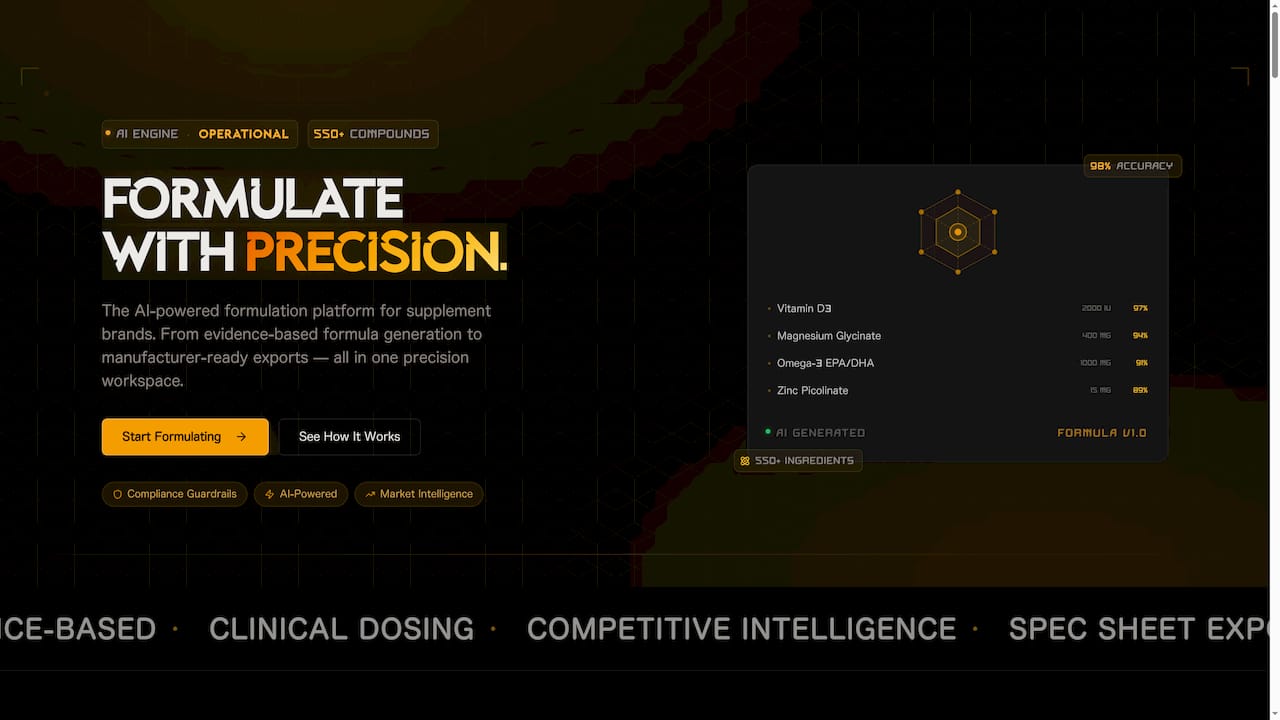
Formlypro gives food manufacturers and QA teams a centralized platform to build, manage, and update ingredient risk assessment checklists without juggling spreadsheets across departments. The platform's compliance module tracks regulatory requirements by market, flags changes that affect your approved ingredient list, and connects risk scores directly to your supplier approval workflow. The 8-phase product development plan built into Formlypro embeds ingredient safety evaluation at the formulation stage, so risk assessment happens before production commitments are made. If you are building a new product or auditing an existing formulation, start with Formlypro to centralize your ingredient risk management from sourcing through launch.
FAQ
What is an ingredients risk assessment checklist?
An ingredients risk assessment checklist is a structured evaluation tool that scores potential hazards across microbiological, chemical, allergen, fraud, supply chain, and compliance dimensions for each ingredient before it enters a product formulation. It defines supplier approval status and determines the testing and audit frequency required.
How many risk categories should a food ingredient assessment cover?
A complete food ingredient assessment covers at least 6 core risk dimensions: microbiological safety, chemical residues, allergen status, food fraud vulnerability, country of origin risks, and functional or legality compliance. Omitting any category creates an auditable gap in your food safety checklist.
How often should an ingredient risk assessment be updated?
The checklist must be reviewed at least annually and reassessed immediately following supplier changes, ingredient reformulations, new scientific data, regulatory updates, or supply chain disruptions. Formal governance with scheduled reviews is the recommended structure for maintaining current risk scores.
What evidence is required for each checklist item?
Each checklist question must specify the exact evidence needed, such as a COA with residue panel results, supplier allergen management policies, third-party audit reports, or authenticity testing results. Vague criteria produce inconsistent reviews and are difficult to defend during regulatory inspections.
How does fraud vulnerability assessment differ from standard risk scoring?
Standard risk scoring assigns a single fraud flag to an ingredient. A fraud vulnerability assessment evaluates 8 criteria including price volatility, history of adulteration, supply chain complexity, and detectability, then produces specific mitigation actions such as requiring NMR-verified COAs or increasing audit frequency during commodity shortages.