

A brand identity system is the connected, governed set of visual, verbal, and behavioral standards that tells every team member, vendor, and partner exactly how the brand should look, sound, and act across every surface it touches. It is not a logo. It is not a PDF of guidelines. It is the operating infrastructure that turns brand strategy into consistent, executable output.
- Business value: A system reduces rework, speeds up asset production, and protects brand equity by removing guesswork from execution decisions.
- Perception gap protection: Brand identity creates emotional connections, but managers routinely face a gap between what the brand intends to communicate and what audiences actually perceive. A system closes that gap by anchoring every element to the same mission and positioning.
- What it replaces: Ad hoc asset folders, inconsistent Canva files, and the informal "ask the designer" approval loop that breaks down the moment a team scales.
Pro Tip: When auditing an existing set of brand assets, start by pulling five random pieces of collateral from different teams or vendors and checking whether they share the same primary color hex code, typeface, and logo variant. If three or more diverge, you have a governance problem, not a design problem.
Key Takeaways
A brand identity system is the governed infrastructure that connects strategy to consistent execution across every touchpoint, and without it, even strong brand design degrades into inconsistency.
| Point | Details |
|---|---|
| System vs. guidelines | A brand identity system includes strategy, assets, tokens, templates, and governance — a PDF of rules is only one layer. |
| Strategy before design | Define brand purpose and positioning before any visual work begins; logo-first thinking is the most common failure mode. |
| Tokenize your palette | Convert color and typography into named design tokens so updates propagate automatically across design and engineering. |
| Name an owner | Every system needs one accountable person with authority to approve changes and maintain the version history. |
| Measure the gap | Track brand recognition scores, time-to-publish, and compliance rates to quantify system impact and justify investment. |
Table of Contents
- What is a brand identity system and why does it matter strategically?
- How does a brand identity system differ from brand guidelines and design systems?
- What are the core components every brand identity system must include?
- How do you build a brand identity system from scratch?
- How do you govern and store a brand identity system at scale?
- What can you learn from Apple, Coca-Cola, and Brandkit about system thinking?
- What are the most common mistakes when building or auditing a brand identity system?
- Your one-page checklist for a complete brand identity system
- What does the research say about brand identity and business outcomes?
- The part most brand managers get wrong
- Sources
What is a brand identity system and why does it matter strategically?
A brand identity system matters because brand identity is a visible, strategic asset whose consistent execution contributes to a brand's financial value over time. That is not a soft claim. Brands with disciplined systems spend less time correcting off-brand work, move faster through approval cycles, and present a more coherent face to the market.
The strategic benefits stack up quickly:
- Recognition: Repeated, consistent use of the same visual and verbal cues builds memory structures in the audience's mind faster than any single campaign.
- Faster delivery: When designers, copywriters, and agencies work from a shared system, first drafts are closer to final. Fewer rounds of revision means lower production costs.
- Positioning alignment: A system forces the brand's visual and verbal choices to trace back to a positioning statement. If a new color or tone of voice doesn't fit the strategy, the system makes that visible immediately.
- Reduced off-brand risk: Templates and approved asset libraries mean non-designers can produce compliant materials without a designer in the room.
On the operational side, the KPIs worth tracking are brand recognition scores (measured via periodic surveys), time-to-publish for standard asset types, and a compliance rate calculated by auditing a random sample of published materials against system standards. These three metrics give you a measurable baseline before and after a system rollout.
Brand identity combines visual and verbal elements and functions as integrated business strategy, not a design department deliverable. That framing matters when you're building the business case. The conversation with a CFO goes better when you frame the system as infrastructure that reduces production cost and brand risk, not as a creative project.
The trust signals that consistent brand identity builds compound over time. Healthcare brands, wellness companies, and consumer goods manufacturers all see this play out the same way: the brands that look and sound the same everywhere earn more trust, faster.
How does a brand identity system differ from brand guidelines and design systems?
These three artifacts are not synonyms, and mixing them up creates real ownership problems.
A brand identity system is the full operating layer: strategy, identity standards, voice, application rules, templates, and governance. It is the connected set that makes brand rules executable across surfaces, sitting above both guidelines and design systems in scope.
Brand guidelines (sometimes called a brand book or style guide) are a document, usually a PDF or web page, that describes the rules. They are a subset of the system. Guidelines tell you what the rules are; the system includes the tools, templates, and governance that make those rules usable.
A design system is an engineering and product artifact: a component library, token set, and documentation built for UI surfaces. It consumes brand identity inputs (color tokens, type scales, spacing) but its primary audience is product designers and front-end engineers, not brand managers or marketing teams.
The ownership split looks like this:
| Layer | Owner | Primary Output |
|---|---|---|
| Brand strategy and positioning | Brand lead / CMO | Positioning document, brand attributes |
| Brand identity standards | Brand designer / creative director | Logo system, color, type, voice |
| Application assets and templates | Brand or marketing team | Ads, decks, packaging, social |
| Design system (UI components) | Product design / engineering | Component library, tokens, code |
Here is where the confusion breaks workflows: a product team builds a new feature and pulls colors from their design system, which was last synced to brand tokens six months ago. The feature ships with a slightly off-brand blue. Nobody flagged it because the brand guidelines PDF was never connected to the token pipeline. The brand identity system, when properly governed, prevents this by making the design system a downstream consumer of a single source of truth.
Many brands have a logo or a brand book but lack the full system that enables non-designers to ship on-brand work. If your team is small and your touchpoints are limited, a lightweight asset kit with clear usage rules may be enough. Once you have multiple teams, agencies, or product surfaces, you need all three layers working together.
What are the core components every brand identity system must include?
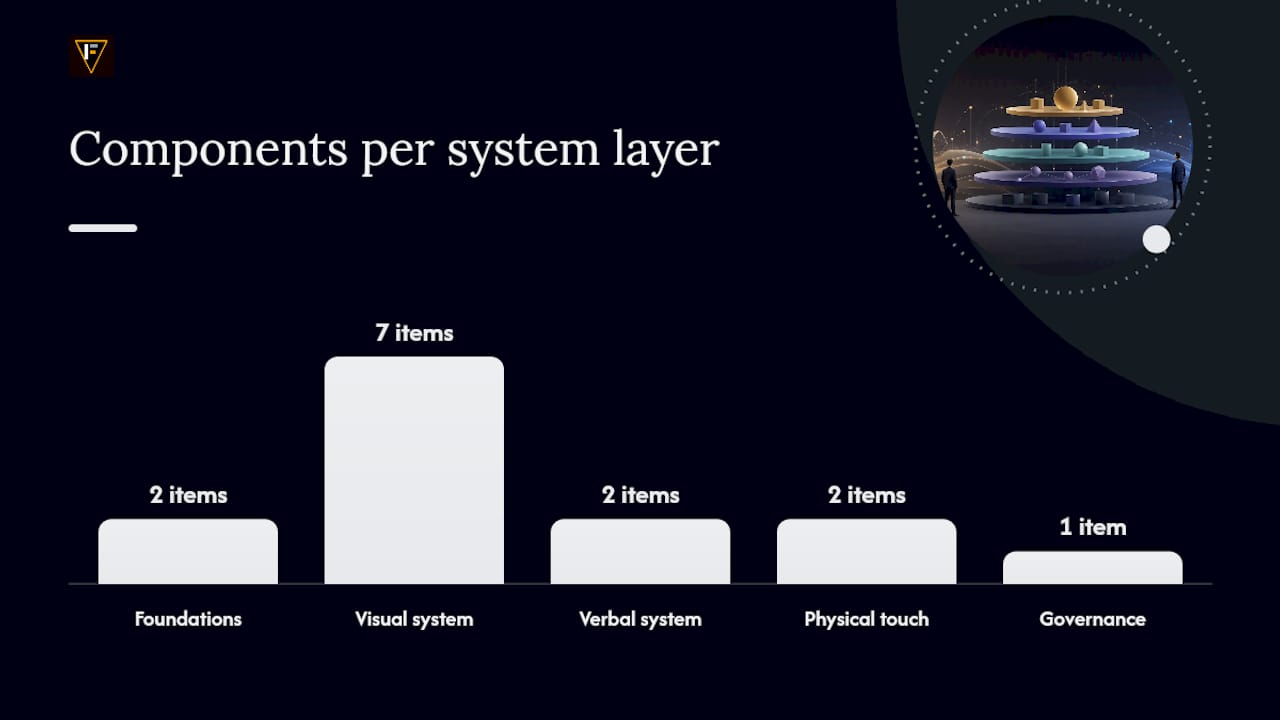
Core brand elements include purpose, name, logo, graphics, iconography, color, typography, voice, and slogans, and they work best when built together rather than in isolation. Here is the full component inventory, organized by system layer:
Foundations
- Brand purpose and positioning: The strategic anchor. Every visual and verbal decision traces back here.
- Brand architecture: How sub-brands, product lines, or service tiers relate to the parent brand.
Visual system
- Logo system: Primary mark, secondary marks, icon/monogram, clear space rules, approved color variants, and prohibited uses. Apple's logo system, for example, spans product hardware, retail environments, and digital UI with a single mark adapted across dozens of surfaces.
- Color system: Primary palette, secondary palette, functional colors (error, success, warning), and accessibility-compliant contrast ratios. Each color should carry a hex, RGB, CMYK, and Pantone value.
- Typography and type scale: Primary and secondary typefaces, a defined scale (display, heading, body, caption), line-height and tracking rules, and web-safe fallbacks.
- Imagery and photography style: Subject matter, lighting, mood, composition rules, and what to avoid. Coca-Cola's imagery guidelines, for instance, specify the emotional register of every photo used in global campaigns.
- Iconography: Icon style (line, filled, outline), stroke weight, grid size, and naming conventions.
- Layout and grid: Column grid, spacing units, margin rules, and responsive breakpoints for digital.
- Motion: Transition timing, easing curves, animation principles, and prohibited motion patterns. Motion standards matter more than most teams realize, especially for digital-first brands.
Verbal system
- Voice and tone: The brand's personality in words. Voice is consistent; tone shifts by context (a product error message sounds different from a campaign headline).
- Messaging architecture: Core brand promise, proof points, audience-specific message variants, and approved taglines.
Interaction and physical
- Packaging and physical touchpoints: Structural templates, material specifications, label layout rules, and finish standards. For wellness and supplement brands, packaging is often the highest-frequency brand touchpoint. See how to create custom packaging for your brand for a practical walkthrough.
- Accessibility rules: Minimum color contrast ratios (WCAG 2.1 AA as a baseline), legible type sizes, and inclusive imagery standards. These belong in the system, not as an afterthought.
Governance
- Digital tokens: Named variables (color-primary-500, font-size-body) that connect the brand palette and type scale directly to code. Tokens are what let the design system stay in sync with brand identity without manual updates.
Pro Tip: Convert your color palette and type scale into design tokens before handing off to engineering. A token named color-brand-amber-600 is far more durable than a hex code copied into a Figma file, because it can be updated in one place and propagated everywhere automatically.
How do you build a brand identity system from scratch?
Building a complete brand identity system requires strategy first, then design. Skipping straight to logo design is the single most common failure mode. Here is the recommended phased process:
- Research and discovery: Audit existing assets, interview stakeholders, map competitor visual and verbal territories, and define the positioning gap the brand needs to own.
- Strategy: Articulate brand purpose, personality attributes, positioning statement, and audience segments. This document governs every design decision that follows.
- Core identity design: Logo system, color system, typography, and primary voice guidelines. These are the non-negotiable foundations.
- Supporting assets: Iconography, imagery style, motion principles, layout grid, packaging templates, and presentation decks.
- Documentation: Assemble the brand guidelines, token library, and usage examples. This is where the system becomes usable by people who were not in the room when it was built.
- Rollout: Communicate the system to all teams and vendors, run training sessions, and migrate existing assets to the new standards.
- Maintenance: Establish a review cadence, a change request process, and a version control protocol.
Phase timeline and effort ranges:
| Phase | Core Deliverables | Typical Duration |
|---|---|---|
| Research and discovery | Audit report, competitive map, stakeholder interviews | 2–4 weeks |
| Strategy | Positioning document, brand attributes, audience map | 2–3 weeks |
| Core identity design | Logo system, color, typography, voice guide | 4 weeks |
| Supporting assets | Icons, imagery, motion, templates, packaging | 4–6 weeks |
| Documentation | Brand guidelines, token library, usage examples | 2–4 weeks |
| Rollout | Training, asset migration, vendor briefing | 2–4 weeks |
| Maintenance | Ongoing quarterly reviews | Ongoing |
Roles and responsibilities:
- Brand lead / creative director: Owns strategy alignment and final approval on all identity decisions.
- Brand designer: Executes core identity and supporting assets.
- Product / engineering: Consumes tokens and components; flags conflicts between design system and brand standards.
- Agency or vendor: Produces campaign and channel-specific assets within the system.
- Legal / compliance: Reviews trademark usage, regulatory claims on packaging, and accessibility requirements.
- Project manager: Tracks milestones, manages handoffs, and owns the rollout timeline.
Cost bands (order-of-magnitude estimates):
- Small brand or startup: A focused engagement covering core identity and a lightweight guidelines document typically runs in the range of a few thousand to tens of thousands of dollars, depending on whether you use a freelancer or a small studio.
- Mid-market brand: A full system with supporting assets, token library, and rollout support from a mid-size agency typically runs significantly higher, driven by the number of touchpoints and asset types.
- Enterprise: Multi-brand or global systems with design system integration, localization, and governance tooling represent the largest investment, often involving dedicated internal teams plus agency partners.
What drives cost up: the number of product lines, the complexity of the digital surface area, localization requirements, and whether the brand needs a design system built in parallel.
Rollout checklist (gating items before launch):
- Core identity approved by brand lead and legal
- Token library published and connected to design system
- Brand guidelines accessible to all teams (not just designers)
- Templates built for the five highest-frequency asset types
- Vendor and agency briefing completed
- Legacy assets flagged for migration or retirement
- Compliance audit of first-wave published materials completed
How do you govern and store a brand identity system at scale?
Governance and tooling are what separate a system that works from a PDF that gets ignored. A functioning brand system includes strategy, identity, application rules, templates, and governance, and these five layers are what let teams produce on-brand work without pulling a designer into every request.
The toolchain typically spans four categories:
- Digital asset management (DAM): Platforms like Bynder, Canto, or Brandfolder store approved assets, enforce version control, and provide permission-based access so external vendors get only what they need.
- Design system / component library: Figma, Storybook, or a similar tool houses the tokenized components that product teams consume. The brand identity system feeds this layer; it does not live inside it.
- Brand portal / knowledge base: A searchable, always-current web destination where any team member can find the guidelines, download assets, and understand usage rules. Notion, Confluence, or a dedicated brand portal tool all work here.
- Approval and workflow tools: Frontify, Lytho, or similar platforms manage asset requests, review cycles, and publishing approvals without requiring a designer to be the bottleneck.
A practical workflow looks like this: a marketing manager requests a new social asset, selects an approved template from the brand portal, customizes within locked parameters, submits for a one-step brand review, and publishes. The token values in the template are already correct because they pull from the same source as the design system. No designer intervention required.
Pro Tip: Set up a single token file (in Figma Variables, Style Dictionary, or Tokens Studio) as the source of truth for color and typography. Any update to that file propagates to both the design system and the brand portal automatically. This eliminates the "which blue is the right blue" conversation permanently.
Version control matters as much as storage. Every update to the system should carry a version number, a changelog entry, and a communication to affected teams. Treating brand assets like software releases, with semantic versioning and release notes, is the governance model that scales.
For brands managing compliance-heavy packaging, a brand compliance workflow that integrates approval gates directly into the asset production process prevents off-spec materials from reaching production.
What can you learn from Apple, Coca-Cola, and Brandkit about system thinking?
Three brands illustrate different dimensions of a well-governed system, and each offers something worth copying.
Apple runs one of the most disciplined logo systems in the world. The mark itself has not changed in decades, but its application spans hardware finishes, retail environments, digital UI, and global advertising without a single inconsistent variant in public-facing materials. The lesson: logo system variants (horizontal, stacked, monochrome, reversed) should be defined and locked before any asset production begins. Ambiguity in the logo system is where inconsistency enters.
Coca-Cola governs imagery at a global scale by specifying not just what photos to use but the emotional register they must convey: optimism, connection, and energy. The color system, anchored to a single Pantone red, is enforced across packaging, point-of-sale, digital, and merchandise in over 200 markets. The lesson: color tokenization at the Pantone and hex level, combined with clear imagery mood guidelines, is what makes a visual system portable across cultures and production environments.
Brandkit takes a platform approach to governance, giving brands a hosted portal where assets, guidelines, and templates live in one place and are accessible to any team or vendor with a link. The lesson: the governance model matters as much as the identity itself. A system that lives in a shared drive nobody can find is not a system. A hosted, searchable brand portal with permission controls is the infrastructure that makes the system executable.
For wellness and supplement brands, packaging is the most visible touchpoint, and the user experience of packaging design directly affects how the brand identity lands on shelf and online. Healthcare brands face a similar challenge: storytelling and consistent visual identity are what build trust with patients and consumers who have high stakes in the brands they choose.
What are the most common mistakes when building or auditing a brand identity system?
Most brand identity failures trace back to a small set of predictable errors.
- Logo-first thinking: Starting with the logo before the strategy is defined produces a mark that may look good but cannot carry the brand's positioning. The logo is an output of strategy, not a substitute for it.
- Over-rigid rules: A system so prescriptive that it cannot flex for context will be ignored or worked around. Build in approved variants and contextual guidance, not just prohibitions.
- No tokenization: Delivering a color palette as a swatch PDF without hex, RGB, CMYK, and Pantone values, and without a token file, guarantees color drift across teams and vendors.
- Missing accessibility checks: Skipping WCAG contrast ratio testing means the system may be legally and ethically non-compliant before it ships. Accessibility rules belong in the core system, not in a later revision.
- No named owner: A system without a single accountable owner degrades quickly. Someone must have the authority and responsibility to approve changes, manage the version history, and enforce standards.
- No update process: Brand systems are not static. Without a defined review cadence and change request process, the system becomes outdated and teams stop trusting it.
- Treating guidelines as the system: A PDF of rules is not a system. Without templates, tokens, and a DAM, the guidelines are aspirational, not operational.
- Skipping the verbal system: Many teams build a thorough visual system and then write voice and tone guidelines as a two-paragraph afterthought. The verbal system is half the brand.
Quick audit checklist (six checks to run on any existing system):
- Pull five random published assets and check hex codes, typefaces, and logo variants against the stated standards.
- Confirm the guidelines are accessible to all teams, not just the design team.
- Check whether a token file exists and whether it is connected to the design system.
- Verify that at least one named person owns the system and has a documented update process.
- Run a WCAG contrast ratio check on the primary color combinations.
- Ask a non-designer to produce a simple asset using only the system's resources. If they cannot, the system is incomplete.
For a more detailed compliance audit framework, the brand compliance checklist covers the governance and documentation steps in depth.
Your one-page checklist for a complete brand identity system
Use this checklist during vendor selection, internal audits, or a new system build. Priority tags: Must = non-negotiable foundation; Should = required for scale; Optional = adds depth for mature systems.
Foundations
- Must: Brand purpose and positioning statement
- Must: Brand personality attributes (3–5 defined traits)
- Should: Brand architecture diagram (if multiple product lines or sub-brands exist)
Visual system
- Must: Logo system (primary, secondary, icon, color variants, clear space, prohibited uses)
- Must: Color system (primary, secondary, functional palettes with hex, RGB, CMYK, Pantone)
- Must: Typography system (typefaces, scale, line-height, web fallbacks)
- Should: Imagery and photography style guide
- Should: Iconography library with usage rules
- Should: Layout and grid specifications
- Optional: Motion and animation principles
Verbal system
- Must: Voice and tone guide
- Should: Messaging architecture (brand promise, proof points, taglines)
Application and governance
- Must: Templates for the five highest-frequency asset types
- Must: Accessibility standards (WCAG contrast ratios, type size minimums)
- Should: Digital token library (color, typography, spacing)
- Should: Brand portal or DAM with permission controls
- Should: Version control and change log protocol
- Optional: Packaging structural templates and material specifications
Usage note: Run this checklist at the start of a vendor brief to confirm scope, and again at system launch to confirm completeness before rollout. The source of truth for all assets should live in a single, named location (brand portal or DAM), not in individual team drives.
What does the research say about brand identity and business outcomes?
Brand identity is a strategic asset with measurable impact on perception and financial performance. Consistent identity and execution contribute to brand strength and financial value over time, and the mechanism is straightforward: audiences who encounter a brand repeatedly in a consistent form build stronger memory structures, which translates to faster recognition, higher trust, and lower acquisition cost.
Harvard Business School frames brand identity as a strategic asset that builds emotional connection and warns specifically of the perception gap between intended communication and actual audience perception. A system reduces that gap by grounding every visual and verbal choice in the same mission and positioning.
The Cambridge English Dictionary defines brand identity as the set of visible elements that create a cohesive image and differentiate a brand from competitors. That definition is useful for stakeholder conversations because it frames identity as a differentiator, not just a style preference.
Measurement plan: three practical checks
- Recognition survey: Run a simple aided and unaided recognition survey with a sample of your target audience before and after a system rollout. Track the delta.
- A/B landing page test: Run two versions of a landing page, one using the new system's standards and one using legacy assets, and measure conversion rate and time-on-page.
- Time-to-publish audit: Track how long it takes to produce five standard asset types (social post, email header, presentation slide, product sheet, packaging proof) before and after the system is in place. Reduction in time-to-publish is the clearest operational signal that the system is working.
The part most brand managers get wrong
Most brand identity projects stall not because the design is bad but because the system was never built. A beautiful logo and a 60-page PDF of guidelines are not a system. They are the raw materials. The system is what happens when those materials are connected to tokens, templates, a DAM, and a named owner with a review cadence.
The brands that get this right treat their identity system the way a software team treats a codebase: versioned, documented, tested, and maintained. The brands that get it wrong treat it like a one-time project that ends at launch.
One action worth taking this week: open your brand's most-used asset template and check whether the color values are pulling from a token or from a hardcoded hex. If it's hardcoded, you have found the exact point where your system will drift. Fix that one file, publish it as the new source of truth, and you have started the governance work that actually matters.
Sources
- What Is Brand Identity? Tips & Examples for Shaping Yours
- What Is a Brand System? · Definition, structure, and how it ships | Bttr.
- Brand Identity System: Build a Complete One from Scratch | Brandhorse
- The Difference Between a Logo, a Brand Identity, and a Brand System | Brands Untamed
- What are brand elements? | HubSpot
- What is brand identity? | Shopify
- Brand identity definition | Investopedia