

TL;DR:
- A multi-brand portfolio strategy involves managing distinct brands to target different customer segments and control price tiers. It maximizes market coverage while avoiding internal cannibalization, but increases marketing complexity and governance challenges. Proper planning, clear roles, and data-driven KPIs help maintain brand differentiation and portfolio health.
A multi-brand portfolio strategy is a deliberate framework where a company manages two or more distinct brands within the same market to capture different customer segments, price tiers, or usage occasions. The primary goal is to maximize market coverage while minimizing internal cannibalization. Three reasons companies choose this path:
- Reach distinct segments without forcing one brand to stretch across incompatible audiences (a luxury buyer and a budget buyer rarely want the same brand story).
- Control price tiers by assigning each brand a clear position, protecting margin at the top while competing aggressively at the bottom.
- Preserve acquired equity during M&A, keeping a legacy brand's goodwill intact while integrating operations behind the scenes.
The core tradeoff is real: more brands mean higher marketing spend, more complex governance, and greater risk of internal competition. The payoff is broader reach and a parent brand that never has to be all things to all people.
Table of Contents
- What is a multi-brand portfolio strategy, exactly?
- How do brand architecture types shape a portfolio?
- What are the real benefits and risks of managing multiple brands?
- How do you develop a multi-brand portfolio step by step?
- Corporate examples that show multi-brand logic in action
- How should you govern investment and decision rights across brands?
- Which KPIs actually tell you if your portfolio is healthy?
- A practical playbook: templates, KPI calculations, and a launch checklist
- Key Takeaways
- The part most brand managers learn too late
- How Formlypro helps you run a multi-brand portfolio without losing positioning discipline
- Useful sources for deeper reading
What is a multi-brand portfolio strategy, exactly?
Brand portfolio strategy involves the design, deployment, and management of multiple brands as a coordinated portfolio of meaning-based assets that address the needs of diverse customers and maximize return while minimizing risk. That definition from Harvard Business School cuts to the point: the portfolio, not any individual brand, is the unit of strategy.
Where a single-brand (or "branded house") approach puts every product under one master name, a multi-brand model assigns each brand its own identity, positioning, and audience. An endorsed or sub-brand model sits between the two: the parent name appears as a secondary cue ("a Marriott property") while the consumer-facing brand carries its own personality.
The decision rule is straightforward. Prefer a multi-brand approach when:
- Research confirms that distinct customer segments exist and perceive meaningful differences between offerings.
- Credible differentiation is achievable, whether functional (different ingredients, formats, or price points) or emotional (different cultural associations or lifestyle signals).
- The organization has the capacity to manage multiple brand identities without diluting any of them.
At the portfolio level, the metrics that matter most are audience overlap (how much do two brands' customers share?) and revenue contribution per brand. These two figures tell you whether each brand is earning its place or quietly cannibalizing a sibling.
How do brand architecture types shape a portfolio?
Brand architecture describes how visible the parent brand is relative to the individual brands in the portfolio. The spectrum runs from fully independent names to tightly linked families, and the choice has direct consequences for risk, synergy, and operational cost.

| Architecture type | Parent visibility | How it works | Example |
|---|---|---|---|
| House of brands | None or minimal | Each brand stands alone; consumers may not know they share an owner | P&G (Tide, Pampers, Gillette) |
| Endorsed brand | Secondary cue | Parent name appears as a quality signal alongside the consumer brand | Marriott (Courtyard by Marriott) |
| Sub-brand / hybrid | Moderate | Parent and sub-brand share equity; the parent name carries weight | L'Oréal Paris (part of L'Oréal Group) |
| Branded house | Dominant | One master brand covers all products; variants are descriptors | Not a multi-brand model |
In a house-of-brands structure, each brand absorbs its own reputational risk. A product recall at one brand does not automatically damage the others. The cost is that you build awareness from scratch for every brand and cannot transfer equity between them. An endorsed structure gives you some of that insulation while letting the parent's credibility do some of the heavy lifting for newer or smaller brands.
Brand architecture choices also determine shared-services boundaries. Legal, supply chain, and compliance functions can be centralized regardless of architecture type, but packaging, creative, and communications usually stay brand-specific to protect distinct identities.
Pro Tip: Surface the parent brand when it adds credibility the sub-brand cannot yet earn on its own (regulatory trust, quality heritage, distribution access). Hide it when the parent's associations would actively conflict with the sub-brand's positioning, such as a premium brand owned by a value-focused parent.
What are the real benefits and risks of managing multiple brands?
The advantages of a multi-brand strategy are well-documented, but so are the failure modes. Both deserve an honest look.
Business benefits
| Benefit | What it means in practice |
|---|---|
| Diversified revenue risk | A downturn in one segment does not sink the whole business |
| Targeted relevance | Each brand can speak authentically to its audience without compromise |
| Shelf and mind-share coverage | Multiple brands occupy more retail space and search real estate |
| M&A flexibility | Acquired brands can preserve legacy equity while operations integrate gradually |
| Price-tier control | Premium and value lines coexist without undermining each other |
Risks and how to mitigate them
The risks are just as concrete. Cannibalization is the most common failure: if consumers cannot perceive a real difference between two brands in the same portfolio, they will split their spending arbitrarily rather than expanding the company's total share. Differentiation must be credible and visible, either functionally or emotionally, or the portfolio simply fragments the market.
Three mitigation tactics practitioners rely on:
- Research-led differentiation. Run perceptual mapping before launch to confirm that the proposed positioning gap is real in consumers' minds, not just on a whiteboard.
- Documented brand roles. Each brand gets a written role card: who it serves, what it promises, and what it explicitly does not do. Overlap in role cards is a warning sign before it becomes a market problem.
- Pruning triggers set in advance. Decide the thresholds that will trigger a brand review before emotions and internal politics make the decision harder. More on those thresholds in the measurement section.
Smaller organizations should treat multi-brand expansion with caution. Building and sustaining multiple brand identities demands significant marketing, operational, and governance capacity. The signal that benefits will exceed costs: you have a proven first brand, confirmed segment separation in research, and a team with bandwidth to manage a second identity without neglecting the first.
How do you develop a multi-brand portfolio step by step?
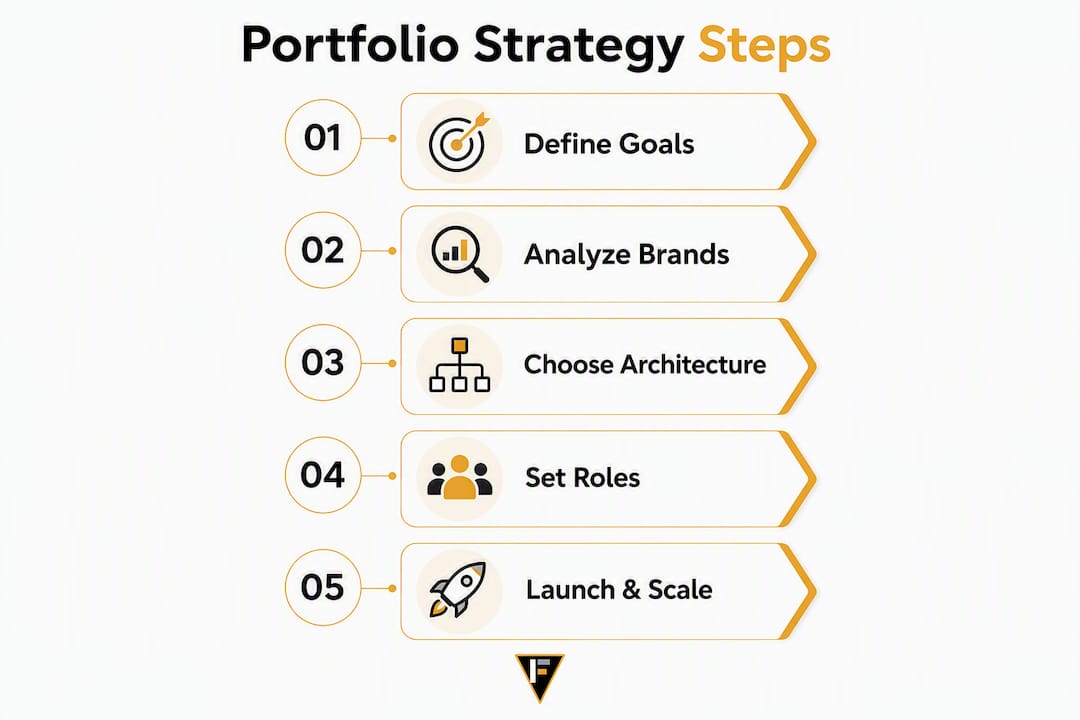
HBS faculty frame portfolio strategy as a unified business asset requiring documented roles, architecture decisions, and investment rules. The five-step sequence below operationalizes that framework.
Step 1: Diagnose market segments
Map the market using perceptual mapping and customer research. Identify whether distinct segments exist with different needs, price sensitivities, or cultural associations. The artifact to produce: a segment map showing where current brands sit and where gaps or overlaps exist.
- KPIs to track: current audience overlap between existing brands, revenue concentration by segment, unmet need scores from customer research.
Step 2: Assign brand roles and scope
Write a role card for each brand (existing and proposed). Each card should specify: the target audience, the core promise, the price tier, the channels it owns, and what it explicitly does not compete for. Role cards prevent the internal drift that leads to cannibalization.
- KPIs to track: role-card completion rate, number of positioning conflicts flagged in review.
Step 3: Choose architecture
Decide how visible the parent brand will be for each brand in the portfolio. Use the architecture table from the previous section as a decision guide. Document the rationale so future brand managers understand why the structure was chosen.
- Artifact to produce: an architecture diagram showing parent-to-brand relationships and visibility rules.
Step 4: Set KPIs and funding rules
Define how investment will be allocated across brands. Map each brand on two axes: market attractiveness and brand strength. Strategic brands with high scores on both axes receive growth investment. Cash-generating brands with strong equity but lower growth potential are maintained. Defensive or fighter brands run lean. Set the investment rubric in writing before budget season.
- KPIs to track: revenue contribution per brand, margin contribution, brand awareness by segment.
Step 5: Launch, scale, and set pruning triggers
For new brand launches, the pre-launch checklist covers: consumer research validation, positioning confirmation, legal clearance, packaging sign-off, supply readiness, pricing architecture, measurement baseline, and documented pruning triggers. For acquired brands, the integration sequence runs: diagnostic (equity, overlap, channel fit) → architecture decision (retain, endorse, or absorb) → systems alignment (shared services) → communication plan → 12–24 month KPI ramp.
Pruning triggers should be set at this stage, not after a brand is struggling. Common operational thresholds:
- Audience overlap with a sister brand exceeding approximately 70%
- Revenue contribution below 1% of total portfolio revenue
- Three consecutive years of decline with no credible recovery path
Corporate examples that show multi-brand logic in action
Procter & Gamble
P&G runs one of the most studied house-of-brands portfolios in consumer goods. Tide, Pampers, Gillette, and Olay share a parent but face consumers as entirely independent brands. Each targets a distinct category and audience; P&G's name rarely appears on packaging. The logic: a diaper buyer and a razor buyer have nothing in common, so a shared brand identity would add nothing and might confuse both.
What to copy: Assign each brand a category it owns completely. Resist the urge to cross-promote between brands that serve unrelated audiences.
L'Oréal
L'Oréal uses a hybrid architecture. L'Oréal Paris operates as a sub-brand that carries the parent's name and quality signal. Meanwhile, Lancôme, Kiehl's, and Garnier operate with more independence, targeting different price tiers and cultural identities. The parent brand surfaces selectively, lending credibility where it helps and staying quiet where it would constrain positioning.
What to copy: Use the parent name as a credibility endorsement for brands that need it, and withhold it from brands where the association would limit their appeal.
Unilever
Unilever's portfolio spans Dove, Axe, Hellmann's, and Ben & Jerry's, among many others. These brands cover distinct price tiers and cultural segments while sharing back-end supply chain and procurement. The caution here is instructive: Unilever has periodically pruned its portfolio aggressively, cutting hundreds of brands to concentrate investment on those with the strongest growth trajectories. Aggressive expansion without pruning discipline creates complexity that eventually forces a painful correction.
What to copy: Build portfolio pruning into your governance calendar from day one, not as a crisis response.
Marriott International
Marriott's portfolio runs from Ritz-Carlton at the luxury end through Courtyard and Fairfield at the midscale tier. The endorsed architecture ("Courtyard by Marriott") lets each brand carry its own personality while the Marriott name signals reliability and loyalty-program access. A traveler booking a Ritz-Carlton is not thinking about Fairfield, but both brands benefit from the shared Bonvoy loyalty infrastructure.
What to copy: Shared infrastructure (loyalty programs, booking platforms, compliance systems) can be centralized even when consumer-facing brands remain fully distinct.
How should you govern investment and decision rights across brands?
Governance is where multi-brand strategies most often break down. Without clear decision rights, brand managers compete for budget, architecture decisions get made inconsistently, and the portfolio drifts toward internal conflict.
Three governance models cover most situations:
- Centralized shared services: A central brand or marketing function sets architecture rules, manages the investment rubric, and owns pruning decisions. Individual brand teams execute within those guardrails. Works well when brands share significant operational infrastructure.
- Federated brand teams: Each brand operates with its own P&L and brand leadership, with a portfolio council that meets quarterly to review overlap, investment allocation, and architecture compliance. Works well when brands serve genuinely different markets with different competitive dynamics.
- Holding-company model: Brands operate as near-independent business units with minimal central coordination beyond financial reporting. Works for conglomerates where brands have no meaningful operational overlap.
For investment allocation, map brands on the market attractiveness / brand strength matrix described in Step 4. The matrix output drives the funding conversation: strategic brands get growth budgets, cash generators get maintenance budgets, and brands below the pruning thresholds get a formal review rather than another year of diminishing investment.
Decision rights for common portfolio choices:
- Who hires brand managers: typically the federated brand team lead, with portfolio council approval for senior hires.
- Who decides architecture changes: portfolio council or CMO, not individual brand teams.
- Who triggers pruning reviews: portfolio council, based on the pre-set KPI thresholds.
Pro Tip: Give each brand manager a written "lane" that defines what decisions they own and what requires portfolio-council sign-off. Ambiguity about decision rights is the single fastest way to turn brand managers into internal competitors rather than collaborators.
Which KPIs actually tell you if your portfolio is healthy?
Jill Avery of Harvard Business School frames brand portfolio strategy as a capital-allocation framework: the metrics you track should tell you which brands deserve more investment and which are candidates for pruning. Financial KPIs alone miss the early warning signs; brand-health measures catch problems before they show up in revenue.
| KPI | Why it matters | How to measure | Cadence |
|---|---|---|---|
| Brand awareness by segment | Confirms each brand is reaching its intended audience | Surveys, aided/unaided recall | Quarterly |
| Market penetration | Tracks share of target segment actually purchasing | Sales data, panel data | Monthly |
| CAC by brand | Identifies which brands are expensive to grow | Marketing spend ÷ new customers | Monthly |
| Margin contribution | Shows which brands are funding the portfolio | Brand P&L | Monthly |
| Audience overlap | Flags cannibalization risk between sister brands | CRM, panel overlap analysis | Quarterly |
| NPS / brand sentiment | Early signal of positioning drift or quality issues | Surveys, social listening | Quarterly |
| Share of shelf / assortment | Measures physical and digital presence | Retail audits, e-commerce data | Monthly |
The audience-overlap metric deserves particular attention. When two brands in the same portfolio share more than approximately 70% of their buyers, they are functionally competing for the same person rather than expanding total market coverage. That threshold is a trigger for a positioning review, not necessarily an immediate pruning decision, but it should never be ignored.
Combining financial and brand-health KPIs gives you a balanced picture. A brand with strong awareness and NPS but declining margin may need a pricing or cost review. A brand with strong margin but falling awareness may be harvesting equity it is not replenishing. Neither signal alone tells the full story.
A practical playbook: templates, KPI calculations, and a launch checklist
Brand role template
Use this structure for every brand in the portfolio:
- Role: What strategic job does this brand perform in the portfolio? (e.g., "defend the value tier against private label")
- Scope: Which categories, channels, and geographies does this brand cover?
- Target audience: Primary buyer profile (demographics, psychographics, usage occasion)
- Primary KPI: The single metric that best measures this brand's success
- Funding priority: Strategic growth / maintain / harvest / review
KPI calculation examples
- Margin contribution: Brand revenue minus brand-specific costs (COGS, dedicated marketing, brand-specific overhead), expressed as a percentage of total portfolio revenue.
- Audience overlap: (Number of buyers who purchased both Brand A and Brand B in the period) ÷ (total unique buyers of Brand A) × 100. If the audience overlap exceeds approximately 70%, it triggers a positioning review.
8-item launch and integration checklist
- Consumer research validation: confirm segment separation and positioning gap before launch.
- Positioning sign-off: role card approved by portfolio council.
- Legal clearance: trademark, regulatory, and compliance review completed.
- Packaging finalized: distinct visual identity confirmed; no consumer confusion with sister brands.
- Supply chain ready: manufacturer confirmed, lead times validated, inventory plan in place.
- Pricing architecture locked: price points do not undercut or overlap with sister brands without a documented rationale.
- Measurement baseline set: pre-launch awareness, penetration, and sentiment benchmarks recorded.
- Pruning triggers documented: thresholds for overlap, revenue contribution, and consecutive decline agreed upon and filed with the portfolio council.
Pro Tip: Align your product development pipeline with your brand role cards before you start formulating. A brand positioned as a clinical-grade supplement should not share a formulation brief with a lifestyle wellness brand in the same portfolio. Formlypro's 8-phase product development workflow and data-driven formulation tools make it practical to run parallel pipelines for different brands without losing track of which formulation belongs to which positioning.
Key Takeaways
A multi-brand portfolio strategy succeeds when each brand holds a distinct, research-confirmed position, investment is allocated by a documented rubric, and pruning triggers are set before they are needed.
| Point | Details |
|---|---|
| Define before you build | Each brand needs a written role card before launch; overlap in role cards predicts market cannibalization. |
| Use the five-step framework | Diagnose segments, assign roles, choose architecture, set KPIs and funding rules, then launch with pruning triggers in place. |
| Watch audience overlap closely | When two sister brands share more than approximately 70% of buyers, this is a trigger for a positioning review. |
| Governance prevents internal competition | Clear decision rights (who owns architecture, who triggers pruning) keep brand managers collaborating rather than competing. |
| Formlypro supports portfolio operations | Formlypro's formulation pipeline, market research tools, and compliance guidance help brand teams run distinct product lines without losing positioning discipline. |
The part most brand managers learn too late
Most brand portfolio failures are not strategy failures. They are governance failures that were visible long before the revenue showed it.
The pattern is consistent: a company launches a second brand with genuine excitement and a credible positioning rationale. Eighteen months in, the brand managers for Brand A and Brand B are quietly competing for the same retail buyer, the same media budget, and sometimes the same consumer. Nobody flagged it because the audience-overlap metric was never set up, the role cards were written once and never reviewed, and the portfolio council meets annually instead of quarterly.
The HBS framing of portfolio strategy as a capital-allocation discipline is the right mental model, but it only works if the allocation decisions are made on data rather than on which brand manager makes the most compelling case in a budget meeting. The companies that manage multi-brand portfolios well, P&G and Marriott among them, treat pruning as a normal part of the portfolio calendar, not as an admission of failure.
If you are in the first 30 to 60 days of a portfolio governance role, the single most useful thing you can do is pull the audience-overlap data for every pair of brands in the portfolio. You will almost certainly find at least one pair that is closer than anyone realized. That finding gives you a concrete, data-backed reason to start the role-card review conversation before the problem shows up in declining margins.
How Formlypro helps you run a multi-brand portfolio without losing positioning discipline
Running parallel product lines across a multi-brand portfolio means managing separate formulation briefs, compliance requirements, and packaging identities simultaneously. That is where most brand teams lose time and, eventually, positioning clarity.

Formlypro is built for exactly this operational challenge. The platform's 8-phase product development workflow lets you run distinct pipelines for different brands side by side, each anchored to its own positioning brief and compliance requirements. The built-in market research and competitive analytics tools give you the perceptual mapping data you need to confirm segment separation before you commit to a launch. The AI Mockup designer handles packaging differentiation so each brand looks distinct at shelf without requiring a separate agency relationship for every SKU.
For supplement and wellness brands managing tiered portfolios, Formlypro also covers FDA and DSHEA compliance guidance at the brand level, so a clinical-grade line and a lifestyle line do not accidentally share claims that would undermine either positioning. Start your portfolio pipeline at formlypro.com.
Useful sources for deeper reading
- Brand Portfolio Strategy and Brand Architecture — Harvard Business School: The primary academic framework for portfolio strategy as a coordinated system of meaning-based assets; supports the definition, architecture, and governance sections.
- Why a Strong Brand Portfolio Is Crucial for Success — HBS Online: Jill Avery's capital-allocation framing of portfolio strategy; supports the five-step framework, investment rubric, and KPI sections.