

TL;DR:
- Ingredient knowledge is essential for agencies to create accurate and compliant marketing claims. It helps build stronger market positions and reduces legal risks. Brands benefit from clearer formulas, faster launches, and stronger consumer trust.
Ingredient knowledge is defined as the technical understanding of what goes into a product, how each component behaves, and what claims it can legally support. Agencies that lack this expertise produce generic marketing copy that fails regulatory review and loses consumer trust. Brand managers who work with ingredient-literate agency partners close product launches faster, defend their claims under scrutiny, and build stronger market positions. This article explains why agencies need ingredient knowledge, how it shapes every stage from formulation to shelf, and what concrete steps turn that expertise into a competitive advantage.
Why agencies need ingredient knowledge to build credible narratives
Consumers no longer accept vague product claims. 88.9% of young consumers are aware of food allergens and preservatives, yet struggle with chemical additive terminology. That gap is the agency's opportunity. Brand managers who brief ingredient-literate teams get marketing copy that bridges scientific accuracy and plain language, which is exactly what informed buyers respond to.

Generic ingredient claims reduce agency effectiveness and client ROI. An agency that writes "contains antioxidants" without specifying the source, dosage, or delivery form gives consumers nothing to act on. Supplement marketing agencies that script complex ingredient stories, covering bioavailability, form, and dosage, charge $100–$500 per ad compared to $50–$150 for generic content. The price gap reflects the value gap.
Ingredient expertise supports differentiated narratives across supplements, beauty, and food sectors. In supplements, the difference between "magnesium" and "magnesium glycinate at 400mg for sleep support" is the difference between a commodity and a brand story. In beauty, specifying that a retinol is encapsulated for stability tells a consumer why your product outperforms a cheaper alternative. In functional food, naming a clinically studied fiber strain rather than just "fiber" anchors a health claim to evidence.
- Ingredient-specific copy supports purchase decisions by giving consumers a concrete reason to choose your product.
- Dosage and form details allow agencies to write claims that survive regulatory review without last-minute rewrites.
- Named ingredient stories build brand equity that generic claims cannot replicate.
- Agencies with ingredient fluency reduce client revision cycles because the first draft is already accurate.
Pro Tip: Build a one-page ingredient brief for every new product brief you receive. Include the ingredient name, form, dosage, mechanism, and any existing clinical references. That document becomes the source of truth for every piece of copy your team writes.
How does ingredient expertise protect agencies from compliance risk?
Compliance is not a final checkpoint. It is a front-end discipline, and ingredient knowledge is the foundation. Ingredient identity is a front-end diligence question that affects scaling and regulatory approval, requiring clear documentation before marketing begins. Agencies that treat compliance as someone else's problem routinely produce campaigns that stall at legal review or, worse, trigger FDA warning letters.
The documentation chain matters as much as the ingredient itself. Winning product offers carry specification files, certificates of analysis, and manufacturing flow details. Agencies that understand what those documents contain can write claims that align with them from day one. Agencies that do not understand them write claims that contradict the actual formulation, creating expensive rework.
Effective teams treat ingredient files, claim files, and traffic plans as a single integrated system rather than three separate workstreams. That integration is what separates agencies that launch on schedule from those that spend months in compliance review. Brand managers should ask their agency partners directly whether those three elements are built together or handed off sequentially.
Here is a practical compliance workflow that ingredient-literate agencies follow:
- Receive the ingredient specification file before writing a single claim. Confirm the ingredient's identity, purity, and any existing regulatory status.
- Map each marketing claim to a specific ingredient attribute documented in the spec file or a cited clinical study.
- Flag structure/function claims that require FDA-compliant disclaimer language and build those disclaimers into the creative brief.
- Cross-check label copy against the ingredient's approved name, concentration, and any restricted usage conditions.
- Coordinate the traffic plan so paid media does not go live before compliance sign-off on the claim file.
Pro Tip: Ask your formulation partner for the certificate of analysis on every ingredient before briefing your copywriters. If a claim cannot be traced back to that document or a cited study, it should not appear in the campaign.
For agencies working with health and wellness brands, a detailed compliance requirements list covers the specific documentation standards that apply across supplements, food, and beauty categories.
What technical advantages does ingredient knowledge bring to product development?
Ingredient behavior at lab scale does not always predict behavior at commercial production scale. Formulations often require adaptation beyond initial lab results because moisture sensitivity and mixing dynamics shift when batch sizes increase. Agencies that understand this reality can set accurate timelines, prepare contingency messaging, and advise clients before a costly batch failure occurs.
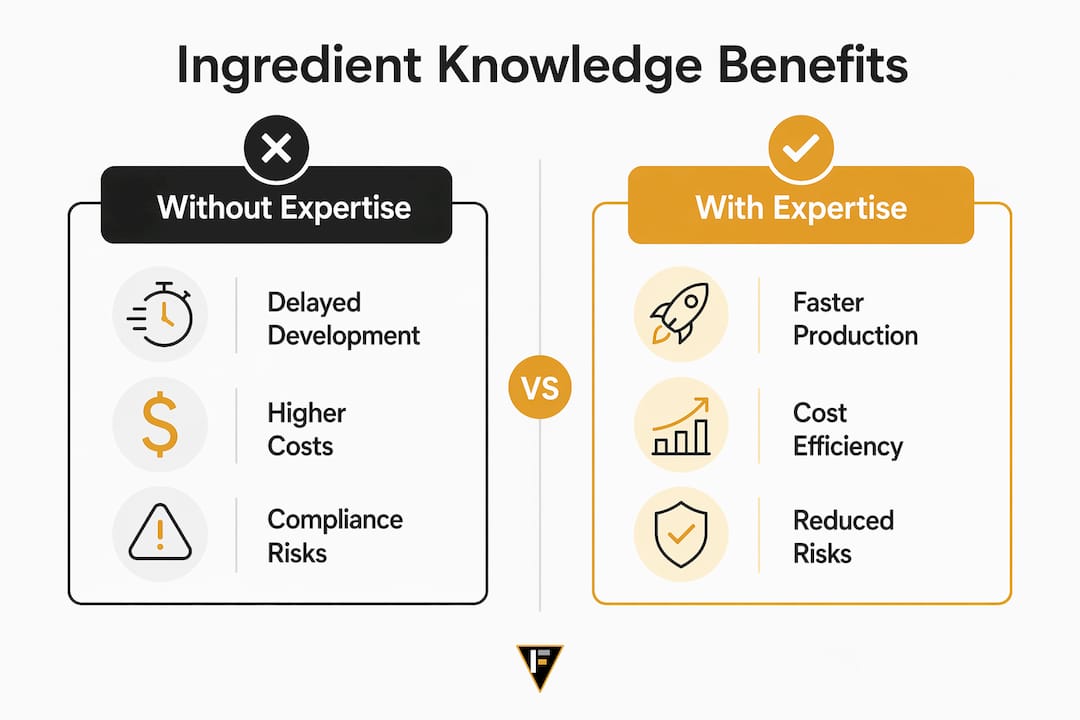
The operational value of ingredient knowledge extends to cost management. High-performance finely milled ingredients reduce ingredient volume by 5–10%, lowering waste and shipping costs. That kind of technical insight, when an agency brings it to a client conversation, positions the agency as a strategic partner rather than a vendor.
The table below shows how ingredient knowledge changes the agency's role at each stage of product development.
| Development stage | Agency without ingredient knowledge | Agency with ingredient knowledge |
|---|---|---|
| Formulation brief | Accepts client brief at face value | Challenges vague ingredient specs and requests documentation |
| Claim writing | Uses generic benefit language | Writes claims tied to specific ingredient attributes and dosages |
| Compliance review | Rewrites copy after legal flags | Submits copy that aligns with spec files from the start |
| Scale-up | Unaware of production variables | Anticipates sensory and stability changes and adjusts messaging |
| Launch timeline | Reactive to delays | Builds contingency plans based on technical milestones |
Expertise is now the key asset in the ingredients industry, surpassing production scale as the primary competitive differentiator. The Ingredion and Tate & Lyle merger in 2026 prioritized formulation know-how and intellectual property over broad portfolio size. That shift at the manufacturer level signals that agencies must match the same standard of technical depth to remain credible partners.
Agencies that understand ingredient transparency also build stronger relationships with manufacturers and suppliers. When an agency can speak the language of a formulator, supplier negotiations move faster, technical questions get resolved in days rather than weeks, and the client's product reaches market with fewer surprises.
Practical steps to build ingredient expertise inside your agency
Ingredient knowledge does not appear overnight. It requires deliberate investment in people, processes, and tools. The agencies that build it fastest treat it as a core competency, not a nice-to-have.
- Hire or train a technical lead. Every agency working in supplements, beauty, or functional food needs at least one person who can read a certificate of analysis, interpret a clinical abstract, and explain bioavailability to a copywriter. That person becomes the bridge between the formulator and the creative team.
- Build an ingredient database. Maintain a living document that catalogs every ingredient your agency has worked with, including its approved names, common forms, typical dosages, and any regulatory restrictions. Update it after every product launch.
- Use supplier documentation as a creative resource. Supplier technical data sheets contain the exact language that supports compliant claims. Copywriters who read them write better first drafts.
- Integrate third-party certifications into your claim strategy. NSF International, USP, and Informed Sport certifications add a layer of credibility that generic claims cannot. Knowing which certifications apply to which ingredient categories is a direct benefit of ingredient expertise.
- Coordinate across functions. Marketing, regulatory, and production teams must share the same ingredient file. Siloed workflows produce conflicting claims and delayed launches.
For agencies working in cosmetics and personal care, formulation compliance requires a specific understanding of restricted ingredient lists and concentration limits that differ by market. Building that knowledge into your agency's standard operating procedures reduces review cycles and protects your clients from market withdrawal risk.
Technology platforms that centralize formulation data, compliance documentation, and market research give agencies a structural advantage. They replace scattered spreadsheets and email chains with a single source of truth that every team member can access and trust.
Key Takeaways
Agencies that treat ingredient knowledge as a core competency produce compliant, credible, and differentiated product campaigns that generic-content agencies cannot match.
| Point | Details |
|---|---|
| Ingredient specificity drives revenue | Agencies scripting complex ingredient stories command significantly higher fees and deliver stronger client ROI. |
| Compliance starts with ingredient identity | Specification files, certificates of analysis, and claim files must align before any copy goes to market. |
| Scale-up changes formulations | Lab results shift at commercial production; agencies with technical knowledge anticipate and manage this. |
| Expertise outranks scale | Industry mergers in 2026 confirm that formulation know-how is now the primary competitive asset. |
| Integrated workflows reduce delays | Treating ingredient files, claim files, and traffic plans as one system cuts compliance review time. |
The uncomfortable truth about ingredient knowledge in agency work
I have worked with brand managers who assumed their agency understood the products they were marketing. Most of the time, that assumption was wrong. The agency knew the brand voice, the target consumer, and the channel strategy. What they did not know was why the ingredient worked, what form it was in, or whether the claim they wrote was defensible under FDA scrutiny.
That gap shows up at the worst possible moment: during a compliance review, a retailer audit, or a consumer complaint. The agency scrambles, the brand manager absorbs the fallout, and the launch slips by weeks or months. The fix is not complicated, but it requires agencies to admit that ingredient knowledge is not the client's job to provide. It is the agency's job to develop.
The agencies I have seen succeed long-term in supplements, beauty, and functional food all share one trait. They treat ingredient expertise as a competitive moat, not a technical detail. They invest in training, they hire people who can read a spec sheet, and they build processes that connect the formulation to the campaign from day one. That investment pays back in faster launches, fewer revisions, and clients who renew because they trust the work.
— Ben
Formlypro gives agencies the ingredient foundation they need
Brand managers and agency professionals who want to close the ingredient knowledge gap have a direct path forward with Formlypro.
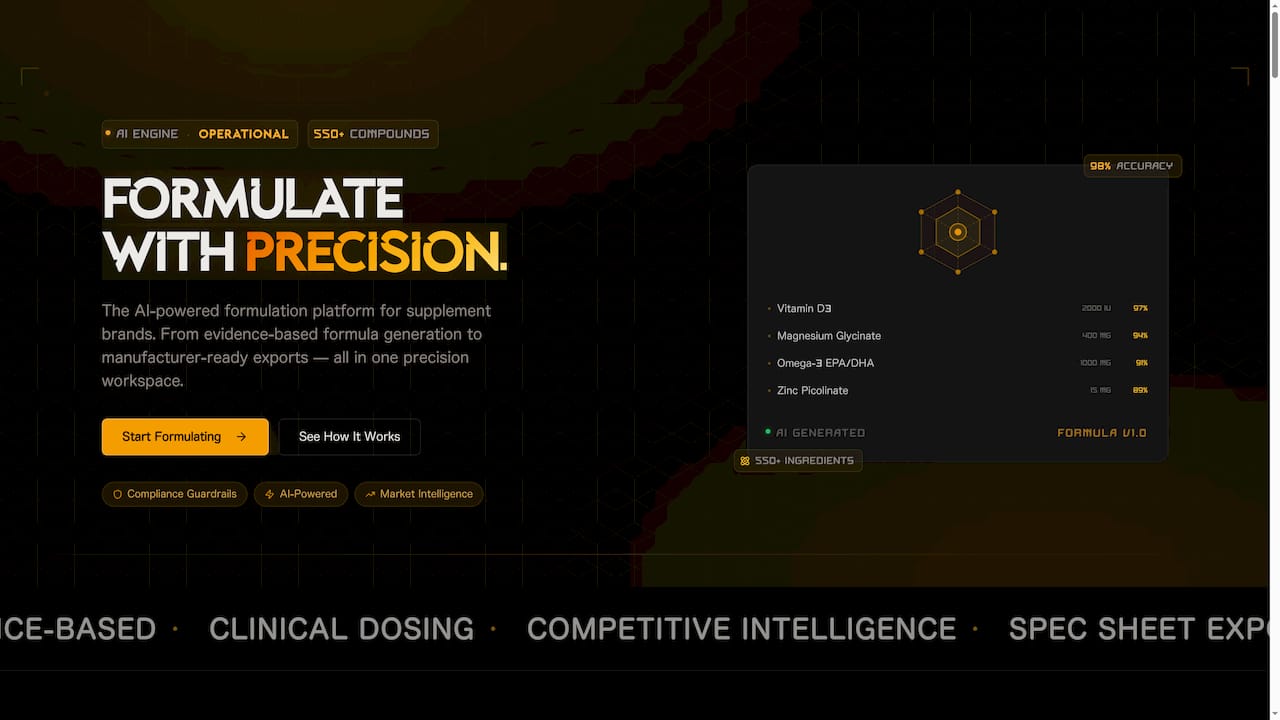
Formlypro is a supplement formulation platform built for brands and the agencies that support them. It provides ingredient-specific data, compliance documentation, and market research in one place, so agencies can move from brief to compliant campaign without chasing down spec sheets or guessing at claim language. The platform's 8-phase product development plan covers formulation, prototyping, compliance, and production, giving agency teams a structured framework that connects ingredient decisions to marketing outcomes. Agencies that use Formlypro reduce revision cycles, launch faster, and deliver work that holds up under regulatory review.
FAQ
Why do agencies need ingredient knowledge for compliance?
Agencies need ingredient knowledge because every marketing claim must trace back to a documented ingredient attribute or clinical study. Without that foundation, claims fail regulatory review and expose clients to FDA enforcement risk.
How does ingredient expertise improve marketing copy quality?
Ingredient-literate agencies write claims tied to specific dosages, forms, and mechanisms rather than generic benefits. That specificity gives consumers a concrete reason to buy and gives regulators a clear basis for the claim.
What is the difference between ingredient awareness and ingredient expertise?
Ingredient awareness means knowing that an ingredient exists. Ingredient expertise means understanding its form, dosage, regulatory status, and behavior in formulation, which is the level agencies need to write defensible claims and advise clients effectively.
How can agencies build ingredient knowledge without hiring scientists?
Agencies can build ingredient knowledge by training a technical lead, maintaining an internal ingredient database, using supplier documentation as a creative resource, and working with platforms like Formlypro that centralize formulation and compliance data.
Does ingredient knowledge matter for beauty and food brands, not just supplements?
Ingredient knowledge applies across supplements, beauty, and functional food. Each category has its own regulatory framework, restricted ingredient lists, and claim standards that agencies must understand to produce compliant and effective campaigns.