

TL;DR:
- Most organizations misunderstand compliance strategy as merely writing policies and hoping for no issues, which is costly. A true compliance strategy is a dynamic governance system integrating risk, culture, oversight, and continuous improvement that protects and scales the business. It requires building seven core elements, aligning them with operational practices, and continuously evolving to meet changing risks and regulatory expectations.
Most business leaders think compliance strategy means writing policies, filing them somewhere, and hoping nothing goes wrong. That framing costs companies far more than regulatory fines. Understanding what is compliance strategy at a deeper level reveals something more useful: a living governance framework that connects risk management, culture, oversight, and continuous improvement into one coherent system. When built correctly, it doesn't just keep regulators satisfied. It protects the business, builds trust, and creates a foundation that scales with growth.
Table of Contents
- Key takeaways
- What is compliance strategy, and why it matters
- Core elements of an effective compliance strategy
- How regulatory expectations shape compliance design
- Common pitfalls in developing compliance programs
- How to develop and continuously improve your strategy
- My take on what compliance strategy has become
- How Formlypro supports your compliance strategy
- FAQ
Key takeaways
| Point | Details |
|---|---|
| Compliance is not a checklist | A real compliance strategy integrates risk management, oversight, training, and enforcement into one connected system. |
| Seven elements form the core | Federal guidance identifies seven foundational elements every effective compliance program must address to be credible. |
| DOJ evaluates three dimensions | Regulators assess whether your program is well designed, adequately resourced, and actually working in practice. |
| Technology alone is not enough | Governance and operational discipline matter more than software purchases when building a compliance posture that holds up. |
| Continuous improvement is mandatory | Programs must evolve as risks change, incorporating lessons from both internal incidents and industry developments. |
What is compliance strategy, and why it matters
A compliance strategy is a deliberate, documented approach an organization takes to meet its legal, regulatory, and ethical obligations while managing the risks that come with operating in regulated environments. The word "strategy" is doing real work here. This isn't about reacting to audits or printing a code of conduct once a year. It's about designing a system that anticipates risks, establishes accountability, and builds the internal culture needed to sustain compliant behavior over time.
The common misconception is that compliance is a legal function that operates separately from the business. In reality, the importance of compliance strategy is felt across every department, from procurement and HR to product development and finance. When compliance is treated as a standalone obligation, companies end up with what regulators call "paper compliance." The policies exist. The training is logged. But the behavior hasn't changed, and the culture doesn't support the written standards.
A well-designed compliance strategy closes that gap. It connects formal obligations to real operations, and it gives the people responsible for execution the tools, authority, and resources to do their jobs. Understanding compliance in product development is one concrete example of how this connection works in practice for regulated product categories.
Core elements of an effective compliance strategy
Effective compliance programs are built on seven foundational elements defined in federal enforcement guidance. These aren't suggestions. They represent the minimum structural requirements that prosecutors, regulators, and courts use to evaluate whether a compliance program is credible.
The seven elements are:
- Written standards and policies that define expected conduct and legal obligations
- High-level oversight from leadership and a governing body with real authority
- Due care in delegation to avoid placing compliance authority in the hands of those with a history of misconduct
- Effective communication and training that reaches every level of the organization
- Monitoring and auditing systems to detect problems before they escalate
- Consistent enforcement and discipline that applies equally regardless of seniority
- Response and corrective action protocols for when violations occur
These elements don't operate in isolation. The table below shows how each element connects to a core function within the compliance strategy:
| Element | Core function |
|---|---|
| Written standards | Define the rules of behavior and legal baseline |
| High-level oversight | Assign accountability at the governance level |
| Due care in delegation | Protect integrity of compliance authority |
| Training and communication | Drive awareness and day-to-day behavior |
| Monitoring and auditing | Detect gaps, risks, and emerging violations |
| Consistent enforcement | Build credibility and deter misconduct |
| Response and corrective action | Demonstrate adaptability and good faith |
Internationally, ISO 37301 provides a certifiable framework for compliance management systems that emphasizes risk-based thinking, leadership commitment, and continuous improvement. Organizations operating across multiple jurisdictions increasingly use ISO 37301 as a structural reference because it integrates with other management systems and provides a recognized benchmark for third-party verification.

When these elements are built into operations rather than layered on top of them, the compliance strategy becomes something the business relies on rather than tolerates.
How regulatory expectations shape compliance design
The U.S. Department of Justice has published detailed guidance on how it evaluates corporate compliance programs, and its framework is worth understanding regardless of whether your organization is currently under investigation. The DOJ evaluates compliance programs using three fundamental questions: Is the program well designed? Is it adequately resourced and empowered? And does it work in practice?
That third question is the one most programs fail. A program can be beautifully documented and technically complete, but if prosecutors find that employees routinely circumvent controls, or that the compliance officer has no real authority, the program offers little protection. The DOJ is specifically looking for evidence that the program operates outside the control of the business units it is supposed to oversee.
The September 2024 update to the DOJ's guidance added meaningful new territory. Companies must now conduct risk assessments of AI usage within their operations, implement controls to mitigate technology-driven risks, monitor AI functions, and train employees on appropriate use. This reflects a broader shift in regulatory expectations: compliance strategies must now account for the tools the business uses, not just the transactions it conducts.
Data analytics is equally central to demonstrating program effectiveness. Regulators now expect companies to actively use data to evaluate controls, detect risks early, and prove that the compliance function is paying attention. Passive monitoring is no longer sufficient.
Pro Tip: Map your data sources to your highest-risk areas first. Don't build a reporting dashboard that measures everything equally. Prioritize the compliance metrics that are most likely to surface real misconduct or control failure, and review them on a defined schedule.
For companies in regulated product categories, a solid regulatory compliance checklist can help translate these broad expectations into practical, trackable requirements.
Common pitfalls in developing compliance programs
Building a compliance strategy is not a linear process, and the organizations that struggle most are often those that treat it like one. Several structural tensions emerge repeatedly, and understanding them early saves significant time and credibility later.
-
The independence problem. Compliance functions that report directly to the business units they oversee lose credibility fast. The compliance officer needs genuine organizational independence, which means reporting lines that don't run through the very leadership whose decisions compliance is meant to check.
-
The paper compliance trap. Policies get written. Training gets logged. But behavior doesn't change. This happens when compliance is treated as a documentation project rather than a cultural one. The written program and the lived reality drift apart, and the gap only becomes visible when something goes wrong.
-
Technology without governance. Over-reliance on compliance technology without strong governance creates complexity without improving your compliance posture. Too many tools, disconnected from clear workflow accountability and data discipline, can reduce productivity while creating a false sense of security.
-
Inadequate resource allocation. A compliance team with no budget authority and no access to senior leadership cannot do its job. Compliance officers who lack real resources end up managing paperwork instead of managing risk.
-
Leadership disengagement. When executives treat compliance as a legal department problem rather than a leadership responsibility, it signals to the entire organization that the program isn't serious. Tone at the top is not a cliché. It determines whether employees report concerns or stay quiet.
Pro Tip: Before adding any new compliance technology, audit your existing workflows. If you don't have clear data ownership and defined escalation paths, adding more software will make things worse, not better.
Well-implemented compliance programs also include compensation structures that reflect compliance performance, including clawback provisions for misconduct and recognition for ethical leadership. If your incentive structure rewards results without regard for how they were achieved, the compliance strategy is already undermined.
How to develop and continuously improve your strategy
Developing a compliance strategy that holds up over time follows a recognizable sequence, but the sequence is never truly finished. Think of it as a loop rather than a ladder.
Start with a risk assessment. Identify your highest-exposure areas based on the industry you operate in, the markets you serve, and the nature of your products or processes. For brands in health, beauty, or food categories, the compliance requirements are layered and specific, and the risk assessment should reflect that specificity.
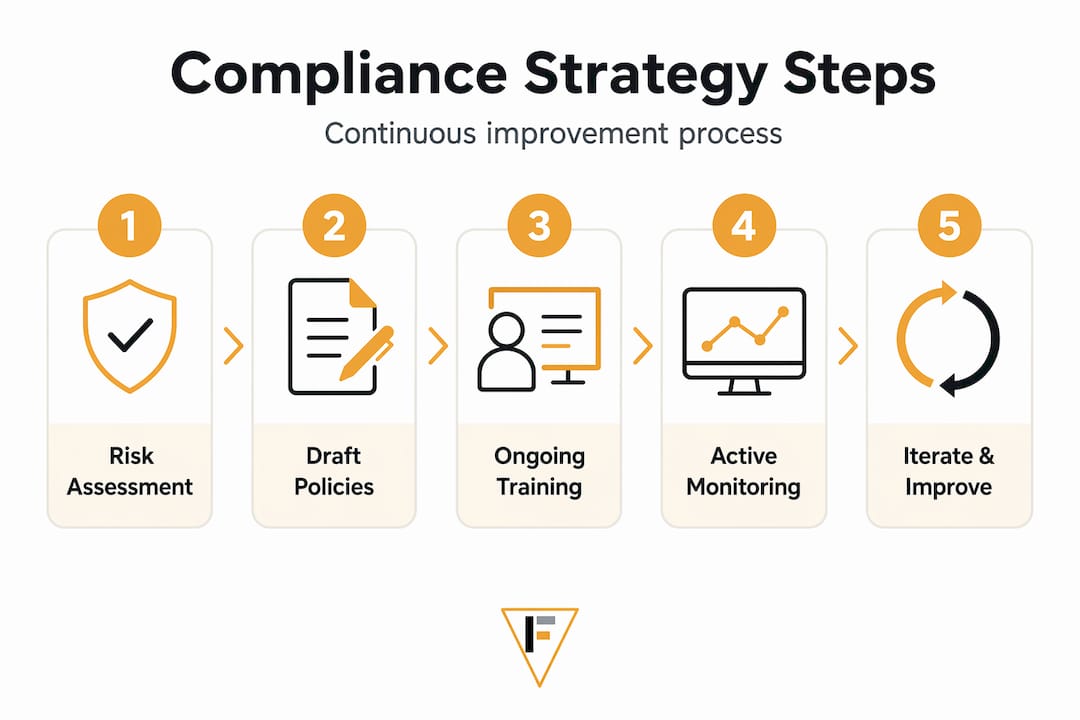
From there, draft policies that address those risks directly. Don't start with a generic policy library. Start with your actual risk map and work outward. Establish oversight structures, define who is responsible for each compliance function, and make sure those people have the authority to act.
Training comes next, and it must be ongoing, not annual. Monitoring systems should be running from day one, with defined escalation paths for when the data surfaces something unexpected.
Compliance programs must evolve to match risk profile changes and incorporate lessons from peer firms' compliance issues. That means scheduling formal program reviews at least annually, and adjusting faster when the regulatory environment shifts or an internal incident surfaces a gap.
The following comparison shows how program maturity levels differ in practice:
| Maturity level | Characteristics |
|---|---|
| Reactive | Compliance addressed only after incidents or audits |
| Developing | Basic policies and training exist, limited monitoring |
| Established | All seven elements present, regular audits conducted |
| Advanced | Data-driven, continuous monitoring, integrated with business decisions |
| Optimized | Predictive risk management, embedded culture, external benchmarking |
Compliance officers are now expected to treat compliance data with the same rigor applied to financial or operational data. That means defined metrics, regular reporting, and a feedback loop that actually informs program decisions.
My take on what compliance strategy has become
I've watched compliance programs evolve significantly over the past decade, and the most consistent pattern I see is this: organizations that treat compliance as a constraint underperform, and organizations that treat it as a governance capability outperform their peers in the long run.
The shift isn't just philosophical. When a compliance function has real authority, good data, and genuine leadership support, it catches problems before they become crises. It builds supplier relationships that hold up under scrutiny. It creates a culture where employees feel safe raising concerns, which is one of the most reliable early-warning systems any organization can have.
What I've found actually works is treating compliance strategy the way good CFOs treat financial strategy: as an active input into business decisions, not a post-hoc review of them. The companies that do this well don't have compliance departments that are siloed from operations. They have compliance thinking embedded in product development, procurement, hiring, and market expansion.
The trap I see most often is the technology purchase that substitutes for governance. You cannot buy your way into compliance posture. The tools matter, but the discipline, the accountability structures, and the culture matter far more.
— Ben
How Formlypro supports your compliance strategy

Building a compliance strategy from scratch is genuinely difficult, especially for brands operating in regulated product categories like supplements, health, and beauty. Formlypro is built to carry much of that load. The platform guides brands through every compliance requirement tied to their product and formulation, embedded directly into an 8-phase development process that takes a product from ideation through production.
Rather than managing compliance as a separate workstream, Formlypro integrates it with formulation, market research, and competitor analysis in one system. Brands get specific guidance on what is required, not generic checklists. For founders and compliance officers who need to move fast without cutting corners, the Formlypro platform is worth a close look.
FAQ
What is a compliance strategy in simple terms?
A compliance strategy is a structured plan that helps an organization meet its legal, regulatory, and ethical obligations while managing the risks that come with operating in regulated industries. It connects policies, oversight, training, monitoring, and enforcement into one coordinated system.
What are the core elements of a compliance strategy?
Federal guidance identifies seven foundational elements: written standards, high-level oversight, due care in delegation, training and communication, monitoring and auditing, consistent enforcement, and corrective action protocols.
How does the DOJ evaluate a compliance program?
The DOJ asks three questions: Is the program well designed? Is it adequately resourced and empowered? And does it work in practice? All three must be satisfied for a program to be considered credible during enforcement review.
What is the difference between compliance and a compliance strategy?
What is compliance refers to the act of meeting a specific requirement or rule. A compliance strategy is the broader system an organization builds to meet all of its obligations consistently, proactively, and across the entire business rather than responding to individual requirements in isolation.
How often should a compliance strategy be updated?
Programs should be formally reviewed at least annually, and updated faster when the risk environment changes, new regulations take effect, or an internal incident reveals a gap. The DOJ expects programs to evolve based on both internal lessons and industry-wide developments.