

TL;DR:
- Chelating agents bind metal ions to prevent oxidation, clouding, and preservative degradation in formulations. They work by forming stable complexes with metals, not by acting as preservatives themselves. Proper selection depends on pH, water hardness, and compatibility, with biodegradable options available.
Chelating agents are chemical compounds that form stable complexes with polyvalent metal ions, making them one of the most functionally critical ingredient categories in modern formulation chemistry. The role of chelating agents in formulation is to neutralize trace metals like calcium, magnesium, iron, and copper before those metals catalyze oxidation, cloud aqueous systems, or degrade active ingredients. Standard usage rates for EDTA-based chelators run 0.1%–0.2% in water-based serums and up to 1.0% in high-mineral formulations. Chelators do not act as preservatives or antioxidants. They work by removing the metal triggers that make those systems fail.
How do chelating agents work in formulation chemistry?
Chelation is a coordination chemistry process. A chelating agent forms multiple bonds with a single metal ion, locking it into a stable, inactive complex. That complex can no longer participate in the redox reactions that degrade oils, discolor formulations, or weaken preservative systems.
The practical consequences of this mechanism are significant:
- Oxidation prevention: Trace iron and copper ions catalyze the oxidation of unsaturated fatty acids and botanical extracts. Chelators remove those catalysts before they can act.
- Clarity maintenance: Calcium and magnesium ions react with anionic surfactants and fatty acids to form insoluble salts. These salts cause the "clouding" or "scumming" seen in shampoos and body washes made with hard water.
- Preservative boosting: Metal ions destabilize preservative systems by competing with active antimicrobial molecules. EDTA enhances antimicrobial efficacy by chelating divalent cations that reinforce bacterial cell membranes, making those membranes more permeable to preservatives.
- Fragrance protection: EDTA improves fragrance stability by sequestering trace metals that catalyze volatile oxidation, preventing off-odors and extending shelf life.
One critical distinction: chelators provide no direct antimicrobial or antioxidant activity. Their stabilizing role is entirely indirect, through metal sequestration. Formulators who list chelators on a safety data sheet as "antioxidants" are misclassifying the ingredient.
Pro Tip: If your formula uses botanical extracts rich in tannins or polyphenols, those compounds can bind metal ions themselves. Test whether a dedicated chelator adds measurable stability benefit before adding it to the formula.
What factors determine the selection of a chelating agent?
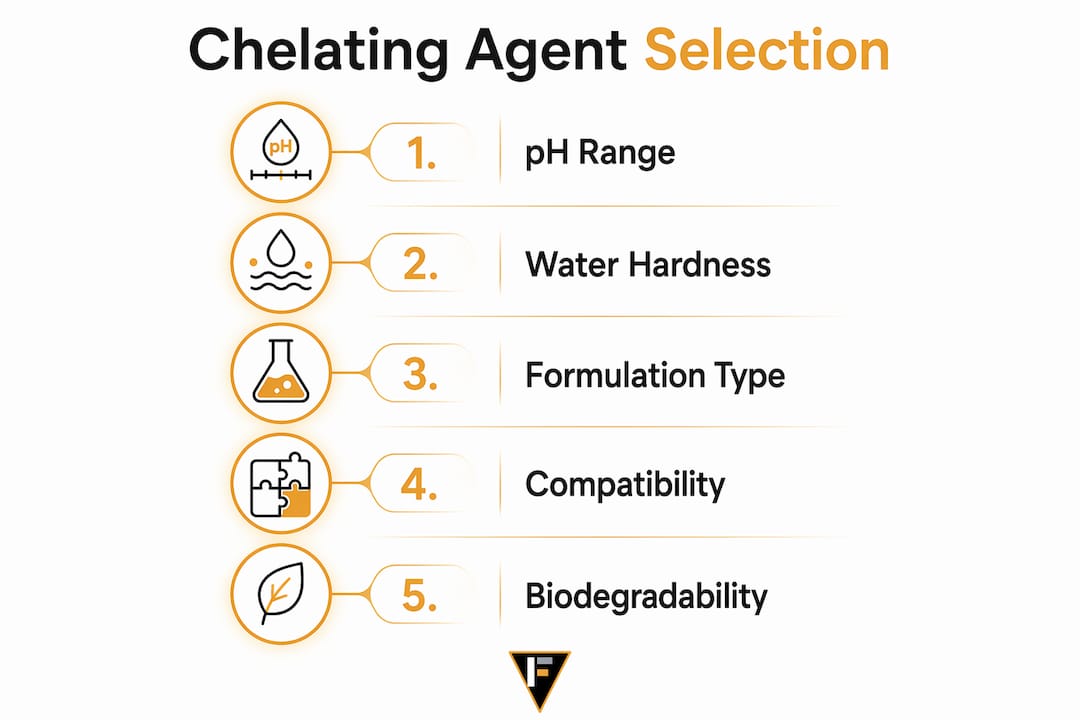
pH is the primary selection variable. Disodium EDTA performs best below pH 7.0, while Tetrasodium EDTA is the correct choice above pH 7.0. This distinction matters because the ionization state of EDTA changes with pH, directly affecting its binding affinity for target metal ions. Using the wrong EDTA form at the wrong pH produces a chelator that is partially inactive.
Biodegradable alternatives
Sodium Phytate and Tetrasodium Glutamate Diacetate (GLDA) are the two most established biodegradable chelator options. These alternatives deliver metal ion control comparable to EDTA while supporting eco-conscious brand positioning. Sodium Phytate works across a wide pH range but can slightly lower the water phase pH, which formulators need to account for during pH adjustment. GLDA is particularly effective in alkaline cleansing systems and is readily biodegradable, making it a strong fit for rinse-off products with environmental claims.
Formulation type and water hardness
The formulation matrix shapes chelator selection as much as pH does. Rinse-off products like shampoos and body washes face continuous exposure to hard water minerals during consumer use. That makes chelator selection a performance decision, not just a stability one. Leave-on products like serums and emulsions face a different challenge: the metal ions present in botanical extracts and tap water used during manufacturing. The criteria for ingredient selection must account for both the manufacturing water profile and the end-use environment.
Compatibility constraints
Cationic surfactants and cationic conditioning polymers present a real compatibility risk. Anionic chelators like Disodium EDTA can form complexes with cationic species, reducing the effectiveness of both the chelator and the conditioning agent. Formulators working on conditioners, 2-in-1 shampoos, or leave-on treatments need to run compatibility testing before finalizing chelator type and concentration. Some anionic polymers, including certain carbomers, can also interact with chelators at high concentrations.
Pro Tip: When formulating with hard tap water, request a water hardness report from your manufacturing facility. The calcium and magnesium content directly informs your chelator concentration. Formulators who skip this step often over-dose or under-dose, both of which create problems.
What are the practical benefits and applications of chelating agents?
The applications of chelating agents span personal care, pharmaceutical manufacturing, and specialty chemical production. Each category benefits from chelation for different but related reasons.
1. Preventing rancidity in oil-containing formulas
Unsaturated oils, including argan, rosehip, and hemp seed oil, are highly susceptible to metal-catalyzed oxidation. Iron and copper ions present in botanical extracts or manufacturing equipment accelerate rancidity. A chelator at 0.1%–0.2% binds those ions before they can initiate lipid peroxidation. This extends product shelf life without requiring higher concentrations of antioxidants like tocopherol or rosemary extract.
2. Boosting preservative system performance
Gram-negative bacteria like Pseudomonas aeruginosa maintain an outer membrane that blocks many preservatives. EDTA disrupts that membrane by chelating divalent cations that hold the membrane together. This makes the bacteria more vulnerable to preservatives already present in the formula. The result is a more effective preservation system at lower preservative concentrations, which matters for both safety and regulatory compliance.
3. Maintaining visual clarity in aqueous systems
Hard water minerals suppress foam formation in cleansing products. Chelating agents prevent this by binding calcium and magnesium ions before they react with surfactants, ensuring consistent lather quality and a visually clear product. This is particularly relevant for transparent shampoos and micellar waters, where any cloudiness signals a quality problem to consumers.
4. Protecting sensitive actives in pharmaceutical formulations
Pharmaceutical formulations containing metal-sensitive actives, including certain vitamins, peptides, and enzyme-based ingredients, require tight metal ion control. Chelators protect these actives during manufacturing and throughout shelf life. The formulation safety testing process for pharmaceutical products often includes specific protocols for metal ion management.
5. Extending fragrance integrity
Fragrance compounds, especially those with aldehyde or terpene structures, oxidize rapidly in the presence of trace metals. A chelator in the formula protects the fragrance system without altering the scent profile. This function complements antioxidant systems but operates through a chemically distinct mechanism.
Chelators also remain among the most chemically stable ingredients in a formula. They are unaffected by light and oxygen and retain full activity throughout product shelf life. That stability makes them reliable across a wide range of storage conditions.
What are common formulation challenges when using chelating agents?
The most persistent misconception is that chelators function as preservatives or antioxidants. They do not. Formulators who add chelators expecting direct microbial control or oxidation prevention will be disappointed. The importance of chelating agents lies in removing the metal triggers that cause those problems, not in addressing the problems directly.
A second common error is adding chelators late in the manufacturing process. Chelators must be added early, preferably dissolved in the water phase before thickeners or gelling agents are introduced. Late addition reduces chelator effectiveness because thickeners can physically trap the chelator or form competing complexes before it has bound the target metal ions.
Key challenges to watch for:
- Unnecessary use: Formulas using purified water and low-metal botanical extracts may not need a chelator at all. Adding one without testing can interfere with cationic conditioning agents or reduce foam quality.
- Ionic interactions: Anionic chelators can complex with cationic conditioners, reducing both the chelator's metal-binding capacity and the conditioner's deposition efficiency.
- pH mismatch: Using Disodium EDTA in an alkaline formula or Tetrasodium EDTA in an acidic one produces a partially inactive chelator. Always match the EDTA form to the formula's final pH.
- Over-reliance on marketing claims: The decision to use a chelator should be based on the metal ion profile of your raw materials and water, not on whether the ingredient sounds "natural" or "clean."
Pro Tip: Run a simple iron challenge test on your formula. Add a known concentration of iron ions and measure oxidation markers over 4 weeks with and without the chelator. This confirms whether the chelator is doing measurable work in your specific system.
The formulation checklist for scientists developed by Formlypro includes metal ion management as a standard quality checkpoint, which reflects how central this decision is to product reliability.
Key Takeaways
Chelating agents work by binding metal ions, not by acting as preservatives or antioxidants, and their correct selection and addition order determines whether they deliver any benefit at all.
| Point | Details |
|---|---|
| Core mechanism | Chelators bind polyvalent metal ions, removing the catalysts that drive oxidation and degradation. |
| pH-dependent selection | Use Disodium EDTA below pH 7.0 and Tetrasodium EDTA above pH 7.0 for full binding activity. |
| Biodegradable options | Sodium Phytate and GLDA match EDTA performance while supporting eco-conscious brand claims. |
| Order of addition | Add chelators to the water phase early, before thickeners, to prevent complex formation that reduces efficacy. |
| Targeted use only | Formulas using purified water and low-metal extracts may not need a chelator; always test before adding. |
What I've learned from watching formulators misuse chelators
The most expensive formulation mistakes I see are not about choosing the wrong active. They are about misunderstanding what a supporting ingredient actually does. Chelators sit in that category more than almost anything else.
Formulators add EDTA because they have seen it on every INCI list and assume it belongs in every formula. That assumption costs money and sometimes creates real compatibility problems in cationic systems. The right question is not "should I add a chelator?" but "do I have a metal ion problem that a chelator would solve?"
The shift toward biodegradable alternatives like GLDA and Sodium Phytate is genuinely positive, but only when formulators understand the performance trade-offs. GLDA is excellent in alkaline cleansing systems. Sodium Phytate requires pH adjustment awareness. Swapping EDTA for a biodegradable option purely for marketing reasons, without understanding the chemistry, often produces a formula that underperforms on stability.
Regulatory expectations around chelator transparency are also tightening in 2026. Consumers and certification bodies want to know not just what is in a formula, but why. Formulators who can document the metal ion rationale for their chelator choice are in a much stronger position than those who add it reflexively. That documentation starts with knowing your water hardness, your extract metal profiles, and your target pH. Everything else follows from that data.
— Ben
How Formlypro supports chelator selection and formulation decisions
Choosing the right chelating agent requires knowing your formula's pH, your water hardness, your extract metal profiles, and your regulatory constraints. Formlypro brings all of that into one platform.

Formlypro's formulation platform guides product developers through an 8-phase process that covers ingredient selection, stability planning, compliance checks, and market positioning. The platform includes ingredient decision frameworks that account for pH-dependent chelator performance, biodegradable alternatives, and compatibility constraints. Formulators also get access to market and competitive analytics, so ingredient decisions connect directly to what is selling and why. From first concept to production-ready formula, Formlypro keeps the technical and commercial decisions aligned.
FAQ
What is the role of chelating agents in formulation?
Chelating agents bind polyvalent metal ions like calcium, magnesium, iron, and copper, preventing those ions from catalyzing oxidation, clouding aqueous systems, or weakening preservative performance. They are metal management tools, not preservatives or antioxidants.
How do chelating agents work at the chemical level?
A chelating agent forms multiple coordination bonds with a single metal ion, creating a stable, inactive complex. That complex cannot participate in the redox reactions that degrade oils, fragrances, or active ingredients.
What is the difference between Disodium EDTA and Tetrasodium EDTA?
Disodium EDTA is the correct choice for formulas with a pH below 7.0, while Tetrasodium EDTA performs best above pH 7.0. Using the wrong form at the wrong pH produces a partially inactive chelator.
Are there biodegradable alternatives to EDTA?
Sodium Phytate and Tetrasodium Glutamate Diacetate (GLDA) are the two most established biodegradable chelators. Both deliver metal ion control comparable to EDTA and support eco-conscious formulation goals.
Do all formulas need a chelating agent?
No. Formulas made with purified water and low-metal botanical extracts may not need a chelator. Adding one without testing can interfere with cationic conditioning agents and reduce overall formula performance.