

Country of origin labeling for supplements is not one rule but three, and they do not always agree. If you import ingredients or finished products, U.S. Customs and Border Protection (CBP) typically requires the package to be legibly marked with the country of origin for the "ultimate purchaser." If you advertise or label a product as "Made in USA" without qualification, the FTC holds you to an "all or virtually all" standard. The FDA controls where required label elements go but generally does not mandate an ingredient origin statement at all.
That last point trips up a lot of brands. FDA silence on origin doesn't mean you're off the hook. It just means the obligation, if one exists, comes from CBP or FTC instead.
- CBP: governs mandatory origin marking on imported goods.
- FTC: governs voluntary "Made in USA" and origin marketing claims.
- FDA: governs required Supplement Facts, allergen, and warning statements, plus their placement.
Quick fact: The FTC's Made in USA rule was codified in 16 C.F.R. Part 323, effective August 13, 2021, giving the agency civil penalty authority it previously lacked.
Key Takeaways
Country of origin labeling for U.S. supplements requires qualified claims unless every ingredient and process step is domestic, and documentation must exist before you need it, not after.
| Point | Details |
|---|---|
| Know your agency | CBP governs import marking, FTC governs origin marketing claims, and FDA governs label structure and placement. |
| Default to qualified claims | Multi-ingredient formulas sourced globally are safer with wording like "Formulated in the USA; ingredients sourced globally." |
| Build documentation before you need it | Supplier declarations, COAs, and lot traceability records should exist for every SKU, not assembled after a claim is questioned. |
| Match visuals to your claim | Flags, patriotic colors, or "proudly American" copy can override careful qualifier text under FTC's consumer-impression standard. |
| Expect tighter scrutiny | Executive Order 14392 raises enforcement priority on origin claims and pushes marketplaces toward stricter self-verification. |
Table of Contents
- CBP Marking Rules and the "Ultimate Purchaser" Test
- The FTC's "All or Virtually All" Standard for Made in USA Claims
- Where Origin Statements Belong on an FDA-Compliant Label
- Building an Audit-Ready Documentation Trail
- Phrasing Templates That Hold Up Under Scrutiny
- Enforcement Risk: FTC Penalties, CBP Consequences, and Executive Order 14392
- How Formlypro Keeps Origin Claims and Documentation in Sync
- Where FTC, FDA, and CBP Authority Actually Overlap
- Exporting Supplements: Origin Rules Change by Market
- Why Origin Labeling Shapes How Shoppers Trust a Supplement
- Multi-Ingredient Formulas Sourced From Several Countries
- Where to Verify the Rules Yourself
- What Actually Matters Here, and What's Overrated
- Frequently Asked Questions
- Sources
CBP Marking Rules and the "Ultimate Purchaser" Test
CBP's authority comes from the Tariff Act, and the operative concept is the ultimate purchaser: the last person in the United States who receives the article in the form in which it was imported. If you import raw botanical extract from India and encapsulate it domestically, the encapsulation facility, not the eventual retail buyer, may count as the ultimate purchaser depending on how much the process changes the good.
That's where "substantial transformation" comes in. CBP asks whether a manufacturing step changes an article's name, character, or use enough to give it a new country of origin.
- Extraction of an active compound from raw plant material often counts as substantial transformation, shifting origin to where extraction happens.
- Blending multiple imported powders into a proprietary formula frequently does not rise to substantial transformation on its own.
- Encapsulation or tableting of an already-finished active ingredient usually keeps the original country of origin intact.
Before you print a label, check three things: where each active ingredient was last meaningfully processed, whether your domestic step changes the ingredient's essential character, and whether your finished product crosses a border before it reaches the shelf. Get any of those wrong and you've mismarked an import, which is a customs violation independent of anything the FTC cares about.
The FTC's "All or Virtually All" Standard for Made in USA Claims
An unqualified "Made in USA" claim on a supplement label, website, or Amazon listing has to clear all three prongs of the FTC's test, not just one:
- Final assembly or processing happens in the United States.
- All significant processing that goes into the product happens domestically.
- All or virtually all ingredients are of U.S. origin, meaning any foreign content is negligible.
Miss any one of those and you can't make the claim without qualification, according to the FTC's Made in USA standard. This trips up brands constantly: a supplement encapsulated and bottled in a Nevada facility, using magnesium stearate sourced from China, does not qualify for an unqualified claim, no matter how much of the process happens on U.S. soil. The foreign ingredient, even a minor excipient, breaks the "virtually all" prong.
Qualified claims are the fix. Something like "Manufactured in the USA from domestic and imported ingredients" is legally sound as long as it's truthful and given equal prominence to the origin claim itself. You can't bury the qualifier in six-point font under a bold "MADE IN USA" banner. The FTC treats that kind of visual hierarchy as deceptive on its own.
Imagery causes more trouble than text. A flag graphic, a "proudly American" tagline, or red-white-and-blue packaging can imply an unqualified origin claim even if your copy never says the words. The FTC evaluates consumer impression, not just literal statements, so a patriotic mockup on a product using imported fish oil is a real liability.
Pro Tip: *Run every label mockup through both a literal-text check and a "first impression" check. Cover the text and ask what a shopper would assume from the visuals alone.
Where Origin Statements Belong on an FDA-Compliant Label
FDA's Dietary Supplement Labeling Guide dictates the structure of your label, not your origin claims. The principal display panel needs the product name, net quantity, and statement of identity. The information panel carries the Supplement Facts box, ingredient list, and manufacturer or distributor address.
Origin claims don't have an assigned FDA slot because FDA doesn't require them. That gives you flexibility, but flexibility creates risk if you're not careful:
- Placing a "Made in USA" claim directly next to the Supplement Facts panel can make it read as an FDA-mandated statement when it's actually a marketing claim subject to FTC rules.
- A qualified claim tucked into fine print near the barcode may fail the FTC's equal-prominence requirement even if FDA has no issue with the placement.
- Legal review should split cleanly: FTC or advertising counsel signs off on origin wording, while FDA-focused labeling counsel confirms required statements and panel placement are correct.
Treat these as two separate compliance passes on the same label, not one. A label can be perfectly compliant with FDA's structural rules and still get you an FTC inquiry over a stray flag icon.
Building an Audit-Ready Documentation Trail
If the FTC or CBP ever asks you to substantiate a claim, "we're pretty sure" is not an answer. You need paper, and you need it organized before you're asked for it.
- Supplier declarations of origin for every raw material, listing the country where each ingredient was grown, extracted, or manufactured.
- Bills of lading and certificates of origin for any imported shipment, matched to the specific lot numbers they cover.
- Certificates of analysis (COAs) confirming identity and purity, cross-referenced to the supplier that provided the material.
- Third-party audit reports for manufacturing facilities, especially any facility performing a substantial-transformation step.
- Lot-level traceability records connecting a finished SKU back to every ingredient batch that went into it.
Map your supply chain before you map your paperwork. Identify who counts as the ultimate purchaser at each import point, and flag exactly where in your process substantial transformation might occur, since that's the step CBP and FTC scrutinize hardest.
Pro Tip: Build a single reference sheet per SKU that shows the origin country for every active and inactive ingredient, next to the exact marketing claim printed on that product's label. When those two things stop matching, you'll catch it before a regulator does.
Retention matters as much as collection. Keep version history on every label design alongside the batch records active when that version shipped, so you can prove which documentation applied to which run if a claim gets questioned two years later.
Phrasing Templates That Hold Up Under Scrutiny
Most brands don't need a lawyer to write a safe origin statement; understanding why US-made supplements matter for health and quality helps in crafting meaningful and compliant claims. They need a short list of phrasing that's already been tested against the FTC's rules.
- "Manufactured in the USA from domestic and imported ingredients" works for products assembled domestically using a mix of sourcing.
- "Bottled in the USA from imported ingredients" fits when the finished dose form is made abroad but final packaging happens stateside.
- "Formulated in the USA; ingredients sourced globally" suits brands emphasizing R&D and formulation work over manufacturing location.
A qualified claim only protects you if it's as visible as the bold headline claim next to it. Font size, color contrast, and placement all factor into whether the FTC considers a qualifier legally sufficient.
A few practical dos and don'ts: don't pair a qualified claim with unqualified imagery, since a flag graphic can override careful text. Do use the same qualified language consistently across your label, your Amazon listing, and your own site, because inconsistent claims across channels are one of the easiest things for a competitor or regulator to flag. Don't assume a claim that passed review two years ago still holds if you've changed suppliers since. Reviewing your ingredient sourcing documentation whenever a supplier changes keeps your phrasing accurate as your supply chain shifts.
Enforcement Risk: FTC Penalties, CBP Consequences, and Executive Order 14392
The FTC's civil penalty authority under 16 C.F.R. Part 323 means a deceptive Made in USA claim is no longer just a warning letter risk. Penalties attach per violation, and the agency can pursue both the brand and, in some cases, individual officers.
- CBP marking violations on mismarked imports can trigger additional duties, seizure, or denial of entry, separate from any FTC action.
- Marketplace platforms increasingly police origin claims themselves, delisting products flagged for inconsistent or unsupported claims before a regulator even gets involved.
- Executive Order 14392, signed March 13, 2026, directs federal agencies to prioritize enforcement against deceptive Made-in-America advertising, which raises the odds that borderline claims draw scrutiny that would have gone unnoticed a few years ago.
Quick fact: The EO explicitly tasks agencies with increasing origin-claim verification, which is already pushing marketplaces toward tighter self-policing ahead of any formal rulemaking.
The practical upshot: the margin for a "close enough" claim just got thinner. If your documentation wasn't audit-ready before, the enforcement climate now makes that gap a genuine liability rather than a theoretical one.
How Formlypro Keeps Origin Claims and Documentation in Sync
Formlypro's 8-phase product development workflow builds compliance mapping into the same process where you're formulating and sourcing, rather than treating it as a separate step you bolt on before launch. That matters because origin claims usually break down when marketing and sourcing decisions happen on different timelines.
- Compliance mapping flags when an ingredient's country of origin could affect an unqualified Made in USA claim, before the label goes to print.
- The platform centralizes supplier declarations, COAs, and audit documentation in one exportable record, so you're not hunting through email threads when a claim needs substantiation.
- Label drafting tools help translate a sourcing reality into qualified claim language that matches what the FTC actually requires.
For teams that want the underlying mechanics of ingredient sourcing and how it interacts with compliance, that's a natural next read on where documentation gaps typically start.
Where FTC, FDA, and CBP Authority Actually Overlap
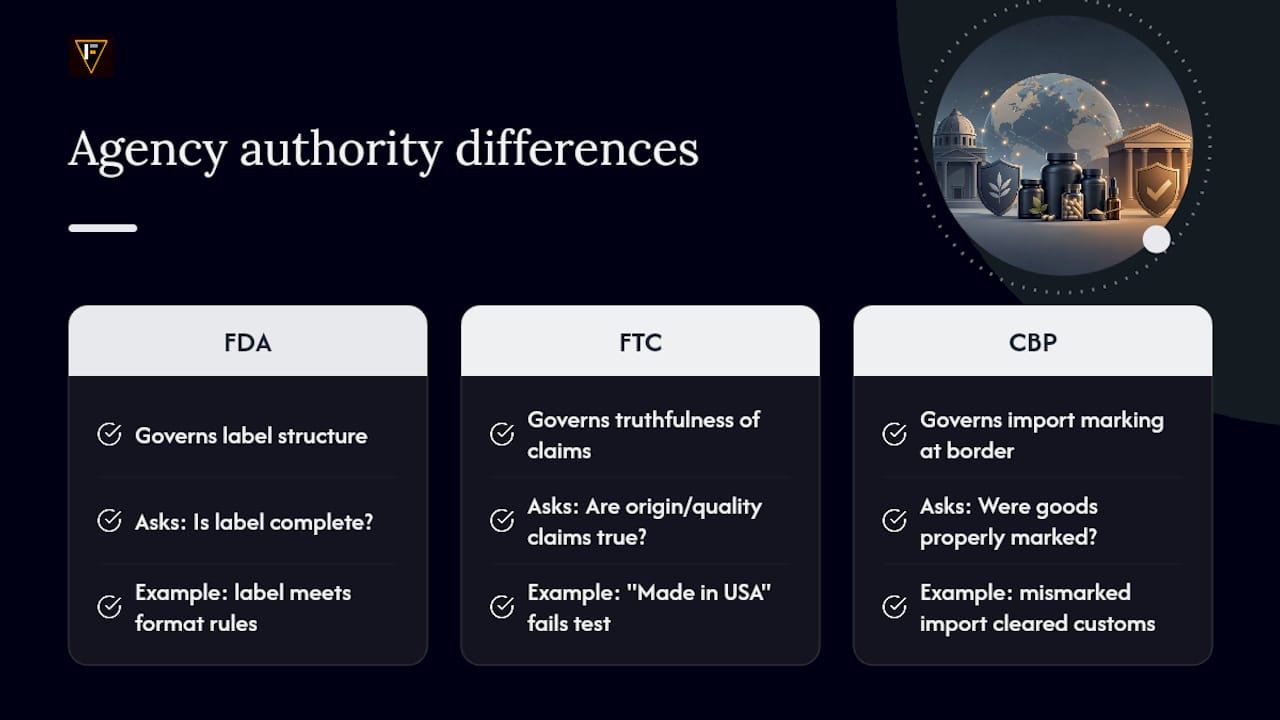
These three agencies rarely talk to each other directly, which is exactly why brands get caught in the gaps between them. FDA governs the structure and required content of your label. FTC governs the truthfulness of origin and quality claims wherever they appear, on the label or off it. CBP governs whether an imported item is properly marked before it ever reaches your warehouse.
A supplement can be fully FDA-compliant, with every required statement in its correct panel, while still failing FTC's Made in USA test and separately failing CBP's marking requirement, because a mismarked import passed customs without appropriate origin disclosure. Each agency evaluates a different question: FDA asks if the label has what it must have, FTC asks if the claims are true, and CBP asks if the physical goods were marked correctly at the border.
Industry guidance from AHPA specifically calls out this tension, noting that CBP's substantial transformation analysis and FTC's all-or-virtually-all standard are separate legal tests that can produce different answers for the same product. A finished capsule might satisfy CBP's transformation threshold for domestic origin marking purposes while still failing FTC's stricter ingredient-composition test for an unqualified marketing claim. That's not a contradiction in the law. It's two different agencies asking two different questions, and brands need to answer both correctly, not just the one that's easier to satisfy.
Exporting Supplements: Origin Rules Change by Market
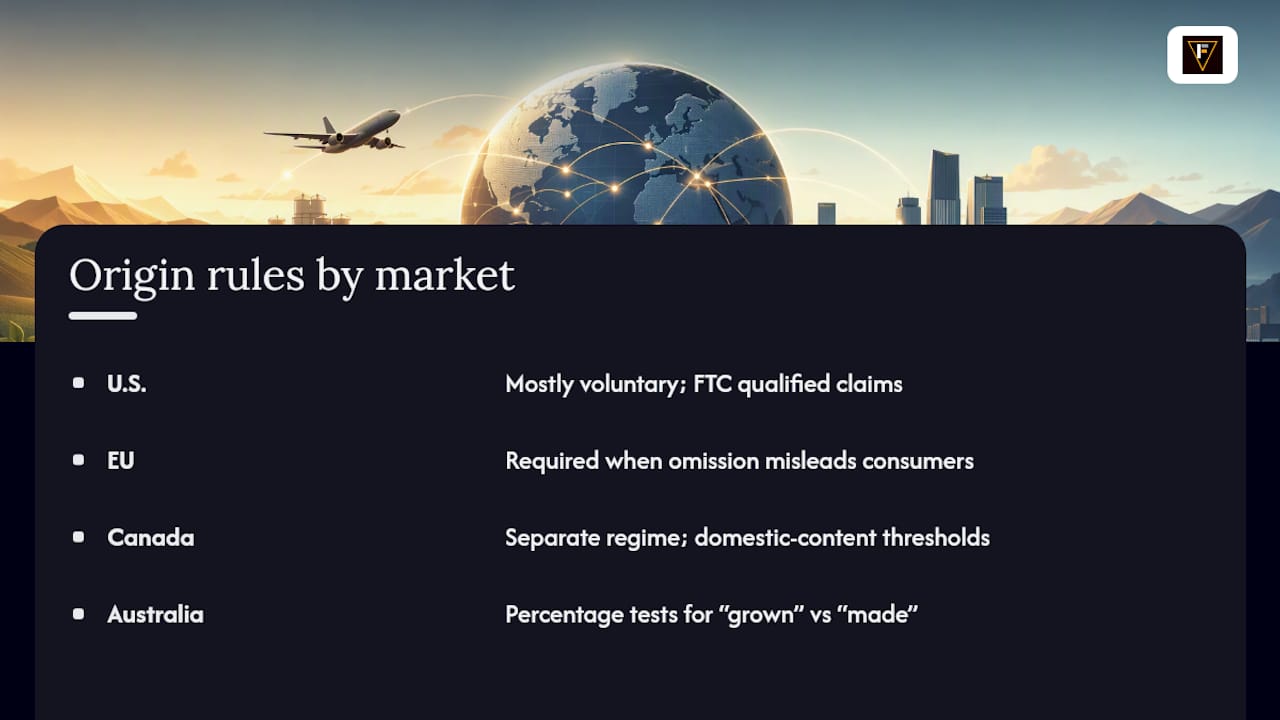
U.S. rules stop at the border. If you sell into the European Union, Canada, or Australia, expect a different set of origin disclosure requirements, and expect them to be less forgiving than the FTC's qualified-claim approach.
The EU generally requires country of origin to appear on food supplements when omitting it would mislead consumers about the product's true origin, a stricter default than the U.S. system where origin disclosure is largely voluntary outside of CBP's import marking rule. Canada's labeling regime, administered separately from its FTC-equivalent advertising rules, has its own specific thresholds for domestic content claims. Australia's consumer law treats country-of-origin claims on supplements with detailed percentage-based tests for "grown in" versus "made in" language, a more granular framework than the FTC's three-factor standard.
The practical takeaway for a U.S. brand expanding overseas: don't assume your FTC-compliant qualified claim travels. A phrase like "Manufactured in the USA from imported ingredients" that satisfies the FTC may need reformatting entirely to meet a destination market's disclosure threshold, sometimes requiring a specific percentage breakdown rather than a general qualifier. Brands entering export markets should treat origin labeling as a market-by-market review, not a single global label design, and budget legal review time for each new country before shipping product there.
Why Origin Labeling Shapes How Shoppers Trust a Supplement
Origin claims move purchasing behavior, which is exactly why the FTC scrutinizes them so closely. A supplement labeled with a clear, honest origin statement signals a level of transparency that shoppers increasingly expect, particularly in a category where ingredient sourcing has direct implications for purity and safety.
The marketing upside is real, but it only holds up when the claim is accurate. A brand that overstates its domestic content and gets flagged, whether by a regulator, a marketplace algorithm, or a competitor's complaint, loses more trust than it would have by using accurate qualified language from the start. Consumers who feel misled about origin tend to generalize that distrust to the brand's other claims, including potency and purity, which is a worse outcome than never making an origin claim at all.
The brands getting real marketing value from origin labeling are the ones treating ingredient transparency as a consistent practice rather than a single label line. That means matching origin claims across your product page, your Amazon listing, your Instagram captions, and your physical label, so a shopper who checks two channels sees the same story on both.
Multi-Ingredient Formulas Sourced From Several Countries
Most supplements aren't single-ingredient products, and that's where origin labeling gets genuinely complicated. A multivitamin with vitamin C from China, magnesium from Israel, and a domestically encapsulated shell doesn't have one origin. It has several, and your label needs to reflect that reality rather than default to whichever country sounds best.
Start by identifying which ingredients are "significant" to the formula versus which are minor excipients or fillers.
For most multi-ingredient supplements sourced globally, a qualified claim is simply the safer and more accurate choice. "Formulated in the USA; ingredients sourced globally" avoids the guesswork entirely and sidesteps the need to recalculate your claim every time a supplier or sourcing region changes. If you insist on an unqualified claim, you need documentation proving domestic origin for every active and inactive ingredient in that specific formula, which is a heavier substantiation burden than most brands anticipate until they're asked to produce it.
Where to Verify the Rules Yourself
- CBP country of origin marking guidance covers when imported ingredients or products must be marked.
- FTC's Made in USA standard and the Federal Register rule text cover origin marketing claims.
- FDA's Dietary Supplement Labeling Guide covers required label placement.
- Formlypro centralizes the documentation and claim drafting these rules require.
What Actually Matters Here, and What's Overrated
The compliance advice circulating in this category tends to fixate on wording templates, as if the right sentence solves the problem. It doesn't. The FTC evaluates consumer impression, documentation, and consistency across channels, and a brand with perfect phrasing but no supplier paperwork is just as exposed as one with sloppy phrasing.
What's genuinely underrated is the supply chain mapping step. Most brands can tell you their finished product's story but not which country supplied their magnesium stearate three suppliers back. That gap is exactly where enforcement risk lives now that Executive Order 14392 has raised the stakes on verification.
If you take one thing from this: build the documentation trail before you need it, not after a marketplace flags your listing. Everything else, the phrasing, the label layout, the qualifier prominence, is easier to get right once you actually know where your ingredients came from.
Frequently Asked Questions
Does the FDA require country of origin on supplement labels? No. FDA's labeling guide controls required statements like the Supplement Facts panel and net quantity, but it doesn't generally mandate an ingredient origin disclosure. Any origin requirement comes from CBP's import marking rules or from the FTC if you choose to make a marketing claim.
Can I say "Made in USA" if my capsules are made domestically but the vitamin C is imported? Not without qualification. The FTC's all-or-virtually-all standard requires ingredients to be domestic too, not just final assembly. A qualified claim like "Manufactured in the USA from domestic and imported ingredients" is the compliant alternative.
What happens if CBP finds an imported ingredient wasn't properly marked? Consequences can include additional duties, denial of entry, or seizure of the shipment, separate from any FTC exposure over marketing claims made about the same product.
Does Executive Order 14392 create new rules, or just enforce existing ones more aggressively? It directs agencies to prioritize enforcement of existing Made-in-America advertising rules rather than creating new statutory requirements, but it raises the practical odds that a borderline claim draws scrutiny.
Sources
- U.S. Customs and Border Protection — Country of origin marking
- FTC — Complying with the Made in USA standard
- Federal Register — Made in USA labeling rule (final rule)
- FDA — Dietary Supplement Labeling Guide: Chapter I. General Dietary Supplement Labeling
- White House — Executive Order 14392: Ensuring truthful advertising of products claiming to be made in America