

Amazon requires third-party TIC (Testing, Inspection and Certification) verification for dietary supplements sold on its U.S. marketplace. Sellers must show either NSF/ANSI 173 or NSF 229 certification, or a current Certificate of Analysis and GMP paperwork submitted directly by an approved TIC provider. All of it expires after a valid period requiring annual renewal. Skip it, and Amazon can pull your listing before you get a warning that feels adequate.
TL;DR:
- Third-party verification must be renewed annually through NSF/ANSI 173 or NSF 229 certification, or via current Certificate of Analysis and GMP paperwork from an approved TIC provider.
- Amazon's requirement now applies broadly to all dietary supplements sold in the U.S., with responsibility falling on the brand owner to maintain compliant documentation.
- Validation involves submitting samples or existing paperwork to an approved TIC, with results being directly submitted to Amazon, speeding up approval if documents are current.
- Accepted certifications and COAs must demonstrate product identity, potency, and absence of contaminants, with NSF programs and GMP certificates from accredited labs being most recognized.
- Costs, timelines, and pitfalls depend on SKU quantity, testing scope, and logistics, making proactive relationship-building with TIC providers key to avoiding delisting.
Table of Contents
- Amazon's Dietary Supplement Policy and Who It Applies To
- How Third-Party TIC Verification Actually Works
- Documents and Certifications Amazon Will Accept
- What Amazon's Testing Panels Actually Cover
- Timelines, Costs, and Where Sellers Get Tripped Up
- Your Compliance Checklist for Staying Listed
- How FormlyPro Supports Amazon-Ready Compliance Prep
- Why Amazon Made Verification Mandatory
- FormlyPro Gets Your Compliance Paperwork Amazon-Ready Faster
- Where to Verify These Requirements Directly
- Sources
Amazon's Dietary Supplement Policy and Who It Applies To
Amazon defines dietary supplements the way the FDA and DSHEA do: products meant to supplement the diet, containing vitamins, minerals, herbs, amino acids, or similar ingredients, sold in pill, capsule, powder, or liquid form. That's a broad net, and Amazon has been widening its policy to match.
The rule started narrower. Sports nutrition, weight management, and sexual enhancement categories drew stricter scrutiny first, since Amazon flagged these as higher-risk for adulteration. By 2025 and into 2026, the requirement expanded to cover dietary supplements broadly sold in the U.S. store, not just the categories that made headlines for contamination scandals.
Responsibility sits with the brand owner, the entity holding the ASIN, not the manufacturer, not a private-label filler, not your fulfillment partner. If your account owns the listing, you own the compliance obligation. That means:
- Checking Amazon Seller Central's Manage Your Compliance dashboard regularly for flagged ASINs
- Confirming which of your SKUs fall under the current enforcement wave
- Keeping documentation current even for ASINs that haven't been flagged yet, since enforcement keeps expanding
Amazon isn't asking politely. This is now baked into seller account health, and ignoring a compliance notice behaves like ignoring a policy violation notice for counterfeit goods.
How Third-Party TIC Verification Actually Works
Amazon notifies sellers through Seller Central, usually via a Manage Your Compliance dashboard alert tied to specific ASINs. From there, the process runs through a defined sequence:
- Review the notification. Amazon specifies which ASINs are flagged and what documentation category applies.
- Select an approved TIC provider. Amazon maintains a list of accepted testing, inspection, and certification bodies, updated monthly on Seller Central.
- Submit a Test Request Form (TRF) to your chosen TIC, detailing the product, facility, and existing documentation.
- Send samples or existing paperwork. If you have current COAs and GMP certificates, the TIC validates them. If not, they order new testing.
- The TIC submits directly to Amazon. Sellers don't upload the results themselves. That direct submission is the structural change from Amazon's old policy, where sellers self-attested and uploaded their own paperwork.
- Amazon updates listing status once verification clears, typically reflected in the compliance dashboard within days of TIC submission.
Validating existing documents moves faster than starting from scratch. If your COAs are current, from an ISO/IEC 17025 accredited lab, and match your GMP certifier's scope, a TIC can often clear you on document review alone. New testing adds lab turnaround time, generally weeks, not days.
If a listing gets suppressed anyway, Amazon provides an appeal path through Seller Central's case log, where you resubmit corrected or updated documentation. Appeals move faster when you've already got a TIC relationship rather than scrambling to find one after the fact.
Pro Tip: Start your TIC relationship before you get flagged. Providers with existing account history for your brand tend to process resubmissions faster than a cold submission from an unfamiliar seller.
Documents and Certifications Amazon Will Accept
Two document types anchor most submissions: GMP certificates and finished-product Certificates of Analysis. Amazon doesn't accept just any paperwork simply bearing a logo.
GMP and cGMP certificates need to come from an accredited third-party certifier, not a self-issued statement from your contract manufacturer. The certificate should specify the facility, the scope of certification, and an issue date that keeps it inside the 12-month window.
Finished-product COAs need several specific elements to pass review:
- Testing performed by an ISO/IEC 17025 accredited laboratory
- A batch or lot number matching the product currently listed
- A test date recent enough to satisfy the 12-month validity window
- Documentation of which tests were run (identity, potency, contaminants)
Certain certifications skip a lot of this friction because they auto-qualify an ASIN outright. NSF/ANSI 173, NSF 229, NSF Certified for Sport, USP Verified, BSCG, and Informed Choice/Informed Sport all count as recognized third-party programs under Amazon's policy.
Here's a number worth sitting with: NSF-cited research shows consumers are willing to pay a premium for certified supplement products. Certification isn't just a compliance checkbox, it's a small but real pricing lever on the retail side too.
Every one of these paths, certification or COA/GMP combo, carries the same 12-month clock. Mark your renewal date the day you receive approval, not the day it expires.
What Amazon's Testing Panels Actually Cover
Testing splits into two functional categories, and Amazon expects both depending on your product category.
Label claim and identity testing confirms the product contains what the label says, in the amounts stated. This applies to every supplement ASIN under the policy. If your label claims 500mg of ashwagandha extract, the lab verifies that potency, not just the presence of the ingredient.
Contaminant and adulterant panels go further, screening for:
- Heavy metals (lead, arsenic, cadmium, mercury)
- Microbial contamination (yeast, mold, pathogenic bacteria)
- Undeclared stimulants or pharmaceutical adulterants
- Category-specific banned substances
Sports nutrition, weight management, and sexual enhancement products draw the heaviest contaminant scrutiny, since these categories have historically shown the highest adulteration rates in FDA enforcement actions. If you sell a pre-workout or a "male enhancement" capsule, expect a fuller panel than a basic multivitamin brand would face.
Two standards do the heavy lifting here. NSF/ANSI 173 is the American National Standard for dietary supplements, covering label claims, contaminants, and ingredient purity in one certification. ISO/IEC 17025 isn't a product standard at all, it's a laboratory accreditation, meaning the lab itself has proven it runs valid, repeatable tests. Amazon and its TIC partners lean on 17025 accreditation as a proxy for "this data can be trusted," which is why a COA from an uncertified lab gets rejected even if the numbers look fine.
Timelines, Costs, and Where Sellers Get Tripped Up
Sellers contacted by Amazon commonly get a a limited window to initiate required action once notified. That sounds generous until you factor in lab scheduling, sample shipping, and the fact that most brands aren't sitting on a shelf of unopened product ready to ship to a lab that afternoon.
Cost scales with a few variables:
- Number of ASINs needing separate verification (each SKU typically needs its own COA)
- Panel breadth, a basic identity test costs far less than a full contaminant and adulterant screen
- Certification versus testing-only, pursuing NSF/ANSI 173 certification costs more upfront but covers you longer term
- Expedited service fees, which most TIC providers charge for rush turnaround
The pitfalls that actually cause delisting rarely involve fraud. They're logistics failures: an expired COA nobody tracked, a facility address on the GMP certificate that doesn't match your current co-packer, or a COA pulled from your ingredient supplier instead of the finished product you actually sell. Sample shipping problems, chain-of-custody gaps, wrong temperature control, cause more delays than any actual test failure.
Pro Tip: Build your sample logistics and document collection in parallel, not sequentially. Waiting for GMP paperwork before you ship lab samples adds weeks you don't need to lose.

Your Compliance Checklist for Staying Listed
Work through these steps in order, and don't skip the documentation audit even if you think your paperwork is current:
- Pull your flagged ASINs from the Manage Your Compliance dashboard in Seller Central.
- Collate identifying details for each product: ASIN, GTIN/UPC, and exact manufacturing facility address.
- Verify your GMP certificate matches the current facility and hasn't crossed the 12-month mark.
- Order fresh COAs from an ISO/IEC 17025 accredited lab if existing ones are expired or missing required fields.
- Choose your path: pursue NSF/ANSI 173 certification for longer-term coverage, or go the COA/GMP validation route through a TIC for faster near-term compliance.
- Select an approved TIC provider from Amazon's current list and submit your TRF.
- Track status through Seller Central and calendar your 12-month renewal the moment you're approved.
Consider Compliance Fast-Track if you already hold certification from a participating partner like BSCG, USP, or Informed. It can auto-validate a product without a full new submission cycle, though the Fast-Track partner list isn't identical to the approved TIC list, so confirm your certifier qualifies before assuming it applies.
| Decision Point | Choose Certification (NSF/ANSI 173) | Choose TIC Validation (COA/GMP) |
|---|---|---|
| Best for | Multi-retailer or long-term brands | Amazon-only sellers needing speed |
| Upfront cost | Higher | Lower |
| Renewal cycle | 12 months | 12 months |
| Retail benefit | Opens other certified-shelf channels | Amazon compliance only |
How FormlyPro Supports Amazon-Ready Compliance Prep
Getting a compliance packet together usually means chasing five different PDFs across three vendors while your listing countdown ticks. FormlyPro's 8-phase product development workflow builds documentation checkpoints into the formulation and manufacturer-vetting phases, so GMP scope and facility details get captured before a TIC ever asks for them.
The platform templates COA and GMP fields against what Amazon's TIC providers actually require, batch numbers, test dates, accreditation scope, and generates exportable compliance packets brands can hand off without reformatting anything. A built-in launch calendar flags renewal dates automatically, which matters most for the 12-month clock nobody remembers until it's already expired. For deeper walkthroughs on certification schemes and label requirements, FormlyPro's compliance resources cover the specifics category by category.
Why Amazon Made Verification Mandatory
Amazon's motive isn't mysterious: adulterated supplements generate lawsuits, FDA warning letters, and brand damage that lands on the marketplace as much as the seller. Shifting verification to accredited TICs moves liability off Amazon's self-attestation model and onto documented, auditable proof.
For brand owners, the strategic move is prioritizing your highest-risk SKUs first, sports nutrition and weight management especially, and treating NSF/ANSI certification as an investment that pays off beyond Amazon if you ever expand into retail or other certified-shelf channels. Budget for the renewal, not just the first submission.
— Ben
FormlyPro Gets Your Compliance Paperwork Amazon-Ready Faster
Most brands lose weeks not to lab science but to disorganized paperwork, a GMP certificate here, a COA scattered in an email thread there, none of it formatted the way a TIC actually wants to see it. FormlyPro closes that gap by building compliance documentation directly into your product development process instead of treating it as a scramble after Amazon flags your ASIN.
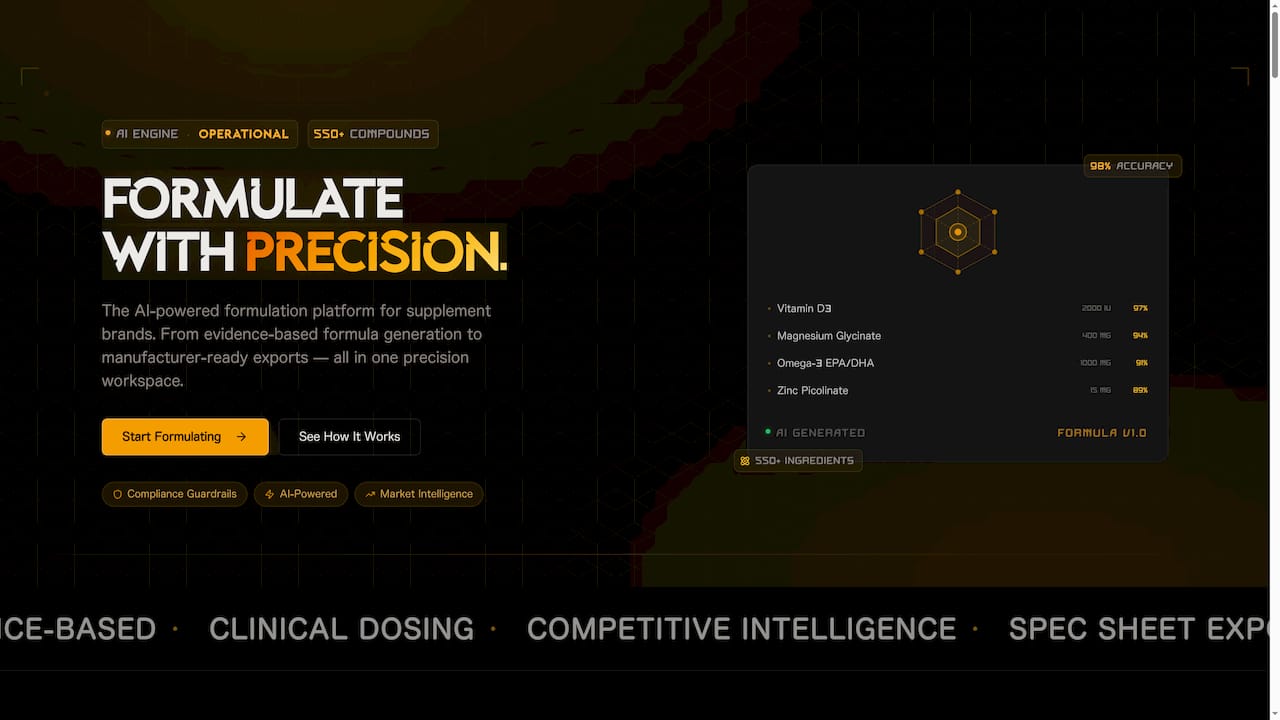
The platform's compliance guidance walks brands through FDA and DSHEA requirements phase by phase, and the export tools generate manufacturer-ready packets formatted for direct TIC submission. Pair that with Pure Blue's consumer education content if you want context on how shoppers actually evaluate supplement claims before they buy. Start a FormlyPro subscription today and build your next ASIN's compliance packet before Amazon ever sends the notification.
Where to Verify These Requirements Directly
For policy specifics, go straight to NSF's compliance FAQ and ANAB's seller requirements guide. For the underlying regulatory text, the FDA's dietary supplement labeling guide covers 21 CFR 101.36 and 111 directly, while Epstein Becker Green's analysis breaks down the approved TIC provider list.
This article is general information, not a substitute for advice from a qualified doctor. Consult a qualified healthcare professional about your own circumstances before acting on anything here.
Sources
- Amazon’s New Dietary Supplements Policy: Enhancing Safety and Compliance — NSF
- Amazon Dietary Supplements Seller Requirements — ANAB
- Amazon's Third-Party Supplement Testing Mandate Explained — Epstein Becker Green
- Amazon requires testing for all supplements — SupplySide