

TL;DR:
- Food brands in the US must meet FDA regulations and pursue voluntary GFSI-recognized certifications to access major markets. Certifications like SQF, FSSC 22000, and BRCGS require ongoing audits and continuous improvement efforts, ensuring long-term brand credibility. Proper compliance tracking and documentation, supported by platforms like Formlypro, streamline preparation and maintenance of these certifications.
The most important regulatory certifications for food brands operating in the United States are FSSC 22000, SQF, BRCGS, ISO 22000, HACCP, GMP, and IFS. These certifications are not legally required in most cases, but they are practically unavoidable if you want shelf space at major retailers, access to global supply chains, or any real credibility with buyers. Here is a quick orientation before the deep dive:
- FSSC 22000 (Food Safety System Certification 22000): A GFSI-benchmarked standard built on ISO 22000, covering food safety management across the entire supply chain.
- SQF (Safe Quality Food): A GFSI-recognized, HACCP-based program covering food safety and quality management, with over 14,000 certified sites globally, as of mid-2026.
- BRCGS (British Retail Consortium Global Standards): A GFSI-benchmarked standard focused on food safety, quality, and operational criteria, widely required by UK and US retailers.
- ISO 22000: An international standard for food safety management systems, applicable across the entire food chain from farm to fork.
- HACCP (Hazard Analysis and Critical Control Points): A science-based system for identifying and controlling food safety hazards; foundational to most other certifications.
- GMP (Good Manufacturing Practices): FDA-aligned baseline standards for facilities, equipment, and processes that every food manufacturer must meet.
- IFS (International Featured Standards): A GFSI-recognized standard popular with European retailers but increasingly relevant for US brands exporting abroad.
The Global Food Safety Initiative (GFSI) benchmarks most of these standards, meaning a brand certified to one GFSI-recognized scheme is generally accepted by retailers and buyers who require another. That mutual recognition is what makes GFSI benchmarking so commercially valuable.
How do the major food safety certifications compare?
Choosing the right certification depends on your product type, your target retail channels, and where your customers are. The table below maps the key differences across the certifications that matter most in the US market.

| Certification | Scope and focus | GFSI recognized | US market applicability | Certification process overview | Key benefits for food brands |
|---|---|---|---|---|---|
| FSSC 22000 | Full supply chain food safety management | Yes | High; accepted by major US and global retailers | Gap analysis, system implementation, third-party audit, certificate issued | Broad retailer acceptance, international recognition |
| SQF | Food safety and quality management, HACCP-based | Yes | Very high; preferred by many US retailers | Pre-assessment, audit, corrective actions, annual recertification | Strong US retail access, covers safety and quality together |
| BRCGS | Food safety, quality, and operational standards | Yes | High; required by many UK-origin and US retailers | Supplier registration, audit (announced or unannounced), graded outcome | Retailer trust, global market access |
| ISO 22000 | International food safety management system | Yes (via FSSC 22000) | Moderate; often used as a foundation for FSSC 22000 | Documentation, internal audit, third-party certification body audit | Global supply chain credibility, proactive hazard control |
| HACCP | Hazard identification and critical control points | Foundational to GFSI schemes | Very high; embedded in FDA and USDA expectations | Hazard analysis, CCP identification, monitoring plan, verification | Regulatory alignment, risk reduction |
| GMP | Facility, equipment, and process baseline standards | Foundational | Universal; required by FDA for all food manufacturers | Facility assessment, documentation, ongoing monitoring | Legal baseline compliance, prerequisite for other certifications |
| IFS | Food safety and quality for retail-branded products | Yes | Moderate; growing relevance for US brands with European distribution | Supplier registration, audit, corrective action plan | European retail access, quality management alignment |
One practical note: HACCP and GMP are not standalone certifications you pursue in isolation. They are prerequisites baked into every GFSI-recognized scheme. If you are pursuing SQF or FSSC 22000, you are already building HACCP and GMP compliance into the process.
FDA compliance is not the same as being certified
This distinction trips up a lot of food brand owners. FDA regulatory compliance is mandatory. Certifications are voluntary. Conflating the two creates real gaps in your compliance strategy.
The FDA regulates approximately 80% of the US food supply, covering packaged foods and beverages, while the USDA oversees meat, poultry, dairy, and organic products. Every food manufacturer must meet FDA baseline requirements under the Federal Food, Drug, and Cosmetic Act regardless of any certification status. That means compliant Nutrition Facts labels per 21 CFR Part 101, proper allergen declarations under FALCPA, and adherence to current Good Manufacturing Practices. The FDA's last major label update came in 2016, and those requirements remain in force today.
Certifications like HACCP and GMP help brands demonstrate alignment with FDA and USDA expectations, but they do not replace legal obligations. A brand can hold an SQF certificate and still receive an FDA warning letter for a labeling violation. The two tracks run in parallel.
Common FDA compliance challenges food brands face include:
- Nutrition Facts label errors: Incorrect serving sizes, missing mandatory nutrients, or outdated formatting.
- Allergen mislabeling: Failure to declare the nine major allergens under FALCPA, including sesame (added in 2023).
- Facility registration: All food facilities must register with the FDA under FSMA and renew every two years.
- FSMA Preventive Controls: The Food Safety Modernization Act requires written food safety plans with hazard analysis and preventive controls for most manufacturers.
Pro Tip: Before pursuing any voluntary certification, audit your FDA compliance baseline first. A gap in your Nutrition Facts label or a missing allergen declaration can derail a certification audit just as fast as a facility hygiene issue. Formlypro's compliance guidance tools can help you map both tracks simultaneously.
Getting your food labeling right before you walk into a certification audit saves time and money. Auditors will check label compliance as part of their documentation review.
How certifications support quality management and long-term brand growth
Certifications are not a finish line. They are a management system you operate continuously, and that ongoing discipline is where the real business value comes from.
BRCGS, for example, requires ongoing audits and continuous improvement, including unannounced audits every three years. Failing an audit does not just mean paperwork. It can lead to certificate suspension, which can trigger retailer delisting. That commercial consequence is what makes certification maintenance a business-critical function, not just a quality team task.
Certification bodies issue certificates within approximately 42 days after a successful audit and resolution of any non-conformities. But the preparation phase is where brands lose the most time. Expect to spend months building documentation, training staff, and running internal audits before your first external audit. Brands that treat certification as a project rather than a system tend to struggle at renewal.
NSF notes that independent certification provides competitive advantage and trusted assurances to retailers, reducing supply chain risk and protecting brand reputation. That is not marketing language. Retailers like Whole Foods, Costco, and Walmart have supplier requirements that reference GFSI-recognized certifications directly. Without one, you may not even get a conversation.
ISO 22000 drives proactive hazard control and aligns international standards for global supply chains, which matters if you are selling into markets beyond the US. The shift from reactive to preventive safety culture is what separates brands that scale cleanly from those that manage crises.
A few practical realities on cost and timeline:
- Initial certification costs vary by scheme, facility size, and certifying body. Costs are not publicly standardized, so get quotes from multiple accredited certification bodies.
- Certification bodies must be accredited for the specific standard they audit. Always verify accreditor credentials before signing a contract.
- Annual surveillance audits are standard across most schemes. Budget for them as an ongoing operational cost, not a one-time expense.
- Non-conformities found during audits must be resolved within defined timeframes. Unresolved major non-conformities lead to suspension.
For food entrepreneurs building their compliance and certification strategy from the ground up, best practices for food entrepreneurs cover the audit preparation and continuous improvement processes that certification bodies expect to see.
Choosing the right certification comes down to three questions: Where are you selling? Who are your buyers? And what does your supply chain look like? A US brand selling to domestic grocery chains should prioritize SQF or FSSC 22000. A brand with European distribution needs IFS or BRCGS. A startup building its first food safety system should start with HACCP and GMP as the foundation, then layer a GFSI-recognized scheme on top once the basics are solid.
How Formlypro helps you manage compliance from day one
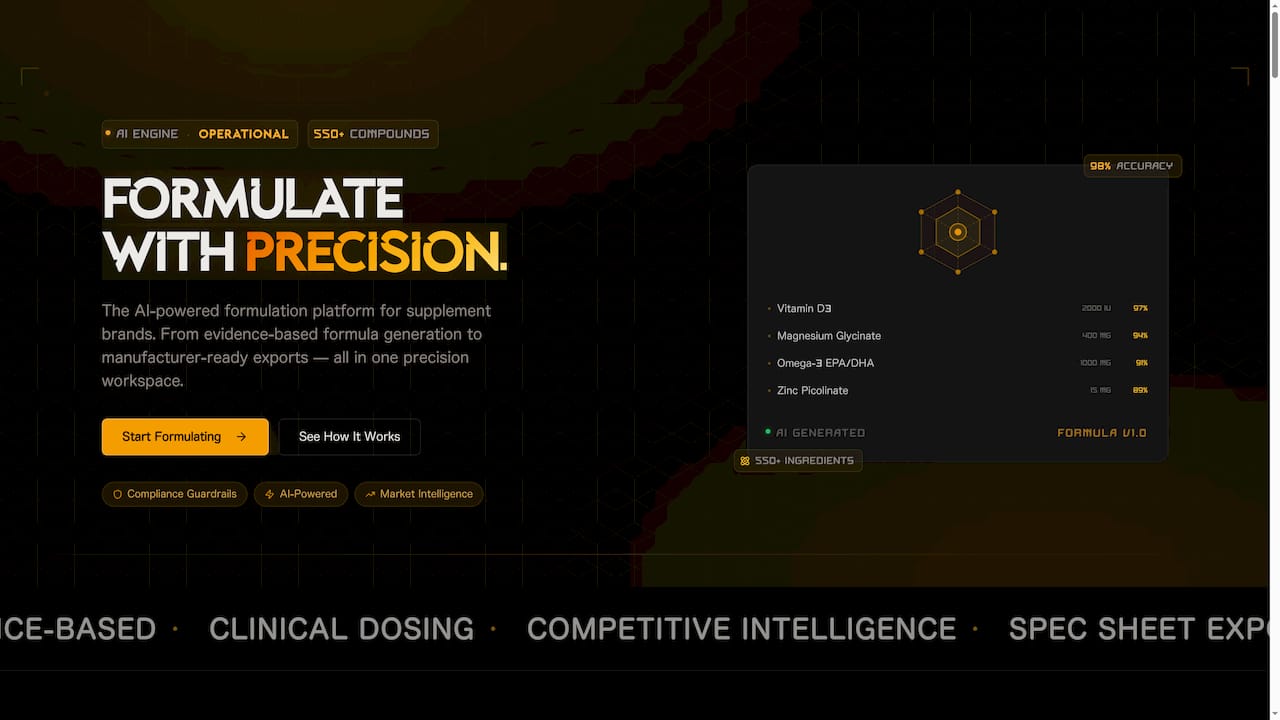
Formlypro is built for exactly this challenge. The platform walks food brands through an 8-phase product development process that includes formulation, market research, and a full compliance track covering FDA labeling requirements, certification readiness, and regulatory documentation. You are not piecing together guidance from three different consultants. It is all in one place.
The compliance module maps your product against current FDA requirements, flags labeling gaps, and helps you build the documentation foundation that certification auditors expect. The AI Mockup designer handles packaging, so your labels meet both regulatory and retail standards before you go to print. If you are building a new food brand or preparing for your first certification audit, start with Formlypro and skip the guesswork.
Key Takeaways
Regulatory certifications for food brands require a dual-track approach: mandatory FDA compliance as the legal baseline, and voluntary GFSI-recognized certifications as the commercial and quality management layer above it.
| Point | Details |
|---|---|
| FDA compliance is mandatory | All US food brands must meet FDA labeling, allergen, and FSMA requirements regardless of certification status. |
| GFSI benchmarking drives retailer access | SQF, FSSC 22000, BRCGS, and IFS are GFSI-recognized, making them accepted across major US and global retail buyers. |
| SQF leads in US market reach | SQF has a large global certified sites network and is preferred by many US retailers for food safety and quality management. |
| Certifications require continuous maintenance | BRCGS and other schemes require ongoing audits, including unannounced visits, with suspension as the consequence of failure. |
| Start with HACCP and GMP | These foundational systems are prerequisites for every GFSI-recognized scheme and align directly with FDA expectations. |