

Technology adoption matters because it directly moves the numbers leaders get judged on: output per employee, cost per unit, customer retention, and how fast a company can scale. The OECD finds that firms adopting advanced digital tools consistently outperform non-adopters on productivity, though the gain depends on pairing the tool with trained people and working infrastructure. Firm-level World Bank research backs this with measurable productivity premiums after adoption. Platforms like Formlypro exist for exactly this reason: to give brand teams a structured path from formulation to launch instead of a scattered one.
The gains cluster into four areas:
- Higher output per employee once workflows digitize
- Lower operating costs from fewer manual errors and rework
- Better customer experience through faster response and personalization
- Faster scaling because repeatable processes replace ad hoc ones
Table of Contents
- Why Technology Adoption Matters More Than Most Leaders Assume
- What Stops Technology Adoption From Working
- How Can Leaders Increase the Odds of Successful Adoption?
- How Do You Measure ROI on Technology Adoption?
- The Five Stages of Technology Adoption
- What Does the Research Actually Say About Adoption?
- A Practitioner's Take on Getting Started
- Frequently Asked Questions
- Sources
Why Technology Adoption Matters More Than Most Leaders Assume
The productivity case is not theoretical. World Bank data on manufacturing firms in developing economies found positive revenue-based total factor productivity gains tied to something as basic as adopting email and company websites. If tools that are unglamorous move the needle, the case for purpose-built platforms in a specific industry is stronger still.
In product development, a formulation team using structured AI-driven workflows can cut the time between concept and prototype substantially, because ingredient research and compliance checks that used to take weeks of back-and-forth with consultants now happen inside one system. In manufacturing, digitized quality tracking shortens the feedback loop between a defect and a fix. In retail, real-time inventory data prevents the double loss of stockouts and overstock at the same time.
None of this shows up on day one. The OECD's research documents a J-curve pattern: productivity often dips while teams learn a new system, then climbs past the old baseline once the tool is embedded in daily work. Leaders who expect an immediate spike often kill a good initiative during the dip, mistaking the learning cost for failure.
Adopters of advanced digital technologies tend to be more productive than non-adopters, but that advantage depends heavily on the human and technological capital surrounding the tool, not the tool alone.
A separate event study of 134 U.S. firms found that profitability and operational metrics like return on assets and inventory turnover improved measurably, but mostly in the period after implementation, not immediately around the announcement. Patience built into the measurement plan matters as much as the technology choice itself.
What Stops Technology Adoption From Working
Most adoption failures are not technology failures. A rapid evidence review from the UK government found that cost and skills gaps top the list of barriers across surveyed studies, and smaller firms consistently adopt advanced technologies at lower rates than larger ones. Integration cost is a real number: connecting a new system to existing databases, retraining staff, and cleaning up legacy data can cost more than the software license itself.
The behavioral side is harder to budget for. Teams resist tools that threaten their expertise or add visible extra work before the payoff arrives. Research on technology diffusion from WIPO makes a point leaders underrate: user acceptance and aligned incentives often decide adoption outcomes more than the software's actual feature set. A brilliant tool nobody wants to use is worse than a mediocre tool everyone adopts.
Diffusion depends less on technical superiority and more on whether the people using the tool see a clear, immediate reason to change how they work.
Pro Tip: Fund training time as a line item, not an afterthought. Blocking two paid hours a week for the first month of rollout does more to prevent quiet abandonment than any feature upgrade.
How Can Leaders Increase the Odds of Successful Adoption?
Adoption succeeds when it follows a sequence, not a launch date. This order works across industries:
- Define the business outcome and KPIs first. Decide what "success" means in numbers before selecting a tool.
- Pilot with a narrow, clear scope. One product line, one team, or one process, not a company-wide rollout.
- Align sponsors and end users early. The people using the tool daily need a voice in choosing it.
- Invest in training and change management. Budget time and money for this before go-live, not after complaints start.
- Scale only with measurement in place. Expand once the pilot shows results against the KPIs set in step one.
The biggest early lift usually comes from low-complexity automation: digitizing a paper process, centralizing scattered spreadsheets, or automating a compliance check that used to require manual review. These wins build the internal case for bigger investments later. A brand team piloting a structured 8-phase development workflow on one product line, for instance, can prove the model before rolling it across an entire portfolio.
On budgeting, tie spend to outcomes rather than an arbitrary percentage of revenue. A company chasing faster time-to-market should fund the workflow and compliance tools that shrink that specific timeline, not whatever platform has the most features. The MDPI event study reinforces this: value comes from how a firm deploys a technology and reworks its processes around it, not from simply owning the license.

How Do You Measure ROI on Technology Adoption?
Group your KPIs by domain so you are not just tracking one number:
- Productivity metrics: time saved per task, output per employee
- Process metrics: error rate, cycle time from concept to launch
- Financial metrics: revenue per employee, cost per unit
- Customer metrics: retention rate, Net Promoter Score
Expect a dip before a rise. The J-curve pattern means a pilot that looks flat or slightly worse in month one is not automatically a failed pilot. Build guardrails instead of an abort switch: set a review point at 90 days, not 30, and compare against the pre-adoption baseline rather than an idealized target. Calculate pilot ROI simply: (value gained minus cost of the pilot) divided by cost of the pilot. If that ratio clears your threshold by the 90-day mark, scale. If it does not, diagnose whether the shortfall is the tool or the rollout before scrapping either.
The Five Stages of Technology Adoption
Every rollout moves through the same five stages, whether the team realizes it or not:
- Awareness. Leadership action: surface the problem the technology solves. Metric: number of stakeholders briefed.
- Interest. Action: run a demo or vendor evaluation. Metric: number of teams requesting a pilot.
- Evaluation and pilot. Action: launch a scoped pilot with a fixed end date. Metric: pilot KPI performance against baseline.
- Adoption and implementation. Action: roll out to the full team with training support. Metric: active usage rate.
- Scaling and embedding. Action: fold the tool into standard operating procedure. Metric: sustained performance after support is withdrawn.
Skipping stage three is the single most common shortcut that backfires. A pilot without a fixed scope quietly becomes a permanent half-rollout that never gets measured properly.
What Does the Research Actually Say About Adoption?
The empirical picture is more nuanced than "adopt and you will grow." World Bank data shows productivity premiums vary significantly across firms and technologies, and adoption alone does not guarantee results without complementary skills and infrastructure in place. Larger firms and those with existing digital capability tend to capture more value from the same tool than smaller or less-prepared firms.
An IMF working paper using historical Korean data adds a strategic layer: adoption drives faster catch-up productivity growth for firms and economies further from the frontier, but as capability closes the gap, the returns shift toward internal innovation instead. That has a direct parallel for any brand choosing between licensing proven external technology and building in-house: adopt first to catch up, then innovate once you're near the front of your category.
Historical evidence shows adoption can deliver rapid productivity catch-up, but the relative payoff of adoption versus innovation shifts as a firm narrows the gap with the frontier.
Complementary investment in skills and process redesign is doing a lot of the work.
A Practitioner's Take on Getting Started
The guide above holds up because it treats adoption as a management problem first and a technology problem second. If you want a shortcut, run a six-week pilot on one product line with three KPIs decided in advance, not five vague hopes.
In the next 48 hours: pick that one process, name the KPI, and assign one owner accountable for the pilot's outcome. Everything else follows from that decision.
Technology adoption pays off reliably only when leaders pair the tool with trained people, clear incentives, and a measurement plan built around a realistic post-implementation timeline.
| Point | Details |
|---|---|
| Productivity depends on complements | Tools deliver gains mainly when paired with trained staff and working infrastructure, per OECD findings. |
| Expect a J-curve dip | Productivity often dips before rising during the learning period, so plan reviews at 90 days, not 30. |
| Cost and skills gaps lead barriers | The Gov found financial cost and workforce skills gaps as top adoption barriers. |
| Pilot narrow, scale with proof | Test on one product line or team with fixed KPIs before rolling out company-wide. |
| Adoption enables catch-up, then innovation | Firms further from the frontier gain more from adoption; returns shift toward innovation as capability closes the gap. |
Frequently Asked Questions
Why does technology adoption matter for small businesses specifically? Smaller firms adopt advanced technologies at lower rates than larger firms, largely due to cost and skills constraints documented in the GOV.UK barrier review. That means the productivity gap between adopters and non-adopters can hit smaller companies harder, making early, well-scoped pilots especially valuable for leveling the field.
How long before technology adoption shows measurable ROI? Most benefits appear after an implementation period rather than immediately. The event study of 134 U.S. firms found profitability and operational gains materializing in the months following rollout, not at the announcement, so a 90-day review window is more realistic than a 30-day one.
What is the single biggest reason technology adoption fails? Missing complementary organizational change. Tools underdeliver when processes, incentives, and management practices around them stay the same, which can even cause short-term productivity to decline before the technology's benefits appear.
Should a company build custom technology or adopt an existing platform? It depends on how close the firm is to the leading edge of its category. Firms further behind typically gain more, faster, from adopting proven external technology; firms already near the frontier see better returns from investing in internal innovation.
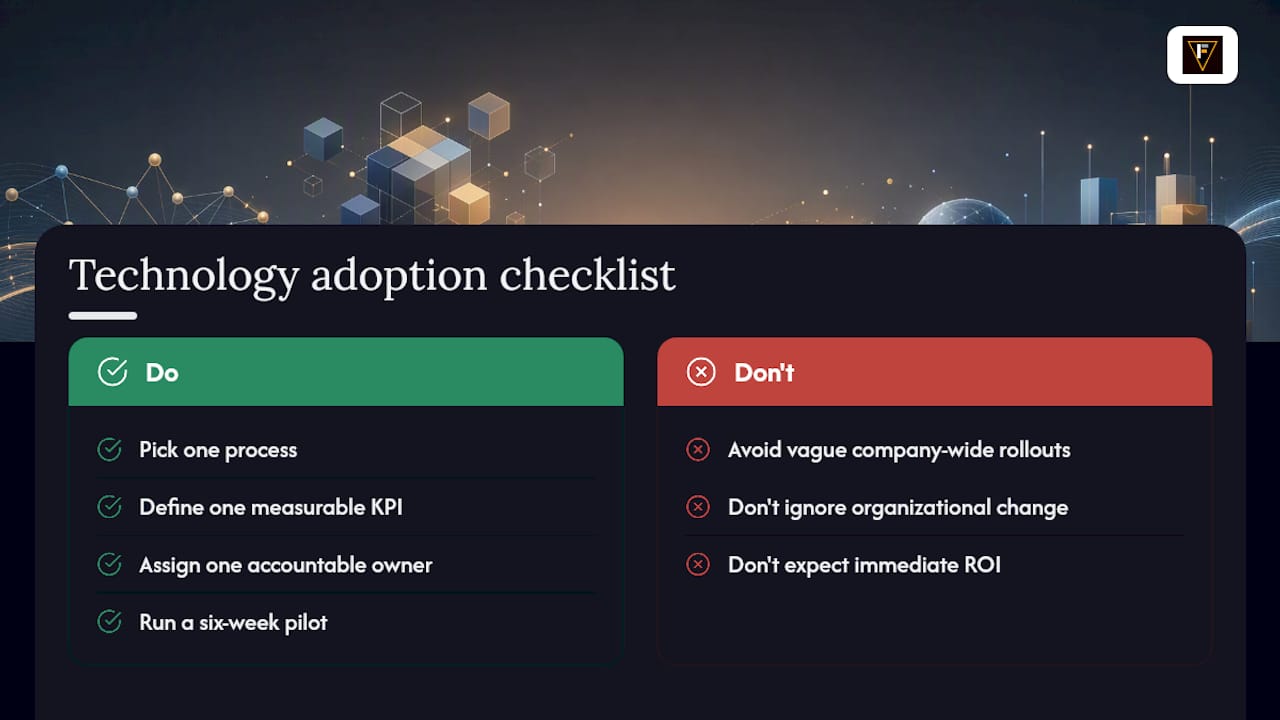
What is one immediate step a leader can take to start improving technology adoption? Pick one process, define one measurable KPI, and assign a single accountable owner for a six-week pilot. That narrow scope prevents the common failure of a vague, company-wide rollout with no clear success measure.
Sources
- The effects of digital technology adoption on productivity and factor demand: Firm-level evidence (World Bank)
- Impact of emerging digital technologies on firms’ financial performance, inventory efficiency, and greenhouse gas emissions: An event study (MDPI, 2026)
- From adoption to innovation: State-dependent technology policy in developing countries (IMF WP/24/154)