

Brand storytelling matters because it turns abstract offerings into emotional meaning that drives trust, preference, and recall. A product spec sheet tells buyers what you sell. A story tells them why it exists, who it's for, and what it changes. That distinction is what separates brands people remember from ones they forget.
Three effects show up consistently across research and practice:
- Emotional connection: Stories activate identification and empathy in ways that feature lists cannot, creating the kind of loyalty that survives a competitor's price cut.
- Trust-building: A large majority of buyers globally say brand trust is as important as price and quality, and a coherent narrative reduces the skepticism that slows purchase decisions.
- Differentiation and memorability: According to HBS Online's framing from Jill Avery, brands that tell compelling stories help customers move from their current state to a desired future state, which is the psychological mechanism behind why story-framing boosts preference over functionally similar competitors.
Industry analysis from System1 and the Binet & Field body of work consistently finds that emotionally effective storytelling produces stronger long-term brand growth than purely rational messaging.
Key Takeaways
Brand storytelling matters because it creates emotional connection, builds trust, and drives differentiation, and the brands that treat it as an operational discipline consistently outperform those that treat it as a campaign.
| Point | Details |
|---|---|
| Emotional connection drives loyalty | Stories activate identification that feature lists cannot, reducing churn and increasing advocacy. |
| Trust is a measurable business lever | A large majority of buyers globally say brand trust is as important as price and quality. |
| Customer-as-protagonist is the core technique | Centering the customer's conflict, not the brand's achievements, creates stronger identification and action. |
| Measure in three phases | Track recall and engagement at —, preference and conversion at —, and retention at —. |
| Formlypro operationalizes story-led launches | The platform aligns formulation, packaging, compliance, and market research with the brand narrative from day one. |
Table of Contents
- What is brand storytelling, and what makes it work?
- Why brand storytelling matters for business outcomes
- What does the research actually show?
- How Warby Parker, Airbnb, Nike, and Burt's Bees use storytelling
- How to put brand storytelling into your marketing
- How do you measure storytelling's impact?
- Common mistakes that undermine brand storytelling
- Your 30/90/180-day storytelling starter checklist
- Storytelling should be treated as an operational capability
- Formlypro connects your brand story to your product
- Sources
What is brand storytelling, and what makes it work?
Brand storytelling is the practice of building a foundational narrative around why a brand exists, who it serves, and the emotional payoff it delivers. It goes beyond a tagline or an origin paragraph on an "About" page. The story is the connective tissue that makes every touchpoint, from a product page to a sales call to a package insert, feel like it comes from the same source.
A practical way to audit whether your team actually has a story is the People + Places + Purpose + Plot framework:
- People: Who is the protagonist? (Almost always the customer, not the founder.)
- Places: What context or world does the story live in?
- Purpose: Why does the brand exist beyond making money?
- Plot: What is the conflict the customer faces, and how does the brand resolve it?
When teams document all four pillars, storytelling scales. Internal messaging variance drops because everyone is drawing from the same narrative foundation rather than improvising.
Why brand storytelling matters for business outcomes
The commercial case for storytelling rests on four concrete levers, each tied to a measurable business outcome.
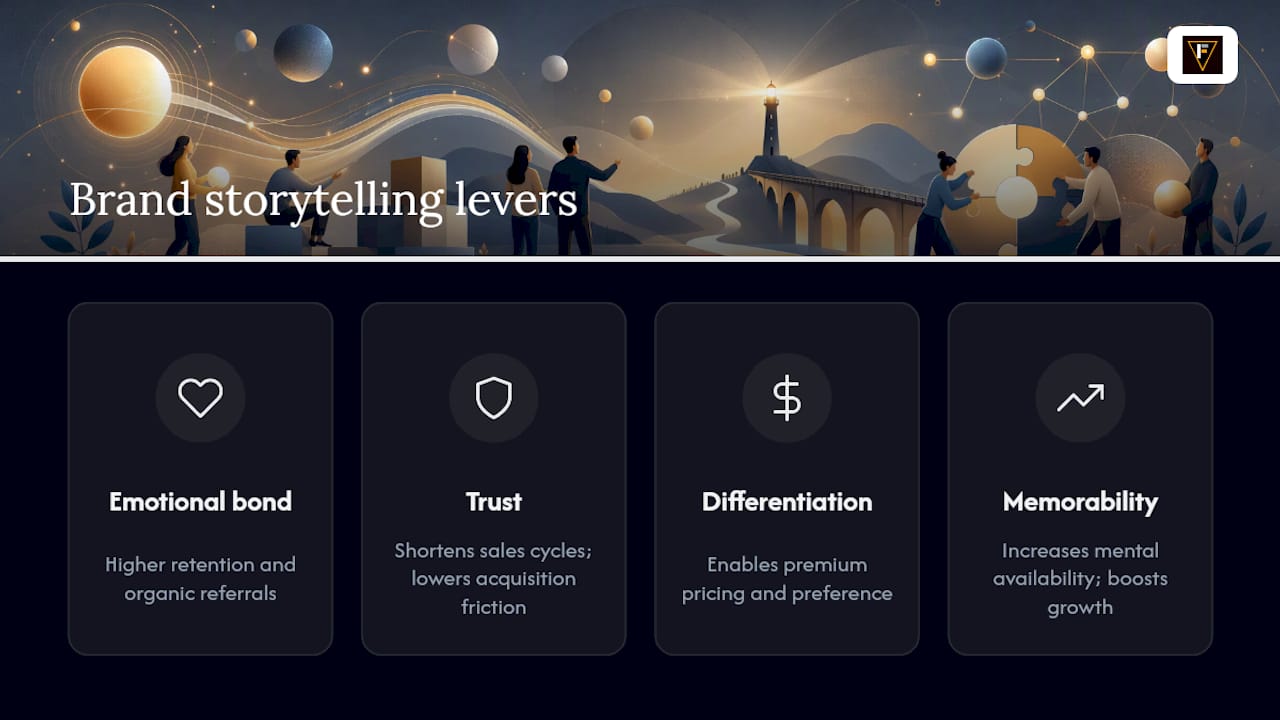
Emotional connection drives loyalty and advocacy. Rational arguments convince people once. Emotional resonance keeps them coming back and gets them talking. Brands that create genuine identification with their audience tend to see higher retention and more organic referrals, both of which reduce long-term customer acquisition costs.
Trust lowers acquisition friction. Skepticism is expensive. When a prospect doesn't trust a brand, they research longer, require more touchpoints, and convert at lower rates. A coherent story that aligns with the actual product experience shortens that cycle. In B2B specifically, a consistent "why" narrative across stakeholders reduces internal friction and can shorten sales cycles meaningfully.
Differentiation creates premium and preference. In crowded categories where products are functionally similar, the story is often the only real differentiator. Brands with a clear narrative can charge more and hold position longer because their identity is harder to copy than a formula or a feature.
Memorability increases mental availability. Emotional, high-fluency creative consistently produces stronger long-term brand growth, according to industry analysis drawing on Binet & Field's The Long and the Short of It. Mental availability, the probability that a buyer thinks of your brand in a purchase moment, is built through repeated, emotionally resonant exposure. Story is the format that makes that repetition feel worth receiving.
The benefits apply differently by context. In B2C, emotional connection and memorability are the primary levers, especially for awareness-stage campaigns. In B2B, trust and differentiation tend to matter more, particularly in sales enablement, where a story helps a champion inside a buying organization sell the solution internally. Building trust as a measurable brand asset requires treating narrative consistency as a discipline, not a campaign.
What does the research actually show?
The evidence base for storytelling's effects spans academic studies, empirical SME research, and large-scale industry analysis. Here is what the strongest sources find and what each means for practitioners.
| Source | What it measured | Key finding | Practical implication |
|---|---|---|---|
| HBS Online / Jill Avery | Psychological framing of brand choice | Story bridges "current state" to "desired future state," explaining brand preference | Frame your narrative around the customer's aspiration, not your product's attributes |
| Springer / Journal of Brand Management | SME survey-based regression analysis | Strategic and tactical storytelling are both positively related to brand positioning and performance | Even small teams with limited budgets can operationalize storytelling effectively |
| ScienceDirect organizational review | Cross-functional storytelling adoption | Embedding storytelling across functions improves shared understanding and delivers value beyond marketing | Story should inform R&D, sales, and HR messaging, not just ad copy |
| System1 / Binet & Field synthesis | Long-term brand growth and ad efficiency | Emotionally effective creative produces stronger long-term growth than rational messaging | Prioritize emotional resonance in brand campaigns alongside performance metrics |
| HubSpot brand story guide | Practitioner frameworks and buyer trust data | A large majority of buyers globally say trust is as important as price and quality | Trust-building through story is a direct lever on conversion and retention |
A note on evidence strength: the Springer SME study and the ScienceDirect review are correlational, not causal. They show that storytelling-oriented brands tend to perform better, but they cannot isolate storytelling as the sole driver. The System1 and Binet & Field work is the strongest causal signal because it draws on large-scale advertising effectiveness databases. Use the academic findings to justify investment and the industry analysis to set creative direction.
Narrative processing also explains why stories work at a cognitive level. People organize experiences through narratives, and when a brand story maps onto that structure, it creates self-brand connections that go deeper than rational preference.
How Warby Parker, Airbnb, Nike, and Burt's Bees use storytelling
These four brands represent different storytelling approaches, and each one has a lesson that transfers directly to other categories.
Warby Parker: purpose as the plot engine
Warby Parker's founding story, two friends who couldn't afford to replace lost glasses, is not just an origin anecdote. It is the plot of every product decision the company makes. The "buy a pair, give a pair" program turns the customer into a co-protagonist: buying glasses becomes an act of extending vision access to someone who can't afford it. The narrative pivot is that eyewear, a commodity category, becomes a vehicle for social impact. The transferable lesson: a clear founding conflict gives every subsequent product launch a built-in "why."
Airbnb: the customer is the story
Airbnb's storytelling centers almost entirely on hosts and guests, not on the platform itself. The brand publishes stories of hosts who funded their mortgages, travelers who found community in a foreign city, and neighborhoods that changed because of local tourism. The platform is invisible in the narrative. That is deliberate. Centering the customer as the protagonist creates stronger identification than any brand-led claim could. The lesson: if you want people to trust your brand, tell their story, not yours.
Pro Tip: When auditing your brand story, count how many times "we" appears versus "you." If "we" wins by more than two to one, the story is still brand-centered. Flip the ratio.
Nike: conflict as the core narrative device
Nike's storytelling is built on a single, durable conflict: the internal battle between giving up and pushing through. "Just Do It" is not a product claim. It is a narrative frame that positions every Nike product as the equipment for that internal struggle. The fluent device, the swoosh, the voice, the athlete-as-everyman framing, has remained consistent for decades. That consistency is what builds mental availability. The lesson: a single, emotionally resonant conflict, repeated across channels and years, compounds in brand value the way interest compounds in an account.
Burt's Bees: authenticity as proof
Burt's Bees built its story around the actual founder, Burt Shavitz, a beekeeper in Maine who sold honey from a truck. That origin is specific, verifiable, and unusual enough to be memorable. The brand uses natural ingredients as proof that the story is real, not marketing copy. Ingredient transparency functions as a storytelling device here: the formula itself validates the narrative. The lesson: proof points embedded in the product make a story credible in a way that copy alone cannot.

For a real-world example of how a consumer wellness brand structures its founding narrative on a homepage, see how Rebire tells its story to connect purpose with product.
How to put brand storytelling into your marketing
This sequence moves from discovery to execution without requiring a large team or a big budget.
- Run a customer narrative audit. Interview five to ten customers and ask them to describe the problem they had before finding your brand and what changed after. Their language, not yours, is the raw material for the story.
- Map your four pillars. Document People, Places, Purpose, and Plot in a single page. If any pillar is blank or vague, the story will drift in execution.
- Write a single-paragraph core narrative. One paragraph, 100 words or fewer, that captures the conflict, the resolution, and the emotional payoff. This is the master document every piece of content draws from.
- Make the customer the protagonist. Rewrite the core narrative so the customer's challenge opens the story. The brand enters as the enabling force, not the hero.
- Structure the plot arc. Status quo (the customer's world before) → conflict (the friction or gap) → resolution (what the brand makes possible) → proof (evidence that the resolution is real).
- Match story to channel. A 90-second video can carry the full arc. A paid search ad carries only the conflict and resolution. A product page carries the proof. Map which story element belongs in which format.
- Collect proof continuously. Customer testimonials, clinical data, usage results, and third-party validation are what make the story credible over time. Build a proof library and update it quarterly.
Pro Tip: Turn the core narrative into a one-page brief and share it with every team that touches the brand: product, sales, customer service, and packaging. When all four teams draw from the same story, the customer experiences a coherent brand regardless of which touchpoint they hit first.
Consumer insights research should feed directly into step one. The language customers use to describe their problem is almost always more compelling than the language a marketing team invents.
How do you measure storytelling's impact?
Storytelling is a long-term investment with short-term signals. The mistake most teams make is measuring only the short-term signals and concluding the story isn't working.
A useful measurement framework runs in three phases:
Short-term spikes in engagement are a signal, not a result. A story-driven campaign that generates high video views but no movement in preference or retention after six months is a warning sign, not a success. The goal is sustained movement in mental availability and purchase intent, which shows up in brand tracker data over quarters, not weeks.
Combine quantitative metrics with qualitative proof. Focus groups and customer interviews often surface the emotional resonance that behavioral data misses. If customers can retell your brand story unprompted, the narrative has taken hold. If they describe your brand only by its features, the story hasn't landed yet.
Trust metrics deserve their own tracking cadence. Trust is a lagging indicator that moves slowly but predicts long-term retention better than most short-term engagement metrics.
Common mistakes that undermine brand storytelling
Most storytelling failures come from one of four sources.
- Inauthenticity. A story that doesn't match the actual product experience destroys trust faster than no story at all. Truth and consistency between a brand's story and its experience are critical; when the narrative promises something the product doesn't deliver, the gap becomes the story customers tell each other.
- Channel incoherence. The brand sounds purposeful on Instagram, transactional on the website, and corporate in sales emails. Customers notice the inconsistency even when they can't name it. The fix is a shared narrative brief that every team uses as a reference before publishing anything.
- No proof. A story without evidence is just a claim. Proof points, customer results, ingredient transparency, third-party validation, are what make a narrative credible rather than aspirational. Build the proof library before scaling the story.
- Treating story as a campaign. A story launched for a product launch and then abandoned is a campaign. A story that informs every piece of content, every sales conversation, and every packaging decision for years is a brand. The difference in business outcome is significant.
Pro Tip: Set a quarterly story audit: pull five random pieces of content from different channels and check whether each one reflects the same core narrative, conflict, and proof. If they don't, the story has drifted and needs a reset before the inconsistency compounds.
Red flags in metrics: a short-term spike in engagement with no movement in brand preference after three months, high content shares with no conversion lift, and positive sentiment in comments that doesn't match NPS scores. Each of these signals a story that entertains but doesn't persuade.
Your 30/90/180-day storytelling starter checklist
Getting started doesn't require a brand refresh or a new agency. It requires a sequence.
Days 1–30: foundation
- Conduct five customer interviews focused on the "before and after" of using your brand.
- Audit existing content for narrative consistency: does it reflect a single conflict and resolution?
- Draft a single-paragraph core narrative using the People + Places + Purpose + Plot framework.
- Share the draft with three internal stakeholders and collect feedback on what feels true versus aspirational.
Days 31–90: pilot
- Create two story-driven assets (one video or audio, one written) using the core narrative.
- Run them against feature-led equivalents in an A/B test and measure engagement and conversion.
- Collect three to five customer proof points (testimonials, results, case sketches) to embed in the story.
- Track brand recall with a small survey panel before and after the pilot.
Days 91–180: operationalize
- Translate the core narrative into a one-page brief for sales, product, and customer service teams.
- Update product copy, packaging, and onboarding materials to reflect the story's conflict and resolution.
- Build a proof library with a quarterly update cadence.
- Set a brand tracker cadence to measure preference and trust movement over the next two quarters.
The 180-day mark is when storytelling shifts from a project to a capability. At that point, the narrative is embedded in systems rather than dependent on individuals, which is the condition under which it actually compounds.
Storytelling should be treated as an operational capability
Most brands treat storytelling as something the creative team does before a launch. That framing is what limits its impact.
The brands that get the most out of narrative, the ones where story actually shortens sales cycles and improves retention, are the ones that treat it as an operational discipline. The story lives in the sales deck, the onboarding email, the product brief, and the packaging spec, not just the brand video. When R&D, marketing, and sales are all drawing from the same narrative foundation, the customer experiences a coherent brand at every touchpoint. That coherence is what builds trust over time.
Research on cross-functional storytelling adoption supports this: embedding storytelling across organizational functions improves shared understanding and delivers value well beyond marketing. The practical implication is that the story brief should be a cross-functional document, not a marketing artifact.
One thing the evidence makes clear: the brands that see the strongest long-term returns from storytelling are not the ones with the biggest budgets. They are the ones with the most consistent narratives. Consistency, repeated over years across every channel, is what builds mental availability. And mental availability is what wins at the moment of purchase.
Formlypro connects your brand story to your product
Brand storytelling only holds up when the product behind it can carry the weight of the narrative. For supplement and wellness brands, that means the formulation, the packaging, and the compliance documentation all need to reflect the same story the marketing team is telling.

Formlypro is built for exactly that alignment. The platform's 8-phase product development workflow takes a brand from concept through formulation, market research, compliance, and production, with competitor analysis and ingredient intelligence embedded at every stage. The AI Mockup designer lets your team create custom packaging that visually expresses the brand narrative before a single unit is manufactured. When your story says "clean, transparent, research-backed," Formlypro gives you the data and the documentation to prove it. Start your free trial at Formlypro and build a product your story can stand behind.
Sources
- What Is a Brand Story? | HBS Online
- How to tell a compelling brand story (guide + examples)
- Storytelling is not just for marketing: Cultivating a storytelling culture throughout the organization
- The role of storytelling in the branding of SMEs | Journal of Brand Management | Springer Nature Link
- What is brand storytelling? Why is it important?