

TL;DR:
- Raw material quality determines all downstream formulation outcomes, including safety and regulatory compliance.
- Controlling critical material attributes early ensures batch consistency and reduces failures, supported by frameworks like Quality by Design.
Raw material quality determines every downstream outcome in formulation, from safety and potency to batch consistency and regulatory standing. A single deviation in particle size, moisture content, or polymorphic form can cascade into failed dissolution tests, rejected batches, or product recalls. Formulators and quality control professionals who treat raw materials as a commodity rather than a critical variable pay for that assumption in rework costs and compliance failures. Understanding why raw material quality impacts formulation is the foundation of every reliable product development program, and the industry frameworks built around Quality by Design (QbD) exist precisely because this relationship is non-negotiable.
Why raw material quality impacts formulation outcomes
Raw material quality dictates 100% of downstream manufacturing success by influencing safety, potency, and stability. That is not a theoretical claim. Minor deviations in excipient properties cause failed dissolution and batch inconsistency, both of which are directly linked to recalls and regulatory deficiencies.

The attributes that matter most are specific and measurable. Particle size distribution affects dissolution rate and content uniformity. Polymorphic form controls solubility and bioavailability. Moisture content drives chemical degradation and compressibility. Each of these properties sits within a specification range, but materials at the edge of that range behave differently than materials at the center.
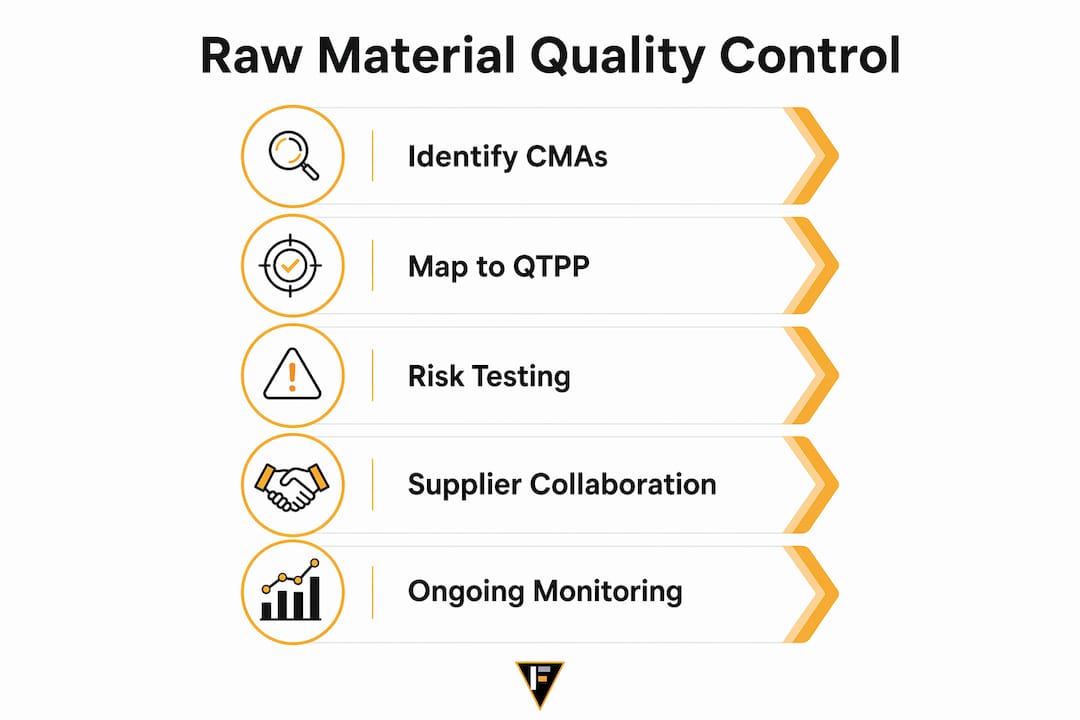
The pharmaceutical industry uses the term Critical Material Attributes (CMAs) to describe these properties formally. A CMA is any physical, chemical, biological, or microbiological property of a raw material that must be controlled to deliver the desired product quality. Identifying CMAs early in development is the difference between a formulation that scales reliably and one that fails at pilot batch.
How do raw material property variations affect formulation?
Excipient variability arises from environmental conditions, manufacturing controls, and supply chain inconsistencies, and each source of variation affects drug product performance differently. A binder with higher-than-expected viscosity will change tablet compression behavior. A surfactant with trace impurities will destabilize an emulsion. These are not edge cases. They are routine challenges that formulators encounter when raw material sourcing lacks rigorous controls.
The most common property variations and their formulation consequences include:
- Particle size distribution: Affects dissolution rate, content uniformity, and flowability in solid dosage forms.
- Moisture content: Drives hydrolysis, affects powder compressibility, and changes API stability.
- Impurity profiles: Trace metals, residual solvents, and degradation products alter API chemistry and shelf life.
- Polymorphic form: Different crystal structures of the same compound have different solubility and bioavailability profiles.
- Surface area and porosity: Influence drug release kinetics in controlled-release formulations.
Minor impurities like extractables or trace metals, introduced by storage or packaging, can have significant impact beyond the raw chemical itself. Robust formulation development assesses the entire material, package, and storage ecosystem, not just the ingredient specification sheet.
Pro Tip: Map each raw material attribute to a specific formulation performance parameter before you finalize your specification. If you cannot draw a direct line from a material property to a product outcome, you are either missing a CMA or carrying an unnecessary test.
What are the best frameworks for managing raw material quality?
Quality by Design is the most widely adopted framework for linking raw material attributes to formulation performance. QbD reduces formulation variability by systematically controlling CMAs, and its implementation is directly linked to enhanced batch consistency and fewer failures. The FDA and ICH Q8, Q9, and Q10 guidelines formalize QbD as the expected standard for pharmaceutical development submissions.
The practical application of QbD starts with defining the Quality Target Product Profile (QTPP), then working backward to identify which material attributes and process parameters must be controlled to hit that target. This is a fundamentally different approach from traditional development, where formulators often locked in a process and then tested the output.
Risk-based raw material testing is the operational complement to QbD. This approach prioritizes supplier history and material criticality, going beyond Certificates of Analysis (CoA) to prevent bottlenecks and blind spots. A CoA confirms that a supplier ran their own tests. It does not confirm that the material you received matches what they tested.
| Approach | Basis for release | Strengths | Limitations |
|---|---|---|---|
| Traditional CoA reliance | Supplier-provided documentation | Fast, low cost | No independent verification; misses contamination |
| Identity testing (FTIR/NIR) | Instrumental confirmation | Detects mix-ups and substitution | Does not quantify impurities |
| Full risk-based testing | Criticality and supplier history | Balances cost, speed, and quality | Requires upfront risk assessment investment |
| QbD-integrated testing | CMAs linked to QTPP | Drives batch consistency and regulatory confidence | Higher development resource requirement |
Pro Tip: Do not apply the same testing intensity to every raw material. Classify materials by criticality and supplier track record first. Reserve full analytical testing for high-risk materials and new suppliers.
How do raw material testing methods compare?
Identity verification is the minimum acceptable standard for any incoming raw material. Testing beyond CoA with methods like FTIR and NIR is essential to detect mix-ups, contamination, and minor impurities introduced during transport or storage. This prevents quality failures even when working with trusted, long-term suppliers.
The three primary instrumental methods each serve a distinct purpose:
- FTIR (Fourier Transform Infrared Spectroscopy): Confirms molecular identity quickly and non-destructively. The standard first-line tool for identity testing of organic raw materials.
- NIR (Near-Infrared Spectroscopy): Enables at-line or in-line testing with minimal sample preparation. Particularly useful for moisture content and blend uniformity monitoring.
- Raman Spectroscopy: Penetrates packaging for non-contact identity confirmation. Effective for aqueous samples where FTIR performance is limited.
Beyond identity, impurity profiling requires a different set of tools. Inductively coupled plasma mass spectrometry (ICP-MS) detects trace metals at parts-per-billion levels. Gas chromatography identifies residual solvents. High-performance liquid chromatography (HPLC) quantifies organic impurities and degradation products. Each method addresses a specific failure mode that CoA review alone cannot catch.
Identity confirmation must include instrumental methods besides CoA review to guard against supply chain contamination or mislabeling. This is not a regulatory formality. Material mix-ups at the incoming stage are one of the most preventable causes of batch failure, and FTIR or NIR testing at receipt takes minutes.
What practical strategies keep raw material quality consistent?
Supplier collaboration is the most underused quality tool in formulation development. Excipient variability stems from multiple factors, and close collaboration between drug developers and excipient suppliers early in development is the most direct way to address it before it reaches your process. Waiting until a batch fails to contact your supplier is the wrong sequence.
Design of Experiments (DOE) helps map critical raw material attributes to process parameters to handle variability at specification edges. This approach enables formulation robustness and reliable scale-up. A DOE study that deliberately tests materials at the low and high ends of their specification range reveals exactly how much process adjustment is needed to absorb that variability.
Supply chain risk is a structural issue, not just a vendor management problem. Geopolitical tensions and climate risks add complexity to material sourcing, and resilience requires data-driven, transparent supply chains and international cooperation. Single-source dependencies for critical raw materials are a formulation risk, not just a procurement risk.
Practical best practices for raw material quality assurance:
- Qualify at least two suppliers for every CMA-bearing raw material before you need them.
- Maintain a material variability log that tracks incoming test results against specification limits over time.
- Run periodic re-qualification studies when a supplier changes their manufacturing site or process.
- Include raw material grade and source in your formulation development records so changes trigger a formal review.
- Use statistical process control (SPC) to detect drift in incoming material quality before it reaches your process.
Pro Tip: Ask your excipient suppliers for their internal process capability data, not just the CoA. A supplier who can share Cpk values for key attributes is telling you they understand their own variability. One who cannot is a risk.
For a structured approach to managing formulation risks, including raw material controls, the Formlypro blog covers six proven strategies that align with current regulatory expectations.
Key takeaways
Raw material quality is the single most controllable variable in formulation development, and every batch failure traces back to an uncontrolled material attribute.
| Point | Details |
|---|---|
| CMAs drive product quality | Identify Critical Material Attributes early and link each one to a specific product performance outcome. |
| CoA alone is insufficient | Use FTIR, NIR, or Raman spectroscopy at receipt to independently confirm identity and catch contamination. |
| QbD is the standard framework | Quality by Design systematically connects material attributes to batch consistency and regulatory compliance. |
| Supplier collaboration prevents failures | Engage excipient suppliers early in development to understand and manage their process variability. |
| Supply chain diversification is a quality strategy | Qualifying multiple suppliers for critical materials reduces the risk of specification drift and supply disruption. |
The excipient blind spot most formulators still have
The assumption that excipients are inactive is the most persistent and costly misperception in formulation science. Treating excipients as inactive leads to overlooked critical impacts on bioavailability, stability, and patient experience. I have seen this play out repeatedly: a formulation that performs well in early development starts showing dissolution variability at scale, and the investigation eventually traces back to a change in the excipient supplier's manufacturing process that no one caught because the CoA still passed.
The industry is moving toward AI and machine learning integration with QbD frameworks to build predictive models for how material attribute combinations affect formulation performance. That is a meaningful shift. But the foundational discipline still matters more than the tools. No predictive model compensates for a team that has not identified its CMAs or a supplier relationship that does not include process transparency.
The formulators who build the most reliable products are the ones who treat every raw material as a variable until proven otherwise. They run DOE studies at specification edges. They maintain variability logs. They call their suppliers before a batch fails, not after. That discipline is not glamorous, but it is what separates a product that scales from one that stalls in development.
For teams building out their ingredient sourcing strategy, the upstream quality decisions made during supplier qualification are the ones that determine whether your formulation holds up at commercial scale.
— Ben
How Formlypro supports raw material quality in formulation
Formulation teams that manage CMAs, supplier data, and compliance requirements across multiple products need a system that keeps all of that connected. Formlypro is built for exactly that workflow.

The Formlypro platform guides product developers through an 8-phase process from ideation through production, with built-in tools for formulation development, market research, competitor analysis, and compliance. The system connects raw material decisions to formulation outcomes, so quality control professionals can track CMA controls alongside regulatory requirements in one place. Formlypro also includes an AI-powered packaging mockup designer, so teams can move from formulation to shelf-ready presentation without switching platforms. For brands building research-backed products with supplier accountability built in, Formlypro provides the structure to do it at scale.
FAQ
Why does raw material quality affect drug formulation?
Raw material quality directly controls the safety, potency, and stability of the final product. Minor deviations in properties like particle size, moisture content, or impurity profiles cause batch inconsistency, failed dissolution tests, and regulatory deficiencies.
What are Critical Material Attributes (CMAs)?
CMAs are the physical, chemical, biological, or microbiological properties of a raw material that must be controlled to achieve the desired product quality. They are identified through risk assessment and linked to process parameters using frameworks like QbD.
Is a Certificate of Analysis enough for raw material release?
A CoA confirms the supplier's own test results but does not independently verify the material you received. Instrumental methods like FTIR and NIR are necessary to detect mix-ups, contamination, and impurities introduced during transport or storage.
How does QbD improve raw material management?
Quality by Design links raw material attributes to formulation performance targets systematically. This reduces variability, improves batch consistency, and builds the regulatory documentation needed for submission and scale-up.
What is the biggest supply chain risk for raw material quality?
Single-source dependency for critical raw materials is the highest-risk scenario. Geopolitical disruptions and climate events can interrupt supply, and qualifying multiple suppliers before a shortage occurs is the most effective mitigation strategy.