

TL;DR:
- Formulation knowledge helps agencies accelerate product development by catching issues early and reducing reformulation cycles. It also supports regulatory compliance through documented quality attributes and control strategies. Building formulation skills enhances communication with partners and strengthens competitive positioning in the market.
Formulation knowledge is defined as the applied understanding of how ingredients interact, stabilize, and perform across development, manufacturing, and regulatory review. For agency professionals and brand strategists, this expertise is not a scientific luxury. It is the difference between a product that clears regulatory review on the first submission and one that burns six months in deficiency letters. Understanding why formulation knowledge helps agencies means recognizing that every ingredient decision made in R&D quietly sets the commercial ceiling for the product that follows.
Why formulation knowledge helps agencies accelerate product development
Speed in product development is not about moving fast. It is about making fewer wrong turns. Agencies that understand formulation science catch problems at the bench, not at the contract manufacturer.
Predictive testing methods like DSC (differential scanning calorimetry), FTIR (Fourier-transform infrared spectroscopy), and TGA (thermogravimetric analysis) identify stability failures before they become expensive reformulation cycles. Early-stage optimization reduces total development time by 6–12 months and lowers costs by avoiding late-stage reformulations and repeat testing. That is not a marginal gain. It is the difference between a product that launches on schedule and one that misses its retail window entirely.
AI-assisted formulation compounds these gains further. AI-enabled predictive modeling achieves up to 90% success in identifying solubility enhancement and 80% accuracy in excipient selection, reducing reformulation cycles. That level of precision narrows candidate selection and cuts lab hours significantly. Agencies that understand how to read and apply these outputs move from concept to prototype faster than those relying on trial and error.
The Quality by Design (QbD) framework, which the FDA and ICH Q8 guidelines formalize, requires that quality be built into formulations from the start rather than tested in at the end. Agencies fluent in QbD principles can structure development plans that satisfy regulatory expectations while keeping timelines tight. Without that fluency, agencies depend entirely on their contract partners to flag problems, which creates delays and erodes negotiating leverage.
- Map critical quality attributes (CQAs) before selecting excipients.
- Run predictive compatibility testing early using DSC or FTIR data.
- Apply AI-assisted dissolution modeling to narrow formulation candidates.
- Document every design decision in a format aligned with ICH Q8 expectations.
- Review scale-up behavior before finalizing the prototype for manufacturer handoff.
Pro Tip: Build a formulation decision log from day one. Regulatory reviewers and contract manufacturers both respond better to documented rationale than to verbal explanations during audits or scale-up meetings.
How does formulation expertise support regulatory compliance?
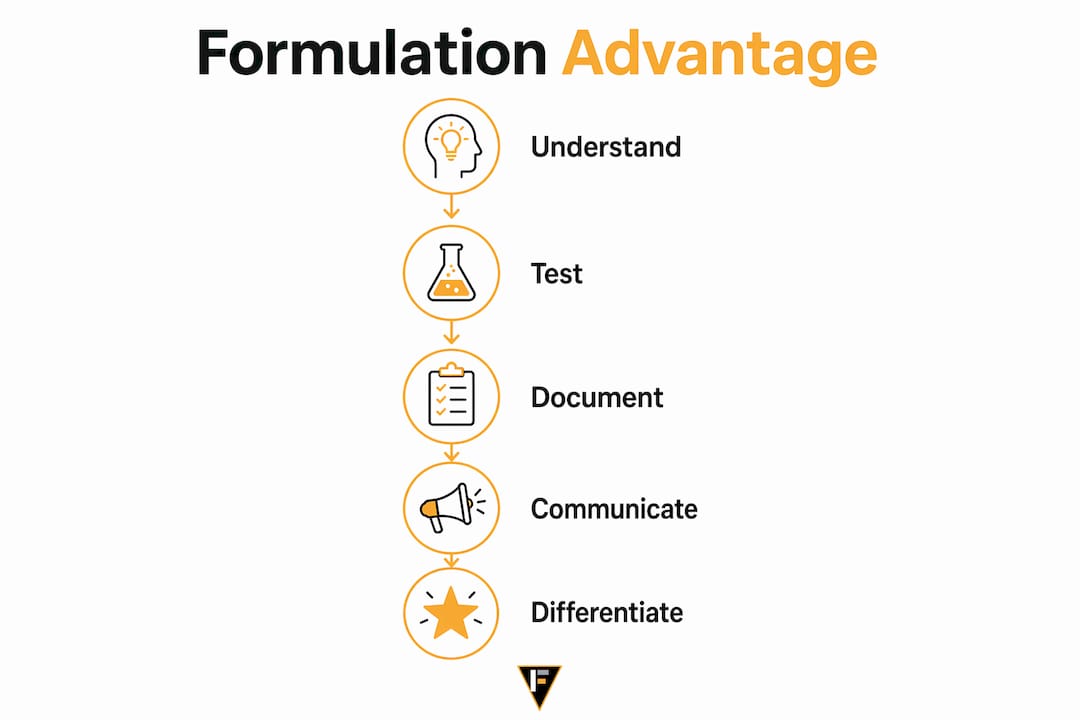
Regulatory compliance is not a checklist. It is a documented argument that your product was designed with quality in mind from the first ingredient decision. Agencies that understand formulation science can build that argument. Those that do not are left hoping their contract manufacturer did it for them.
The FDA expects documented understanding of critical quality attributes and control strategies as part of ICH Q8–Q11 compliance. These guidelines require that agencies demonstrate how formulation choices affect product performance, stability, and safety. That is a technical conversation, and agencies without formulation knowledge cannot lead it.
The practical consequences of poor formulation documentation are concrete:
- Deficiency letters delay ANDA and NDA submissions by months, often requiring full reformulation data packages.
- Post-approval changes trigger additional regulatory review, adding cost and time after launch.
- Audit failures at contract manufacturing sites often trace back to undocumented CQAs that the agency never defined.
- Supply chain substitutions create regulatory risk when agencies cannot evaluate whether an alternative excipient maintains the original control strategy.
| Compliance risk | Root cause | Formulation knowledge fix |
|---|---|---|
| Deficiency letters | Undocumented CQAs | Define CQAs before submission |
| Stability failures | Poor excipient selection | Run predictive compatibility testing |
| Post-approval delays | Unplanned ingredient changes | Document control strategy upfront |
| Audit gaps | Missing process rationale | Maintain formulation decision logs |
Formulation decisions in R&D define operating constraints that affect regulatory risk, supply chain stability, and commercial viability. That means the agency's role in early formulation is not administrative. It is the foundation of every regulatory interaction that follows.
How do formulation skills improve agency communication with partners?
Agencies sit between brands and manufacturers. That position requires translating commercial goals into technical specifications and translating technical limitations into strategic decisions. Formulation knowledge makes that translation accurate.

Formal formulation training helps agencies reduce costly mistakes by improving their understanding of ingredient interactions beyond surface-level recipes. This directly improves communication with manufacturers and regulatory consultants. When an agency can evaluate whether a proposed excipient swap affects bioavailability or stability, it stops relying on the manufacturer's word alone. That is a significant shift in accountability and quality control.
Contract manufacturing feasibility is another area where formulation knowledge pays off early. Agencies that understand viscosity ranges, pH sensitivity, and emulsification requirements can assess whether a proposed formula is manufacturable before signing a development agreement. Without that knowledge, agencies often discover incompatibilities after paying for pilot batches.
Formulation expertise changes the agency's role from order-taker to technical collaborator. When you understand why a formula behaves the way it does, you can negotiate from a position of knowledge rather than trust. That shift protects timelines, budgets, and client relationships simultaneously.
Experienced formulators recognize that scale-up behavior differs from lab prototypes, requiring judgment and operational oversight beyond chemistry alone. Agencies that internalize this reality ask better questions during manufacturer reviews and catch scale-related risks before they become production failures.
Pro Tip: Before signing any contract manufacturing agreement, ask the manufacturer to walk through the formula's scale-up behavior at three batch sizes. If they cannot explain the differences, that is a risk signal worth addressing before development begins.
How does formulation expertise drive competitive differentiation?
Formulation knowledge is a credential in competitive markets, not just an operational tool. Brands choose agency partners based on confidence, and agencies that speak the language of formulation science earn that confidence faster.
AI-assisted formulation development accelerates innovation and quality by enabling data-driven optimization and predictive analytics aligned with QbD. Agencies that can apply these tools, or work fluently with partners who do, compress innovation cycles and bring differentiated products to market ahead of competitors relying on traditional trial-and-error approaches. The benefits of AI in formulation extend from excipient selection through dissolution modeling, giving agencies a measurable edge at every development stage.
Hybrid frameworks combining classical Design of Experiments (DoE) with machine learning improve pharmaceutical formulation optimization for complex systems. Future competitive success depends on agencies that can integrate traditional methods with AI-driven techniques. That interdisciplinary capability is what separates agencies that lead product categories from those that follow them.
| Agency capability | Without formulation knowledge | With formulation knowledge |
|---|---|---|
| Product positioning | Based on marketing claims alone | Grounded in documented ingredient performance |
| Innovation speed | Dependent on manufacturer timelines | Accelerated by predictive modeling |
| Regulatory confidence | Reactive to deficiency letters | Proactive through documented CQAs |
| Client trust | Built on relationship | Built on technical credibility |
Consumer trust also follows formulation credibility. Brands that can explain why their formula works, backed by documented ingredient rationale and clinical alignment, build stronger market positions than brands relying on label claims alone. Agencies that provide this level of support become indispensable partners rather than interchangeable vendors. The role of agencies in product formulation is shifting toward exactly this kind of technical collaboration.
Key Takeaways
Formulation knowledge is the single most underleveraged capability in agency workflows, and agencies that build it reduce development time, regulatory risk, and client attrition simultaneously.
| Point | Details |
|---|---|
| Development speed | Early predictive testing cuts total development time by 6–12 months and prevents costly reformulations. |
| Regulatory readiness | Documented CQAs and control strategies aligned with ICH Q8–Q11 prevent deficiency letters and audit failures. |
| Partner communication | Formulation fluency lets agencies evaluate manufacturer feasibility and negotiate from technical knowledge. |
| Competitive positioning | AI-assisted and DoE-driven formulation gives agencies a measurable edge in innovation speed and client credibility. |
| Commercial impact | Formulation decisions made in R&D define regulatory risk, supply chain stability, and commercial viability. |
What I've learned from watching agencies ignore formulation science
The agencies I have seen struggle most with product development share one pattern. They treat formulation as the manufacturer's problem. They hand over a brief, receive a prototype, and then react to whatever comes back. That approach works until it does not, and when it fails, it fails expensively.
The agencies that consistently deliver on time and on budget treat formulation knowledge as an internal capability, not an outsourced function. They do not need to employ a PhD chemist. They need enough working knowledge to ask the right questions, evaluate the answers, and recognize when a manufacturer's explanation does not hold up. That is a trainable skill, and it pays for itself on the first project where it prevents a reformulation cycle.
The shift to AI-assisted formulation addresses the inefficiencies of traditional trial-and-error by accelerating development and improving outcomes. Agencies that build even a foundational understanding of these tools will be better positioned to evaluate vendor claims, interpret data outputs, and guide clients through increasingly complex product categories. The agencies that do not will find themselves increasingly dependent on partners whose incentives do not always align with the client's best interest.
My advice is direct: invest in formulation literacy before you need it. The time to build that capability is not during a regulatory crisis or a failed scale-up. It is now, when you can apply it proactively.
— Ben
How Formlypro gives agencies a formulation advantage
Agencies that want to build formulation capability without hiring a full R&D team have a direct path forward with Formlypro.
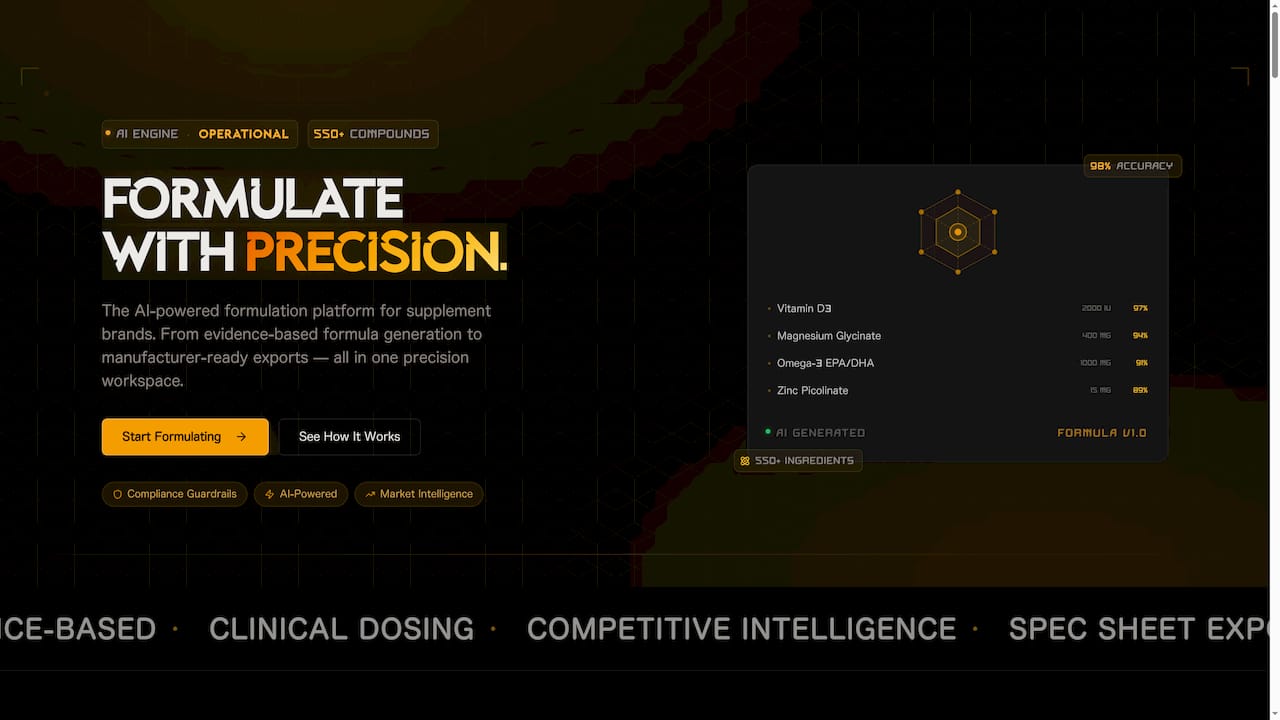
Formlypro's platform guides agencies through an 8-phase product development process, from ideation through production, with built-in compliance guidance, market research, and competitive analytics at every stage. The formulation platform includes AI-assisted tools for ingredient selection, stability assessment, and packaging design, giving agency teams the technical depth they need without requiring a laboratory. Agencies can evaluate competitor formulations, assess regulatory positioning, and generate market-ready documentation from a single subscription. For teams managing multiple brand clients across complex product categories, Formlypro turns formulation expertise from a gap into a genuine competitive asset.
FAQ
Why does formulation knowledge matter for agency professionals?
Formulation knowledge lets agency professionals evaluate product feasibility, anticipate regulatory risks, and communicate accurately with manufacturers. It reduces costly reformulation cycles and strengthens the agency's credibility with brand clients.
How does formulation expertise support regulatory compliance?
The FDA and ICH Q8–Q11 guidelines require documented critical quality attributes and control strategies. Agencies with formulation knowledge can build compliant documentation from the start, reducing deficiency letters and post-approval delays.
What is Quality by Design, and why should agencies understand it?
Quality by Design (QbD) is an FDA-recognized framework requiring that product quality be built into formulations from the first ingredient decision. Agencies that apply QbD principles structure development plans that satisfy regulatory expectations and reduce late-stage failures.
How does AI-assisted formulation benefit agency workflows?
AI-enabled predictive modeling achieves up to 90% success in identifying solubility enhancement and 80% accuracy in excipient selection. These tools reduce lab hours, narrow candidate selection, and accelerate the path from concept to prototype.
Can agencies build formulation knowledge without hiring scientists?
Agencies can build working formulation literacy through training, structured platforms like Formlypro, and documented development frameworks. Enough knowledge to evaluate manufacturer claims and apply QbD principles is achievable without a full in-house R&D team.