

Brand equity is the total value a brand earns from what consumers think, feel, and believe about it, independent of the product itself. That collection of perceptions and associations directly shapes whether someone pays full price, comes back for a second purchase, or trusts a brand extension into a new category. Strong equity means a customer picks you over a cheaper, functionally identical rival because awareness, feelings, and associations built over time make you the obvious choice.
This article breaks down:
- The two lenses for defining brand equity (consumer perception vs. firm valuation)
- The Aaker and Keller models, mapped to metrics you can actually track
- Why equity affects pricing power, loyalty, and how easily new products succeed
- Concrete steps to build it and a measurement framework to track it
- Real examples of equity gained and equity lost
Key Takeaways
Brand equity turns customer perception into measurable financial outcomes, and only disciplined, ongoing measurement connects the two.
| Point | Details |
|---|---|
| Equity is perception, not valuation | Track consumer-based metrics like awareness and perceived quality separately from firm-level brand value. |
| Aaker and Keller give you structure | Map loyalty, awareness, quality, and associations to specific metrics instead of vague sentiment tracking. |
| Quality comes before messaging | Perceived quality is the foundation; a strong identity can't compensate for an inconsistent product. |
| Measurement needs a behavioral link | Pair every survey metric with a behavioral proxy like repeat purchase rate to confirm it drives revenue. |
| Erosion happens faster than growth | A single reputational event can undo years of equity building within days. |
Table of Contents
- What Is Brand Equity From a Consumer's Perspective?
- What Are the Core Models for Brand Equity?
- Why Does Brand Equity Matter for Business Outcomes?
- How Is Brand Equity Different From Brand Value?
- How Do You Build Brand Equity?
- How Do You Measure Brand Equity?
- What Do Real Examples of Brand Equity Look Like?
- How Does Research-Backed Product Development Support Brand Trust?
- Ready to Build Equity Into Your Next Launch?
- What Actually Matters Most in a Brand Equity Program?
- Frequently Asked Questions
- Sources
What Is Brand Equity From a Consumer's Perspective?
Marketers use two different lenses to talk about brand equity, and mixing them up causes most of the confusion in this space. The consumer-based view treats equity as something that lives entirely in people's heads: awareness, associations, quality perceptions, and emotional attachment. The firm-based view treats it as a financial asset with a dollar figure attached, useful for accounting and mergers but disconnected from the day-to-day work of marketing teams.
Consumer-based brand equity is the one that matters for building strategy, because it's diagnostic. It answers why someone chooses your product over a competitor's, rather than just confirming that they did. A strategic framing from Harvard Business School treats perception metrics as the explanation and financial metrics as the scoreboard. You need both, but you build the first before you can claim the second.
Here's the part that trips people up: none of this matters financially until perception changes behavior. A brand can enjoy high awareness and warm feelings from consumers who never buy anything. Equity only becomes valuable when those perceptions translate into a purchase decision, a repeat visit, or tolerance for a higher price. Awareness without behavior is just a nice reputation.
- Equity is a mindset asset, not a static number on a balance sheet.
- It requires ongoing reinforcement. Skip a few quarters of consistent messaging and quality control, and equity erodes.
- Reputation events can undo years of investment in a matter of weeks.
A dynamic asset, not a trophy: Brand equity grows with strong marketing investment and consistent experiences, but can decline quickly when a brand breaks its promises. That volatility is why tracking it once a year isn't enough for any brand competing on trust.
Understanding brand equity this way changes how you budget for it. It's not a campaign line item you fund once. It's closer to a maintenance cost, like keeping a manufacturing line calibrated, except the thing you're calibrating is what millions of people believe about you.
What Are the Core Models for Brand Equity?
Two frameworks dominate how marketers structure brand equity thinking, and both still hold up decades after they were introduced.
David Aaker's model breaks equity into five components, each of which you can track independently:
- Brand loyalty: the willingness to repurchase or stick with the brand despite competitive pressure.
- Brand awareness: whether people recognize or recall the brand unprompted.
- Perceived quality: the gap between what customers believe about your product and its actual specs.
- Brand associations: the mental shortcuts people attach to the brand, like a specific feeling, use case, or lifestyle.
- Other proprietary assets: patents, trademarks, and channel relationships that competitors can't easily replicate.
Kevin Keller's Customer-Based Brand Equity (CBBE) pyramid works differently. It's sequential, building from identity ("who are you?") to meaning ("what are you?") to response ("what do I think or feel about you?") to relationships ("what kind of association do I want with you?"). Both frameworks are standard reference points for structuring an equity program, but Keller's version is more useful for creative strategy because it forces you to nail identity and meaning before chasing emotional resonance.
The real value of both models shows up when you map each component to something measurable:
| Component | Practical metric |
|---|---|
| Brand awareness | Unaided recall rate in category surveys |
| Perceived quality | Brand attribute lift versus category average |
| Brand loyalty | Repeat purchase rate, Net Promoter Score |
| Brand associations | Association test results (what words/images link to your brand) |
| Proprietary assets | Trademark portfolio strength, exclusive distribution count |
Pro Tip: Don't try to track all five Aaker dimensions with equal intensity from day one. Pick the two that are weakest for your brand right now and build your first dashboard around those before expanding.
Why Does Brand Equity Matter for Business Outcomes?
Strong equity shows up on the income statement, not just in survey results. The clearest benefit is pricing power: brands with high perceived quality and strong associations can charge more and see less drop off in demand when they do. Economists call this lower price elasticity, and it's one of the most tangible ways equity pays for itself.
The second benefit is retention. Customers who trust a brand come back without needing another discount code to justify it, which raises lifetime value and lowers the cost of every subsequent sale.
Beyond direct purchase behavior, equity opens doors: retailers give shelf space and negotiating leverage to brands they trust will sell, and product launches under an established name convert faster than a launch from an unknown brand starting from zero.
- Price premiums with reduced sensitivity to competitor discounting
- Higher repeat purchase rates and stronger customer lifetime value
- Preferred access to distribution partners and retail shelf space
- Faster adoption curves for product extensions and new categories
The risk side deserves equal weight. Reputation events can trigger measurable, near-immediate drops in equity and market value, regardless of how many years a brand spent building trust beforehand. Equity built slowly can be spent quickly by one bad decision that becomes public. That asymmetry is exactly why measurement can't be a once-a-year exercise; you want an early warning system, not a postmortem.
How Is Brand Equity Different From Brand Value?
Brand equity and brand value get used interchangeably, but finance teams and marketing teams need to keep them separate.
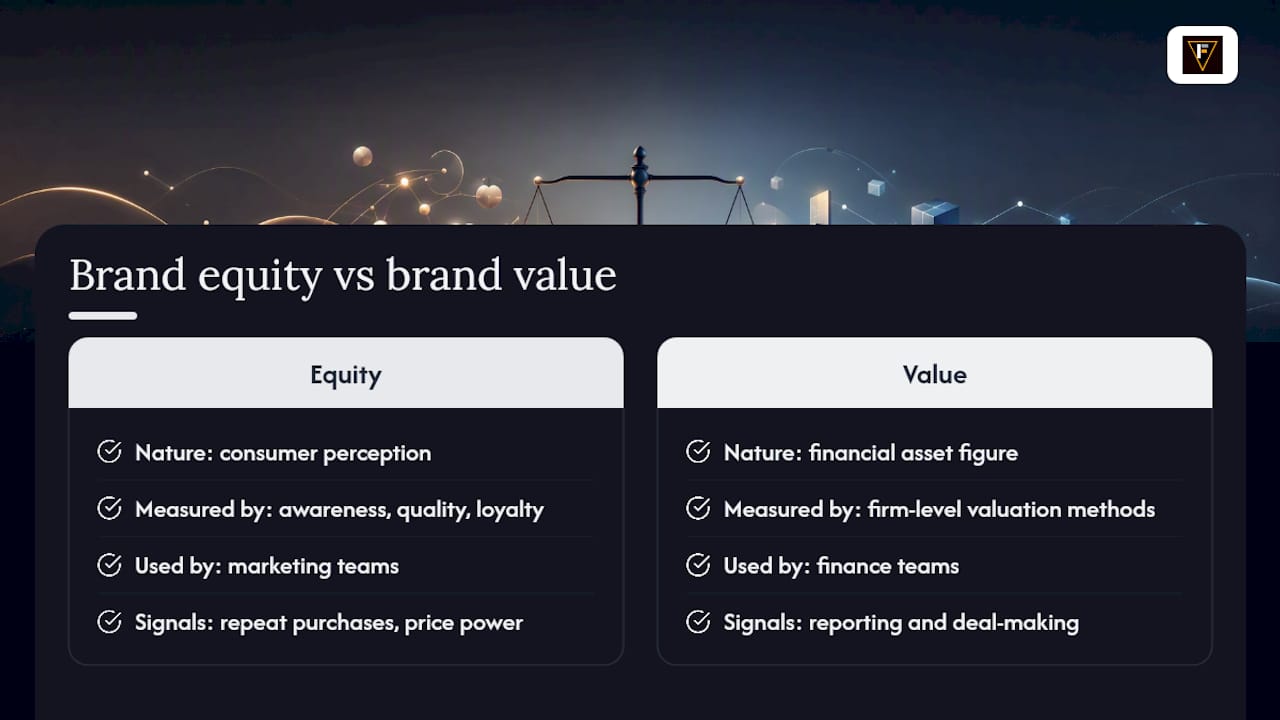
Brand equity is the perceptual asset: awareness, associations, loyalty, and perceived quality living in customers' minds. Brand value is the financial output; a dollar figure assigned to the brand as an asset, typically produced through valuation methodologies used for M&A, licensing deals, or balance sheet reporting.
Firm-level valuation depends heavily on commercial performance: revenue attributable to the brand name, projected cash flows, and royalty rates the brand could command if licensed. These methods are only as good as the underlying sales data, which means a brand can have genuinely strong consumer equity and still get a modest valuation if its commercial execution lags.
Here's the practical split: marketing and product teams should own equity metrics for diagnostic health checks, because those numbers explain why customers behave the way they do. Finance teams should own valuation metrics for reporting, acquisitions, and licensing conversations, because those numbers answer how much is this worth today. Confusing the two roles means marketing chases a number it can't directly control, and finance loses the perceptual context behind the figure it reports.
How Do You Build Brand Equity?
Building brand equity is sequential work, not a checklist you can tackle in any order. Skip the foundation and every later tactic underperforms.
- Nail product quality first. Perceived quality is the foundation Aaker's model rests on, and no amount of clever messaging survives a product that disappoints on first use.
- Build a distinctive, consistent identity. Visual identity, tone, and messaging need to stay recognizable across every channel a customer encounters. A consistent brand voice is what turns repeated exposure into recognition instead of noise.
- Match awareness tactics to where customers actually are in their journey. Earned media builds credibility, paid media builds reach, and owned channels build depth; using all three in the wrong sequence wastes budget.
- Use storytelling and partnerships to shape associations deliberately. Consumers attach meaning to brands through narrative, and that meaning is harder to build now that attention is scarcer than it was a decade ago. Strategic partnerships can transfer trust faster than advertising alone.
- Measure what's working, then reinvest. Every equity-building tactic needs a feedback loop back into the measurement framework covered next; guessing at what's landing is how budgets get wasted on the wrong channel.
Transparency deserves a special mention here because it does double duty. It builds perceived quality and it protects you during a crisis. Brands that publish ingredient transparency and sourcing details give customers a reason to trust claims they can't personally verify, which is exactly the trust deficit new products face at launch.
Pro Tip: If your budget forces a choice, fund product quality control and compliance rigor before you fund a rebrand. A beautiful identity built on top of an inconsistent product accelerates how fast negative word of mouth spreads.
How Do You Measure Brand Equity?
Measurement works best as a layered system: consumer perception metrics at the top, behavioral proxies in the middle, and financial valuation at the bottom for reporting purposes.

Consumer metrics capture what's happening in customers' minds before it shows up in sales data. Unaided brand awareness (can someone name your brand without a prompt?) and aided awareness (do they recognize it when shown a list?) form the baseline. From there, association tests reveal what words, images, or feelings people connect to your brand, attribute tracking shows whether perceived quality is rising or falling relative to competitors, and consideration or purchase-intent questions predict near-term demand shifts.
Behavioral proxies connect perception to money without waiting for a full valuation cycle. Repeat purchase rate is the simplest signal of loyalty in action. Price-elasticity testing (how much can you raise price before demand drops meaningfully) reveals real pricing power rather than survey-stated willingness to pay. Market-share trend analysis over multiple quarters shows whether equity gains are translating into category position.
Valuation methods exist for finance-level reporting, not week-to-week marketing decisions. Brand contribution to revenue and residual-based valuation approaches estimate what portion of total company value comes from the brand name itself, separate from tangible assets. These calculations matter for licensing negotiations, acquisitions, and board reporting, but they lag too far behind daily marketing performance to guide tactical decisions.
You can measure brand equity through recognition, loyalty, and satisfaction data, but the connection back to actual behavior is what turns those numbers into something with financial weight. A survey score that never gets checked against purchase data is just an opinion poll.
On operational cadence: run awareness and association surveys quarterly at minimum, segment results by customer tenure and channel, and keep sample sizes large enough to detect a five-point shift with confidence rather than noise. A simple dashboard design maps one leading metric and one supporting metric to each Aaker component, which keeps a measurement program from sprawling into forty tracked numbers nobody actually reviews.
- Track unaided awareness and association tests quarterly, not annually
- Pair every perception metric with a behavioral proxy to confirm it matters
- Reserve full valuation exercises for finance reporting cycles, not weekly reviews
What Do Real Examples of Brand Equity Look Like?
Apple built equity strong enough to command premium pricing across an entire product ecosystem, then leveraged that trust to extend successfully into wearables and services most competitors couldn't touch at the same margin. That's equity compounding: each extension inherits trust the last product earned.
The inverse played out when Volkswagen admitted to cheating diesel emissions tests, and the stock dropped sharply within days as investors priced in the reputational damage. Recovery required years of compliance overhauls and public accountability measures before consumer trust rebuilt.
- Positive equity compounds: trust earned in one category transfers to the next launch.
- Negative equity events are fast and disproportionate to the original mistake's size.
How Does Research-Backed Product Development Support Brand Trust?
Perceived quality doesn't happen by accident. It's built through decisions made months before launch, during formulation, compliance review, and packaging design.
Formlypro supports that groundwork directly with tools built for supplement and wellness brands: competitor analysis that shows what's actually selling and how rivals formulate, compliance workflows covering FDA and DSHEA requirements, and an AI mockup designer for packaging that shapes first impressions before a customer reads a single ingredient.
- Market and competitor research informs positioning before formulation begins.
- Compliance guidance reduces the regulatory risk that erodes trust fastest.
- Packaging mockups let brands test how design choices affect perceived quality before production commits.
Pro Tip: Run your positioning research before you lock formulation. Brands that formulate first and position later often discover the market wanted a different quality tier entirely.
Ready to Build Equity Into Your Next Launch?
Formlypro's 8-phase product development workflow was built for exactly the gap this article covers: turning brand-equity theory into a repeatable process. It runs from ideation and market research through formulation, compliance, prototyping, and production, so perceived quality and trust get engineered into the product instead of patched on with marketing after the fact.
If you're a product manager or founder trying to launch a supplement or wellness product that earns loyalty on day one instead of building it slowly over years, explore Formlypro's platform to see how research-backed formulation and compliance tools fit into your next product cycle.
What Actually Matters Most in a Brand Equity Program?
The conventional advice tells marketers to "build brand awareness" as if recognition alone creates value. It doesn't. The research behind this piece points somewhere less comfortable: perceived quality is the load-bearing wall, and most brands underinvest in it because quality work is slower and less visible than a campaign.
Where the standard playbook falls short is treating measurement as an annual report card instead of a quarterly instrument panel. If you're only checking awareness once a year, you're diagnosing a fever after the patient's already been sick for months.
Prioritize this order: get the product right, keep the identity consistent, then measure quarterly with behavioral proxies attached to every perception score. Skip straight to storytelling and you're decorating a foundation that hasn't been poured yet.
Frequently Asked Questions
What is brand equity in simple terms? Brand equity is the value a brand earns from what consumers think, feel, and believe about it, separate from the product's raw functional specs. That value shows up as willingness to pay more, loyalty, and success when the brand launches new products.
How do you measure brand equity? You measure it through consumer metrics like awareness and perceived quality, paired with behavioral proxies like repeat purchase rate and price elasticity. Firm-level valuation methods translate those signals into a financial figure for reporting purposes.
What is the difference between brand equity and brand value? Brand equity lives in consumer perception; brand value is the financial figure assigned to the brand as an asset. Marketing teams should track equity for diagnostic purposes, while finance teams use valuation for reporting and deal-making.
What are the main components of brand equity? Aaker's model breaks it into brand loyalty, awareness, perceived quality, brand associations, and proprietary assets like trademarks. Keller's CBBE pyramid structures it sequentially from identity to meaning to emotional response to relationships.
Can brand equity decline quickly? Yes. Reputation events like product recalls or public scandals can cause a measurable drop in equity within days, even after years of consistent brand investment. Recovery typically takes far longer than the erosion did.
Sources
- Brand Equity Explained: How to Build and Measure Success
- Brand equity (Wikipedia)
- Brand equity (NIQ)