

TL;DR:
- The VOC formula calculates regulatory VOC by subtracting water and exempt compounds from both mass and volume to accurately reflect reactive VOC content. It is essential to distinguish between regulatory VOC, which excludes water and exempts, and actual VOC, which includes all volatile substances, especially for low solids coatings. Incorporating MIR analysis reveals that exempt solvents like acetone still contribute to ozone formation, highlighting the need for comprehensive environmental impact assessment beyond compliance number improvements.
The VOC formula is defined as the mass of volatile organic compounds minus water and exempt compounds, divided by the total volume minus water and exempt volumes, expressed in grams per liter. This calculation is the regulatory backbone of product compliance for formulators working in health and beauty, personal care, and cosmetic product development. Standards like EPA Method 24 and frameworks from the South Coast Air Quality Management District (SCAQMD) govern how VOC content is measured and reported. Tools ranging from VOC calculator spreadsheets to Maximum Incremental Reactivity (MIR) analysis extend the formula's utility well beyond a single compliance checkbox.

What is the VOC formula and how does it work?
The standard regulatory formula for VOC content is:
VOC Regulatory (g/L) = (Ws − Ww − Wec) / (Vm − Vw − Vec)
Each variable has a precise meaning. Ws is the total weight of all volatile compounds in the formulation. Ww is the weight of water. Wec is the weight of exempt compounds. Vm is the total volume of the coating or product. Vw is the volume contributed by water. Vec is the volume contributed by exempt compounds.
The calculation follows a logical sequence:
- Weigh all volatile components in your formulation to determine Ws.
- Identify and weigh water separately to establish Ww.
- Identify and weigh all exempt solvents to establish Wec.
- Measure total product volume for Vm.
- Calculate the volume of water (Vw) and exempt compounds (Vec) using their known densities.
- Subtract water and exempt values from both numerator and denominator.
- Divide the adjusted volatile mass by the adjusted volume to get VOC Regulatory in g/L.
The reason water and exempt compounds are subtracted from both sides is to eliminate the dilution effect. Without this adjustment, a formulator could add water or acetone to a product and artificially lower the reported VOC ratio without actually reducing the volatile organic compound load relative to the active solids. The formula prevents that manipulation.
| Variable | Meaning | Unit |
|---|---|---|
| Ws | Total weight of volatiles | grams |
| Ww | Weight of water | grams |
| Wec | Weight of exempt compounds | grams |
| Vm | Total product volume | liters |
| Vw | Volume of water | liters |
| Vec | Volume of exempt compounds | liters |
EPA Method 24 is the authoritative test method for measuring VOC content for regulatory compliance. It uses gravimetric heating to quantify total volatiles, water content, and exempt solvents. When calculated values and test results conflict, Method 24 results govern compliance decisions.
Pro Tip: Always verify your exempt compound list against the current EPA or state-level exemption registry before running calculations. Exemption status changes, and using an outdated list can invalidate your compliance submission.
Regulatory VOC vs. actual VOC: what's the difference?
These two metrics measure the same product but serve different purposes, and confusing them is one of the most common compliance errors in formulation work.
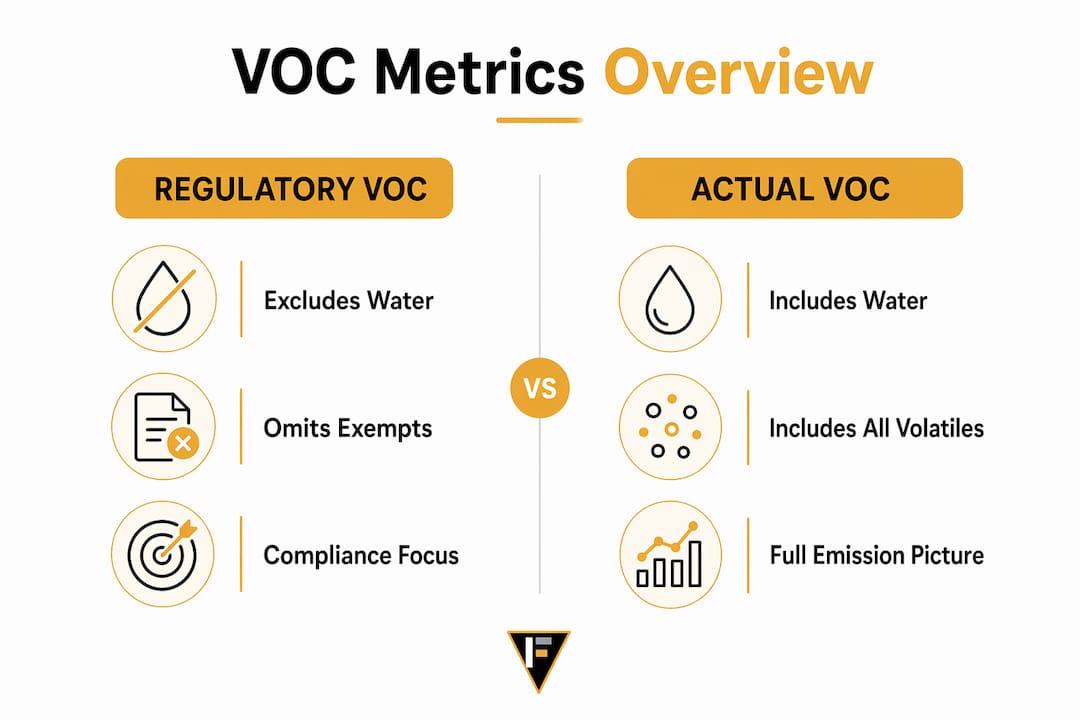
Regulatory VOC excludes water and exempt compounds from both the mass and volume calculations. It reflects the concentration of photochemically reactive volatile compounds relative to the non-water, non-exempt volume of the product. This is the number compared against legal emission limits for most coatings and personal care products.
Actual VOC, also called VOC of material, includes all volatile content. It captures the full picture of what evaporates from a product, including water and exempt solvents. VOC of coating versus VOC of material are computed separately in most VOC calculator spreadsheets, and each serves a distinct regulatory function.
| Metric | Includes water and exempts | Primary use case |
|---|---|---|
| Regulatory VOC | No | Compliance limits, labeling |
| Actual VOC (VOC of material) | Yes | Emissions fee calculations, low solids coatings |
Low solids coatings are regulated by actual VOC rather than regulatory VOC. These products contain less than one pound of solids per gallon, and the standard formula does not apply. Misidentifying a low solids product and applying the regulatory formula produces a compliance report that understates the true VOC burden.
Switching between these metrics mid-project also creates labeling problems. A product that passes regulatory VOC limits may still carry a high actual VOC value that triggers emissions fee thresholds in certain jurisdictions. Formulators working across multiple markets need to calculate and track both numbers from the start.
Pro Tip: Build both regulatory VOC and actual VOC outputs into your formulation spreadsheet from day one. Retrofitting the calculation after a compliance review costs significantly more time than running both in parallel.
What role does MIR play in VOC-exempt compound assessment?
VOC-exempt solvents like acetone and methyl acetate are excluded from regulatory VOC calculations, but that exemption does not mean they are environmentally inert. VOC-exempt compounds still contribute to ozone formation, and Maximum Incremental Reactivity (MIR) is the metric that quantifies that contribution.
MIR measures how many grams of ozone a compound generates per gram of the compound released into the atmosphere. Acetone, for example, carries an MIR value of 0.36. That is low compared to many reactive solvents, but it is not zero. A formulation loaded with acetone to stay under regulatory VOC limits can still carry a meaningful smog-forming potential.
The blend MIR is calculated as a weighted average:
- Determine the mass fraction of each volatile ingredient in the formulation.
- Identify the MIR value for each ingredient from a published MIR database.
- Multiply each ingredient's mass fraction by its MIR value.
- Sum all products to get the blend MIR.
| Solvent | MIR value (g ozone/g compound) | Regulatory status |
|---|---|---|
| Acetone | 0.36 | Exempt |
| Methyl acetate | 0.07 | Exempt |
| Ethanol | 1.53 | Non-exempt |
| Isopropanol | 0.61 | Non-exempt |
The practical implication is significant. A formulator who replaces ethanol with acetone reduces regulatory VOC content, but the blend MIR only drops from 1.53 to 0.36 per gram of solvent replaced. If the acetone loading is high, the overall smog score of the product may remain elevated. Formulators must evaluate both VOC content and smog score to fully understand environmental impact.
This matters for health and beauty brands positioning products as clean or sustainable. A regulatory VOC claim does not automatically support an environmental responsibility claim. MIR analysis provides the additional layer of evidence that sophisticated buyers, retailers, and regulators increasingly expect.
Practical formulation considerations for VOC compliance
Accurate ingredient measurement is the foundation of every valid VOC calculation. Errors in raw material weights, density values, or exempt compound classification cascade through the entire formula and produce compliance numbers that cannot be defended under audit.
Several common mistakes appear repeatedly in health and beauty formulation workflows:
- Ignoring MIR values for exempt solvents, which leads to products that pass regulatory thresholds but carry high ozone-forming potential.
- Mixing up VOC types by applying the regulatory VOC formula to a low solids product that requires actual VOC reporting.
- Using outdated density data for volume calculations, particularly for solvent blends where density varies with temperature and concentration.
- Overlooking test method requirements for specific product categories. Energy-curable coatings require ASTM D5403 or ASTM D7767 for volatile content determinations, not the standard gravimetric approach.
VOC content testing and VOC emission testing are also distinct disciplines that serve different compliance needs. Content testing uses ASTM D2369 or ISO 11890 to measure mass in liquid form. Emission testing uses ISO 16000-6 or VDA 278 to measure what releases from a solid or cured product. Formulators who submit content test results for an emission compliance requirement, or vice versa, create regulatory exposure that is entirely avoidable.
VOC emissions calculations involve multiplying the VOC content of a coating by the amount used, then adjusting for transfer efficiency and any capture or control systems in place. This step matters for facilities that report to state air quality agencies and for brands calculating their environmental footprint.
Software tools that integrate VOC content, MIR calculations, and emissions estimation into a single workflow reduce the risk of cross-calculation errors. They also create an auditable record that supports both regulatory submissions and internal quality documentation. For formulators working across multiple product lines, a formulation compliance checklist that includes VOC calculation steps prevents the kind of omissions that surface during third-party audits.
Pro Tip: When sourcing new raw materials, request the supplier's VOC content data and MIR value alongside the standard safety data sheet. Building this into your supplier qualification process saves significant rework during formulation.
Key takeaways
Accurate VOC formula application requires calculating regulatory VOC using the standard subtraction method, distinguishing it from actual VOC, and supplementing both with MIR analysis for a complete compliance and environmental impact picture.
| Point | Details |
|---|---|
| Core VOC formula | VOC Regulatory (g/L) = (Ws − Ww − Wec) / (Vm − Vw − Vec) per EPA Method 24. |
| Regulatory vs. actual VOC | Regulatory VOC excludes water and exempts; actual VOC includes them and governs low solids products. |
| MIR fills the gap | Exempt solvents like acetone still form ozone; blend MIR quantifies that impact beyond regulatory numbers. |
| Test method matters | Energy-curable and thin-film products require specific ASTM methods, not the standard gravimetric approach. |
| Software reduces errors | Integrated VOC and MIR calculation tools create auditable records and prevent cross-calculation mistakes. |
Why the VOC formula is more nuanced than most formulators expect
I have reviewed formulation packages from brands across skin care, hair care, and color cosmetics, and the same gap appears consistently. Formulators calculate regulatory VOC correctly, confirm they are under the limit, and stop there. They treat compliance as a binary pass or fail rather than a spectrum of environmental and regulatory obligations.
The MIR piece is where I see the most significant blind spots. A brand will reformulate a spray product to replace ethanol with acetone, celebrate the drop in regulatory VOC content, and then face questions from a retail partner's sustainability team about ozone-forming potential. The regulatory number improved. The environmental story did not, at least not by as much as the team assumed.
The distinction between content testing and emission testing also catches people off guard. These are not interchangeable. A product that passes ASTM D2369 content testing may still require ISO 16000-6 emission testing depending on the end-use category and the jurisdiction. Treating them as equivalent is a compliance gap that auditors find quickly.
My broader observation is that VOC compliance in health and beauty is becoming more demanding, not less. State-level regulations in California, New York, and Washington are tightening limits and expanding the product categories covered. Formulators who build rigorous VOC calculation workflows now, including both regulatory and actual VOC outputs plus MIR analysis, will spend far less time on reactive reformulation as those rules evolve. The brands that treat VOC formula work as a core competency rather than a compliance checkbox are the ones positioned to move faster when regulations shift.
For teams building health and beauty brand formulations from scratch, getting the VOC calculation architecture right at the ideation stage is far less costly than retrofitting it after the product is in development.
— Ben
How Formlypro supports VOC formula compliance
Formlypro is built for formulators who need more than a spreadsheet to manage compliance across a full product line.

The platform integrates VOC content calculations, regulatory limit tracking, and formulation data into a single workflow, so you are not reconciling numbers across separate tools. Formlypro's 8-phase product development plan covers compliance at every stage, from ideation through production, with market research and competitor analysis built in. You can track both regulatory VOC and actual VOC outputs, flag low solids exceptions, and generate documentation ready for regulatory submission. For health and beauty brands managing multiple SKUs across different jurisdictions, that level of formulation compliance support removes the guesswork and keeps your team focused on product performance rather than paperwork.
FAQ
What is the standard VOC formula for regulatory compliance?
The regulatory VOC formula is VOC (g/L) = (Ws − Ww − Wec) / (Vm − Vw − Vec), where Ws is total volatile weight, Ww is water weight, Wec is exempt compound weight, and the denominator subtracts the corresponding volumes of water and exempt compounds from total product volume.
Why are water and exempt compounds subtracted in the VOC calculation?
Water and exempt compounds are subtracted to eliminate the dilution effect, preventing formulators from artificially lowering the reported VOC ratio by adding water or exempt solvents without reducing the actual volatile organic compound concentration relative to active solids.
What is the difference between regulatory VOC and actual VOC?
Regulatory VOC excludes water and exempt compounds and is used for compliance limit comparisons. Actual VOC includes all volatile content and is used for emissions fee calculations and for low solids coatings that contain less than one pound of solids per gallon.
Do VOC-exempt solvents contribute to ozone formation?
Yes. VOC-exempt solvents like acetone carry MIR values and contribute to smog formation despite their regulatory exemption. Acetone has an MIR of 0.36 g ozone per gram of compound, which means high-acetone formulations can still carry meaningful ozone-forming potential.
How does EPA Method 24 relate to the VOC formula?
EPA Method 24 is the definitive test method for measuring VOC content for regulatory compliance. It uses gravimetric heating to quantify total volatiles, water, and exempt solvents. When calculated VOC values and Method 24 test results conflict, the test results govern compliance determinations.