

The best posture for most new supplement brands is a DTC subscription first launch, backed by Amazon and practitioner channels as fast followers. Prioritize five moves: subscription-based DTC acquisition, disciplined Amazon SKU management, practitioner or clinical distribution, selective retail, and one or two institutional partnerships. None of it works without compliance and formulation groundwork finished before the first ad runs.
TL;DR:
- Prioritize a direct-to-consumer subscription model to control pricing, gather first-party data, and smooth revenue fluctuations during initial launch months.
- Use distinct SKUs on Amazon and focus practitioner channels for credibility, avoiding channel cannibalization and building trust among high-value buyers.
- Sequence marketing efforts carefully over six months, starting with paid social and email capture, then expanding into Google, Amazon, and retail, based on proven creative and cost metrics.
- Ensure compliance steps, including FDA notifications, GMP standards, and clear influencer disclosures, are completed before advertising or retail listing to prevent launch stalls.
- Track key metrics such as blended CAC, average order value, churn rate, and repurchase cadence weekly, and model 12-month profitability based on early actual data.
Table of Contents
- Recommended Go-to-Market Strategies for Supplement Launches
- How Should You Sequence and Budget Your Marketing Channels?
- What Positioning and Packaging Actually Convert Supplement Shoppers?
- What Compliance Steps Are Non-Negotiable Before You Launch?
- What Does a Realistic Launch Timeline Look Like?
- Which Metrics Actually Tell You to Scale or Stop?
- How Does FormlyPro's 8-Phase Workflow Support This Launch Plan?
- Three Lessons Founders Usually Miss in Their First Launch
- Let FormlyPro Run Your Formulation-to-Launch Pipeline
- Sources
Recommended Go-to-Market Strategies for Supplement Launches
Most founders ask the wrong first question. It's not "which channel should we launch on?" It's "which channel gives us the pricing control and customer data we need to survive the next eighteen months?" For supplements, that's almost always direct-to-consumer subscription.
DTC subscription wins because it protects margin and hands you first-party purchase data you'd otherwise pay Amazon or a retailer to access secondhand. Recurring revenue also smooths the wild demand swings that hit new supplement brands during their first two quarters.
Amazon still matters, but treat it as a reach channel, not your pricing anchor. The operator playbook behind today's fastest-scaling wellness brands treats Amazon mastery and DTC subscription as coexisting pillars rather than competing ones, largely because they solve different problems: Amazon buys you discovery among comparison shoppers, DTC buys you loyalty and margin.
A few structural rules keep those two channels from cannibalizing each other:
- Run distinct Amazon SKUs. Different bundle sizes or multipacks on Amazon protect your DTC subscription price point from direct comparison.
- Reserve practitioner and clinical channels for credibility, not just volume. Chiropractors, nutritionists, and functional medicine practices move slower but convert at higher trust levels and rarely churn.
- Use retail selectively. A regional specialty grocer or gym pro shop builds brand presence without the margin hit of national big-box listings.
- Layer in institutional partnerships. Gyms, sports teams, and corporate wellness programs offer bulk volume and social proof you can't buy through ads.
- Pick your primary channel based on cash runway, not preference. If you have 12+ months of runway, DTC subscription first. If you need revenue in 90 days, Amazon plus one wholesale account moves faster.
The decision test is simple: whichever channel gets you to profitable unit economics fastest without giving up long-term pricing control is your primary path. Everything else supports it.
How Should You Sequence and Budget Your Marketing Channels?
Channel sequencing is where most supplement launches quietly fail. Founders spread a thin budget across five channels at once instead of proving one works first.
Start narrow. In month one, run paid social creative tests, three to five variations, against a single landing page built around one core benefit claim. Capture every email address that hits the page, even non-converters, because that list becomes your retargeting and launch-day audience.
Once a creative and offer combination converts at a rate you can defend on paper, expand into Google Search and Shopping for intent-driven buyers, then YouTube for longer educational content that explains mechanism and dosage. Search traffic tends to convert at a lower cost per acquisition than cold social once your brand has enough query volume to matter.
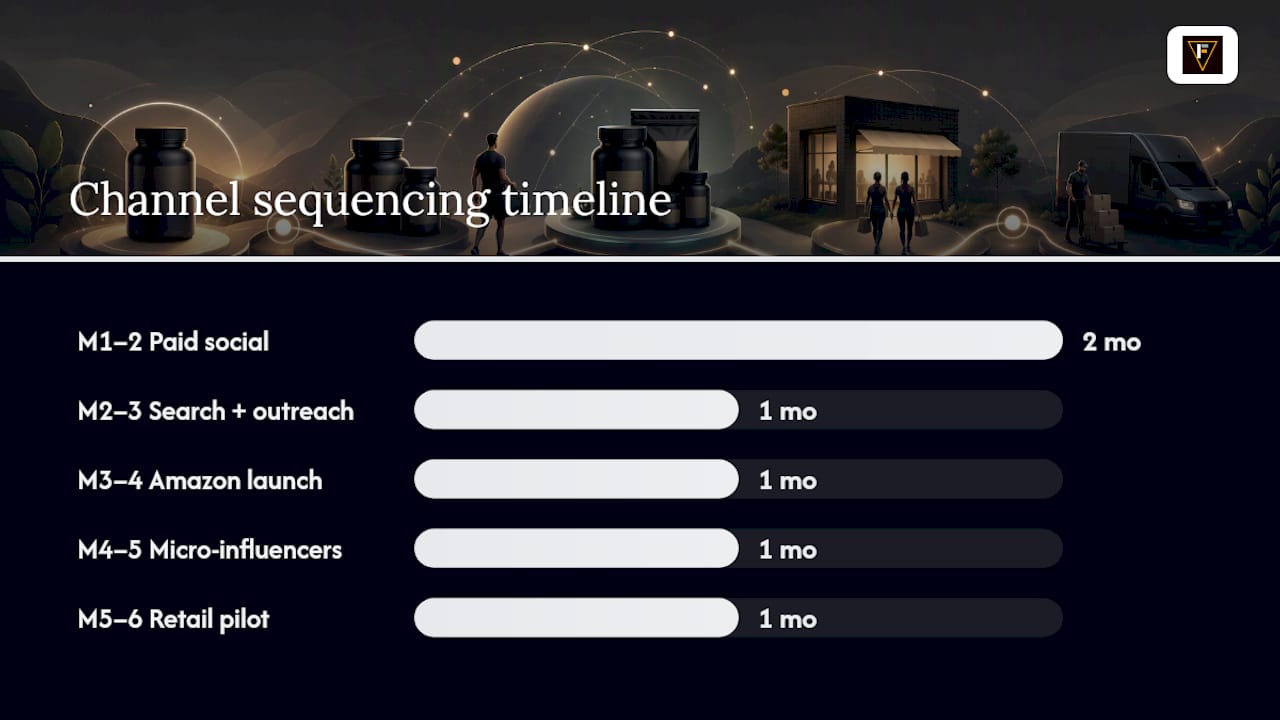
A practical sequencing framework for the first six months looks like this:
- Months 1-2: Paid social plus email capture, single hero product, no Amazon listing yet.
- Months 2-3: Add Google Search/Shopping once creative proves out; begin practitioner outreach in parallel.
- Month 3-4: Launch on Amazon with a distinct SKU or bundle size, not your DTC best-seller pack.
- Month 4-5: Layer in micro-influencer and creator partnerships focused on ingredient education rather than hard selling.
- Month 5-6: Test one retail or institutional partnership pilot if DTC economics are proven.
Adjust weekly based on blended cost per acquisition, not gut feel.
Pro Tip: Build your creator strategy around micro-experts (registered dietitians, physical therapists, strength coaches with 5,000 to 50,000 followers) instead of celebrity influencers. They cost less, disclose more credibly, and their audiences already trust their opinion on ingredients.
What Positioning and Packaging Actually Convert Supplement Shoppers?
Positioning fails when it tries to speak to everyone. Map two or three buyer segments, then write one sentence of positioning per segment, not one sentence for the whole brand.
A 35-year-old strength athlete cares about third-party testing and dosage precision. A 50-year-old managing joint pain cares about proof it works and how fast. A postpartum mom cares about ingredient safety and clean labels. Same product, three different opening lines.
The creative structure that outperforms generic sales copy follows a simple order: problem, ingredient, benefit, proof. State the problem the reader already feels, name the specific ingredient addressing it, state the benefit in plain terms, then back it with a study citation, COA, or practitioner endorsement. Structural, education-first content built this way consistently outperforms sales-first creative because it closes the credibility gap before asking for the sale.

Packaging carries more weight than most founders assume. The industry is visibly shifting away from sterile, clinical-looking bottles toward lifestyle-focused packaging and outcome-driven branding, especially as GLP-1 adoption pulls more mainstream buyers into the protein, creatine, and EAA categories who expect a beauty-aisle look, not a pharmacy one.
Packaging and label rules worth following without exception:
- Lead the front label with the single strongest, most specific benefit claim you can substantiate.
- Use color and typography that match your buyer segment's existing purchase habits, not your own taste.
- Keep the ingredient panel visible and legible; hidden or cramped panels read as something to hide.
- Match a pharma aesthetic only if you're selling into clinical or practitioner channels where that signals rigor instead of sterility.
Get this right and your ingredient transparency does double duty: it builds trust and gives your creative team proof points to work with.
What Compliance Steps Are Non-Negotiable Before You Launch?
Compliance isn't a checkbox you handle after the marketing plan is done. It's the plan's foundation, and skipping it is the single most common way founders stall their own launch.
Under DSHEA, any new dietary ingredient not already recognized as present in the food supply before October 1994 requires a New Dietary Ingredient notification to the FDA before it hits shelves. Good Manufacturing Practice standards under 21 CFR Part 111 apply regardless of who manufactures your product, and GMP compliance along with label review and third-party testing needs to be finished before any retailer or marketplace listing goes live, not during.
FTC endorsement rules require any paid or gifted influencer relationship to carry clear, conspicuous disclosure, and vague hashtags like #sponsored buried in a caption don't satisfy the standard. If a creator makes a specific health claim your label doesn't substantiate, that liability lands on your brand, not theirs.
Platform ad policy adds its own friction. Ad restrictions and compliance requirements remain among the biggest marketing barriers in this category, and Meta specifically requires pre-approval for many supplement ad types. Expect longer review cycles and rejected ads if you haven't submitted substantiating evidence with your creative, so build a two-week buffer into any paid launch date.
Pre-launch actions to complete, in order:
- Secure certificates of analysis (COAs) from your manufacturer for every batch.
- Commission third-party lab testing independent of your manufacturer's internal QC.
- Run a full label review against FDA labeling requirements before print, not after.
- Draft an influencer disclosure policy and require sign-off before any paid post goes live.
Statistic Callout: Meta's supplement ad pre-approval process means creative submitted without substantiating evidence gets rejected far more often than creative submitted with it, which is why compliance documentation needs to exist before your media buyer touches the platform.
For a deeper walk-through of the regulatory sequence, compliance for formulation launches covers the process end to end, and manufacturing partners like SUPERIOR Formulas' compliance guide break down the same steps from the production side.
What Does a Realistic Launch Timeline Look Like?
Manufacturing lead times, usually eight to twelve weeks, are not dead time. They're the single best window you have to build momentum before you need to sell anything.
- Weeks 1-4 (pre-manufacturing): Finish market research, competitor analysis, packaging design, and your compliance filings. Lock formulation before you order a single label.
- Weeks 4-10 (manufacturing window): Build your creative library, seed product with three to five micro-influencers under signed agreements, and start practitioner or retailer outreach conversations that take weeks to close anyway.
- Week 10-12 (pre-launch): Soft-launch your landing page and email capture flow; run a small paid test to validate cost per acquisition before spending real budget.
- Launch week: Go live on DTC, activate your seeded influencer content, and hold Amazon for two to three weeks later so DTC reviews accumulate first.
- Days 30-60: Layer in Amazon with a distinct SKU, expand paid social budget only if blended CAC stays under your target.
- Days 60-90: Add Google Search/Shopping, evaluate your first retail or practitioner pilot, and set the gate for increasing spend: repeat purchase rate above your category benchmark before you scale further.
Founders who start selling before compliance and supply chain are actually ready tend to stall hard, because restarting a buyer conversation after a compliance gap is far harder than delaying it by two weeks in the first place.
Which Metrics Actually Tell You to Scale or Stop?
Every supplement launch generates noise. The metrics below cut through it.
Your customer lifetime value to customer acquisition cost ratio, LTV to CAC, is the single number that tells you whether a channel deserves more budget. A supplement subscription business typically needs healthy repurchase cadence and blended gross margins in a range that supports paid acquisition; operator benchmarks for subscription and Amazon revenue mixes give founders a reference point for what "healthy" looks like at scale.
Track these five numbers weekly, not monthly:
- Blended CAC across all channels, not per-channel CAC alone, since customers touch multiple channels before converting.
- Average order value (AOV), especially first-order AOV versus subscription reorder AOV.
- Monthly churn rate for subscribers; anything above your category norm signals a product or expectation mismatch, not a marketing problem.
- Repurchase cadence, meaning the actual days between reorders versus your suggested dosage schedule.
- Channel-level CAC compared side by side, since Amazon CAC and DTC CAC rarely match and shouldn't be judged by the same bar.
Pro Tip: Model your 12-month P&L off your first 90 days of real data, not your business plan projections. Take your actual blended CAC, actual churn, and actual AOV, then extend those three numbers forward. If the resulting margin doesn't support your ad budget, fix the offer before you fix the marketing.
How Does FormlyPro's 8-Phase Workflow Support This Launch Plan?
Every checklist above, compliance, positioning, packaging, timeline, maps directly onto FormlyPro's 8-phase workflow: ideation, formulation, prototyping, market research, compliance, packaging, production, and launch planning.
Instead of juggling separate tools for competitor analysis, formulation, and label compliance, the platform keeps them in one pipeline. Concrete outputs founders use during launch:
- Manufacturer-ready formulation exports that shorten the handoff to your production partner.
- A built-in compliance checklist covering FDA and DSHEA requirements before you file anything.
- An AI packaging mockup designer for testing lifestyle-focused label concepts before print costs hit.
- Competitor analysis showing what's actually selling and what ingredients rival brands are using.
Visit the FormlyPro platform to see how the 8-phase pipeline maps to your own launch timeline.
Three Lessons Founders Usually Miss in Their First Launch
Most founders start marketing too late, treating creative and audience building as a launch-week activity instead of something to run during the manufacturing window. Compliance gets underestimated next. It's treated as paperwork instead of the thing that determines whether your ads even get approved. And retention gets the least attention despite driving the most long-term value.
Three moves to make now: build your email list before you have inventory, finish your compliance documentation before your first ad, and set your subscription retention target before you set your acquisition budget.
— Ben
Let FormlyPro Run Your Formulation-to-Launch Pipeline
Every checklist in this article, compliance, positioning, packaging, timeline, lives inside FormlyPro's 8-phase workflow instead of scattered across five different tools and a folder of PDFs.

Subscribers get manufacturer-ready formulation exports, a built-in FDA/DSHEA compliance checklist, competitor analysis showing what's actually selling in your category, and an AI mockup designer for packaging that fits the lifestyle-focused aesthetic buyers now expect. If you're still deciding between DTC subscription, Amazon, or a practitioner channel as your primary path, the platform's market research module models each one against your actual formulation and cost structure before you commit budget. Start a session on the FormlyPro platform and run your product idea through the 8-phase pipeline before your next manufacturing quote comes in.
Sources
- 2026 Vitamins, Minerals, and Supplements Trends | Clarkston Consulting
- Complete Marketing Strategy for Supplement & Wellness Brands | ATTN Agency
- Supplement DTC GTM Playbook 2027 — GLP-1 Stack Positioning, Amazon Mastery, and the .2B AG1 Operator Path