

Yes, U.S. dietary supplement manufacturers can use structure-function claims. The catch is that every claim must be truthful, backed by evidence matched to your exact formulation, and carry the FDA disclaimer on the label. You also have to notify the FDA within 30 days of first marketing under 21 CFR 101.93. Skip any of those three steps and you've handed the agency an easy misbranding case.
TL;DR:
- Claims about supporting normal body functions must be carefully worded to avoid implying disease treatment or prevention, which the FDA restricts.
- Evidence must be directly relevant, peer-reviewed, and match the product's dose and target population before claims are made or approved.
- The FDA disclaimer must be precisely placed on labels, and a 30-day notification with specific claim details is required before marketing.
- Visuals and marketing language that suggest disease claims, especially related to immunity, digestion, or pain, can trigger enforcement actions.
- Regular claim audits and strict process management are essential to prevent unintentional violations and maintain ongoing compliance.
Table of Contents
- What Legally Counts as a Structure-Function Claim
- Wording Rules: Compliant Phrases vs. Trigger Words to Avoid
- Building a Substantiation File That Holds Up
- The Disclaimer, the 30-Day Notice, and Your Marketing Channels
- Enforcement Risk and How to Reduce Exposure
- Your Pre-Launch Compliance Checklist
- What Actually Breaks Compliance in Practice
- Managing Claims Compliance Without the Guesswork
- Sources
What Legally Counts as a Structure-Function Claim
A structure-function claim describes how an ingredient affects the normal structure or function of the human body, like "calcium builds strong bones" or "fiber maintains bowel regularity." The FDA's own framing draws a hard line here: claims about maintaining normal processes are allowed, while claims implying diagnosis, treatment, or disease prevention are not. That's the difference between a supplement and a drug, and DSHEA is what created this whole category back in 1994, carving out room for supplement makers to talk about wellness without going through drug approval.
Structure-function claims sit apart from health claims (which link a nutrient to reduced disease risk, like the plant sterol and coronary heart disease claim spelled out in 21 CFR 101.83) and nutrient content claims (which describe amount, like "high in vitamin C"). Health claims require far more rigorous review. That's exactly why so many brands lean on structure-function language instead.
Context matters as much as wording. The 2000 Federal Register final rule lays out criteria the FDA uses to spot when a statement crosses into disease-claim territory, and it isn't just the words on the front panel. Symptom lists, disease-associated imagery, or even the product name can convert an otherwise fine claim into an implied disease claim.
Wording Rules: Compliant Phrases vs. Trigger Words to Avoid
Word choice is where most brands trip. Verbs like "supports," "maintains," and "promotes healthy" describe normal body function and generally stay on the right side of the line. Verbs like "treats," "prevents," "cures," or "boosts" (as in "boosts immunity") tend to imply a disease outcome, and the FDA and courts read them that way even when marketing teams didn't intend it that way.
Common rewrites that hold up:
- "Boosts your immune system" → "Supports normal immune function"
- "Prevents colds and flu" → "Helps maintain a healthy immune response"
- "Treats occasional indigestion" → "Supports healthy digestion"
- "Relieves joint pain" → "Supports joint comfort and flexibility"
- "Cures fatigue" → "Helps maintain healthy energy levels"
Immune claims get flagged constantly. Legal analysis of common enforcement patterns shows that "boosts immunity" and "prevents colds" are treated as disease claims almost every time, because both statements point at fighting off illness rather than supporting a normal function.
Imagery counts too. A joint supplement showing an inflamed knee, or an energy product listing "fatigue, brain fog, and low motivation" as symptoms it addresses, reads like a treatment claim even if the copy itself says "supports." Keep visuals and symptom framing as far from disease territory as the words.
Building a Substantiation File That Holds Up
Every structure-function claim needs competent and reliable evidence behind it before it goes on a label, not after a warning letter arrives, as detailed in the discussion of Do You Really Need a Supplement? – Pure Blue. The FDA leaves the exact quality bar somewhat flexible, but the safest posture is a conservative, evidence-first approach: prioritize peer-reviewed human trials over mechanistic or in vitro data, and treat lab-bench findings as supporting evidence only.
Your evidence has to match your actual product. A study on 500mg of an ingredient doesn't support a claim on a product dosed at 150mg, and a trial run on adults over 60 doesn't necessarily support a claim aimed at general adult consumers.
Organize each file the same way every time:
- Study summary (design, sample size, population, results)
- Relevance note (how the study maps to your dose, formulation, and target population)
- Statistical endpoints and whether they reached significance
- Limitations (small sample, short duration, animal-only data, etc.)
- Legal signoff confirming the claim wording matches what the evidence supports
Pro Tip: Build the substantiation file before you finalize label copy, not after. Writing claims first and hunting for evidence second is how mismatched dose and disease-adjacent wording slip through.
The Disclaimer, the 30-Day Notice, and Your Marketing Channels
Every label carrying a structure-function claim needs this exact disclaimer, word for word: "This statement has not been evaluated by the Food and Drug Administration. This product is not intended to diagnose, treat, cure, or prevent any disease." Placement should keep it legible and clearly associated with the claim, not buried in fine print elsewhere on the package. Formlypro's compliance requirements resource walks through label placement in more detail if you're setting up a review process.
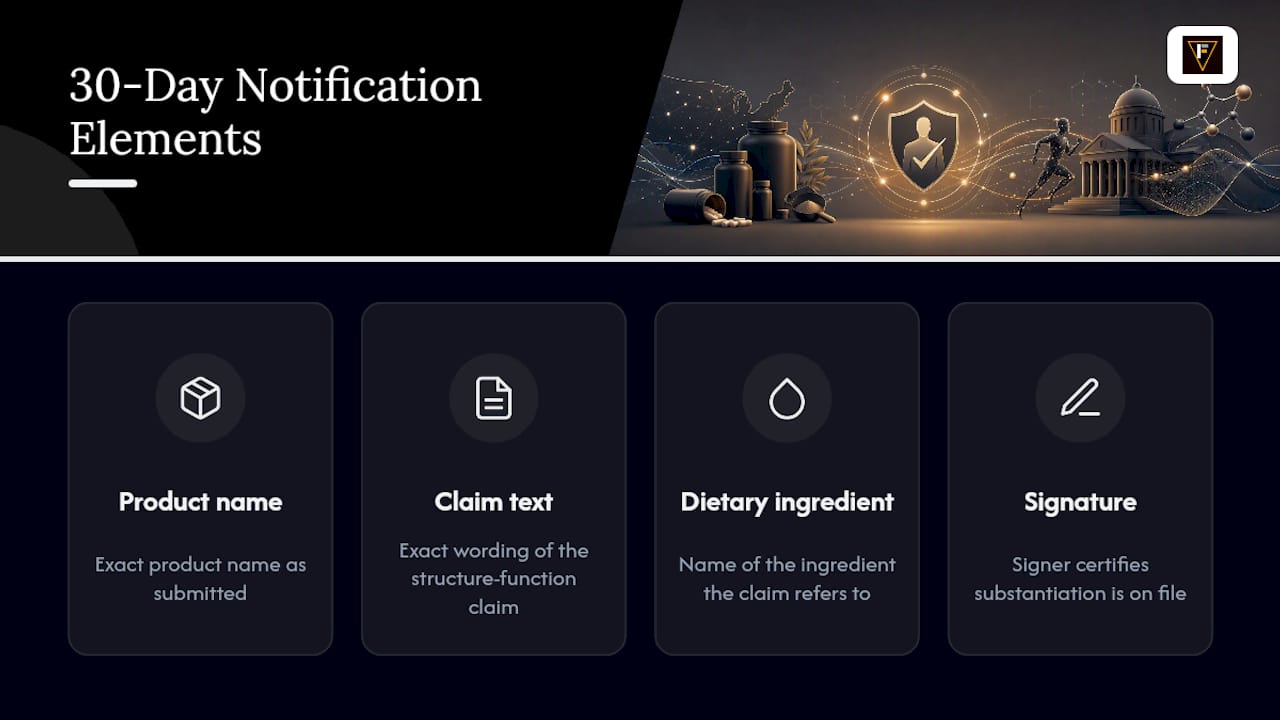
The 30-day notification to FDA needs four things: the exact product name, the exact text of the claim, the name of the dietary ingredient the claim relates to, and a signature certifying you have substantiation on file. Miss the window and you've created a paper trail showing noncompliance from day one.
Your website, social posts, and influencer content all count as labeling in FDA's eyes. Audit those channels the same way you audit the physical package, and check the 21 CFR 101.36 requirements while you're at it, since supplement facts panels and structure-function claims often get reviewed together.
Enforcement Risk and How to Reduce Exposure
Warning letters are the most common enforcement tool, and the FDA typically gives companies a window to respond and correct the issue before escalating. Repeated violations or claims tied to serious health risks can move faster toward seizure or injunction. Either way, the exposure isn't limited to the FDA.
Court decisions have narrowed how much protection FDA compliance actually provides in private litigation. Legal analysis of preemption doctrine shows plaintiffs' attorneys can still challenge your substantiation or argue a claim implies disease treatment, even when your label technically follows the rules. Compliant wording reduces risk. It doesn't remove it.
Practical mitigations that actually move the needle:
- Run a claim audit on every SKU at least twice a year, not just at launch
- Put influencer and affiliate content under contract requiring pre-approved language only
- Route any ambiguous claim through counsel before it ships, not after a complaint arrives
- Document every remediation step if you correct a claim, including the date and the reason
Formlypro's guide on why compliance matters for supplement brands covers the business cost side of these failures if you need it for an internal budget conversation.
Your Pre-Launch Compliance Checklist
Run through this before a single unit ships:
- Draft claim wording and check it against acceptable structure-function language
- Assemble the substantiation file matched to your exact dose and formulation
- Confirm the FDA disclaimer appears correctly on the label
- Cross-check website, social, and influencer copy against the approved claim wording
- File the 30-day notification with product name, claim text, ingredient name, and certifying signature
- Set a recurring review date, typically every six months, to re-audit claims against current evidence
Fields your notification needs ready to go:
- Exact product name as it appears on the label
- Verbatim text of each structure-function claim
- Name of the dietary ingredient the claim is based on
- Signature certifying the manufacturer has substantiation on file
Once the product is live, monitoring doesn't stop. Watch for marketing copy drift, meaning claims that quietly get bolder over time as different team members touch the copy. Formlypro's regulatory compliance checklist is a useful reference point for building this into a repeatable post-market process rather than a one-time launch task.
What Actually Breaks Compliance in Practice
Most claim violations aren't malicious. They're drift. Marketing rewrites a claim for punchier copy six months after legal approved the original, and nobody flags the change against the substantiation file. Or a brand skips the 30-day notification because nobody owned that task. Or the clinical study backing a claim used a 1,000mg dose while the finished product ships at 300mg, and no one caught the mismatch.
The fix isn't more rules, it's better process. Assign one person who owns claim vetting from first draft to shelf. Build the check into your product development workflow instead of treating it as a final step before printing labels. And revisit your substantiation file periodically, since a claim that was solid two years ago can look thin next to newer research.
— Ben
Managing Claims Compliance Without the Guesswork
Formlypro gives you a faster path to compliant claims than juggling spreadsheets, outside counsel emails, and label proofs across three different tools. The platform builds claim vetting directly into your product development workflow: draft wording against FDA-aligned templates, attach your substantiation file to the specific formulation and dose it supports, and get reminders when your 30-day notification window is approaching.
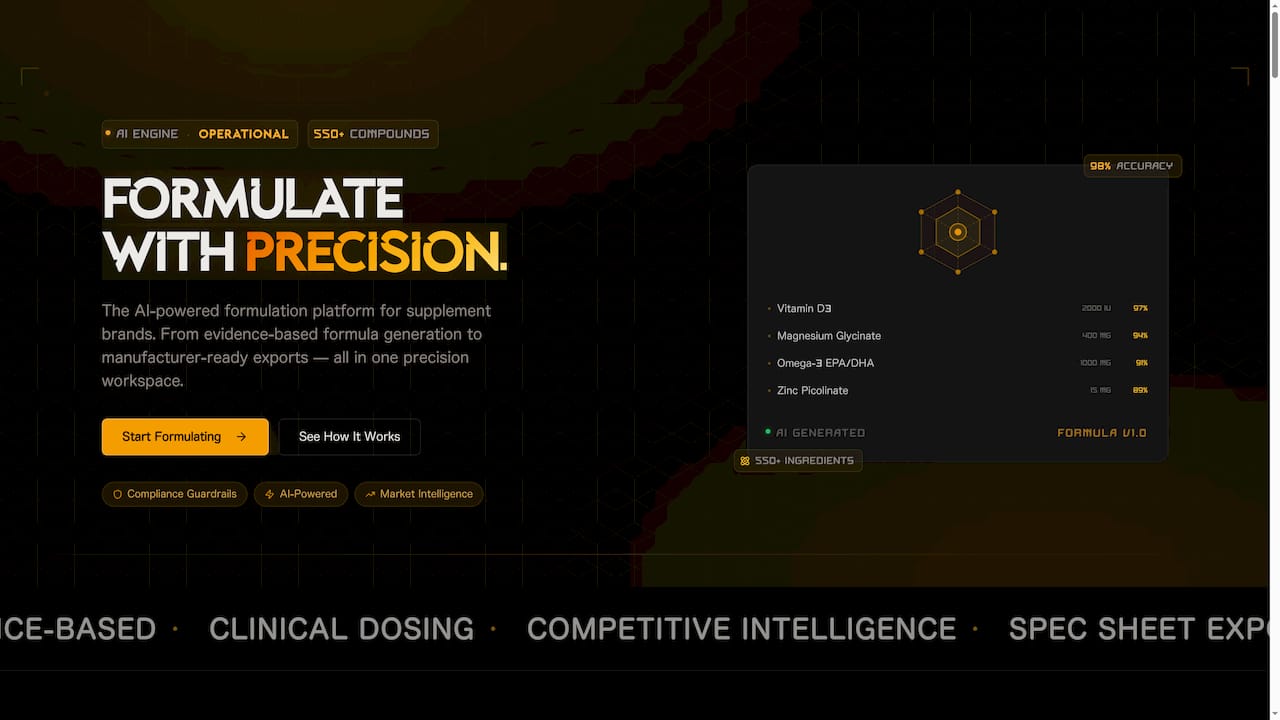
Outside counsel still matters when a claim is genuinely ambiguous or the science is thin. But for the routine work of matching claim language to evidence, tracking notification deadlines, and keeping your website and label copy in sync, a dedicated system beats manual tracking every time. Formlypro also handles the packaging side, letting you generate compliant mockups with disclaimer placement built in from the start. If you're prepping a launch or auditing an existing line, visit Formlypro to see how the compliance tools fit into your formulation process before your next label goes to print.
This article is general information, not a substitute for advice from a qualified lawyer. Consult a qualified legal professional about your own circumstances before acting on anything here.
Sources
- Small entity compliance guide on structure/function claims | FDA
- Regulations on statements for dietary supplements concerning effect on structure or function of the body (Federal Register final rule, Jan 6, 2000)
- Preemption of structure/function claims (analysis)