

Food chemists working on product development draw from a wide toolkit: experimental lab-based studies, analytical instrumental techniques, systematic literature reviews, sensory evaluation, quality control protocols, and statistical analysis. Each approach serves a different purpose, and the most effective formulation work combines several of them rather than relying on any single method.
A few core principles apply across all of them:
- Define your research objective before choosing a method, not after
- Use standard operating procedures (SOPs) to keep results reproducible
- Document minor variables like pH, storage temperature, and solvent choice
- Apply sensory evaluation alongside chemical analysis to validate real-world performance
- Consider emerging tools like biosensors and green extraction methods for faster, cleaner data
The complexity of food matrices, which contain proteins, lipids, carbohydrates, water, and bioactive compounds all interacting simultaneously, means no single technique captures the full picture. That diversity of methods is not a complication. It is the point.
Table of Contents
- How to define your research objectives and plan your methodology
- What lab-based research methods food chemists rely on most
- Which analytical instrumental techniques give you the most precise data
- Emerging innovations and best practices shaping food chemistry research
- How Formlypro supports food chemists and brand owners in research and formulation
- Statistical methods and data analysis in food chemistry research
- Sample preparation and handling protocols
- Key Takeaways
How to define your research objectives and plan your methodology
The most common mistake in food research is jumping to lab work before the research question is fully formed. A testable hypothesis or a clearly identified knowledge gap should come first.
Start with a systematic literature review using databases like Scopus, Web of Science, or PubMed. Search iteratively, not once. As you find relevant papers, new terms and synonyms will surface that sharpen your search and reveal gaps you had not considered. Tools like EndNote help manage references, remove duplicates, and track which papers you have screened.
Once the literature picture is clear, you can decide whether your project calls for experimental (lab-based) work or analytical (desk-based) work. Lab-based projects involve direct testing of samples and require ethical clearance for any human subjects. Desk-based projects analyze existing data or published literature, and they also require ethical clearance when surveys or human participant data are involved.

Experimental design matters as much as method selection. Define your independent and dependent variables, your sample selection criteria, and your controls before you run a single test. Vague experimental design produces data you cannot interpret.
Pro Tip: Treat your literature search as a living document. Revisit it after your first round of lab results. New findings often reveal a more precise framing of your original question, saving you from redundant experiments later.
What lab-based research methods food chemists rely on most
Standard lab analyses for food chemistry follow well-established protocols for proximate composition. These are the methods that generate the nutritional and chemical baseline every formulation needs:
- Moisture content: hot air oven or vacuum oven methods, depending on sample sensitivity
- Ash content: gravimetric method to quantify total mineral content
- Fat content: acid hydrolysis or manual solvent extraction
- Protein nitrogen: the Kjeldahl method, which digests the sample with sulfuric acid and measures nitrogen to calculate protein content
- Carbohydrates: phenol-sulfuric acid method for total carbohydrate; HPLC for individual sugars
- Vitamins: Vitamin C by indophenol titration; fat-soluble vitamins by HPLC
- Minerals: atomic absorption spectrophotometry for calcium, magnesium, and other metals
Every one of these methods requires a detailed SOP covering reagent preparation, equipment calibration, waste disposal, and safety precautions. The Kjeldahl method, for example, involves concentrated sulfuric acid and requires fume hood use, proper protective equipment, and careful neutralization before disposal.
Reproducibility depends on thorough documentation of the details that seem minor until results diverge between runs: storage conditions before analysis, exact pH adjustment methods, solvent lot numbers, and instrument calibration dates. Sensory evaluation panels and quality control checks round out experimental research by validating that chemical results translate to real product performance.
Which analytical instrumental techniques give you the most precise data
Instrumental methods extend what wet chemistry can measure, often with greater speed and sensitivity. The standard analytical toolkit in food chemistry covers spectroscopy, chromatography, mass spectrometry, and newer sensor-based technologies.
| Technique | Primary Use | Key Advantage | Limitation |
|---|---|---|---|
| Near-Infrared (NIR) Spectroscopy | Moisture, protein, fat screening | Fast, non-destructive | Requires calibration models |
| Mid-Infrared (MIR) Spectroscopy | Adulteration detection, composition | High chemical specificity | Sample prep needed for some matrices |
| Raman Spectroscopy | Structural identification, authenticity | Non-contact, minimal prep | Fluorescence interference |
| Gas Chromatography (GC) | Volatile compounds, fatty acids, flavor | High resolution for volatiles | Not suitable for thermolabile compounds |
| Liquid Chromatography (LC/HPLC) | Sugars, amino acids, vitamins, contaminants | Broad compound range | Slower than GC for volatiles |
| Mass Spectrometry (MS) | Compound identification, contaminants | Definitive structural ID | High cost, operator expertise required |
| Ambient Mass Spectrometry | Rapid screening, minimal prep | Near real-time analysis | Lower quantitative precision |
| Biosensors | Pathogen and contaminant detection | Portable, field-deployable | Selectivity limitations |
| Electronic Noses/Tongues | Flavor and odor profiling | Mimics sensory perception | Requires extensive training data |
For complex food matrices, combining techniques produces far more reliable results than any single instrument. GC-MS, for instance, is the standard approach for volatile flavor profiling because gas chromatography separates compounds while mass spectrometry identifies them structurally. HPLC paired with MS is similarly standard for amino acid quantification and contaminant screening.
Emerging innovations and best practices shaping food chemistry research
The direction of innovation in food analysis is toward methods that are faster, greener, and less destructive to samples. A few developments worth knowing:
- Ultrasound-assisted extraction reduces solvent use and extraction time compared to conventional methods, with no loss in yield for most bioactive compounds
- Microfluidic devices enable analysis at very small sample volumes, useful for high-throughput screening during formulation development
- Non-destructive analysis using NIR or Raman spectroscopy preserves sample integrity, which matters when working with limited prototype batches
- Omics approaches (metabolomics, proteomics, foodomics) map the full chemical profile of a food matrix, revealing interactions that targeted assays miss
Best practices have shifted alongside these tools. Regulatory compliance and ethical documentation are no longer end-stage concerns. The FDA's requirements for food labeling, ingredient safety, and Good Manufacturing Practice (GMP) standards mean that compliance considerations should be built into research design from the start. Updating your research strategy iteratively, as new data comes in, keeps formulations aligned with both scientific evidence and regulatory expectations.
Pro Tip: When working with limited prototype quantities, prioritize non-destructive methods like NIR spectroscopy first. You preserve the sample for confirmatory testing with destructive methods only when the screening data warrants it.
How Formlypro supports food chemists and brand owners in research and formulation
Running rigorous research alongside product development is a significant operational challenge for most food and wellness brands. Formlypro is built to close that gap.
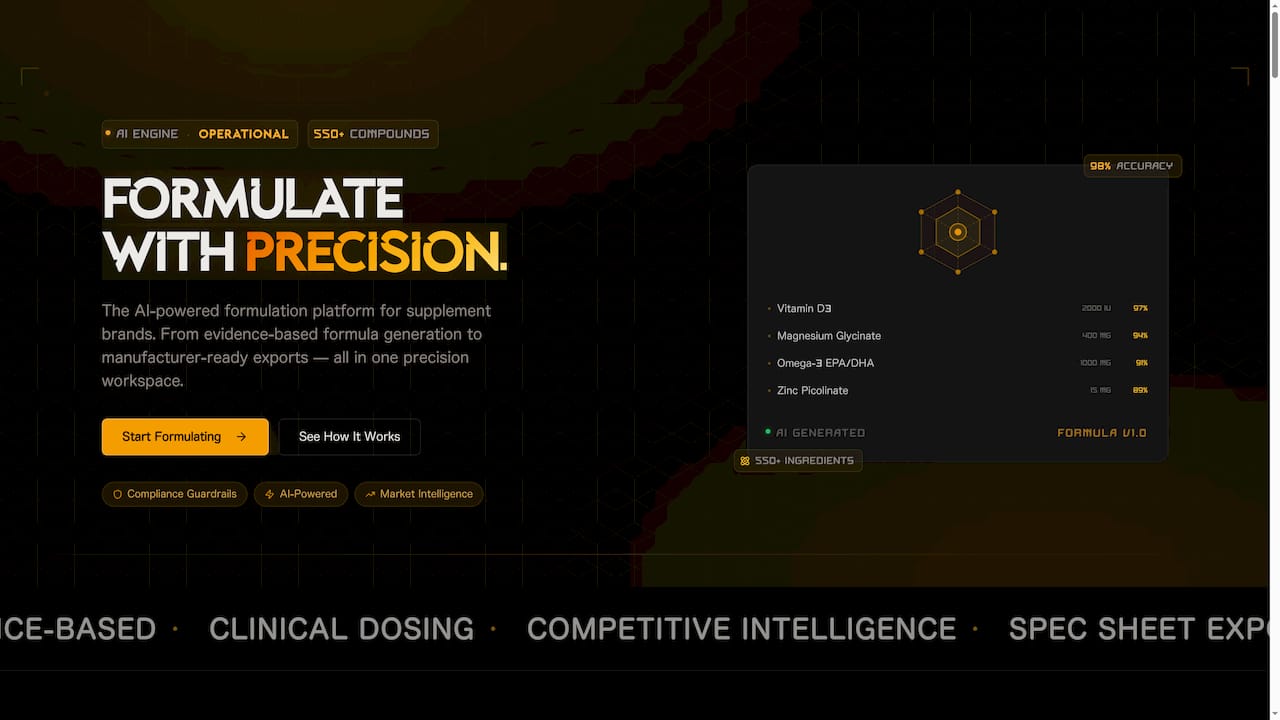
The platform gives brand owners access to:
- Integrated market research and competitor analysis: see which products are selling, what formulations competitors are using, and where market gaps exist
- An 8-phase product development plan: takes a new product from ideation through formulation, prototyping, market research, compliance, and production with structured guidance at every stage
- Compliance support: built-in guidance on FDA labeling requirements, ingredient safety, and regulatory standards so compliance is part of the workflow, not an afterthought
- AI-powered packaging design: a mockup designer integrated directly into the platform for custom packaging development
- Subscription tiers: structured access to research-backed formulation tools scaled to where your brand is in its development
For brand owners who need to move from concept to shelf without a full in-house R&D team, Formlypro connects the research layer to the commercial layer. The food product market research and market analytics resources on the Formlypro blog extend that support further, covering analytical methods, packaging compliance, and formulation strategy in depth.
Start building your formulation on Formlypro
Statistical methods and data analysis in food chemistry research
Data without proper statistical treatment is just numbers. Food chemistry research relies on several core statistical approaches to extract meaningful conclusions.
Analysis of variance (ANOVA) is the standard tool for comparing means across multiple treatment groups, such as different formulation concentrations or processing temperatures. When ANOVA identifies a significant difference, post-hoc tests like Tukey's HSD pinpoint which specific groups differ. Principal component analysis (PCA) is widely used in sensory evaluation and spectroscopic data to reduce high-dimensional datasets to interpretable patterns.
Regression analysis quantifies relationships between variables, for example, how moisture content affects shelf life at different storage temperatures. Chemometrics, the application of statistical and mathematical methods to chemical data, is particularly important for interpreting NIR and Raman spectroscopy outputs, where calibration models must be validated against reference methods. Any analytical method used in a regulatory or commercial context should include method validation data: linearity, precision, accuracy, detection limits, and quantification limits.
Sample preparation and handling protocols
Sample preparation is where most analytical errors originate. A well-designed instrumental method cannot compensate for a poorly prepared sample.
Homogenization is the first step for solid or semi-solid foods: grinding, blending, or milling until the sample is uniform. For moisture-sensitive samples, freeze-drying before grinding prevents compositional changes. Liquid samples are typically filtered or centrifuged to remove particulates before analysis.
Storage conditions between collection and analysis matter considerably. Samples held at the wrong temperature or exposed to light can undergo lipid oxidation, enzymatic activity, or microbial changes that alter the composition you are trying to measure. Document the time between collection and analysis, storage temperature, container type, and any preservatives used. For trace contaminant analysis, contamination from containers, solvents, or lab environment is a real concern, and blank samples run alongside test samples catch it early. The formulation checklist on the Formlypro blog covers sample documentation requirements in the context of commercial product development.
Key Takeaways
Effective food chemistry research combines multiple methods, rigorous documentation, and iterative refinement to produce reliable, commercially viable formulations.
| Point | Details |
|---|---|
| Define objectives first | A testable hypothesis and systematic literature review should precede any lab or instrumental work. |
| Use SOPs for every protocol | Document reagent prep, calibration, storage, and waste disposal to protect reproducibility across runs. |
| Combine analytical techniques | Complex food matrices require multiple methods; GC-MS and LC-MS pairings are standard for definitive identification. |
| Build compliance in from the start | FDA labeling and GMP requirements should shape research design, not be addressed after formulation is complete. |
| Sample prep determines data quality | Homogenization, storage conditions, and blank controls are where most analytical errors originate. |