

TL;DR:
- Effective product testing employs multiple validation methods throughout development, reducing defects and costs. Continuous testing using AI and human judgment ensures higher quality and faster time-to-market. Prioritizing issues with frameworks like the Impact vs. Effort matrix optimizes product improvements.
Product testing best practices are methodologies that maximize product quality and user satisfaction through validated, iterative testing at every development stage. The most effective programs combine functional QA, usability testing, regression testing, and AI-assisted simulation rather than relying on a single gate before launch. Industry benchmarks set the bar at 70–80% unit test coverage and defect leakage below 2%, with usability task success rates below 70% flagged as critical failures requiring immediate action. Teams that embed testing throughout the full product lifecycle catch defects earlier, spend less on post-launch fixes, and reach product-market fit faster.
1. Which testing methodologies yield the most effective results?
The strongest testing programs use five core methods together: functional QA, usability testing, regression testing, market testing, and AI-assisted simulation. Each method covers a different failure mode, and no single approach catches everything.
- Functional QA verifies that every feature works as specified. It catches logic errors, broken workflows, and integration failures before users ever see the product.
- Usability testing measures whether real people can complete key tasks without confusion. A task success rate below 70% signals a design problem serious enough to delay launch.
- Regression testing confirms that new code does not break existing functionality. This is non-negotiable in agile environments where code changes daily.
- Market testing validates product-market fit by exposing the product to a representative sample of the target audience before full release.
- AI-assisted simulation runs thousands of synthetic user scenarios to surface edge cases that human testers would never encounter in a standard session.
Combining 3–4 strategies, including risk-based, agile, exploratory, and agentic approaches, produces stronger validation than any single method. Risk-based testing focuses effort on the features most likely to fail or cause the most damage. Exploratory testing lets skilled testers roam freely, finding issues that scripted tests miss. Agentic testing uses AI agents to autonomously author, execute, and self-heal tests, with human engineers focused on oversight and strategy.
Pro Tip: Map your dominant product risks before choosing methods. A compliance-heavy supplement product needs different test weighting than a consumer app. Start with the risk, then pick the method.
2. How to design an efficient product testing lifecycle
Continuous testing embedded throughout development is the single most reliable way to prevent defects from reaching production. Treating testing as a one-time pre-release gate consistently produces higher defect leakage and more expensive post-launch fixes.
A well-structured testing lifecycle runs through these phases:
- Requirement traceability — Link every test case to a specific product requirement so gaps are visible before a single line of code is written.
- Unit and integration testing — Run automated checks at the code level during every sprint. Target 70–80% unit test coverage as a floor, not a ceiling.
- Functional and regression testing — Execute full test suites after each major build. Integrate these into your CI/CD pipeline so they run automatically.
- Usability and prototype testing — Test with real users at the prototype stage, not just at the finished product stage. Early feedback is cheaper to act on.
- Market and beta testing — Expose the product to a controlled audience segment to validate positioning, pricing, and feature priority before full launch.
- Post-launch monitoring — Track defect rates, user behavior, and support tickets continuously. Issues that slip through pre-launch testing surface here.
AI-assisted platforms now compress testing cycles from 4–6 weeks to under 24 hours while enabling sample sizes of 50–100+ participants versus the traditional 5–10 users. That shift makes "qual-at-scale" validation practical for teams that previously could not afford large-sample usability research.
| Phase | Primary goal | Key output |
|---|---|---|
| Requirement traceability | Prevent scope gaps | Traceability matrix |
| Unit and integration | Catch code-level defects early | Coverage report |
| Functional and regression | Validate features and stability | Defect log |
| Usability and prototype | Confirm user task success | Session recordings |
| Post-launch monitoring | Detect production issues | Incident dashboard |

Pro Tip: Automate your regression suite inside your CI/CD pipeline so every code push triggers a test run. This removes the human bottleneck that causes testing to slip when deadlines tighten.
3. What are best practices for test case design and execution?
Test case design is where most teams leave coverage gaps without realizing it. Three techniques close the majority of those gaps without requiring an exponential number of test cases.
- Equivalence partitioning groups inputs into classes that the system should treat identically, then tests one representative from each class. This cuts redundant tests while maintaining meaningful coverage.
- Boundary value analysis tests the edges of input ranges, where defects cluster most frequently. If a field accepts values from 1 to 100, test 0, 1, 100, and 101.
- Decision table testing maps combinations of conditions to expected outcomes. It works best for features with complex business logic involving multiple variables.
- Pairwise testing addresses combinatorial explosion. Pairwise testing reduces large combinations to fewer than 12 tests by covering every pair of input values at least once. That reduction makes thorough coverage achievable without a massive test suite.
Human validation of AI-generated test cases is not optional. AI tools generate test cases quickly, but they also generate false confidence. A qualified engineer must review every AI-authored assertion to confirm it actually validates the intended behavior.
"Avoid 'lead-the-witness' test scripts. Scripts should act as high-level guides that let users interact naturally with the product, revealing authentic usability insights rather than confirming what the team already believes." — Prototype and Test: The PM's Guide to De-Risking Product Bets
Leading questions in usability scripts are one of the most common and most damaging errors in product evaluation. If a moderator asks "Was the checkout button easy to find?" instead of "Please complete a purchase," the result tells you nothing useful. For a deeper look at QA execution standards, the principles apply across both software and physical product categories.
4. How to interpret testing data and prioritize issues
Raw testing data is not a roadmap. Teams need a framework to turn feedback into a ranked list of changes worth making.
Categorize all feedback into four buckets before prioritizing anything: usability issues (users cannot complete a task), missing features (users expect something that does not exist), confusing copy (users misread or misunderstand labels and instructions), and strategic misalignments (the product solves the wrong problem for the audience). Each bucket requires a different response, and mixing them in a single backlog creates confusion about what to fix first.
The Impact vs. Effort matrix is the most practical prioritization tool for product teams. Place every identified issue on a two-axis grid: impact on user success or business outcome on one axis, effort to fix on the other. High-impact, low-effort fixes go first. High-impact, high-effort fixes go into the roadmap. Low-impact fixes get deprioritized or dropped.
| Quadrant | Impact | Effort | Action |
|---|---|---|---|
| Quick wins | High | Low | Fix immediately |
| Major projects | High | High | Schedule in roadmap |
| Fill-ins | Low | Low | Fix when capacity allows |
| Time wasters | Low | High | Drop or defer |
Video clips from usability sessions are the most effective tool for stakeholder buy-in. A two-minute clip of a user failing to complete a core task communicates more than a 20-page report. Emotional intelligence analysis during usability sessions also surfaces non-verbal cues like hesitation and delight that written feedback misses entirely.
Pro Tip: Tag every usability session clip with the specific issue category and the affected user task. This makes it fast to pull evidence when a stakeholder questions a prioritization decision.
5. Which tools and team strategies support testing excellence in 2026?
The most effective testing teams in 2026 combine AI-augmented platforms with clear human ownership and documented strategy. Technology accelerates execution. Humans provide judgment.
- Agentic testing platforms use AI agents that autonomously author, execute, and self-heal test suites. Agentic QA testing was introduced at scale in 2024 and has since become a standard component of enterprise testing programs. Human engineers shift from writing repetitive test scripts to reviewing results and setting strategy.
- CI/CD integration makes automated testing a default part of every code deployment. Teams that run tests manually on a schedule accumulate defect debt between runs.
- Automated usability baselines set measurable thresholds for task success rates and flag regressions automatically when a new build drops below the baseline.
- Quarterly strategy reviews keep the testing approach aligned with the current product stage and risk profile. A product in early beta needs different test weighting than a mature product with millions of users.
- Cross-team ownership assigns clear accountability for each testing phase. QA owns functional and regression coverage. Product managers own usability and market testing. Marketing teams own message and positioning validation.
For teams building physical products, the lab quality review process follows many of the same principles: define acceptance criteria before testing, use validated methods, and document every result with traceability back to the original specification.
Combining 3–4 strategies tailored to your dominant risks and lifecycle stage consistently outperforms any single-method approach. The key is documenting which strategies you use and why, then revisiting that decision quarterly as the product and its risk profile evolve. Teams that skip the documentation step repeat the same coverage mistakes across product generations.
Key Takeaways
Effective product testing requires continuous, multi-method validation embedded throughout the full development lifecycle, not a single pre-release gate.
| Point | Details |
|---|---|
| Combine multiple methods | Use functional QA, usability, regression, and AI-assisted testing together for full coverage. |
| Embed testing continuously | Testing at every lifecycle phase prevents defects from reaching production and reduces fix costs. |
| Design test cases with precision | Use equivalence partitioning, boundary value analysis, and pairwise testing to maximize coverage efficiently. |
| Prioritize with a clear framework | Apply the Impact vs. Effort matrix to rank fixes by business value before committing resources. |
| Validate AI outputs with humans | AI-generated test cases require human review to catch false positives and missed edge cases. |
Why testing is the best investment a product team can make
Testing is an insurance policy. That framing changed how I approach every product launch I have been involved with.
The teams I have seen struggle most with product quality share one habit: they treat testing as a final checkpoint rather than a continuous practice. They compress it when deadlines slip, skip usability sessions when budgets tighten, and then spend three times as much fixing post-launch problems that a two-day prototype test would have caught. The math never works in their favor.
The insight that shifted my thinking came from watching a usability session where a user spent four minutes trying to find a button that the design team considered "obvious." No one on the team would have written a test case for that scenario because they all knew where the button was. That is exactly the problem. Testing as a risk-reduction engine forces you to confront what you do not know, not just confirm what you do.
The other mistake I see constantly is leading the witness. Teams write test scripts that guide users toward the "right" answer, then report high task success rates that mean nothing. Authentic usability insight requires letting users struggle. That discomfort is the data.
My practical recommendation: name your killer uncertainty first before you design a single test. What is the one assumption, if wrong, that would make the product fail? Build the cheapest valid behavioral test around that assumption. Run it early. Then repeat the process for the next biggest uncertainty. This approach produces more useful insight per testing dollar than any comprehensive test plan written before a prototype exists.
Speed matters, but certainty matters more. AI tools now make it possible to get both.
— Ben
How Formlypro supports your product testing workflow
Building a product that passes testing is only half the challenge. Building one that was designed to pass testing from the start is where most teams gain a real edge.
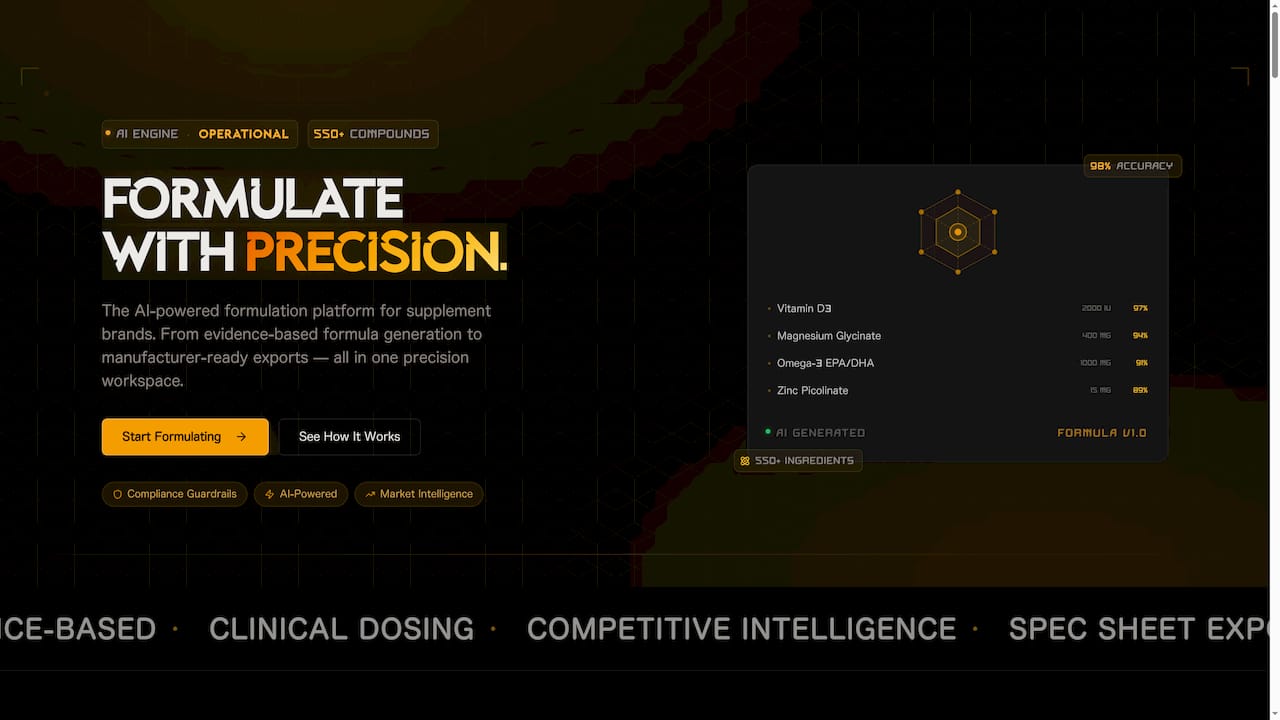
Formlypro is built for product managers and QA teams who need to move from idea to validated, compliant product without losing momentum. The platform's 8-phase product workflow covers formulation, prototyping, market research, compliance, and production in a single system. Every phase includes the data and structure you need to test with confidence, not guesswork. The AI Mockup designer handles packaging validation, and the built-in compliance guidance keeps your product on the right side of regulatory requirements before testing begins. If you are building supplement or wellness products and want a faster path from concept to launch-ready, Formlypro gives your team the foundation to launch faster and smarter.
FAQ
What is the minimum unit test coverage for effective QA?
Effective QA programs target 70–80% unit test coverage as a baseline. Defect leakage should stay below 2% to meet industry standards for pre-release quality.
How does AI-assisted testing change the testing timeline?
AI-assisted platforms compress testing cycles from the traditional 4–6 weeks to under 24 hours. They also expand usable sample sizes from 5–10 users to 50–100+ participants for more reliable results.
What is pairwise testing and when should you use it?
Pairwise testing reduces large combinations of input variables to fewer than 12 test cases by covering every pair of values at least once. Use it when a feature has multiple interacting variables that would otherwise require hundreds of test cases.
How do you prioritize issues found during product testing?
The Impact vs. Effort matrix is the most practical tool. Rank every issue by its effect on user success and the cost to fix it, then address high-impact, low-effort issues first.
Why should teams avoid scripted usability test questions?
Leading questions in usability scripts push users toward expected answers, which invalidates the results. High-level task prompts that allow natural user behavior produce authentic and usable insight.