
TL;DR:
- A cosmetic formulator develops safe, effective beauty products by combining scientific knowledge, ingredient science, and sensory evaluation. They work across skincare, haircare, and cosmetics, leveraging software and AI tools to accelerate development and ensure regulatory compliance. Success in the field depends on niche specialization, understanding production scale challenges, and integrating business insights into formulation strategies.
A cosmetic formulator is a professional who develops safe, effective beauty products by combining chemistry knowledge, ingredient science, and sensory evaluation to create formulations that perform in real-world conditions. This role spans skincare, haircare, body care, and color cosmetics, requiring both lab precision and market awareness. The industry increasingly demands fluency in cosmetic formulation software, AI-assisted R&D, and regulatory compliance, making the modern formulator part scientist, part strategist. Whether you are building your first serum or launching a full product line, understanding how formulators work gives you a decisive edge in a market where ingredient transparency and clinical performance are no longer optional.
What does a cosmetic formulator actually do?
A cosmetic formulator combines scientific knowledge with practical formulation skills to develop products that are both safe and clinically effective across skin, hair, and body care categories. The role goes well beyond mixing ingredients. Formulators define the product concept, select raw materials, build the formula architecture, run stability and compatibility tests, and prepare documentation for regulatory submission.
The scope of a formulator's work depends heavily on the product type. A skin care formulator working on a vitamin C serum must account for oxidation stability, pH sensitivity, and delivery mechanisms. A makeup formulation specialist developing a long-wear foundation must balance film-forming polymers, pigment dispersion, and skin feel. These are not interchangeable skill sets, which is why specialization matters early.
Most professional formulators today work alongside cosmetic formulation software and AI tools rather than relying solely on bench work. Platforms like Formulate and Formulator handle version control, batch scaling, and ingredient documentation, while predictive AI tools from companies like Intellico AI model viscosity and stability before a single prototype is made. The result is faster development cycles and fewer wasted raw materials.
Essential skills every formulator needs
Technical competency is the foundation, but the most effective formulators combine chemistry fluency with sensory judgment and business awareness. Here is what the role actually requires:
- Ingredient functionality: You must understand what emollients, humectants, surfactants, film formers, and preservatives do at a molecular level and how they interact within a formula matrix.
- pH and stability chemistry: Many active ingredients are pH-sensitive. Knowing how to buffer a formula and predict interactions between ingredients prevents costly reformulation later.
- Sensory evaluation: Texture, spreadability, skin feel, and fragrance perception are measurable outputs. Formulators train their senses the same way a chef trains their palate.
- Performance testing: Claims like "24-hour hydration" or "reduces redness in 7 days" require structured clinical or consumer testing protocols to substantiate.
- Regulatory literacy: Every market has its own restricted ingredient lists, labeling rules, and safety assessment requirements. A formulator who cannot read a compliance brief is a liability.
Dr. Juliet Moncrieff of The Formulary emphasizes that continuous specialized training in niches like natural surfactants and cosmeceuticals is what separates formulators who plateau from those who build lasting careers. The cosmetic chemistry career path rewards depth over breadth, especially as consumer demand for bioactive and clinically validated products grows.
Pro Tip: Pick one niche, whether it is waterless formulation, microbiome-friendly skincare, or color cosmetics, and go deep before expanding. Generalists compete on price; specialists compete on expertise.
Custom, semi-custom, or turnkey: which model fits your brand?
The formulation development model you choose shapes your timeline, budget, brand exclusivity, and relationship with manufacturers. These three models are not equally suited to every business stage.
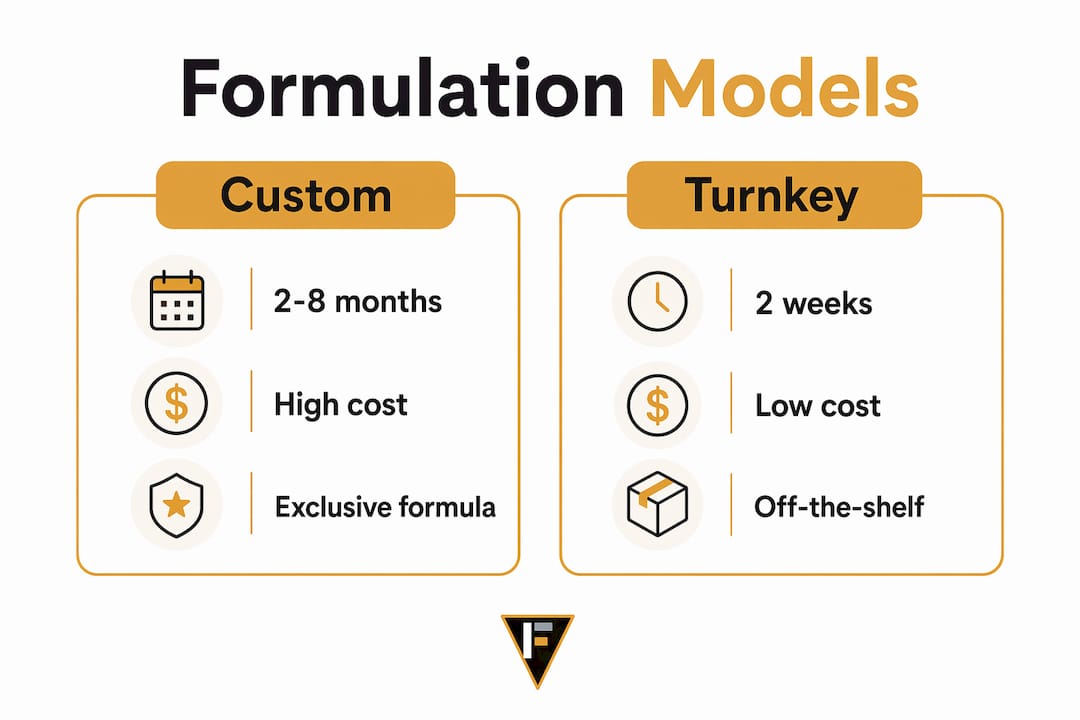
| Model | Timeline | Cost level | Exclusivity | Best for |
|---|---|---|---|---|
| Custom | 2 to 8 months | High | Full ownership | Established brands with R&D budget |
| Semi-custom | 4 to 10 weeks | Moderate | Partial | Entrepreneurs balancing speed and differentiation |
| Turnkey | 2 to 4 weeks | Low | None | Fast market entry, low risk testing |
Custom formulation gives you complete ownership of the formula, the ingredient selection, and the performance profile. According to Elite Formulations, the typical professional custom development process runs 1 to 4 months for development plus 1 to 4 months for production, with two working prototypes included. This model suits brands that have validated a market need and are ready to invest in a defensible product.
Semi-custom formulation starts from a proven base formula that is then modified with actives, fragrance, or texture adjustments specific to your brand. Elite Formulations advises that semi-custom provides significant brand differentiation with faster timelines compared to fully custom development. For most early-stage beauty entrepreneurs, this is the most practical starting point.
Turnkey formulation uses an existing, off-the-shelf formula that you brand and sell. Speed to market is the only real advantage here. You own no intellectual property, and your formula is available to any other brand working with the same manufacturer.
Pro Tip: Before committing to a development model, map your minimum viable product against your launch timeline. If you need to be on shelves in 60 days, custom formulation will not get you there. Semi-custom will.
For a deeper look at how these models work in practice, the guide on custom formulation for health and beauty brands breaks down the decision criteria clearly.
How cosmetic formulation software changes the development process
Cosmetic formulation software is no longer a luxury for large R&D teams. It is the infrastructure that keeps formulas accurate, compliant, and reproducible across every batch and every team member.
The core problem software solves is recipe drift. Without version control, a formula modified during a stability test can quietly diverge from the original, and that divergence compounds across production runs. Tools like Formulate and Formulator prevent recipe drift by maintaining an immutable formula version history alongside consistent batch calculations. Every change is logged, every version is recoverable, and every batch calculation pulls from the same verified source.
Beyond version control, the best cosmetics formulation software platforms deliver:
- Ingredient databases with INCI names, supplier data, usage levels, and regulatory flags across multiple markets
- Batch scaling calculators that automatically adjust quantities when you move from a 100g lab batch to a 500kg production run
- Documentation generation for safety data sheets, product specifications, and regulatory dossiers
- Team collaboration tools that allow multiple formulators to work on the same project without overwriting each other's data
Formulation software also integrates with regulatory and manufacturing workflows, reducing the manual handoff errors that slow down product launches. Specialized compliance software has been shown to improve efficiency by at least 40% compared to manual methods, which translates directly to faster time-to-market for brands operating on tight launch schedules.
How AI is reshaping cosmetic product development
AI predictive modeling is the most significant shift in cosmetic R&D since the introduction of digital formulation databases. The practical impact is measurable and immediate.
Intellico AI's platform predicts formulation properties like viscosity and stability in minutes, reducing R&D costs by cutting the number of lab tests and raw material iterations required before a formula is stable. Explainable AI goes further by identifying which specific ingredients are driving a particular formulation parameter, so you can make targeted adjustments rather than reformulating from scratch. This is the difference between a scalpel and a sledgehammer.
The practical workflow looks like this. You input your formula into the AI system. The model predicts stability, skin feel, and viscosity based on training data from thousands of prior formulations. It flags potential incompatibilities and suggests ingredient substitutions ranked by predicted performance. You enter the lab with a formula that has already been stress-tested computationally, which means your first prototype is far closer to your target than a trial-and-error approach would produce.
For entrepreneurs without a full R&D team, AI tools level the playing field considerably. You do not need a PhD in polymer chemistry to use a predictive model. You need to understand what output you are optimizing for and how to interpret the results.
Pro Tip: Use AI prediction to narrow your formula candidates to two or three before any lab work begins. This alone can cut your prototype cycle by 30 to 50 percent and reduce raw material waste significantly.
You can explore research-backed formulation examples to see how predictive approaches have been applied across cosmetic and food product categories.
Scaling from lab to production: where formulas break
The most common mistake in cosmetic product development is treating a successful lab batch as proof that a formula will work at scale. It is not. Scaling formulations is a physical challenge where lab formulas frequently fail at industrial scale due to differences in heat transfer, mixing dynamics, and aeration. A cream that emulsifies perfectly in a 500ml beaker can break apart in a 500-liter tank.
The key practices that prevent scale-up failures are:
- Engage your contract manufacturer early. Share your formula before you finalize it, not after. Manufacturers know which ingredients cause processing problems at scale and can flag issues before you have committed to a production run.
- Run pilot batches at an intermediate scale. Moving directly from 1kg to 1,000kg skips the data you need to identify instability. A 50kg pilot batch reveals mixing time, temperature sensitivity, and viscosity behavior under real processing conditions.
- Document your critical process parameters. Mixing speed, temperature range, addition sequence, and hold times must be recorded and replicated exactly. Undocumented processes cannot be reproduced consistently.
- Complete stability testing before production commitment. Accelerated stability at 40°C and 75% relative humidity over 12 weeks predicts real-world shelf life. Skipping this step to save time almost always costs more time later.
For a step-by-step view of the full development process, the guide on creating market-ready formulations covers each phase from concept through production sign-off.
Key takeaways
Becoming a successful cosmetic formulator requires mastering ingredient science, choosing the right development model, and using software and AI tools to build formulas that survive both the lab and the production floor.
| Point | Details |
|---|---|
| Define your specialization | Niche expertise in cosmeceuticals, natural products, or color cosmetics builds career leverage faster than generalist knowledge. |
| Match development model to stage | Custom formulation suits funded brands; semi-custom balances speed and differentiation for early-stage entrepreneurs. |
| Use software from day one | Formulation software prevents recipe drift and scales batch calculations accurately, protecting formula integrity across production runs. |
| Apply AI before lab work | Predictive tools like Intellico AI reduce prototype cycles and raw material waste by stress-testing formulas computationally first. |
| Scale with manufacturer input | Early collaboration with contract manufacturers prevents the physical failures that sink lab-proven formulas at industrial scale. |
Why most formulators underestimate the business side
I have worked with dozens of aspiring formulators who are technically gifted but struggle to get products to market. The pattern is consistent. They spend months perfecting a formula and almost no time thinking about how that formula fits into a brand story, a price point, or a retail channel. The science is the easy part to teach. The market positioning is where most people stall.
The formulators I have seen build real businesses treat compliance, packaging, and competitive analysis as part of the formulation process, not afterthoughts. They know which ingredients their competitors are using, which claims are substantiated in their category, and what their target consumer reads on a label before buying. That intelligence shapes formula decisions from the start, not after the product is already in production.
Specialization also matters more than most people admit. A skin care formulator who owns a specific niche, say, barrier repair for sensitive skin or peptide-based anti-aging, commands higher fees, attracts better brand partnerships, and builds a body of work that speaks for itself. Generalists compete on availability. Specialists compete on outcomes.
The technology shift happening right now is real and worth taking seriously. AI and formulation software are not replacing formulators. They are raising the floor for what a competent formulator can produce independently. If you are not using these tools, you are working harder than you need to for results that are less predictable than they should be.
— Ben
Build your next formulation with Formlypro
Formlypro is built specifically for beauty entrepreneurs and aspiring formulators who want to move from idea to market without the guesswork.
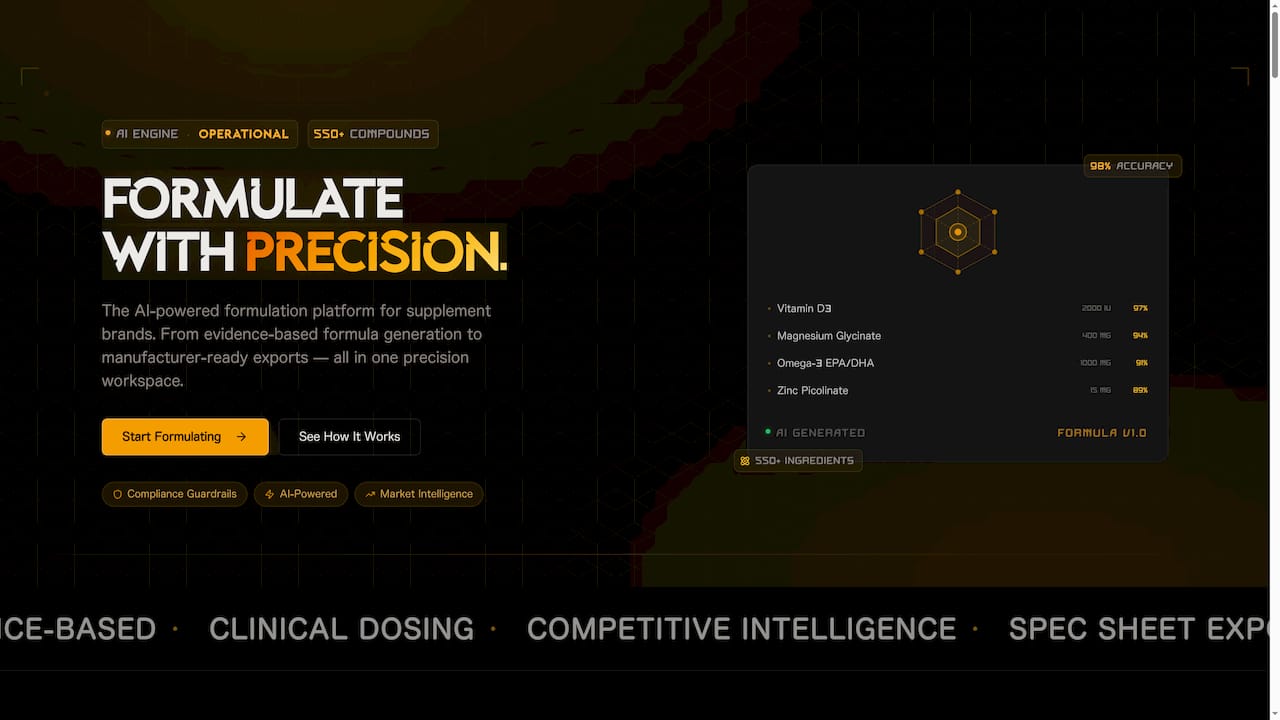
The platform includes an 8-phase product development plan that takes you from ideation through formulation, prototyping, compliance, and production. Market research and competitor analysis show you exactly which products are selling and what ingredients those brands are using. The built-in compliance guidance covers your product and your brand across the markets you are targeting. A packaging section with an AI mockup designer lets you visualize and create custom packaging without a separate design agency. If you are serious about building a formulation brand that is research-backed and market-ready, Formlypro gives you the infrastructure to do it right.
FAQ
What is a cosmetic formulator?
A cosmetic formulator is a professional who develops safe and effective beauty products by applying ingredient science, testing methods, and regulatory knowledge across skin, hair, and body care categories.
How long does cosmetic product development take?
Development timelines range from 2 weeks for turnkey formulations to 1 to 4 months for fully custom development, plus an additional 1 to 4 months for production depending on complexity and testing requirements.
What does cosmetic formulation software do?
Cosmetic formulation software manages ingredient databases, batch scaling, version control, and regulatory documentation. It prevents recipe drift and keeps formulas consistent across every production run.
How does AI help in cosmetic formulation?
AI tools predict formulation properties like viscosity and stability before lab work begins, reducing prototype cycles and raw material waste. Platforms like Intellico AI use explainable AI to identify which ingredients drive specific formulation outcomes.
Do I need a chemistry degree to become a cosmetic formulator?
Formal chemistry training helps, but many successful formulators build expertise through specialized courses, certificate programs, and hands-on lab work. Continuous education in niches like cosmeceuticals or natural surfactants, as Dr. Juliet Moncrieff recommends, is more predictive of success than a specific degree.