

Subscription models deliver three things that one-time sales rarely can: predictable recurring revenue, higher customer lifetime value (LTV), and the behavioral data to keep improving both. Stripe's analysis of subscription businesses confirms that MRR and ARR smooth forecasting and free capital that would otherwise sit idle waiting for the next sale cycle. Harvard Business School's faculty note on subscription models adds that the model forces continuous value delivery, which, when done well, compounds retention and LTV over time.
The core benefits, at a glance:
- Predictable revenue via MRR/ARR that replaces lumpy, transactional cash flow
- Higher LTV because subscribers stay longer and buy more
- Behavioral data that enables personalization, upsell, and churn prediction
- Upsell and cross-sell mechanics that grow revenue without new acquisition spend
- Scalability at low marginal cost, especially in digital products
- Valuation premium from investors who pay higher multiples for recurring revenue
Product-led SaaS companies, consumables brands, and B2B services firms tend to extract the most value from this structure, though the model has proven itself across media, wellness, and professional services as well.
Key Takeaways
Subscription models build compounding revenue assets, but only when retention, unit economics, and continuous value delivery are managed as core business functions.
| Point | Details |
|---|---|
| Predictable revenue changes planning | MRR and ARR replace lumpy cash flow and let you make hiring, inventory, and marketing decisions with confidence. |
| NRR above 100% is the growth multiplier | Expansion revenue from existing subscribers costs less than new acquisition; track NRR monthly alongside churn. |
| Onboarding drives first-year retention | Subscribers who reach a clear value moment in the first 14–30 days churn at materially lower rates than those who don't. |
| Annual plans improve cash flow and reduce churn | Offering a discount for annual commitment pulls cash forward and reduces the frequency of renewal decisions. |
| Start with a small pilot, measure cohorts | Launch with 50–100 customers, track 30-day and 60-day retention by cohort, and iterate before scaling acquisition. |
Table of Contents
- What are the real business benefits of subscription-based models?
- Which subscription model type fits your business?
- What KPIs should every subscription business track?
- Why do subscribers leave, and how do you keep them?
- Is your business ready to launch a subscription offering?
- Which industries benefit most from subscription models?
- How do AI and predictive analytics sharpen subscription performance?
- What risks and legal considerations come with subscriptions?
- How do you acquire customers for a subscription business?
- How subscriptions change your cash flow and capital requirements
- The case for starting smaller than you think you need to
- Sources
What are the real business benefits of subscription-based models?
The benefits of subscription-based models go well beyond "steady income." Each one has a direct line to a metric that affects how you run, fund, and eventually sell your business.
Predictable, recurring revenue
When revenue arrives on a schedule, you plan differently. Hiring decisions, inventory orders, and marketing budgets stop being guesses tied to last month's sales spike. GoCardless notes that recurring payments also improve inventory and fulfillment forecasting for physical goods, which cuts both overstock and stockout costs. For digital businesses, the effect is even cleaner: MRR compounds month over month as long as churn stays below growth.
Higher LTV and lower effective customer acquisition cost (CAC)
Alex Berman's practitioner analysis shows that subscription customers routinely generate multiple times the lifetime revenue of one-time buyers, which lets you shift marketing spend from constant acquisition toward retention and expansion. The math is straightforward: if a subscriber stays 24 months at $50 per month, they generate $1,200. A one-time buyer at $80 generates $80. The CAC to acquire both customers may be identical, making the subscriber dramatically more efficient on a per-dollar basis.
Data-driven personalization and retention
Every billing cycle, login, and feature interaction is a data point. Subscription businesses accumulate behavioral signals that transactional businesses simply never see. Statista's research on personalization shows that a high share of consumers expect tailored experiences, and subscription data is what makes those experiences possible at scale. Usage patterns reveal which features drive retention, which segments are at risk, and which product changes will move the needle on renewal rates.
Statistic callout: Personalization is no longer optional. Consumer research consistently shows that tailored experiences are a primary driver of subscription renewal decisions, making usage data one of the most valuable assets a subscription business owns.
Upsell, cross-sell, and expansion revenue
That happens through upsells to higher tiers, add-on purchases, and cross-sells to adjacent products. Salesforce's analysis citing Gainsight leadership makes the case directly: high net retention drives materially more efficient growth because expansion revenue from existing customers costs far less than new acquisition.
Scalability and low marginal cost
Digital subscription products add users at near-zero marginal cost. A software platform serving 500 subscribers costs almost the same to operate as one serving 5,000, which means gross margin expands as the customer base grows. Physical goods subscriptions work differently: fulfillment, packaging, and shipping costs scale with volume. But even there, demand predictability lets you negotiate better supplier terms and reduce waste, which partially offsets the cost structure.

Valuation and investor advantages
Investors and acquirers apply a premium multiple to companies with predictable MRR. Subscription businesses frequently command higher exit multiples than comparable transactional businesses because the revenue is contractual, foreseeable, and harder to disrupt. If you are building toward a fundraise or an exit, recurring revenue is one of the most direct levers you can pull to improve your company's valuation.
Pricing flexibility and cash-flow control
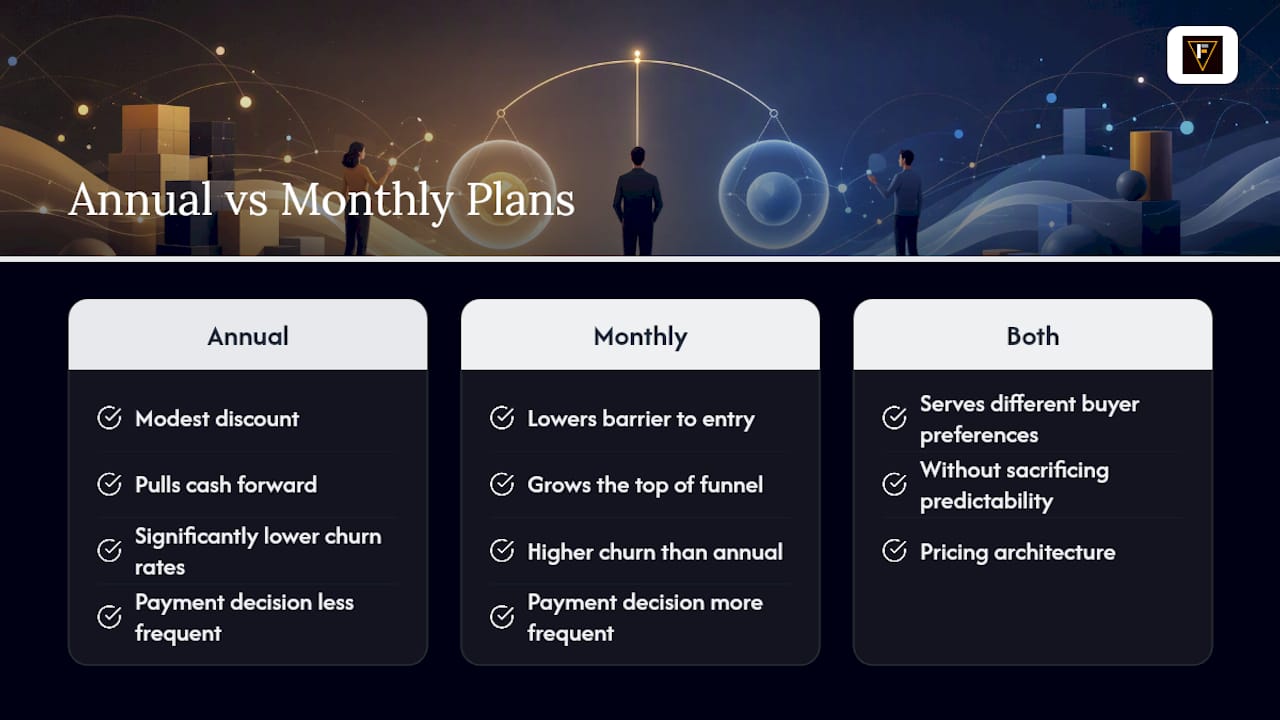
Annual plans, offered at a modest discount, pull cash forward and reduce monthly churn in one move. Practitioners consistently find that annual subscribers churn at significantly lower rates than monthly subscribers, partly because the payment decision happens less frequently. Monthly plans lower the barrier to entry and grow the top of funnel. Running both gives you a pricing architecture that serves different buyer preferences without sacrificing predictability.
Which subscription model type fits your business?
Not every subscription structure works for every product. The model you choose shapes your pricing mechanics, cash flow, and growth ceiling.
- Tiered subscriptions offer two to four fixed plans at different price points, each with a defined feature set. This is the dominant model in SaaS. It captures multiple customer segments and creates a natural upgrade path as customers grow into higher tiers.
- Usage-based (metered) subscriptions charge customers based on consumption: API calls, seats, data volume, or transactions. Stripe and Twilio are the canonical examples. This model aligns cost with value but makes revenue less predictable month to month.
- Replenishment subscriptions automate reorders for consumable physical goods. Coffee, supplements, skincare, and pet food all fit here. Demand is predictable, logistics can be optimized, and churn is often lower because the product is genuinely needed on a schedule.
- Freemium gives a base tier away for free and monetizes a subset of users who upgrade. Conversion rates from free to paid are typically low, so this model works best when the free tier itself drives viral growth or network effects.
- Hybrid models combine a base subscription fee with usage overages or add-on purchases. This structure balances revenue predictability (the base fee) with expansion potential (usage and add-ons). It is increasingly common in B2B SaaS and professional services.
Pricing mechanics matter as much as model type. Monthly billing maximizes accessibility; annual billing maximizes cash flow and reduces churn.
Pro Tip: Before committing to a model, run a simple pricing experiment with a small cohort. Offer two plan structures to separate segments and measure conversion rate, time-to-first-payment, and 60-day retention. The data from 100 customers will tell you more than any pricing framework.
What KPIs should every subscription business track?
A subscription business without a KPI dashboard is flying blind. These are the metrics that actually matter, organized by what they tell you.
Core revenue metrics
| Metric | What it measures | Why it matters |
|---|---|---|
| MRR (Monthly Recurring Revenue) | Predictable monthly revenue from active subscribers | The baseline health signal; tracks growth and contraction in real time |
| ARR (Annual Recurring Revenue) | MRR × 12 | Used for investor reporting and valuation benchmarks |
| ARR Growth Rate | Year-over-year ARR change | Signals whether the business is accelerating or decelerating |
| Net Revenue Retention (NRR) | Revenue retained plus expansion from existing customers | NRR above 100% means growth without new acquisition |
| Gross Revenue Retention (GRR) | Revenue retained excluding expansion | Shows pure churn impact, independent of upsell |
Unit economics
- LTV (Customer Lifetime Value): Average revenue per customer over their full relationship with you. Calculate as average monthly revenue per customer divided by monthly churn rate.
- CAC (Customer Acquisition Cost): Total sales and marketing spend divided by new customers acquired in the same period.
- LTV:CAC ratio: A ratio above 3:1 is generally considered healthy for SaaS; below 1:1 means you are losing money on every customer.
- CAC payback period: How many months it takes to recover acquisition cost. Shorter payback means faster reinvestment capacity.
Retention and engagement metrics
Monthly churn rate is the most watched number in any subscription business, but it can mislead if read in isolation. Track churn by cohort, not just as a blended average, because cohort analysis reveals whether newer customers retain better than older ones, which is the signal that product improvements are working.
Time-to-value (TTV) is the engagement metric most directly tied to early churn. Customers who reach their first meaningful outcome quickly are far more likely to renew. Product analytics can surface exactly where new subscribers stall before reaching that first value moment.
Measurement cadence: Review MRR, churn, and activation weekly for operational decisions. Review LTV, CAC, NRR, and cohort data monthly for strategic decisions. Quarterly, run a full cohort analysis to assess whether retention curves are improving.
Why do subscribers leave, and how do you keep them?
Churn is the tax every subscription business pays for a poor customer experience. The good news: most churn is predictable and preventable.
Common churn triggers
- Poor onboarding: Customers who don't reach a clear value moment in the first 14–30 days churn at dramatically higher rates than those who do.
- Pricing friction: A price increase without a corresponding value increase is one of the fastest ways to trigger cancellations.
- Product stagnation: Subscribers who stop seeing new features or improvements start questioning whether the subscription is worth renewing.
- Irrelevant communications: Generic email blasts that ignore usage behavior signal that the company doesn't know its customers, which erodes trust.
- Billing failures: Failed payments that aren't caught and retried quickly result in involuntary churn, which is entirely preventable with proper dunning.
Retention tactics that work
- Build a structured onboarding sequence that guides new subscribers to their first meaningful outcome within the first week. Map the steps, automate the nudges, and measure completion rates by cohort.
- Use usage-based triggers to identify at-risk subscribers before they cancel. A customer who hasn't logged in for 21 days needs a different message than one who logs in daily.
- Personalize renewal communications based on what each subscriber actually uses. Showing someone the specific value they've received (reports generated, products formulated, hours saved) is more persuasive than a generic "thanks for being a member" email.
- Run win-back flows for recently churned customers. A targeted offer 30–60 days after cancellation, tied to a product improvement they didn't have access to, converts a meaningful share of churned subscribers back.
- Implement payment retry and dunning logic to recover failed payments automatically. Streamlining recurring billing with smart retry schedules and pre-dunning notifications can recover a significant portion of involuntary churn before it registers as a lost subscriber.
Pro Tip: In your first 90 days, focus exclusively on onboarding completion and payment recovery. These two levers have the highest return on effort and require no product changes to implement.
90-day churn reduction checklist
- Map your current onboarding flow and identify where subscribers drop off
- Set up automated nudges for subscribers who haven't completed key activation steps
- Configure payment retry logic with at least three retry attempts over seven days
- Segment your subscriber list by usage level and send targeted re-engagement campaigns to low-usage accounts
- Add a cancellation survey to capture exit reasons and feed them back into product and pricing decisions
Is your business ready to launch a subscription offering?
Readiness isn't just about having a product worth subscribing to. It's about having the operational infrastructure to deliver, bill, and retain at scale.
Readiness checklist
- Product fit: Does your product deliver recurring value? A one-time-use product is a poor subscription candidate; a product that improves with continued use is a strong one.
- Value frequency: How often does the customer need the product or service? Weekly or monthly needs fit subscriptions well; annual needs are harder to sustain.
- Billing and payments: Do you have a subscription billing platform that handles recurring charges, failed payment retries, plan changes, and proration? Stripe Billing, Chargebee, and Recurly are the standard options in the U.S. market.
- Legal and terms: Your subscription terms must clearly state billing frequency, cancellation policy, and refund terms. The FTC's negative option rule requires clear disclosure of recurring charges before the customer commits.
- Customer success capacity: Do you have the team or tooling to monitor subscriber health and intervene before churn? Even a lightweight customer success process outperforms no process.
- Analytics and CRM: Can you track subscriber behavior, segment by usage, and trigger automated communications? A CRM like HubSpot or Salesforce connected to your billing data is the minimum viable stack.
Typical MVP launch timeline
- Weeks 1–4: Define the offer, pricing tiers, and cancellation terms. Set up billing infrastructure and integrate with your CRM.
- Weeks 5–8: Pilot with a select cohort of 50–100 customers. Offer an annual plan with a discount to test price sensitivity and to pull cash forward.
- Weeks 9–12: Measure 30-day and 60-day retention cohorts. Identify the top two or three onboarding drop-off points and fix them before scaling.
- Month 4 onward: Scale acquisition, refine pricing based on cohort data, and introduce upsell mechanics once baseline retention is stable.
The pilot phase is where most businesses learn the most. Keep it small, measure obsessively, and resist the urge to scale before retention cohorts show a stable curve. Formulation analytics and data-driven iteration follow the same principle: small, measured cycles outperform big launches every time.
Which industries benefit most from subscription models?
Subscription mechanics work across a wide range of industries, but the primary benefit realized differs by sector.
- SaaS and digital platforms: The clearest fit. Near-zero marginal cost to add users, tiered pricing that captures multiple segments, and expansion revenue through seat additions or feature upgrades. The primary benefit is compounding NRR. A SaaS company with strong net retention grows its revenue base even in months with flat new-customer acquisition.
- Consumables and replenishment businesses: Supplements, skincare, coffee, and pet food all have predictable consumption cycles. The subscription removes the friction of reordering and gives the brand demand visibility that improves supplier negotiations and inventory planning. GoCardless highlights that this demand predictability is one of the most operationally valuable benefits for physical goods businesses.
- B2B services and managed offerings: Retainer-style engagements, managed services, and professional subscriptions generate high LTV because switching costs are real and relationships deepen over time. The primary benefit is revenue stability that allows the service provider to staff and invest with confidence.
- Media and membership communities: Engagement-driven retention is the core mechanic here. Members who participate in community features, attend events, or consume exclusive content churn at lower rates than passive subscribers. The data from engagement patterns also informs content strategy and product development.
- Beauty and wellness brands: Subscription boxes, replenishment programs, and membership tiers are well-established in this category. Retention tactics for beauty and wellness businesses often center on personalization and loyalty rewards, both of which are enabled by the behavioral data that subscriptions generate.
How do AI and predictive analytics sharpen subscription performance?
The research on this is consistent: businesses that layer analytics over subscriber data outperform those that rely on intuition alone.
Salesforce's analysis argues that high net retention is the single most efficient growth lever available to a subscription business, because expansion revenue from existing customers costs a fraction of what new acquisition costs. The implication for analytics is direct: if you can predict which subscribers are likely to expand and which are likely to churn, you can allocate your customer success resources with far more precision.
Stripe's practitioner guidance on subscription revenue models describes how layering algorithms over usage data improves both renewal forecasting and pricing decisions. The starting point doesn't need to be sophisticated. A cohort churn model built on login frequency, feature adoption, and billing history will surface at-risk accounts more reliably than any manual review process.
Statistic callout: AI-driven personalization is now a core retention strategy. Models that surface churn triggers and deliver targeted interventions materially improve renewal rates, according to Bank of America's analysis of subscription business models.
Concrete starting points for analytics implementation:
- Cohort churn modeling: Group subscribers by signup month and track their retention curves. This reveals whether product changes are improving retention for newer cohorts.
- Renewal propensity scoring: Score each subscriber's likelihood to renew based on usage, support interactions, and payment history. Use the score to prioritize customer success outreach.
- Pricing sensitivity analysis: Test price changes on small cohorts before rolling them out broadly. Usage data tells you which features subscribers value most, which informs where pricing power actually exists.
Pro Tip: Start with the data you already have. Login frequency, feature adoption, and payment history are available in most billing and product analytics stacks today. Build a simple churn risk score from those three signals before investing in more complex ML infrastructure.
What risks and legal considerations come with subscriptions?
Subscription models carry real operational and legal risks that are worth understanding before you launch.
- Revenue recognition (ASC 606): Under U.S. GAAP, subscription revenue is recognized over the period it is earned, not when cash is received. Annual prepayments sit on the balance sheet as deferred revenue until each month of service is delivered. This is a high-level accounting note; consult a CPA or financial advisor for your specific situation.
- Subscription fatigue and ethical billing: Consumers are increasingly wary of subscriptions they can't easily cancel. The FTC's updated negative option rule requires clear disclosure of recurring charges and a simple cancellation mechanism. Burying cancellation in a multi-step process is both a legal risk and a reputational one.
- Vendor lock-in: Subscribers who feel trapped by data portability issues or difficult offboarding become vocal detractors. Offering data export options and a clean cancellation flow is both ethical and good for long-term brand reputation.
- Operational scaling: As subscriber volume grows, so does the complexity of support, billing edge cases, and fulfillment (for physical goods). Plan for this before it becomes a crisis.
Wikipedia's overview of subscription model risks notes that customer inertia can lead to unwanted charges, which damages trust and invites regulatory scrutiny. The mitigation is straightforward: clear terms, proactive billing notifications, and a cancellation flow that takes under 60 seconds.
This section provides general information, not legal or accounting advice. Confirm current FTC requirements and ASC 606 treatment with a qualified attorney or CPA.
How do you acquire customers for a subscription business?
Subscription acquisition strategy differs from one-time purchase acquisition in one critical way: the unit economics only work if you acquire customers who will stay. A high-churn acquisition channel is worse than no channel at all, because it burns CAC without building the recurring revenue base.
Lead with the value of the subscription, not the price. Free trials, freemium tiers, and money-back guarantees reduce the perceived risk of committing to a recurring charge. They also give you a cohort of trial users whose behavior predicts which acquisition channels bring high-LTV subscribers.
Invest in content and SEO for long-term, low-CAC acquisition. Subscription businesses benefit disproportionately from organic traffic because the LTV of a subscriber justifies the upfront content investment. A blog post that ranks for a high-intent keyword and converts readers to trial users generates compounding returns over its lifetime.
Use referral programs to leverage existing subscribers. Satisfied subscribers are the most credible advocates for a subscription product. A referral program that rewards both the referrer and the new subscriber lowers CAC and tends to bring in higher-quality customers because they arrive with a trusted endorsement.
Segment acquisition by expected LTV. Not all acquisition channels deliver the same customer quality. Track 90-day retention by acquisition source and shift budget toward channels that bring subscribers who stay. Payment processing practices that reduce friction at signup also improve conversion rates from trial to paid, which directly lowers effective CAC.
Annual plan incentives at the point of signup are one of the highest-leverage acquisition tactics available.
How subscriptions change your cash flow and capital requirements
The cash-flow profile of a subscription business is fundamentally different from a transactional one, and the difference cuts both ways.
Annual prepayments improve cash flow dramatically. When a subscriber pays $600 upfront for an annual plan, you receive cash before you deliver most of the service. That float funds operations, reduces the need for external capital, and gives you a buffer against slow acquisition months. For early-stage businesses, this can be the difference between needing a funding round and not.
Monthly subscriptions create predictable but smaller cash inflows. The predictability is valuable for planning, but the cash arrives in smaller increments. If your cost structure has large fixed components (engineering, fulfillment infrastructure, customer success headcount), monthly billing may require more working capital than annual billing to cover those costs while the subscriber base grows.
Deferred revenue is a liability on the balance sheet. Annual prepayments that haven't been earned yet sit as deferred revenue, which means your reported revenue lags your cash position. This is a feature for cash flow but a nuance for financial reporting under ASC 606. Investors and acquirers understand this well; make sure your financial statements reflect it accurately.
Churn has a compounding effect on capital efficiency. High churn forces continuous reinvestment in acquisition just to maintain flat MRR. That acquisition spend is capital that could otherwise fund product development, expansion, or distribution. Reducing churn by even two or three percentage points per month has an outsized effect on how much capital the business needs to grow.
The case for starting smaller than you think you need to
The businesses that build durable subscription revenue don't usually launch with a polished three-tier pricing page and a full customer success team. They start with a single offer, a small cohort, and a ruthless focus on whether subscribers actually come back.
The most common mistake is treating a subscription like a product launch: build it, announce it, and move on. Subscription businesses are living systems. They require continuous investment in the product, the onboarding experience, and the customer relationship. Harvard Business School's analysis frames this clearly: the model only works when the business delivers ongoing value that justifies the recurring charge. When it doesn't, churn accelerates and the economics collapse.
At Formlypro, we see this dynamic play out directly with the product teams and supplement brands we work with. The ones who succeed with subscription offerings are the ones who treat the first 90 days of a subscriber's experience as the product, not an afterthought. They measure time-to-value obsessively, iterate on onboarding based on cohort data, and use behavioral signals to personalize retention before churn becomes visible in the aggregate numbers.
The practical next step is smaller than most people expect: pick 50 customers, offer them an annual plan with a meaningful discount, and measure 60-day retention. That single experiment will tell you more about your subscription's viability than any financial model.
Sources
- Subscription business models: types, benefits, and how to choose one | Stripe
- Why more companies could benefit from a subscription-based model | Harvard Business School (faculty note)
- Subscription revenue models: the complete guide | Alex Berman
- 5 benefits of a subscription business model | GoCardless