

This checklist maps every practical compliance checkpoint to its exact citation in 21 CFR Part 111, so you can run a self-audit that mirrors what an FDA investigator actually checks. It covers component testing, master manufacturing records, quality control sign-off, and recordkeeping retention, drawn directly from the Small Entity Compliance Guide and the full CFR text. Start with the self-assessment below to triage where your gaps actually are before an inspector finds them for you.
TL;DR:
- Independent identity testing of incoming ingredients is mandatory unless scientifically justified exemptions are properly documented and approved.
- Master Manufacturing Records and Batch Production Records must include equipment IDs, actual yields, and personnel signatures to be considered inspection-ready.
- A designated QC person must review and approve each batch before release, with written procedures and training records documenting compliance.
- Records such as component testing, lab results, and complaint investigations must be retained for at least one year past the product's shelf life or two years after distribution.
- Common FDA inspection findings include incomplete batch records, missing or outdated SOPs, and insufficient supplier qualification, requiring immediate and thorough correction.
Table of Contents
- What Does a 21 CFR 111 Checklist Actually Cover?
- Who Signs Off? Quality Control Roles and Written Procedures
- Facility, Water, and Equipment: What Sanitation Checks Matter Most
- Are Your MMRs and BPRs Actually Inspection-Ready?
- Is Your Supplier Qualification Process Strong Enough?
- What Do Lab Records Need to Show for Release?
- How Long Do You Have to Keep Records?
- What Are the Most Common FDA 483 Observations?
- How Do You Score and Close Out a Self-Assessment?
- How Formlypro Turns This Checklist Into Working Documents
- Do Holding and Distribution Areas Need Their Own Controls?
- What Happens When a Supplement Is Returned or Recalled?
- Should Brand Owners Rely on Their Contract Manufacturer's Compliance Alone?
- Build Your MMRs and BPRs Faster With Formlypro
- Where to Verify the Rules Yourself
- Sources
What Does a 21 CFR 111 Checklist Actually Cover?
A working checklist for Part 111 compliance breaks the regulation into functional zones, not legal jargon. Each zone maps to a specific subpart, and each subpart drives a set of documents an inspector will ask to see within the first hour of a facility walkthrough.
Part 111 governs current good manufacturing practice for anyone who manufactures, packages, labels, or holds a dietary supplement sold in the United States, whether the facility is domestic or overseas. The 2007 final rule built these requirements from the ground up specifically for supplements, distinct from food GMPs, and it exempts certain retail-level holding activities under 21 CFR 111.1. If your facility touches a raw material, blends it, encapsulates it, or stores finished product before shipment, Part 111 applies to that operation.
Here's how the checklist sections line up against the actual CFR subparts:
- Components and suppliers → §111.70 through §111.80 (identity testing, specifications, receiving)
- Production and process controls → §111.55 through §111.83 (MMRs, BPRs, deviation handling)
- Quality control → §111.100 through §111.136 (designated QC personnel, material review, release)
- Laboratory operations → §111.320 (test method validity)
- Records and retention → §111.605 (retention timelines and accessibility)
Use this checklist in three distinct situations: a pre-inspection dry run, routine quarterly QA sampling, and vetting a new contract manufacturer or supplier before you sign an agreement. For scoring, a simple pass, fail, or not-applicable rating per item works better than a numeric score, because a single fail on identity testing or MMR completeness should halt release regardless of how well everything else scores. Most mid-size supplement facilities benefit from running the full checklist twice a year, with spot checks on component receiving and BPR completeness monthly, since those two areas generate the most 483 observations in practice. For a broader view of where Part 111 fits alongside labeling and other FDA obligations, this compliance requirements overview is worth bookmarking.
Who Signs Off? Quality Control Roles and Written Procedures
Part 111 requires a designated quality control person for every step of manufacturing, and that person's authority has to be documented, not implied. Under §111.105, QC has to review and approve, or reject, every batch before it moves to distribution, and that approval can't be delegated to production staff who have a stake in getting product out the door.
Here's what an inspector expects to find when checking your QC structure:
- A written job description or organizational chart naming the QC-designated individual, separate from production management
- Signed batch disposition records showing QC approval before release, not after
- Written procedures (SOPs) for every operation the facility performs, from receiving to packaging to holding
- A documented material review and disposition process for any batch that fails specifications
- Complaint-handling procedures that specify who investigates, what triggers a formal investigation, and how findings get closed out
Written procedures are the backbone inspectors probe first, because a missing SOP means there's no defined standard to audit against. Every procedure needs a version number, an effective date, and a signature trail showing who approved it and when it was last reviewed. If your SOPs haven't been touched in three years, that's usually a sign nobody's actually following them, and inspectors notice stale revision dates.
Training records need to tie specific personnel to specific SOPs, with dates and, where relevant, competency verification. A hygiene program without documented training on it is functionally the same as no hygiene program at §111.10, since inspectors ask employees directly what they were trained on and cross-check answers against the paper trail.

CAPA, or corrective and preventive action, needs defined timelines under §111.83. A deviation identified today shouldn't sit open for six months with no interim containment action. Build a simple rule: root cause identified within 15 business days, corrective action implemented within 30, and verification of effectiveness documented within 90.
Pro Tip: Keep a single running CAPA log across the whole facility instead of separate logs per department. Inspectors frequently ask to see the full CAPA history in one sitting, and a fragmented system makes it look like nobody owns the process.
Facility, Water, and Equipment: What Sanitation Checks Matter Most
Plant design gets scrutinized before an inspector even opens a single batch record. A facility that allows raw material staging to physically cross paths with finished, labeled product is an automatic flag, regardless of how clean the floors look.
Walk your own facility with these questions in mind:
- Does the layout physically separate receiving, staging, production, and finished-goods holding to prevent cross-contact?
- Are dust, allergen, and pest controls documented with logs, not just verbal assurance from the floor supervisor?
- Is there a defined traffic flow that keeps personnel from tracking contamination between zones?
- Are gowning and hand-washing stations positioned at every zone transition point, not just at the building entrance?
Water is an area facilities underestimate constantly. If your process uses water in manufacturing, whether for cleaning, as an ingredient, or for equipment rinse cycles, you need documented testing of that water's potability, along with temperature and pressure logs for any system where microbial growth is a risk. A water system that hasn't been tested in over a year, sitting quietly behind a mixing tank, is exactly the kind of gap that turns a routine walkthrough into a formal Form 483.
Equipment controls split into two buckets: cleaning and calibration. Cleaning schedules need to specify what gets cleaned, how often, with what agent, and who verifies it. A "clean between batches" note with no signature is not documentation. Calibration logs for scales, thermometers, and any measuring device used to release product need current calibration certificates, with a defined recalibration interval, not a one-time calibration from when the equipment was installed.
Validation documentation matters most for cleaning procedures used on shared equipment across multiple formulations. If the same encapsulator handles three different products, you need evidence the cleaning process actually removes residue between runs, not just an assumption that it does. Preventive maintenance logs should show scheduled service dates alongside actual completion dates, because a maintenance schedule that's consistently pushed back is a pattern investigators are trained to spot.
Are Your MMRs and BPRs Actually Inspection-Ready?
Master Manufacturing Records and Batch Production Records are the two documents that carry the most weight in any Part 111 inspection, and they're also the two most commonly incomplete when facilities get audited. An MMR is your blueprint; a BPR is proof you followed it.
Every MMR needs to contain these elements to satisfy §111.55:
- The complete formulation, including every ingredient, its quantity, and the specification it must meet
- Written procedures for each production step, in the sequence they're performed
- In-process specifications and testing points, including acceptance criteria
- Equipment identification and required settings for each processing stage
- Packaging and labeling specifications tied to that specific formulation
- Sampling plans for both in-process checks and finished product testing
An MMR that's missing equipment identification is one of the most common gaps, because facilities often assume "the usual mixer" is documentation enough. It isn't. If your facility has two blenders of different capacities, the MMR needs to specify which one, because process parameters like mix time and speed differ by equipment.
The BPR is where MMR compliance gets proven or disproven. Every BPR needs to capture actual data, not planned data:
- The date and time each production step actually occurred
- Actual yield at each stage, compared against the expected yield range from the MMR
- The specific personnel who performed and who verified each step, by signature
- The actual equipment used, matched against what the MMR specified
- In-process test results with the specification and actual reading side by side
- Any deviation from the MMR, documented at the point it occurred, not reconstructed afterward
When actual yield falls outside the MMR's expected range, that's not a footnote, it's a trigger for investigation under §111.77. The same applies to any batch flagged as nonconforming: the disposition decision (rework, reject, or release with justification) needs a documented rationale, signed by QC, before that material moves anywhere. A batch that gets quietly blended into a larger lot to "average out" an out-of-spec reading is one of the more serious findings an inspector can document, because it suggests the facility is hiding failures rather than investigating them.
Pro Tip: Build your MMR template once, in a format that maps directly onto your BPR fields. If the MMR lists six process steps, your BPR should have six corresponding entry blocks in the same order. This alignment makes discrepancies visible instantly instead of requiring line-by-line cross-referencing. A structured MMR template built for FDA compliance removes most of the guesswork here.
Is Your Supplier Qualification Process Strong Enough?
Component receiving is where a huge share of Part 111 violations originate, because it's the point where an outside supplier's quality problem becomes your quality problem the moment you accept the shipment. Every incoming lot needs a documented receiving check before it moves to production staging.
Your receiving checklist should confirm:
- A Certificate of Analysis (COA) accompanies the shipment and matches the purchase order specification
- Shipment packaging is intact, with no evidence of temperature excursion, moisture damage, or tampering
- The lot is physically quarantined, labeled as such, and kept separate from released inventory until testing clears it
- Container counts match the packing slip, with any discrepancy documented before acceptance
Identity testing is the single most enforced requirement under §111.75, and the rule is unambiguous: every incoming lot of every dietary ingredient requires at least one identity test, unless you have a documented, scientifically justified exemption. Relying solely on a supplier's COA without independent identity confirmation is one of the most frequently cited gaps in Part 111 enforcement. If a supplier genuinely can't support 100% identity testing because of low sample volume or a lack of validated methods for that ingredient, the path forward is to document the scientific rationale and consider a petition under 21 CFR 10.30 for an alternative verification approach, with that petition and its supporting data kept in the supplier qualification file.
Supplier qualification itself needs to go beyond a signed vendor agreement. Request the supplier's own quality manual, recent audit history, and FDA registration status before the first order, not after a problem surfaces. When a supplier's documentation is thin or their COA data looks inconsistent between lots, escalate to an on-site or third-party audit rather than accepting the paperwork at face value. NSF and similar third-party certification programs give you an added layer of verification when a supplier's own documentation doesn't fully close the gap.
What Do Lab Records Need to Show for Release?
Laboratory operations under §111.320 require that any test method used to verify identity, purity, strength, or composition be scientifically valid, meaning accurate, precise, specific for its intended purpose, and reproducible under the conditions it's actually used in. A method pulled from a general pharmacopeia reference without verifying it works for your specific matrix is a gap inspectors catch often.
Method validation documentation needs to show:
- The specific method used, with a reference to its source (USP, AOAC, or an internally validated protocol)
- Data demonstrating the method works for your specific product matrix, not just the pure ingredient
- Analyst qualifications and equipment used to run the test
- Acceptance criteria defined before testing, not adjusted afterward to fit the result
If you use a contract lab, your responsibility for the data doesn't transfer away. Request the lab's own method validation package, chain-of-custody documentation showing how your sample was handled and stored, and a signed report tying results directly to your specific lot number. A verbal "it passed" from a contract lab with no traceable paper trail leaves you exposed if that result gets questioned later.
Most enforcement actions tied to Part 111 cite deficient specifications or inadequate testing rather than outright contamination, based on patterns documented across FDA compliance guidance. Finished-product release should never rely on a single test point. Your release checklist needs identity confirmation, purity and strength results against label claim, composition verification against the MMR formulation, and a documented review confirming all in-process specifications were met before the batch shipped.
How Long Do You Have to Keep Records?
Recordkeeping under §111.605 has a specific retention rule that catches facilities off guard: you keep records for one year past the shelf life of the product, or two years past the date of distribution if the product carries no shelf-life date at all. Whichever period is longer applies, and records need to be readily available for FDA review during that entire window, not archived somewhere that takes weeks to retrieve.
The record types that need this retention treatment include:
- MMRs and BPRs for every batch produced
- Component receiving records, COAs, and supplier qualification files
- Laboratory test results and method validation data
- Complaint files, including investigation notes and final disposition
- Training records and equipment calibration logs
Complaint handling has its own documentation trail separate from routine QC. Every complaint needs an intake log entry with the date received, the nature of the complaint, and whether it involves a possible adverse event. A complaint mentioning illness or injury triggers a formal investigation, and that investigation needs to determine whether the issue is isolated to one unit or points to a batch-wide or systemic problem. If the investigation can't rule out a manufacturing defect, that's the trigger point for evaluating a recall.
Distribution records need to support traceability all the way from raw material lot to the specific customer shipment. If you can't trace a finished-goods lot number back to which retailers or distributors received it, you can't execute an effective recall if one becomes necessary, and that gap itself is a compliance finding independent of any product defect.
What Are the Most Common FDA 483 Observations?
Certain findings show up again and again across Part 111 inspections, and knowing the pattern lets you prioritize remediation before an investigator walks in the door.
- Missing or incomplete identity testing on incoming components, usually because a facility relied on a supplier's COA instead of independent verification
- Undefined or missing product specifications for identity, purity, strength, and composition at multiple points in the manufacturing process
- Incomplete Batch Production Records, particularly missing actual yield data, equipment identification, or personnel sign-off at each step
- Inadequate quality control oversight, where batch release approvals lack a clear signature trail from a designated QC individual
- Insufficient investigation of deviations or complaints, especially cases closed without documented root-cause analysis
Prioritize remediation using a three-tier structure. Tier one covers anything that blocks product release or creates a safety risk, such as missing identity testing on a component currently in production; fix these immediately, even if it means halting a production run. Tier two covers documentation gaps that don't stop shipment today but will generate a 483 if left alone, like stale SOP revision dates or thin CAPA closure evidence. Tier three is housekeeping: mislabeled storage bins, minor gowning inconsistencies, items that matter for a clean facility but won't sink an inspection on their own.
For each tier-one item, assemble the actual evidence before the inspector asks: the specific lot's COA, the identity test result, and the QC disposition decision, all in one place, ready to hand over rather than searched for on the spot.
How Do You Score and Close Out a Self-Assessment?
A working self-assessment groups checklist items by regulatory area, with a simple pass, fail, or not-applicable box next to each one, similar to the practical format used in Certify Consulting's free Part 111 checklist.
- Group items by area: components, production, QC, laboratory, records, facility
- Mark each item pass, fail, or not applicable, with a brief note explaining any fail
- Assign an owner and a target closure date to every failed item immediately, not after the review is finished
- Convert every fail into a formal CAPA entry with root cause, corrective action, and verification steps
Recommended remediation timelines follow the same tiers used for inspection prep: safety and release-blocking items closed within days, documentation gaps within 30 to 60 days, and housekeeping items within a routine maintenance cycle. Document evidence of closure for every CAPA, whether that's an updated SOP, a new training record, or a corrected specification sheet, because an open CAPA with no evidence attached looks unfinished even if the underlying problem was actually fixed.
| Checklist Area | Primary CFR Citation | What Closes the Gap |
|---|---|---|
| Component identity testing | §111.75 | Documented test result or approved exemption petition |
| MMR completeness | §111.55 | Equipment IDs, specs, and procedures for every step |
| QC batch disposition | §111.105 | Signed release approval before distribution |
| Record retention | §111.605 | Retrievable records for the full retention window |
How Formlypro Turns This Checklist Into Working Documents
A checklist tells you what's missing; it doesn't build the document that fixes it. Formlypro's compliance workflows generate manufacturer-ready MMR and BPR templates mapped to the exact fields inspectors expect, so a failed checklist item on equipment identification or specification detail turns into a completed record instead of an open task. The platform's compliance guidance layer flags Part 111 gaps as you build a formulation, not after production starts. For teams managing in-process controls day to day, this breakdown of in-process QC responsibilities pairs directly with the production checklist above, and the formulation-level compliance checklist extends this same rigor down to individual specifications.
Do Holding and Distribution Areas Need Their Own Controls?
Holding and distribution get overlooked because they feel like the least technical part of the operation, but Part 111 treats them as full-fledged control points, not a passive storage step. Any area where finished product sits before shipment needs the same contamination and mix-up controls as the production floor.
Your holding checklist should verify that finished goods are physically segregated from components and work-in-progress, with clear labeling distinguishing released product from anything still in quarantine. Temperature and humidity conditions matter here too, particularly for formulations sensitive to moisture or heat, and any storage condition specified in the MMR needs a corresponding log showing the holding area actually met it.
Distribution controls extend that same discipline to shipping. Every outgoing shipment needs a record tying the specific lot number to the destination, the ship date, and the quantity shipped. This is the exact data that makes a recall executable rather than theoretical. A facility that can produce a clean MMR and BPR but can't tell you which distributors received a specific lot has a distribution gap that undermines the value of everything documented upstream.
Rotation practice matters as well: a first-in, first-out approach prevents older stock from sitting past its tested shelf life while newer stock ships first, a pattern that inspectors sometimes catch simply by comparing lot dates on the shelf against shipping records.
What Happens When a Supplement Is Returned or Recalled?
Returned product handling under §111.560 requires a specific decision path, and "just put it back on the shelf" is never an acceptable default. Every returned unit needs to be identified by lot, and a documented evaluation has to determine why it was returned before any decision gets made about its disposition.

If the return reason suggests a quality defect, contamination, or any issue affecting product integrity, that returned unit cannot simply be redistributed. It needs to go through the same material review and disposition process as an internally flagged nonconforming batch, with QC signing off on whether it's destroyed, reprocessed under a documented rationale, or, in rare cases where the evaluation clearly rules out a quality issue, cleared for redistribution.
Recall procedures build directly on the traceability records covered earlier. A facility needs a written recall procedure specifying who has authority to initiate a recall, how affected lots get identified using distribution records, and how customers and, where required, the FDA get notified. The speed of a recall depends entirely on whether your distribution records were complete before the recall started, not on how quickly you can build them after the fact.
Document every returned-product decision with the same rigor as a batch disposition record, because an investigator reviewing a recall will ask to see the paper trail showing why earlier returns weren't caught as an early warning sign.
Should Brand Owners Rely on Their Contract Manufacturer's Compliance Alone?
Working with a contract manufacturer doesn't transfer your legal responsibility, it just adds another party that needs oversight. Treat every contract manufacturer as an extension of your own quality system, not an outsourced black box. Request their most recent third-party audit report and verify their FDA facility registration before you sign anything, and build audit access into the manufacturing agreement itself rather than assuming you'll get it if you ever ask.
Brand owners retain legal responsibility for label claims and final product release regardless of who physically manufactures the product. If a label makes a claim the formulation doesn't support, that liability sits with the brand, not the contract facility. Your manufacturing agreement should specify audit rights, COA-sharing requirements, and a defined process for notification if the manufacturer identifies a deviation. Skipping that negotiation step because a manufacturer seems established is how brand owners end up discovering compliance gaps during their own product's inspection.
— Ben
Build Your MMRs and BPRs Faster With Formlypro
Turning this checklist into finished documentation is the part that eats the most time in most facilities, and that's the gap Formlypro was built to close. Instead of building MMR and BPR templates from scratch for every new formulation, Formlypro generates manufacturer-ready records already structured around the fields inspectors check, complete with compliance guidance layered in as you formulate rather than bolted on afterward.
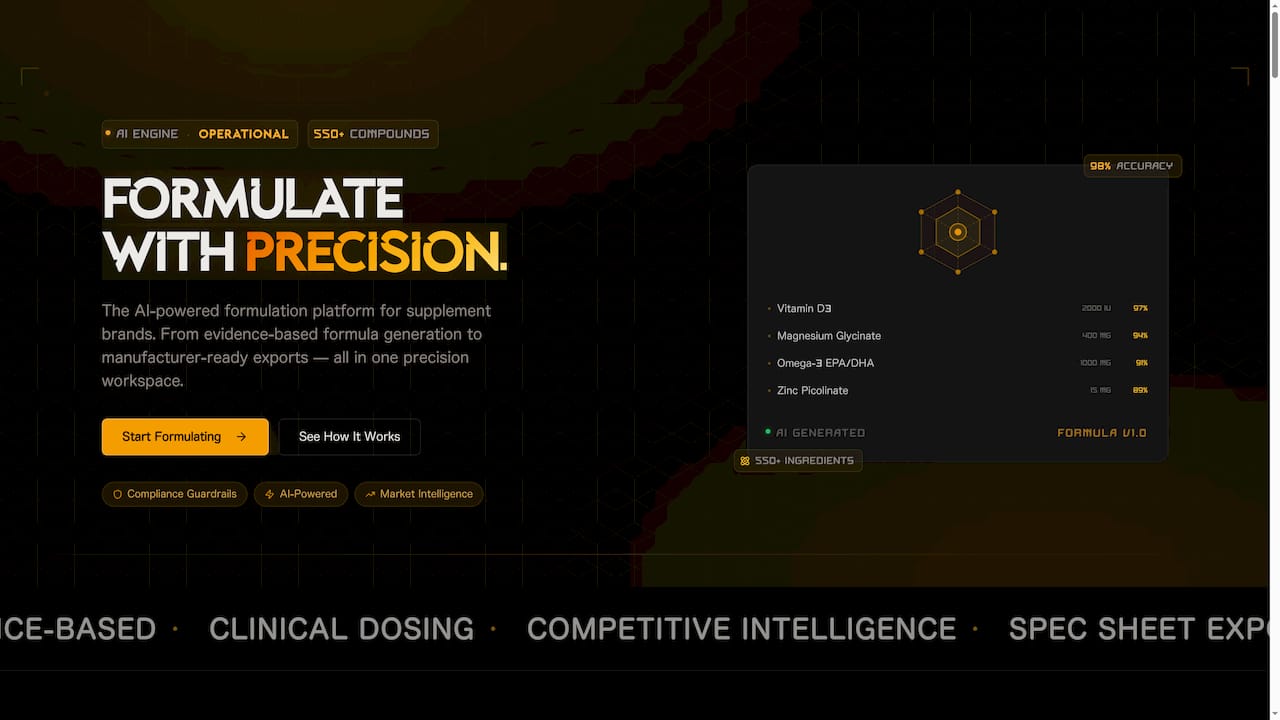
The platform's 8-phase workflow carries a formulation from initial concept through prototyping, compliance review, and production-ready export, so the same system that helped you develop the product also produces the documentation you need to defend it during an inspection. If your team is still tracking specifications, supplier data, and CAPA items across separate spreadsheets, that's exactly where gaps like the ones covered above tend to slip through. Start a session on Formlypro and run your next formulation through a workflow built with Part 111 in mind from the first step.
Where to Verify the Rules Yourself
The full text of Part 111 on GovInfo is the authoritative source for exact section language. The 2007 Federal Register final rule explains the regulation's original intent, and the FDA's Small Entity Compliance Guide translates it into plain-language expectations.
Sources
- Small Entity Compliance Guide: Current Good Manufacturing Practice in Manufacturing, Packaging, Labeling, or Holding Operations for Dietary Supplements | FDA
- PART 111—CURRENT GOOD MANUFACTURING PRACTICE IN MANUFACTURING, PACKAGING, LABELING, OR HOLDING OPERATIONS FOR DIETARY SUPPLEMENTS (govinfo)
- Free 21 CFR Part 111 Compliance Checklist | Dietary Supplement GMP Self-Assessment (Certify Consulting)