

TL;DR:
- Prototype testing is a strategic process of validating design decisions early by exposing representations of products to real users. It reduces development costs, accelerates time-to-market, and helps teams ship confidently by uncovering issues before costly tooling. Matching testing methods to prototype types and framing clear hypotheses ensure meaningful insights and successful product outcomes.
Most product designers treat prototype testing as a formality. Something you do to show stakeholders progress, check a box, and move on. That framing is expensive. Understanding what is prototype testing, at its real strategic depth, is what separates products that launch confidently from those that require painful and costly redesigns six months after tooling. This guide breaks down the prototype testing definition, the methods that actually produce validated learnings, and the concrete benefits your team leaves on the table every time you skip it.
Table of Contents
- Key takeaways
- What prototype testing actually means
- Prototype types and testing methods
- The benefits of prototype testing, with real numbers
- How to conduct prototype testing effectively
- My take on what makes prototype testing actually work
- Take your prototype testing further with Formlypro
- FAQ
Key takeaways
| Point | Details |
|---|---|
| Testing is not showcasing | Prototype testing is a structured investigation to validate decisions, not a design presentation. |
| Fidelity shapes your method | Match your testing approach to prototype type to get the most relevant feedback at each stage. |
| Early fixes cost far less | Changes caught in prototype testing cost up to 100 times less than fixes made during production. |
| Data beats assumptions | Use measurable criteria like task completion time to turn user sessions into validated evidence. |
| Iteration compounds returns | Each test cycle reduces risk and builds toward a launch that connects with your actual users. |
What prototype testing actually means
Prototype testing is the structured practice of exposing a physical or digital representation of your product to real users or defined test conditions in order to validate design decisions before committing to full production. That distinction matters. This is not the same as a proof of concept, which asks "Can we build this?" Prototype validation asks a different and more demanding question: "How should we build this, and does it actually work for the people who will use it?"
The prototype testing definition also separates it from user acceptance testing. UAT happens at the end of development when the product is functionally complete. Prototype testing happens throughout the design process, often before a single line of production code is written or a mold is cut. The goal is to learn early, when corrections are still cheap.
Three core objectives define every good prototype test:
- Validate the user experience. Does the design allow users to accomplish their goals without friction, confusion, or frustration?
- Test functionality under real conditions. Does the prototype perform as intended when used the way actual customers will use it?
- Reduce downstream risk. Catch the assumptions that are wrong before they become tooling changes or product recalls.
The importance of prototype testing sits squarely in this last point. Prototype testing is strategic inquiry, not a design showcase. Every session should produce validated learnings your team can act on.
Prototype types and testing methods
Not all prototypes are built to answer the same questions, and testing them the same way wastes resources. Understanding the five major prototype categories helps you match the right method to the right stage.
| Prototype type | What it tests | Typical testing method |
|---|---|---|
| Concept prototype | Core idea, rough form | Stakeholder review, early user interviews |
| Appearance prototype | Visual design, perceived quality | First impression testing, preference testing |
| Functional prototype | Fit, assembly, strength | Mechanical testing, stress testing |
| Engineering prototype | Performance under real materials | Lab testing, failure analysis |
| Pre-production prototype | Full manufacturing readiness | Pilot runs, regulatory review |
The trade-off is real. Lower fidelity prototypes are faster and cheaper to build but give you less certainty. Higher fidelity prototypes take more time and investment but surface problems that only appear with production materials and methods. The skill is knowing which stage demands which depth of validation.

One category where designers consistently misjudge fidelity is 3D printing. It feels production-ready because it looks polished, but 3D printed prototypes can hide manufacturability issues like wall thickness inconsistencies and tolerance stack-up that only appear when you switch to injection molding or CNC machining. The confidence you get from a 3D print can be misleading if you skip the functional prototype stage.
Testing methodologies also vary by purpose. Moderated usability tests give you qualitative richness because a trained facilitator can probe for the "why" behind user behavior. Unmoderated remote tests scale broadly and generate data faster. Guerrilla tests, where you recruit participants informally in public spaces or through quick online outreach, are best for rapid early feedback on low-fidelity prototypes.
Pro Tip: Whenever you move from one prototype type to the next, write down what question you are trying to answer before you build anything. If you cannot state a clear hypothesis, you are not ready to test.
The benefits of prototype testing, with real numbers
The benefits of prototype testing are not theoretical. They are measurable and significant enough to change how your organization funds product development.
Prototype testing can reduce development costs by up to 33%, cut collaboration time by 25%, accelerate time-to-market by 50%, and increase customer loyalty by 240%. Those numbers exist because testing front-loads learning. The further a problem travels through your development pipeline, the more it costs to fix.
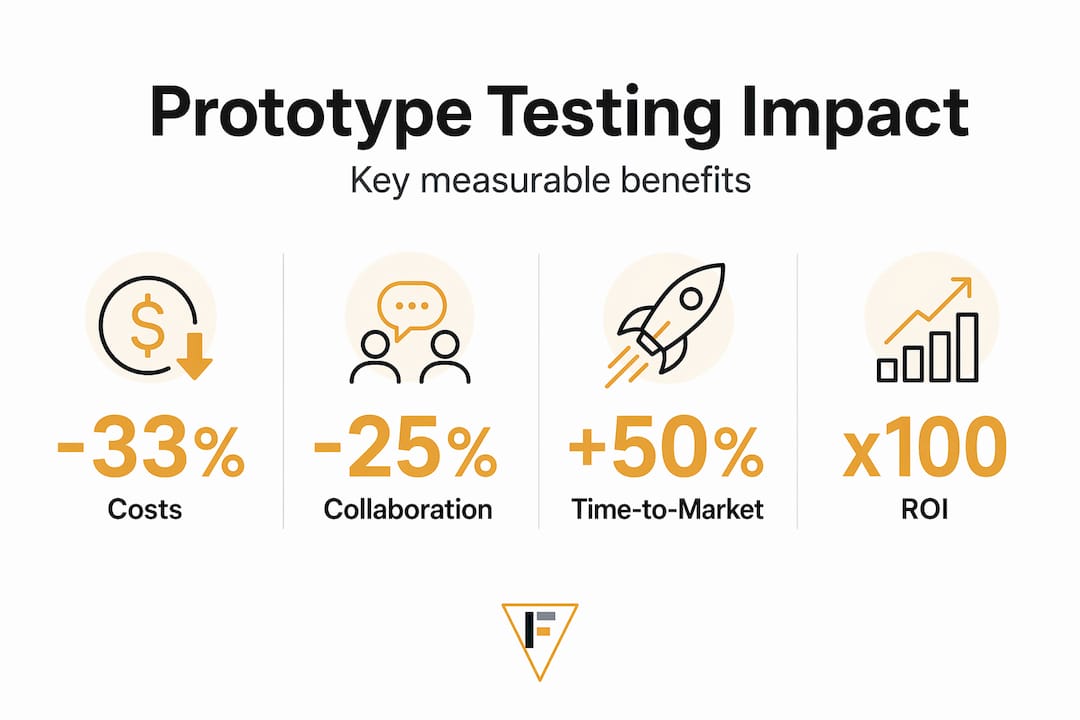
Consider the downstream math. Changes caught during prototype testing cost 10 to 100 times less than changes made during production. If a design flaw surfaces after tooling is complete, you are looking at costs that dwarf what a two-week testing sprint would have required. Assembly issues discovered post-tooling run 5 to 10 times more expensive than the same fix made at the prototype stage.
The benefits of iterative prototyping compound across the product lifecycle:
- Faster decision-making. Real user data replaces internal debates about what customers want.
- Stronger stakeholder alignment. A testable prototype communicates intent better than any slide deck.
- Improved regulatory readiness. Products in regulated categories, like supplements or medical devices, benefit from documented testing as part of the compliance record.
- Higher launch confidence. Teams that test iteratively ship products they have evidence for, not products they hope will land.
The ROI picture is sharp. Investing $1 in early prototype testing can return up to $100 by preventing post-launch fixes and improving user satisfaction. That is not a rounding error. That is the entire financial argument for building testing into your process from day one.
How to conduct prototype testing effectively
Good prototype testing does not start with users. It starts with a hypothesis. Before you schedule a single session, your team needs a clear, measurable statement of what you are trying to prove or disprove. Something like: "We believe users can complete the onboarding flow in under three minutes without external help." A measurable completion threshold like this gives you a concrete benchmark to evaluate results against.
Here is a practical process that works across product categories:
- Write your hypothesis first. State the assumption you are testing, define the success metric, and identify who you need to test with. Do not recruit broadly. Test with the people who represent your actual customers.
- Select your testing method based on prototype fidelity. Low-fidelity concepts pair well with moderated interviews. Functional prototypes need task-based testing where you observe real behavior under real conditions.
- Collect both quantitative and qualitative data. Completion rates and time-on-task give you numbers. Post-session interviews and think-aloud protocols give you the reasoning behind the numbers.
- Analyze patterns, not outliers. One user struggling with a feature is worth noting. Three users making the same mistake in the same place is a design problem you need to fix.
- Iterate before advancing fidelity. Never move from a functional prototype to an engineering prototype until you have resolved the open questions the previous test surfaced.
The most common failure mode in prototype testing is what experienced PMs call "product theater." That is when teams run testing sessions that look rigorous but are actually designed to confirm decisions already made. Prototype tests must be hypothesis-driven with measurable outcomes, or they produce noise instead of signal.
Skipping functional validation before committing to tooling is the single most expensive mistake in hardware product development. The fix is not complicated. It just requires discipline.
Pro Tip: Record every session and review footage with your engineering team, not just your design team. Engineers catch functionality gaps that designers often miss because they are focused on the experience layer.
My take on what makes prototype testing actually work
I have seen smart, well-funded teams skip prototype validation because they were confident in the concept. Confidence is not evidence. The products that consistently land well are built by teams who treat testing as a method for reducing uncertainty, not a performance of due diligence.
What I find most telling is how teams interpret failure during testing. A failed hypothesis is not a setback. It is the most valuable output a prototype test can produce because it prevents a much larger failure downstream. The teams that get uncomfortable when users struggle with their prototype are the ones who ship products that struggle in the market.
My experience also tells me that fidelity mismatches are a bigger problem than most teams realize. I have watched companies run expensive usability tests on high-fidelity prototypes to answer questions that a low-cost concept test would have resolved in two days. Matching your testing method to your prototype stage is not just about efficiency. It is about asking the right question at the right time. Top product managers treat prototype testing as validated learnings they ship, and that framing changes everything about how they prepare for each session.
If you take one thing from this: the importance of prototype testing is not in the act of testing itself. It is in what you do with what you learn.
— Ben
Take your prototype testing further with Formlypro
If you are building a physical product, particularly in the supplement or wellness space, prototype testing does not happen in isolation from formulation, compliance, and packaging decisions. All of those variables interact, and getting one wrong can invalidate the others.
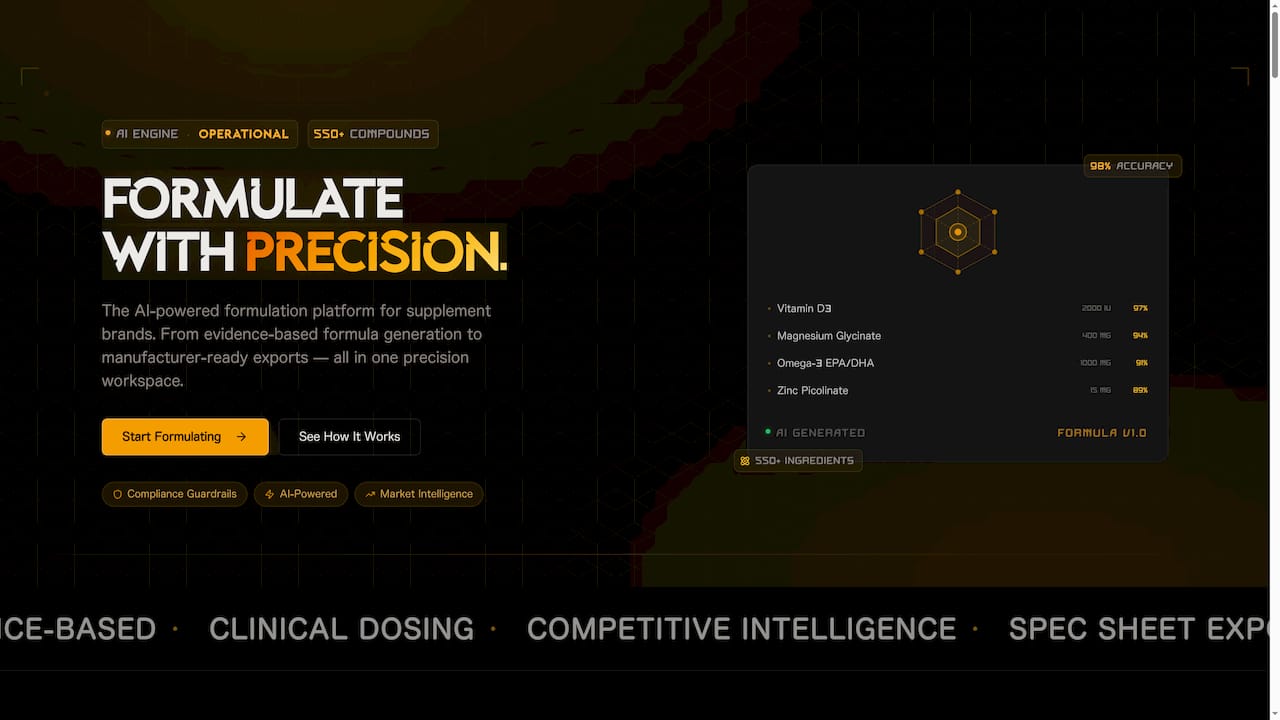
Formlypro is built for exactly this. The platform walks you through an 8-phase product development process that integrates formulation validation with market research, compliance guidance, and competitive analysis from a single system. You get structured support from ideation through pre-production, including tools to document and iterate on your prototype testing results. If you are ready to stop guessing and start building with evidence, Formlypro gives you the framework to do it. You can also explore more on reducing formulation risks as part of your broader testing strategy.
FAQ
What is the prototype testing definition?
Prototype testing is the process of evaluating a product representation against user behavior and defined criteria before full production, with the goal of validating design decisions and reducing development risk.
How is prototype testing different from proof of concept?
A proof of concept answers whether something can be built. Prototype validation answers how it should be built by testing usability, performance, and user experience under realistic conditions.
What are the main benefits of prototype testing?
Testing early can reduce development costs by up to 33%, accelerate time-to-market by 50%, and increase customer loyalty by 240%, while preventing changes that cost 10 to 100 times more when caught in production.
What are the most common prototype testing methods?
Moderated usability tests, unmoderated remote tests, and guerrilla tests are the primary methods. The right choice depends on your prototype's fidelity and the specific questions you need to answer.
How do you know if a prototype test was successful?
A successful test produces a clear answer to your original hypothesis, whether confirmed or refuted, using measurable data like task completion rates or time on task rather than subjective impressions.