

Omnichannel branding means delivering one consistent brand experience across every channel a customer touches, whether that's your website, retail shelf, mobile app, email, or customer service line. The customer never feels a gap. McKinsey defines omnichannel as integrating all channels so the experience is unified rather than parallel, and Wharton frames it as a customer-centric approach that maps journeys across platforms to deliver continuity, not siloed channel work.
Three elements make it genuinely omnichannel rather than just "present everywhere":
- Visual identity parity: The same logo, color system, and typography render correctly across digital and physical touchpoints.
- Unified messaging: One documented brand voice with channel-specific adaptation rules, not separate creative briefs per team.
- Shared customer context: A single customer view built on integrated CDP/CRM data so every channel knows what the customer did last.
Pro Tip: Start with the customer record, not the creative assets. Brands that fix data first move faster because every downstream channel update draws from one source of truth.
Key Takeaways
Omnichannel branding requires shared customer data, a governed design system, and a cross-functional operating model to deliver consistent experience across every channel.
| Point | Details |
|---|---|
| Audit before you build | Map channel gaps and data sources first; a gap map prevents wasted investment. |
| Pick one strategic priority | Commerce, personalization, or service: one focus keeps the pilot scoped and measurable. |
| Sync a core attribute set | Start with 8–12 customer attributes shared across channels before attempting full integration. |
| Pilot one high-value journey | Instrument it end-to-end for several weeks before scaling to additional channels. |
| Govern continuously | A brand-ops function with SLAs and a central asset library is what sustains parity at scale. |
Table of Contents
- Why does omnichannel branding matter for your bottom line?
- How does omnichannel differ from multichannel marketing?
- What components does omnichannel branding actually require?
- How to implement omnichannel branding step by step
- How do you measure omnichannel branding success?
- What operational challenges should you plan for?
- What do strong omnichannel brands actually look like?
- The blind spots brand managers miss most often
- Sources
Why does omnichannel branding matter for your bottom line?
Consistent branding reduces the cognitive friction customers feel when they switch channels mid-journey. That friction costs conversions. When a shopper researches a product on your app, walks into a store, and finds different pricing or a different visual system, trust erodes and the sale often doesn't close.
The commercial case is direct: the AMA notes that unified messaging and visual identity across platforms strengthen brand recognition and drive engagement. Higher recognition shortens the consideration phase. Shorter consideration means higher conversion at lower acquisition cost.
Stat to know: Klaviyo reports that many consumers expect more personalized experiences in the near future. Personalization at scale is only possible when customer data flows across channels without gaps.
The benefits compound over time:
- Loyalty: Customers who experience consistency across channels are more likely to return and spend more per visit.
- Lifetime value: A unified brand identity system reduces churn by making the brand feel reliable and recognizable at every stage.
- Marketing efficiency: When creative assets and messaging are centralized, teams stop rebuilding from scratch for each channel, which cuts production costs.
How does omnichannel differ from multichannel marketing?
The short answer: multichannel puts the channel at the center; omnichannel puts the customer there. A multichannel approach means your brand is active on many platforms. An omnichannel approach means those platforms share context and behave as one system.
| Dimension | Multichannel | Omnichannel |
|---|---|---|
| Integration vs. silo | Channels operate independently | Channels share data and context in real time |
| Customer experience consistency | Varies by channel; gaps are common | Consistent across all touchpoints by design |
| Operational complexity / data needs | Lower; each team manages its own channel | Higher; requires a unified data layer and governance |
| Tools & systems required | Channel-specific tools (email platform, CMS, POS) | CDP/CRM, identity resolution, integrated analytics |
| Time & cost to implement | Faster and cheaper to start | Longer runway; higher upfront investment |
Multichannel still makes sense early in a brand's life when resources are limited and the priority is simply establishing presence. The move from multichannel to omnichannel happens when you have enough customer data to see where journeys break across channels, and enough organizational maturity to fix them.
What components does omnichannel branding actually require?
TechTarget makes the point clearly: omnichannel branding is operationalized through systems and governance, not just creative guidelines. Here's what must be in place:
- Design system: A documented component library covering logo usage, color tokens, typography, and imagery rules that every channel team pulls from.
- Brand voice guidelines: A single tone-of-voice document with explicit rules for how the voice adapts per channel (email vs. in-store signage vs. push notification).
- Single customer view: A CDP or CRM integration that resolves customer identity across touchpoints and keeps a shared attribute set current.
- Journey maps: Cross-channel personas that describe how customers actually move between digital and physical touchpoints, not just how you wish they would.
- Channel parity rules: Documented policies for pricing, promotions, and product availability across channels, plus a clear exception process when parity isn't possible.
- Governance model: A cross-functional steering group (brand, product, CX, ops) with defined roles, a change-control workflow, and SLAs for asset updates.
- Measurement stack: Integrated analytics with a blended attribution approach and privacy-compliant data governance.
Pro Tip: You don't need a full legacy rip-and-replace to start. A lightweight real-time customer context layer, a middleware or thin CDP integration that pushes a core set of customer attributes to each channel, gets you to meaningful parity without a multi-year infrastructure project.
How to implement omnichannel branding step by step
McKinsey recommends anchoring your omnichannel strategy to one of three priorities: commerce, personalization, or service. Picking one focus first prevents the program from sprawling before it has traction.
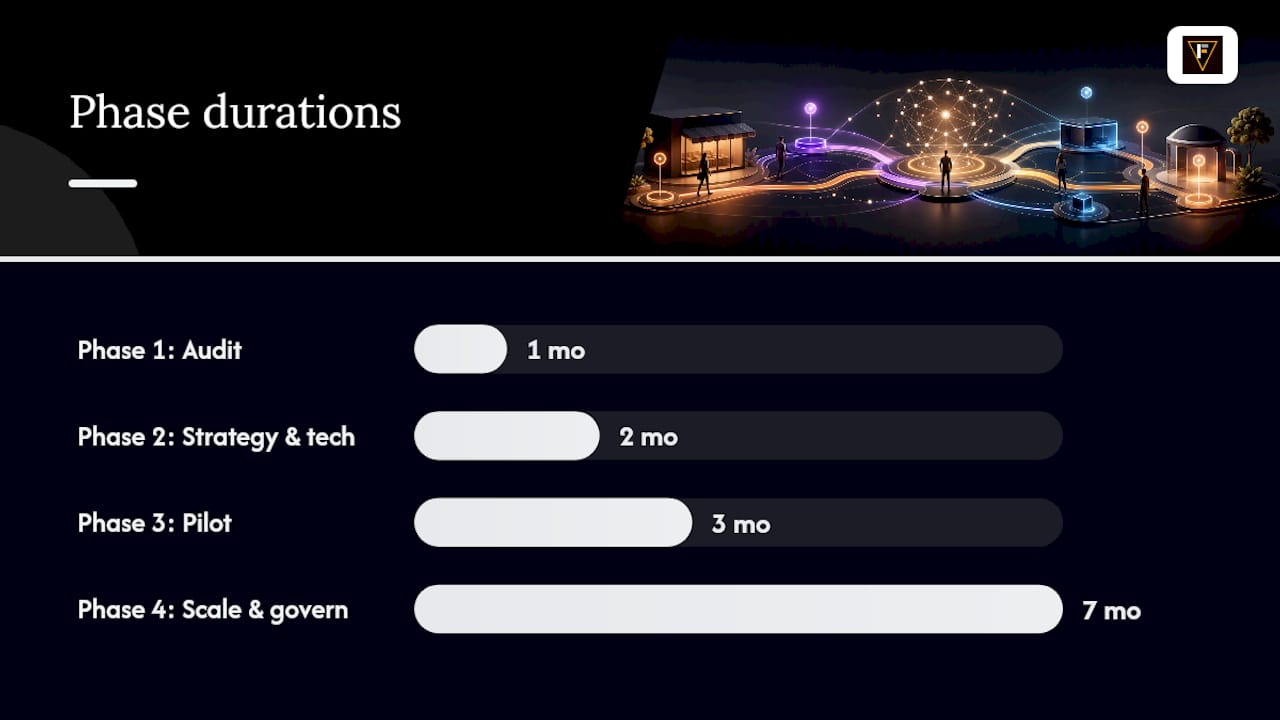
Phase 1: Audit (Weeks 1–4)
- Inventory every active channel and brand asset.
- Map data sources: what customer data exists, where it lives, and whether it's connected.
- Produce a gap map showing where visual identity, messaging, or customer context breaks down.
- Score channels by friction level to prioritize where to act first.
Phase 2: Strategy and technical foundation (Months 2–3)
- Define your primary omnichannel objective (commerce, personalization, or service).
- Select a single-customer-view approach: CDP, CRM with identity resolution, or a middleware layer.
- Document the 8–12 core customer attributes that every channel must share.
- Align stakeholders on a RACI and a steering committee structure.
Phase 3: Pilot (Months 3–5)
- Pick one or two high-value customer journeys, such as loyalty enrollment across app and in-store.
- Define success metrics before launch: conversion lift, NPS delta, repeat purchase rate.
- Run a 6–12 week pilot with weekly iteration cycles.
Phase 4: Scale and govern (Months 6–12)
- Sequence rollout by region, channel, or persona based on pilot results.
- Publish a central asset library with versioning rules so distributed teams stay in sync.
- Establish governance SLAs: how quickly must a brand update propagate to all channels?
Pro Tip: Instrument the pilot end-to-end before scaling. Brands that skip this step scale problems, not performance.
How do you measure omnichannel branding success?
Adobe's framework for omnichannel ties measurement to real-time customer behavior across touchpoints, not just last-click attribution. Your KPI stack should reflect that.
| KPI | Data source | Reporting cadence |
|---|---|---|
| Cross-channel NPS / CSAT | Customer surveys, CRM | Monthly |
| Channel-to-channel conversion lift | CDP events, web/app analytics | Weekly (pilot), monthly (steady state) |
| Repeat purchase rate | CRM transactions, POS | Monthly |
| Customer lifetime value | CRM, finance data | Quarterly |
| Identity resolution match rate | CDP / data warehouse | Weekly |
| Time-to-update brand asset in channel | Asset library logs, governance SLA | Per release |
Blended attribution matters here. Last-click models undercount the contribution of upper-funnel channels like email and in-store, which are often where omnichannel consistency pays off most. Use journey-based attribution during pilots, then move to a blended model at scale.
What operational challenges should you plan for?
Most omnichannel programs stall on the same four problems.
- Data silos: Customer records fragment across email, POS, and e-commerce platforms. Fix this with phased identity resolution: start with email as the canonical identifier, then layer in loyalty IDs and device IDs.
- Organizational misalignment: Brand, product, and CX teams optimize for their own channel metrics. A single product owner with cross-functional authority and a short RACI for quick decisions breaks the deadlock faster than any committee.
- Legacy tech complexity: Full system replacement is rarely feasible. An API-led middleware or CDP layer lets you connect existing systems without replacing them, which is how most mature programs actually achieve brand compliance at scale.
- Creative drift: Distributed teams produce off-brand assets when guidelines are buried in PDFs. A central asset library with a lightweight QA checklist and versioning rules keeps channels aligned without slowing production.
- Privacy and governance: Shared customer data across channels creates compliance exposure. Build privacy-by-design from the start: document lawful bases, minimize PII in shared layers, and audit data flows before scaling.
Pro Tip: Sync only the 8–12 customer attributes that actually drive channel decisions. Full-attribute sync is expensive and rarely needed. Prioritizing a core set cuts integration cost and reduces privacy surface area.
What do strong omnichannel brands actually look like?
Three U.S. brands show what this looks like when it works.
- Sephora links its Beauty Insider loyalty program across the mobile app, website, and in-store experience. Associates can see a customer's purchase history and preferences at the register, which means the in-store conversation starts where the app left off. The lesson: loyalty data is the connective tissue that makes channel parity feel personal.
- Starbucks lets customers order on the app, earn rewards in-store, and reload their card from any channel. The visual system and brand voice are identical whether you're reading a push notification or standing at the counter. The lesson: operational consistency (ordering, payment, rewards) is as important as visual consistency.
- Nike maintains a unified product catalog, pricing, and visual system across its app, website, and retail stores, while using purchase and browsing data to personalize recommendations in each channel. The lesson: a single product data layer is the foundation that makes cross-channel personalization possible without creative chaos.
The blind spots brand managers miss most often
Most brand managers who struggle with omnichannel branding are not failing at creativity. They're failing at governance.

The most common miss is treating omnichannel as a creative refresh: updating logos, refreshing color palettes, and calling it done. Visual consistency is necessary but not sufficient. The experience breaks when a customer calls support and the agent has no record of the online order they just placed. That's a data problem, not a design problem.
The second miss is overcomplicating identity resolution before the program has any traction. Trying to build a perfect single customer view across every data source before launching a pilot is how programs spend 18 months in infrastructure and never reach customers. Start with one canonical identifier and expand from there.
The third miss is underinvesting in the governance function. A brand-ops role, even a part-time one, that owns the asset library, enforces parity SLAs, and runs the steering committee is what separates programs that hold together at scale from those that drift back to silos within a year. Governance is what preserves brand equity over time, not the initial launch.
Sources
The following sources informed this guide and are worth reading directly for implementation depth:
- What is omnichannel marketing? | McKinsey
- What Is Omnichannel Marketing? - Wharton Executive Education
- How to create an omnichannel marketing strategy | TechTarget
- What Is Omnichannel Marketing? | AMA
- How to build a high-impact omnichannel strategy | Klaviyo
- Omnichannel marketing basics | Adobe