

TL;DR:
- Market validation is a disciplined process of testing whether enough customers will pay for a product before investing heavily in development. It involves structured customer interviews, behavioral demand signals, and ongoing reassessment to reduce risk and accurately identify market fit. Skipping validation leads to wasted resources, whereas thorough validation improves product focus, investor confidence, and long-term success.
Most entrepreneurs think market validation means posting a survey in a Facebook group or texting a few friends. It doesn't. What is market validation, really? It's a disciplined, structured process of testing whether enough real people will actually pay for your product before you spend serious money building it. The distinction matters enormously. Casual feedback feels encouraging. Actual validation tells you the truth. This guide breaks down the full process, the most common mistakes brands make, and how to apply validation in a way that genuinely de-risks your next product launch.
Table of Contents
- Key takeaways
- What market validation actually means
- The market validation process, step by step
- Common mistakes that undermine validation
- Benefits of market validation for brands and entrepreneurs
- My honest take on market validation
- How Formlypro helps you validate and build smarter
- FAQ
Key takeaways
| Point | Details |
|---|---|
| Validation is not research | Market validation tests willingness to pay, not just market size or awareness. |
| Follow a structured process | Define your ideal customer, interview 10–15 prospects, and test real demand signals before building. |
| Behavioral signals beat opinions | Signups, deposits, and letters of intent reveal more than survey responses ever will. |
| Avoid confirmation bias | Design tests to find reasons your idea will fail, not reasons it will succeed. |
| Validation is ongoing | Re-validate after every major pivot, feature change, or positioning shift. |
What market validation actually means
Market validation is the practice of presenting a product concept early to learn whether the idea is worth pursuing, based on direct feedback from prospective buyers. That's the clean definition. But the concept carries more nuance than it gets credit for.
A lot of founders conflate market validation with two closely related ideas: market research and product-market fit. They are not the same thing, and confusing them leads to expensive mistakes.
Market research is broad. It maps the size of a market, demographic trends, purchasing behavior, and competitive activity. It tells you that a market exists. Market validation, by contrast, focuses specifically on whether your specific product, at your specific price point, solves a real problem for real buyers. It's narrow by design. Product-market fit comes later. It's a post-launch signal that your product is genuinely resonating at scale.
Think of it this way: market research tells you the ocean is big. Market validation tells you whether anyone will buy your boat. Product-market fit tells you whether they keep coming back.
The importance of market validation is clearest when you consider the cost of skipping it. Building a product without validation is the single most common reason early-stage brands waste their development budget. You're not just risking money. You're risking months of formulation work, supplier negotiations, packaging decisions, and launch planning that a single honest conversation with a prospective buyer could have redirected.
The market validation process, step by step
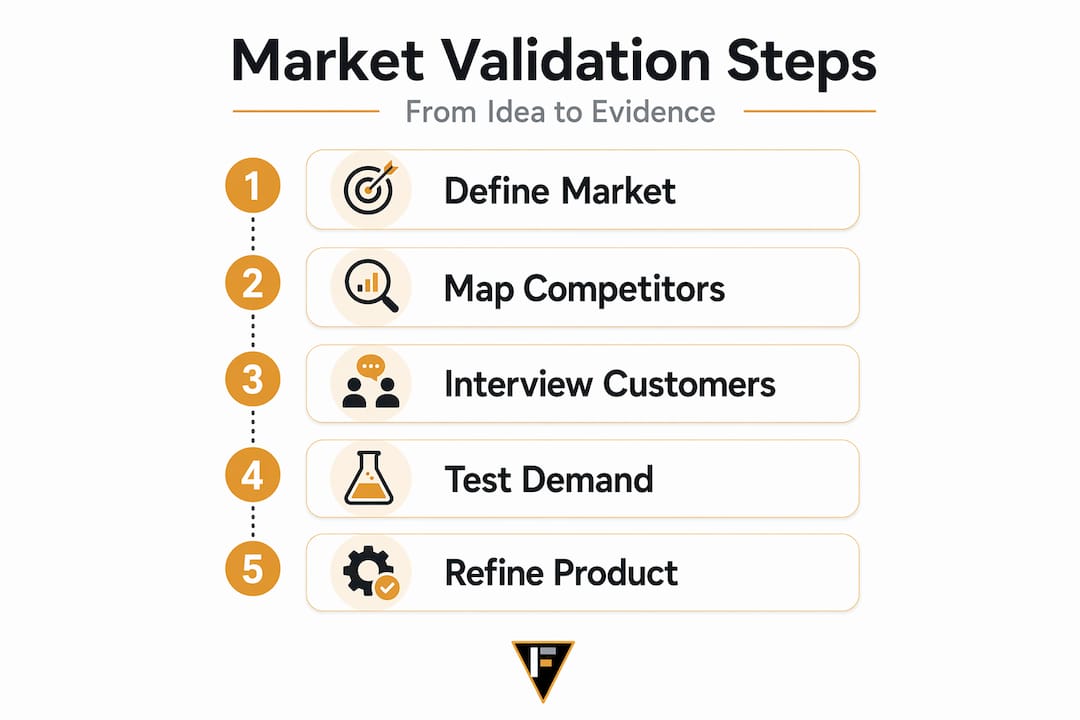
Market validation typically takes 3 to 6 weeks and follows a structured sequence. Here's how to move through it effectively:
-
Define your ideal customer profile (ICP). Before you talk to anyone, get specific about who you're building for. Age, job, habits, pain points, and spending behavior all matter. A vague ICP produces vague feedback.
-
Map your competitive environment. Who already serves this customer? What do those products include, cost, and promise? Understanding the competitive baseline helps you position your concept with clarity and ask smarter interview questions.
-
Conduct customer discovery interviews. Aim for 10 to 15 conversations with people who genuinely match your ICP. Ask about their current behavior, frustrations, and spending habits. Do not pitch your product yet. Listen.
-
Run behavioral demand tests. This is where validation separates itself from opinion gathering. Real demand signals include pre-orders with actual payment, waitlist signups with a credit card gate, letters of intent from B2B buyers, or crowdfunding campaigns. If no one acts, the enthusiasm from step three was noise.
-
Make a go or no-go decision. Analyze what the data tells you. Did you get real commitments? Did the problem your product solves come up unprompted in interviews? Did people ask where they could buy it today?
Pro Tip: Don't ask potential customers "Would you buy this?" Ask instead, "How do you currently handle this problem and how much does that cost you?" The second question reveals actual behavior and real spending, which is the data you need.
Customer discovery interviews remain indispensable even as AI tools compress other phases of the research process. You can use AI to analyze competitors or identify ICP clusters faster. You cannot use AI to replace the moment a potential customer tells you their real frustration, unprompted, in their own words. That signal is irreplaceable.

Also critical: talking to the right customers matters as much as talking to enough of them. Ten conversations with your actual target buyer beat one hundred conversations with people who are mildly curious but would never spend money.
Common mistakes that undermine validation
Even founders who believe in the market validation process often undermine it in practice. These are the four patterns that show up most consistently.
-
Conflating need with viability. This is the most expensive mistake. Customers may confirm a problem while being completely unwilling or unable to pay to solve it. Someone nodding enthusiastically in an interview is not the same as someone handing over a credit card. Viability requires both need and demonstrated willingness to pay.
-
Confirmation bias in interview design. If you ask "Wouldn't you love a product that does X?" you will almost always hear yes. That's not validation. That's encouragement. Effective validation designs questions and tests specifically to find reasons your idea might fail. Treat a "no" or an uninterested response as the most valuable data in the room.
-
Relying on opinions over behavior. Surveys and focus groups produce opinions. Behavior produces truth. A pre-order, a signed letter of intent, or a real signup with an email and a commitment carries more weight than a hundred survey responses saying "I'd probably try it."
-
Delaying validation until after you've built. This is more common than it sounds. A lot of founders spend months building before they talk to customers, because building feels productive and talking feels uncertain. Skipping validation entirely, or delaying it until after the product exists, turns what should be a learning exercise into a justification exercise.
Pro Tip: Record your customer interviews (with permission) and review them afterward. Founders often hear what they want to hear in the moment. The playback reveals what the customer actually said.
The confirmation bias issue runs deep. Many teams design validation to prove an idea works rather than to genuinely test whether it does. If your validation process only looks for green lights, it will find them. Build in friction deliberately.
Benefits of market validation for brands and entrepreneurs
The benefits of market validation extend well beyond risk reduction, though that alone justifies the process. Here's how validation creates real leverage across a product's lifecycle.
| Without validation | With validation |
|---|---|
| Feature decisions based on internal assumptions | Feature prioritization driven by actual customer pain points |
| Budget spent on full product build before feedback | Capital protected until real demand is confirmed |
| Weak pitch decks with market size projections only | Investor presentations backed by real pre-orders or LOIs |
| Product launch aimed at broad, undefined audiences | Launch focused on a tested, responsive customer segment |
| Pivots after launch (expensive) | Pivots before build (cheap) |
Market validation enhances investor confidence by giving you concrete evidence of demand rather than a compelling story. Investors hear a lot of compelling stories. They fund products with validated traction.
For consumer brands specifically, validation shapes more than just the go or no-go decision. It informs packaging language, the specific claims you lead with, which format to prioritize (capsule vs. powder vs. gummy, for example), and even the price range customers have already indicated they'll accept. That intelligence feeds directly into the formulation and product development phase, reducing rework and wasted prototype cycles.
Validation also matters after launch. Market validation is a continuous process that requires reassessment whenever you change a feature, shift positioning, or enter a new segment. The market you validated for version one of your product is not automatically the right market for version two. Brands that treat validation as a one-time checkbox end up relaunching products into audiences that have moved on or were never the right fit to begin with.
Pro Tip: If you're expanding to a new market segment or adding a major product feature, treat it like a new product and run a condensed validation cycle before committing resources.
For brands working on physical products, connecting early validation to risk reduction strategies can save significant time and money at the formulation stage.
My honest take on market validation
I've watched a lot of founders skip thorough validation, and the reasoning is almost always the same. They say their product is too new for customers to understand, or that no one understood the iPhone before it launched. That's a self-serving comparison. Apple had decades of hardware and software validation embedded in its product decisions. Most first-time founders are not Apple.
What I've found is that the founders who genuinely resist validation usually aren't afraid of failure. They're afraid of honest feedback that might slow them down or change their idea. A well-earned "no" from ten real customers is more valuable than an untested "yes" from ten enthusiastic friends. One redirects you cheaply. The other costs you a product launch.
I also think the industry undersells just how much direct customer conversation sharpens your thinking. Not because customers design products, they don't. But because hearing how someone describes their own problem, without your framing, teaches you things about positioning and language that no competitor analysis tool can replicate.
The other thing most articles won't tell you: validation never really stops. I've seen brands nail validation for a v1 product, scale successfully, change one key ingredient or add a new format, and completely lose their audience because they assumed the original validation still applied. It doesn't. Every meaningful change deserves a fresh look.
— Ben
How Formlypro helps you validate and build smarter
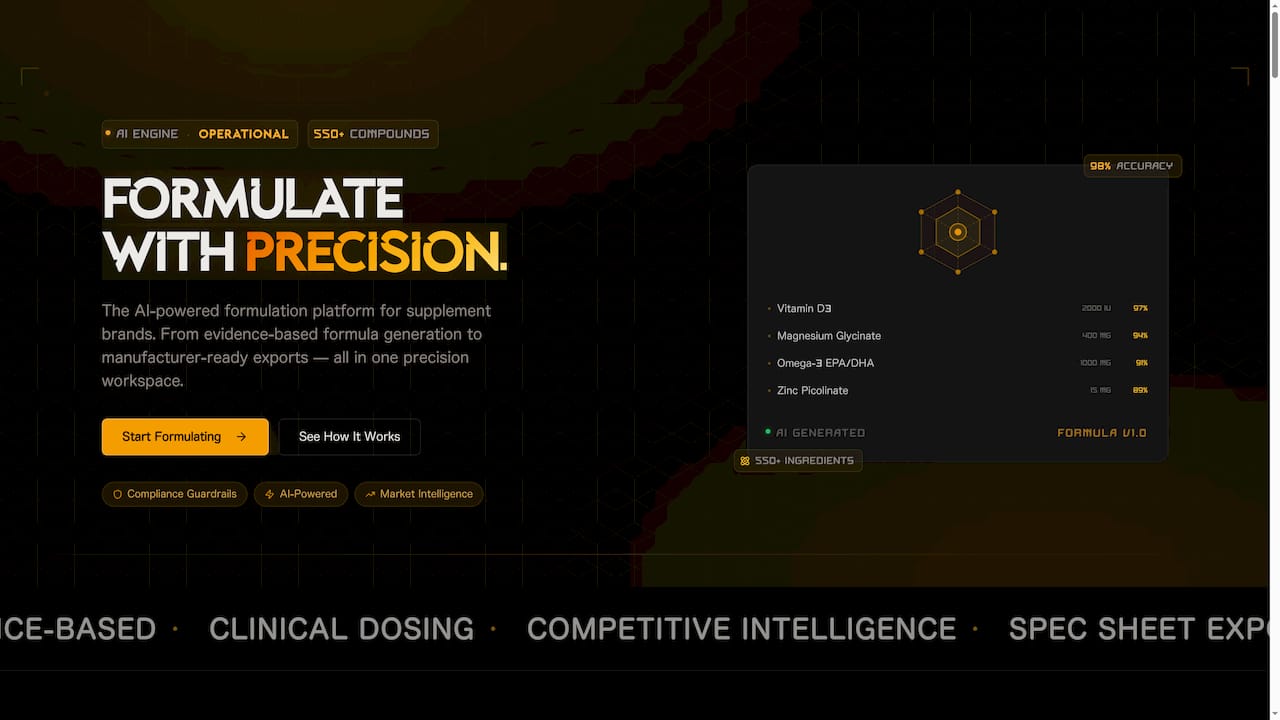
Formlypro is built specifically for brands that want to move from validated concept to finished product without the guesswork. The platform's 8-phase system guides you from ideation through formulation, prototyping, compliance, and production, with market research and competitor analysis integrated at every stage. You can see what competing products are selling, what they contain, and how your concept stacks up before you commit to a single ingredient. Explore the full formulation platform to see how Formlypro supports the entire product development process, including the validation work that happens before a single prototype is made.
FAQ
What is market validation in simple terms?
Market validation is the process of testing whether real customers will pay for a product before you build it. It uses interviews, behavioral tests, and demand signals to confirm genuine market interest.
How is market validation different from market research?
Market research covers broad data like market size and demographics. Market validation is narrower and tests whether a specific product will actually sell to a specific customer.
How long does market validation take?
A structured market validation process typically runs 3 to 6 weeks and includes ICP definition, competitor mapping, 10 to 15 customer interviews, and at least one behavioral demand test.
What counts as a valid demand signal?
Real demand signals include pre-orders with payment, waitlist signups tied to a commitment, letters of intent from B2B buyers, and crowdfunding pledges. Opinions and survey responses alone do not qualify.
Do you need to re-validate after a product change?
Yes. Market validation should be repeated after significant pivots, feature additions, or positioning shifts to confirm that the updated product still aligns with your target customer's needs.