

TL;DR:
- Market research involves gathering and analyzing customer, market, and competitor information to reduce business uncertainty. It enables entrepreneurs to validate demand, uncover unmet needs, and make informed decisions that foster growth. Modern AI tools accelerate this process, but human judgment remains essential for interpreting insights and guiding strategic choices.
Most entrepreneurs assume market research is something large corporations do with six-figure budgets and dedicated research teams. That assumption costs people their businesses. What is market research, at its core? It's the practice of gathering and interpreting information about your customers, market, and competitors to reduce uncertainty before you spend money. It's not a luxury. It's the difference between building something people actually want and spending a year on a product nobody asked for.
Table of Contents
- Key takeaways
- What market research is and why it matters
- Types and methods: primary vs. secondary research
- How AI is changing market research
- How to conduct market research step by step
- How market research drives growth and competitive edge
- My take on market research after working with brands at every stage
- Put your research to work with Formlypro
- FAQ
Key takeaways
| Point | Details |
|---|---|
| Market research cuts risk | Collecting data before you build or launch dramatically reduces the chance of costly missteps. |
| Two research types work together | Primary research validates specifics; secondary research establishes market context and size. |
| AI is changing the timeline | Generative AI can compress research that once took months into days, though human judgment still matters. |
| Research must tie to decisions | Effective research is built around specific business questions, not general curiosity. |
| Small businesses benefit most | Entrepreneurs gain the most from even lightweight research because they have the least margin for error. |
What market research is and why it matters
The formal definition of market research covers the process of gathering, analyzing, and interpreting information about a target audience, a market, or competitors. It examines who your buyers are, what they need, where they currently get it, and why they behave the way they do. That knowledge lets you position your product accurately and anticipate where the market is heading.
The role of market research goes deeper than most people realize. It's not just about confirming a hunch. It's a structured way to reduce business risk before you commit capital, time, or a full product team to any direction. The U.S. Small Business Administration recommends starting research early to reduce risk, which means before your idea is fully formed, not after your product is built.
Here's what good market research actually does for your business:
- Surfaces unmet needs your competitors may have overlooked
- Validates demand so you're not building on assumptions
- Reveals how customers think about the problem your product solves
- Identifies the right price range based on real willingness to pay
- Maps competitive dynamics so you understand who you're up against
"Market research is not about getting answers you want to hear. It's about getting answers you can build on — including the ones that challenge your original direction."
One thing worth clarifying: market research and competitive analysis are related but different. Competitive analysis zeroes in on what your rivals are doing. Market research is broader. It includes customer psychology, buying behavior, economic data, and industry trends. You need both, but they serve different purposes.
Types and methods: primary vs. secondary research
Understanding the two main types of market research helps you pick the right tool for the job. Each has real trade-offs in cost, speed, and specificity.
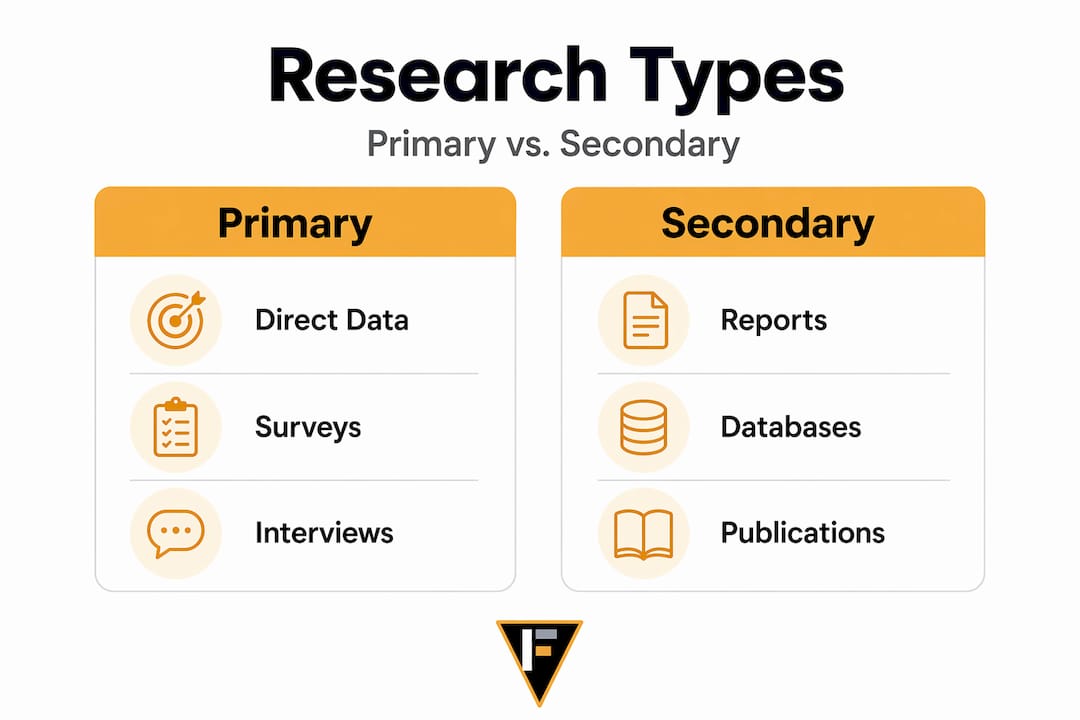
Primary research means collecting data directly from your audience. You own it, it's tailored to your exact questions, and nothing else gives you that level of specificity. Methods include:
- Customer surveys (online or in-person)
- One-on-one interviews with target buyers
- Focus groups with 6 to 10 participants
- Observational research watching customers in real environments
- Product testing with a small beta group
Secondary research uses data someone else already collected: industry reports, government databases, trade publications, census data, and academic studies. It's faster and cheaper, but less specific to your audience. Secondary research tells you what the market looks like in aggregate. Primary research tells you what your specific customers think.
| Research type | Cost | Speed | Specificity | Best for |
|---|---|---|---|---|
| Primary | Higher | Slower | High | Validating assumptions, testing concepts |
| Secondary | Lower | Faster | Lower | Sizing a market, identifying trends |
Beyond the primary/secondary divide, research also splits into qualitative and quantitative. Qualitative methods like interviews and focus groups give you the why behind behavior. Quantitative methods like large-scale surveys give you the how many and how often. Neither is superior. The best research programs use both.
Pro Tip: Use secondary research to set your context and size the opportunity first. Then run targeted primary research to validate the specific claims you need to support a product or marketing decision. Doing it in that order saves time and sharpens your questions.
For entrepreneurs building food, beverage, or supplement products, the practical steps for a successful product launch typically start with exactly this kind of layered research approach.
How AI is changing market research
Traditional market research had three chronic problems: it was expensive, slow, and limited by sample size. Running a proper primary research study could take three to six months and cost tens of thousands of dollars. That's not viable for most early-stage businesses.

Generative AI is compressing research timelines from months to days. AI tools can analyze vast amounts of unstructured data, from customer reviews to social media conversations to open-ended survey responses, at a scale no human team could match. That changes the math on what's possible for a small business.
One of the more striking developments is the concept of digital consumer twins. These are AI-simulated consumer profiles that let you test product concepts, messaging, and pricing scenarios before you invest in real surveys or prototypes. Think of it as a low-cost first screen that filters out bad ideas quickly.
What AI handles well today:
- Sentiment analysis across thousands of reviews in minutes
- Pattern detection in large qualitative datasets
- Rapid synthesis of secondary research from multiple sources
- AI-moderated interviews that scale qualitative research affordably
What AI still can't replace:
- Human judgment in defining the right research question
- Contextual interpretation of nuanced cultural or behavioral signals
- The relationship-driven insight that comes from a real conversation with a customer
The reality is that humans stay in the loop, especially for problem definition and interpretation. AI accelerates the data collection and analysis phases. You still need to know what question you're trying to answer.
Pro Tip: Before using any AI research tool, write down the specific business decision you're trying to make. AI is extremely good at answering clear questions and extremely bad at helping you figure out what question to ask.
If you're curious how AI is reshaping adjacent areas of product development, the role of AI in packaging is another domain where speed and efficiency gains are showing up fast.
How to conduct market research step by step
The biggest mistake entrepreneurs make is jumping straight to data collection without a clear objective. Research questions must align with specific business decisions, otherwise you end up with interesting data that doesn't actually tell you what to do next.
Here's a practical framework:
- Define your objective. What decision does this research need to support? Pricing? Messaging? Product features? Be specific. "Learn about our customers" is not an objective.
- Start with secondary research. Pull industry reports, competitor reviews, census data, and trade publications to establish market size, trends, and key demographics. This sets your baseline and sharpens your primary research questions.
- Design your primary research. Based on what secondary research left unanswered, build a targeted survey or interview guide. Keep surveys under 10 minutes and interview guides focused on 5 to 7 core questions.
- Collect data. Run your surveys or interviews. For startups, even 20 to 30 interviews can generate strong directional insight. You don't need 500 responses to spot a pattern.
- Analyze and synthesize. Look for patterns, not just individual answers. In qualitative data, the same theme appearing in 6 out of 10 interviews is a signal worth acting on.
- Apply the insights. This is the step most entrepreneurs skip. The research doesn't end when the data is collected. It ends when a decision gets made.
A few pitfalls to avoid:
- Asking leading questions that push respondents toward the answer you want
- Only talking to people who already like your idea (confirmation bias is real)
- Using only secondary research to validate a very specific product claim
- Waiting until the product is done before you start the research
Combining large-scale secondary data with targeted primary checks is the approach that consistently gives entrepreneurs the best return on their research investment. For manufacturers looking to refine this process further, optimizing the research workflow can save significant time across multiple product cycles.
How market research drives growth and competitive edge
Why market analysis matters becomes most obvious when you look at how research-backed companies make decisions versus how gut-driven companies do. Research-backed companies don't just launch products. They launch products into windows of opportunity they've actually identified.
Demographic, economic, and competitive data help you spot where a market is underserved, where competitors are weak, and where demand is growing faster than supply. That's not abstract strategy. That's where you find the opening.
Here's how market research directly shapes competitive advantage:
- Product design: Customer feedback reveals features people will actually pay for versus features that sound good on paper
- Pricing strategy: Competitive benchmarking and willingness-to-pay research prevent both underpricing and overpricing
- Marketing messaging: Understanding how your audience describes their own problem lets you speak their language
- Distribution decisions: Research identifies where your target buyers actually shop and how they prefer to buy
- Launch timing: Market saturation data shows whether you're entering at the right moment or walking into a crowded space
My take on market research after working with brands at every stage
I've watched early-stage entrepreneurs skip market research for one of two reasons. Either they think it's too expensive, or they're afraid of what the data might say. Both are understandable. Neither is a good reason to skip it.
What I've found is that the fear of invalidation is usually worse than the actual findings. In practice, research rarely kills a good idea entirely. More often, it reshapes the idea into something better. The entrepreneurs who use research early don't abandon their vision. They sharpen it.
I've also learned that data alone isn't sufficient. The most effective founders I've seen blend their research with genuine trend awareness and their own experience in the category. A spreadsheet won't tell you about the cultural shift that's about to change what customers want. Your market sense will. The data confirms or challenges that instinct.
My honest view on AI in market research: it's genuinely useful, especially for speed and scale. But it's most valuable when someone who understands the business is directing it. AI-generated insight without business context is just noise at scale.
If I had to give one piece of advice on how to conduct market research as a founder, it would be this: tie every research question to a decision you actually have to make. Not a question you're curious about. A decision. That one constraint will make your research ten times more useful.
— Ben
Put your research to work with Formlypro
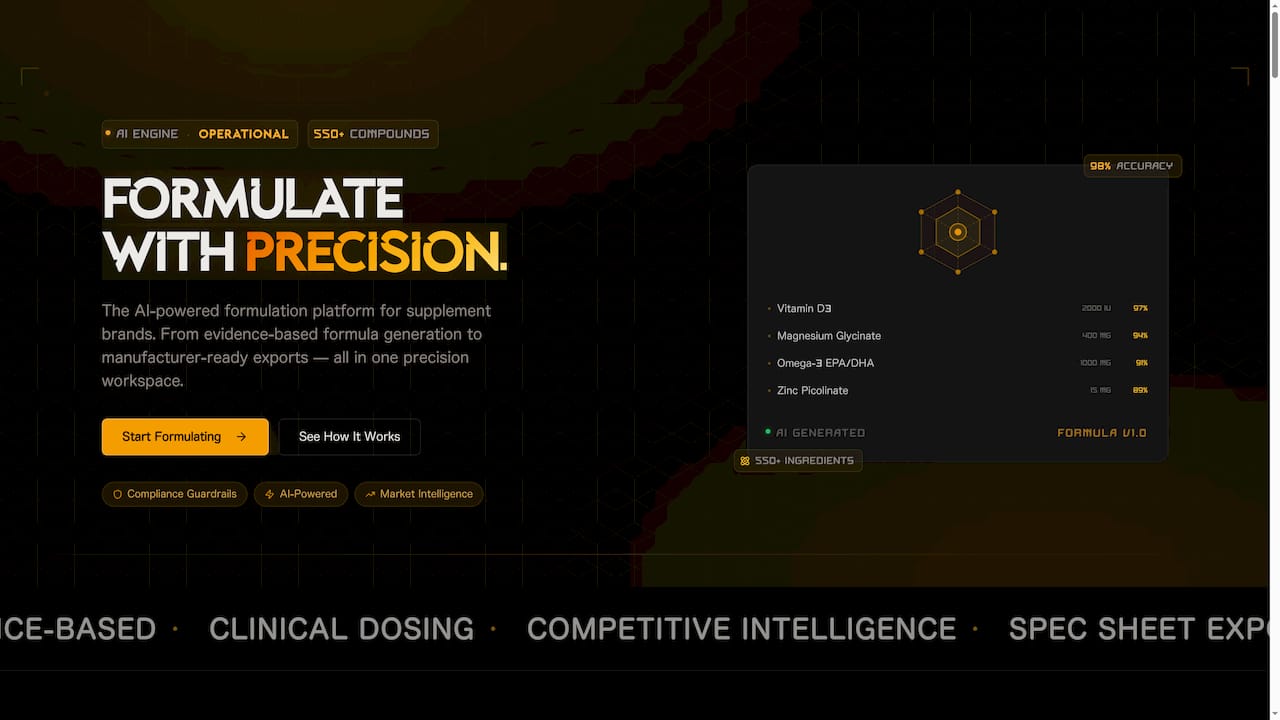
Understanding market research concepts is one thing. Having a system that builds research directly into your product development workflow is another entirely. Formlypro is built for brands that want both. The platform combines competitor analysis, market positioning data, and formulation tools inside a single 8-phase product development plan. From concept validation through compliance and production, every stage is backed by real market data. You're not guessing what the market wants. You're seeing what's selling, what's in those products, and where the gaps are. If you're building a new product and want research woven into every step, explore the Formlypro platform and see how it works in practice.
FAQ
What is market research in simple terms?
Market research is the process of collecting and analyzing information about your customers, competitors, and market to make smarter business decisions. It reduces guesswork before you invest in a product or campaign.
Why conduct market research before launching a product?
Launching without research means betting on assumptions. Market research confirms whether real demand exists, what customers will pay, and how your product should be positioned before you spend on development.
What are the main types of market research?
The two main types are primary research, which you collect directly from customers through surveys or interviews, and secondary research, which draws from existing sources like industry reports and government data.
How has AI changed market research for small businesses?
AI tools can now compress research timelines from months to days by analyzing large datasets, running AI-moderated interviews, and generating digital consumer simulations that test concepts before real investment.
How do I know if my market research is working?
Effective market research leads directly to a business decision. If the data you collected doesn't change or confirm a specific choice you needed to make, the research question wasn't defined clearly enough.