

TL;DR:
- Emulsion formulation involves creating stable mixtures by dispersing droplets of one liquid into another using emulsifiers and mechanical energy. Proper ingredient selection, processing control, and understanding instability mechanisms are essential for producing durable products like cosmetics, foods, and pharmaceuticals.
Emulsion formulation is defined as the process of creating a stable mixture by dispersing fine droplets of one liquid into another immiscible liquid, using emulsifiers and mechanical energy to prevent separation. The two primary emulsion types are oil-in-water (O/W), where oil droplets are suspended in water, and water-in-oil (W/O), where water droplets are suspended in oil. These systems appear in mayonnaise, moisturizing lotions, intravenous drug delivery, and dozens of other products you use daily. Understanding the formulation process means understanding why some products last two years on a shelf while others separate within days.
What is emulsion formulation and how are emulsions classified?
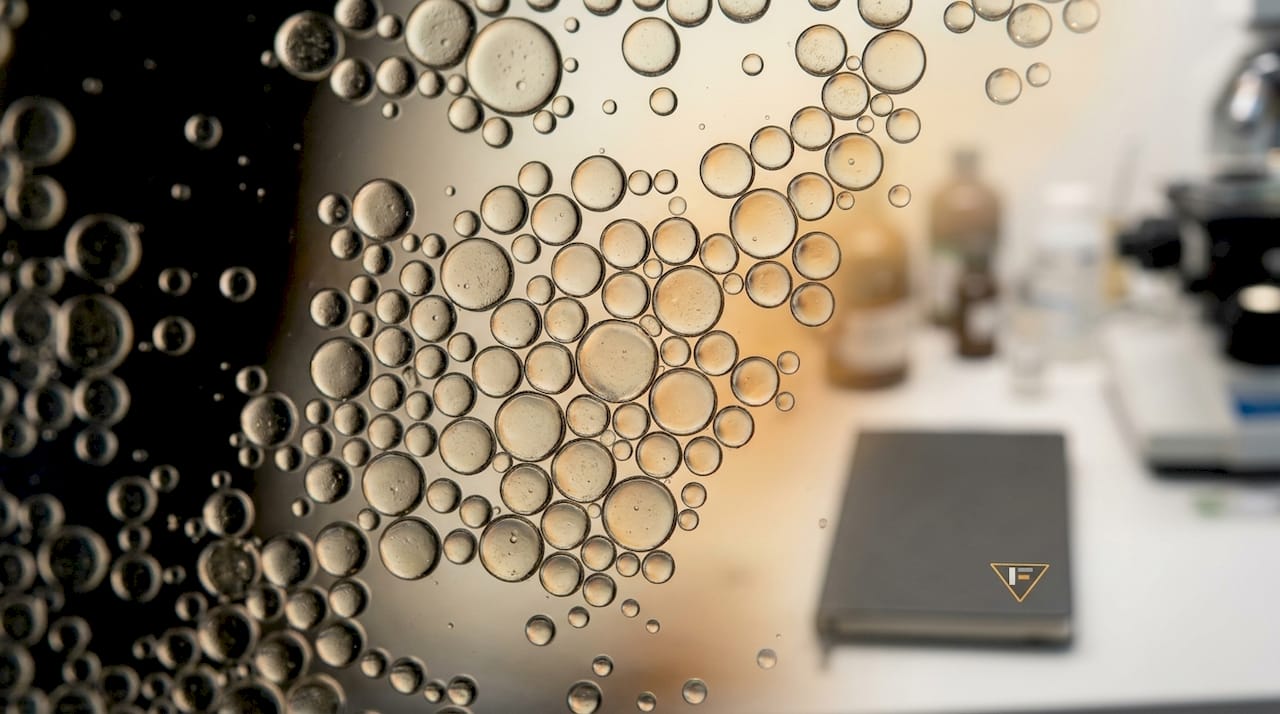
An emulsion system is thermodynamically unstable by nature. Left alone, oil and water always separate. Emulsion formulation is the science of slowing or preventing that separation through careful ingredient selection and controlled processing. The industry recognizes two foundational types: O/W emulsions, which feel lighter and rinse off easily, and W/O emulsions, which feel richer and provide better occlusion on skin.
A third category, multiple emulsions, exists for advanced applications. Water-in-oil-in-water (W/O/W) systems are used in pharmaceutical controlled-release products, where an active ingredient sits inside an inner water phase, surrounded by oil, then dispersed in an outer water phase. These structures require precise mechanical control during processing. Getting the droplet architecture wrong collapses the entire system.
Regulatory bodies including the FDA, the EU Cosmetics Regulation framework, and Codex Alimentarius set standards for emulsion-based products across pharmaceutical, cosmetic, and food categories respectively. Formulators working in 2026 must account for both stability requirements and compliance requirements simultaneously. Formlypro addresses both within a single platform, guiding brands through formulation and compliance in parallel.
What are the key ingredients and emulsifiers used in emulsion formulation?
Emulsifiers are amphiphilic molecules, meaning they have both a water-loving (hydrophilic) head and an oil-loving (lipophilic) tail. This dual nature lets them sit at the oil-water interface and form a protective film around droplets. Without emulsifiers, no amount of mechanical mixing produces a stable emulsion.
The Hydrophilic-Lipophilic Balance (HLB) system is the standard tool for selecting the right emulsifier. HLB values run from 1 to 20. Low HLB values (3–6) favor W/O emulsions; higher values (8–18) favor O/W emulsions. Matching your emulsifier's HLB to your target emulsion type is the first decision every formulator makes.
Common emulsifiers across industries include:
- Cosmetics: Cetearyl alcohol, polysorbate 60, glyceryl stearate, and lecithin
- Food: Soy lecithin, mono- and diglycerides, polysorbate 80, and DATEM
- Pharmaceuticals: Egg lecithin, Cremophor EL, and poloxamers for parenteral emulsions
Standard industrial cosmetic emulsions use emulsifier concentrations of 2–5% for O/W systems and 3–8% for W/O systems to maintain stability. Higher concentrations do not automatically improve stability and can introduce texture or sensory problems.
Using a mixed HLB emulsifier system combining multiple emulsifiers greatly improves interfacial film strength and emulsion stability across temperature ranges. A single emulsifier rarely performs as well as a paired system across the full range of storage conditions a product faces.
Pro Tip: When building a mixed HLB system, target a blended HLB value within 1 point of your required HLB. Use a primary emulsifier for film formation and a co-emulsifier for film flexibility.
How does the emulsion formulation process work?
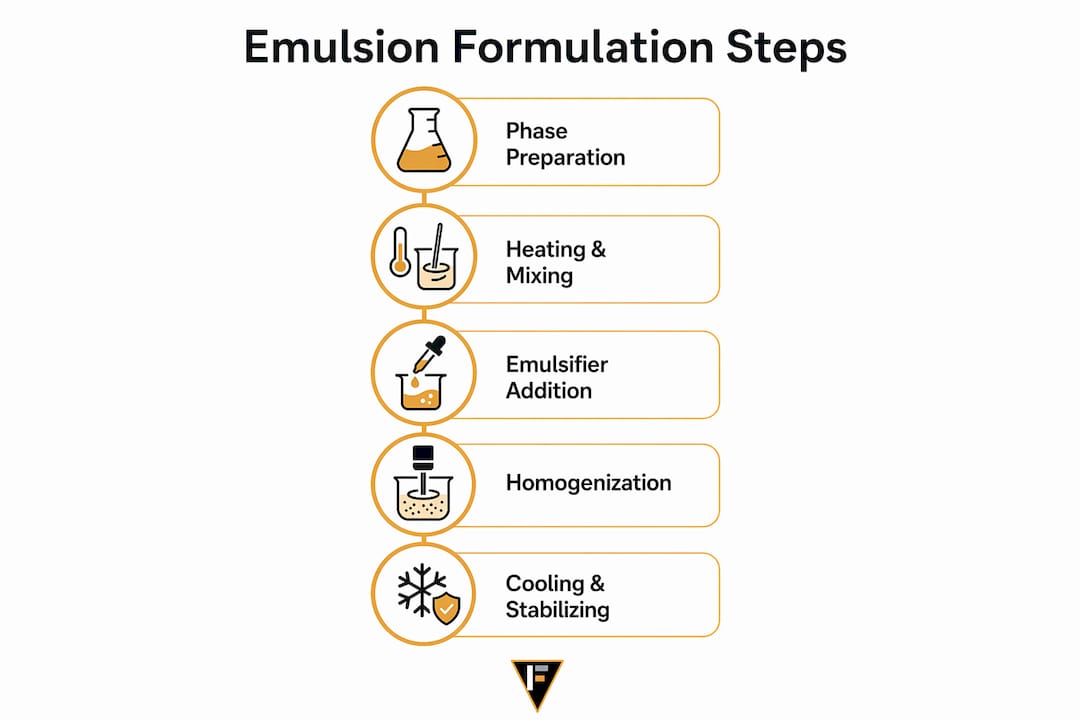
Emulsification refers to uniformly dispersing oil and water using emulsifiers, while homogenization mechanically reduces droplet size to achieve long-term stability. These are two distinct steps, and confusing them is a common formulation error. Emulsification creates the initial dispersion; homogenization refines it.
The standard emulsion formulation process follows these steps:
- Prepare the water phase. Dissolve all water-soluble ingredients, including hydrophilic emulsifiers, humectants, and water-soluble actives, into purified water.
- Prepare the oil phase. Melt all oil-soluble ingredients, including lipophilic emulsifiers, waxes, and oils, together in a separate vessel.
- Heat both phases. Heat and hold methods maintaining 71–82°C for 20 minutes ensure full solubility of emulsifiers and prevent early separation or creaming. This step is non-negotiable for wax-containing systems.
- Combine the phases. Add the oil phase into the water phase slowly, with continuous mixing. Never add the water phase into the oil phase for O/W emulsions unless the formula specifically requires it.
- Homogenize. Apply mechanical energy to reduce droplet size. High-pressure homogenization operates at 100–250 bar for dairy applications, 200–400 bar for beverages, and 500–2,000 bar for nanoemulsions.
- Cool under mixing. Maintain agitation during cooling to prevent phase separation as viscosity increases.
- Add heat-sensitive ingredients. Fragrance, certain actives, and preservatives go in below 40°C to prevent degradation.
In cosmetic cream production, sustained heating at 70–80°C for about 40 minutes is required during the incorporation phase, and total batch times can reach 4.25 hours. That timeline surprises many first-time formulators who expect emulsification to be quick.
Pro Tip: Use a high-shear mixer for initial emulsification, then switch to a colloid mill or high-pressure homogenizer for droplet size reduction. The two-step approach produces tighter droplet size distributions than a single mixing method.
What causes emulsion instability and how can you prevent it?
Emulsions fail through predictable mechanisms. Knowing them lets you design around them before you ever run a batch.
The main instability mechanisms are:
- Creaming: Droplets rise or settle due to density differences. Smaller droplets cream more slowly.
- Flocculation: Droplets cluster without merging. This is reversible but signals early breakdown.
- Coalescence: Droplets merge into larger droplets. This is irreversible and leads to full separation.
- Ostwald ripening: Smaller droplets dissolve into the continuous phase and feed larger ones. Common in nanoemulsions.
- Phase inversion: The emulsion flips from O/W to W/O or vice versa, usually from temperature extremes or excess emulsifier.
Exceeding emulsifier capacity to coat droplets causes emulsion breaking, regardless of mechanical energy applied. Ratio management is the most underrated skill in emulsion formulation. More emulsifier is not always better.
Order and rate of phase addition critically affect droplet size uniformity. Rapid addition of the dispersed phase leads to large droplets and instability. Slow, controlled addition gives the emulsifier time to coat each new droplet as it forms.
Mechanical refining through homogenization is the primary factor determining droplet size distribution and resulting shelf life, more so than emulsifier choice alone. A well-homogenized emulsion with a modest emulsifier system outperforms a poorly processed emulsion with an expensive emulsifier blend.
| Instability type | Primary cause | Formulation fix |
|---|---|---|
| Creaming | Density difference between phases | Reduce droplet size; add viscosity builders |
| Coalescence | Weak interfacial film | Use mixed HLB emulsifier system |
| Ostwald ripening | Droplet size polydispersity | Add ripening inhibitor; tighten homogenization |
| Phase inversion | Emulsifier overload or temperature shock | Control emulsifier ratio; test at storage extremes |
For cost-effective formulation, managing emulsifier ratios and homogenization parameters together produces better results than increasing ingredient spend alone.
What are common applications and examples of emulsion formulations?
Emulsion formulation examples span nearly every consumer and clinical product category. The formulation choices differ significantly by application, driven by texture requirements, regulatory constraints, and delivery goals.
Food emulsions include:
- Mayonnaise: a classic O/W emulsion stabilized by egg yolk lecithin, with oil content typically above 70%
- Salad dressings: temporary emulsions (French dressing) or permanent emulsions (ranch, Caesar)
- Ice cream: a complex O/W emulsion with air incorporated during freezing, stabilized by mono- and diglycerides
- Beverages: flavor emulsions using weighting agents and gum arabic to prevent creaming in diluted drinks
Cosmetic emulsions include:
- Moisturizing lotions: lightweight O/W emulsions with water contents above 60%
- Rich face creams: W/O emulsions or high-oil O/W emulsions for occlusive skin feel
- Waterproof sunscreens: W/O emulsions that resist water wash-off, often using silicone-based emulsifiers
- High-performance serums: nanoemulsions with droplet sizes below 200 nanometers for deeper active delivery
For a deeper look at formulation examples across categories, the differences between food-grade and cosmetic-grade emulsifier choices become especially clear.
Pharmaceutical emulsions include:
- Parenteral fat emulsions: intravenous nutrition products using purified egg lecithin and soybean oil
- Topical creams: O/W or W/O systems delivering active pharmaceutical ingredients through the skin
- Oral emulsions: lipid-based drug delivery systems improving bioavailability of poorly water-soluble drugs
Oral care products also use emulsion principles. An oil-in-water emulsion rinse applies the same O/W dispersion logic to deliver oil-soluble actives in a water-based mouthwash format.
Emerging trends in 2026 center on nanoemulsions and Pickering emulsions. Pickering emulsions use solid particles instead of traditional emulsifiers to stabilize the interface, offering cleaner labels and better temperature resistance. These systems are gaining traction in both food and cosmetics as consumers push for simpler ingredient lists.
Key Takeaways
Stable emulsion formulation requires matching emulsifier HLB values to the target system, controlling phase addition rate, and applying sufficient homogenization pressure to achieve uniform droplet size.
| Point | Details |
|---|---|
| HLB system guides emulsifier selection | Match blended HLB to your target emulsion type before selecting any other ingredient. |
| Mixed emulsifier systems outperform single emulsifiers | Combining a primary and co-emulsifier improves interfacial film strength across temperature ranges. |
| Homogenization determines shelf life | Droplet size distribution from mechanical processing matters more than emulsifier choice alone. |
| Phase addition rate controls droplet size | Add the dispersed phase slowly to give emulsifiers time to coat each droplet as it forms. |
| Instability follows predictable patterns | Identify the failure mechanism first, then address it through formulation or process adjustment. |
What I've learned from watching emulsions fail
Most emulsion failures I've seen come down to one of two mistakes: adding the oil phase too fast, or trusting a single emulsifier to handle the full job. Both are fixable, and both are avoidable with the right process discipline.
The phase addition rate problem is especially common among formulators moving from small bench batches to pilot scale. At 100 grams, you can pour oil in by hand and the mixing speed compensates. At 50 kilograms, that same pour rate overwhelms the emulsifier's ability to coat new droplets, and you end up with a grainy, unstable mess. The fix is always the same: slow down the addition, increase mixing time, and let the chemistry work.
The single-emulsifier trap is subtler. A formula can look stable at room temperature and fail completely at 40°C or after three freeze-thaw cycles. That's because a single emulsifier builds a rigid interfacial film that cracks under thermal stress. A mixed HLB system builds a more flexible film that bends without breaking. Testing at storage extremes before launch is not optional. It's the difference between a product that passes stability and one that gets recalled.
The trend I'm watching most closely in 2026 is the shift toward Pickering emulsions in premium cosmetics. Brands are replacing polysorbates with silica or starch particles to clean up their ingredient lists. The formulation complexity goes up, but the consumer appeal is real. If you're building a new emulsion-based product this year, it's worth at least running a Pickering prototype alongside your conventional formula.
— Ben
How Formlypro supports your emulsion formulation process
Building a stable emulsion from scratch takes more than a good recipe. It takes market context, compliance knowledge, and a clear path from bench to production.
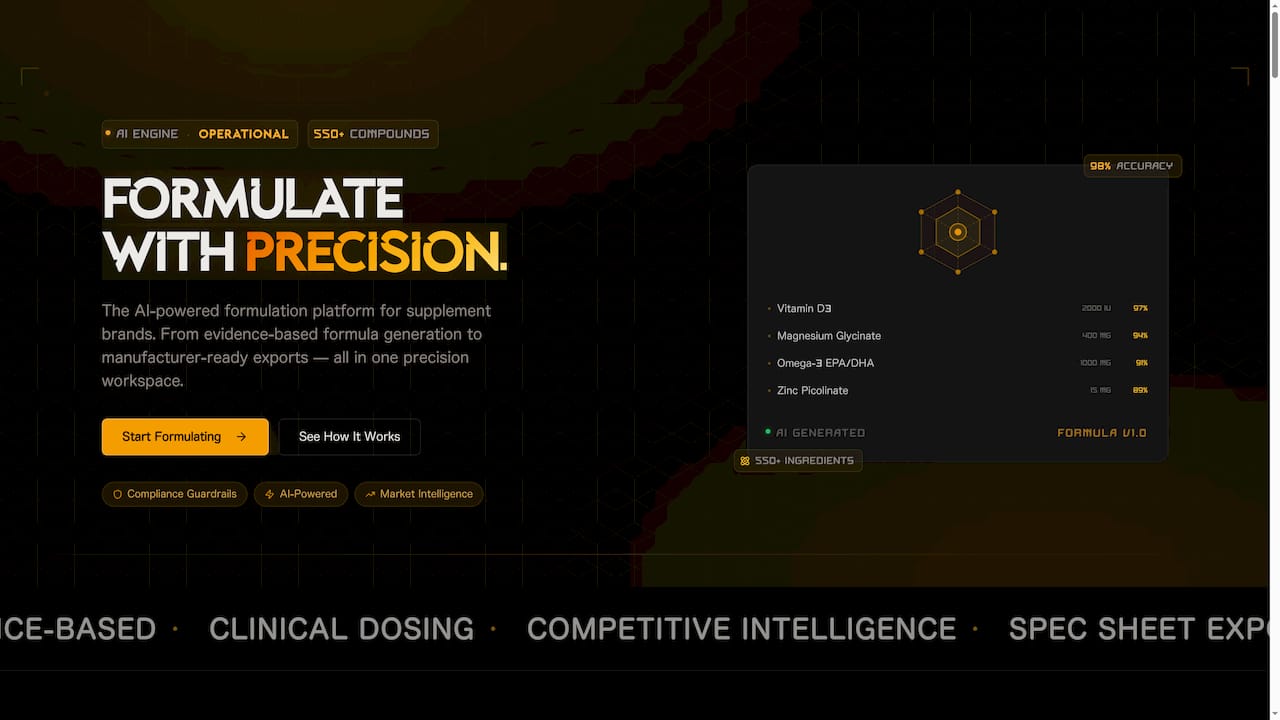
Formlypro gives cosmetic, food, and pharmaceutical formulators a structured 8-phase plan that takes a product from initial concept through formulation, prototyping, compliance, and production. The platform includes market research and competitive analytics so you know what emulsifier systems competing products use and how your formula stacks up before you spend a dollar on manufacturing. The AI-powered packaging mockup tool lets you visualize your finished product at the same time you're finalizing the formula. Visit Formlypro to see how the platform fits your formulation workflow.
FAQ
What is the difference between O/W and W/O emulsions?
An O/W emulsion disperses oil droplets in a continuous water phase, producing a lighter feel. A W/O emulsion disperses water droplets in a continuous oil phase, producing a richer, more occlusive texture.
What HLB value should I use for an O/W emulsion?
O/W emulsions typically require emulsifiers with HLB values between 8 and 18. A mixed emulsifier system blended to a target HLB within that range produces better stability than a single emulsifier.
How do I know if my emulsion is stable?
Run accelerated stability testing at 40°C, 4°C, and through freeze-thaw cycles. Measure droplet size distribution at each interval. Increasing droplet size or visible separation indicates instability.
What causes an emulsion to break?
Emulsions break when the emulsifier cannot coat all available droplet surface area, when droplets collide and merge (coalescence), or when temperature extremes invert the phase structure. Controlling emulsifier ratio and homogenization pressure prevents most failures.
Can I use natural emulsifiers in pharmaceutical emulsions?
Yes. Purified egg lecithin and soy lecithin are approved for parenteral pharmaceutical emulsions under FDA and EMA guidelines. They require tighter purity specifications than food-grade equivalents and must meet pharmacopeial standards.