
Every dietary supplement label that carries a structure/function, general well-being, or nutrient-deficiency disease claim must display this exact text: "This statement has not been evaluated by the Food and Drug Administration. This product is not intended to diagnose, treat, cure, or prevent any disease." That requirement comes from 21 CFR 101.93 under DSHEA, and manufacturers must also notify the FDA within 30 days of first marketing the claim. Getting the wording, placement, or notification wrong won't necessarily draw a warning letter, but it strips away the legal protection the disclaimer is supposed to provide, and it does nothing to shield you from the FTC if your advertising oversells what the product does.
TL;DR:
- The disclaimer must be exactly worded as "This statement has not been evaluated by the Food and Drug Administration" and placed near the claim or linked with an asterisk.
- Only structure/function, general well-being, and nutrient-deficiency disease claims require the disclaimer, and the wording must not imply drug treatment or approval.
- Typesize for the disclaimer is at least one-sixteenth inch boldface, with a smaller exception for packages under three square inches, confirmed through physical measurement.
- Filing a 30-day notification with the FDA is necessary after substantiating claims, but this does not mean the FDA approves the claim; it only becomes part of a public record.
- Most labeling violations are preventable and result from simple oversights like misplaced disclaimers or incorrect typesize, which should be caught during proofing before printing.
Table of Contents
- The FDA Disclaimer for Supplements: Exact Wording and Why It Can't Be Paraphrased
- When Does a Supplement Label Actually Require the Disclaimer?
- Placement Rules: Type Size, Boxing, and Symbol Linking
- The 30-Day Notification and What Substantiation Really Means
- Why the DSHEA Disclaimer Won't Save a Misleading Ad
- What the December 2025 FDA Letter Changes for Your Packaging
- A Compliance Checklist and Copy-Ready Disclaimer Templates
- Why Most Label Failures Are Preventable, Not Complicated
- Building Compliance Checks Into Your Product Timeline, Not Bolting Them On After
- Sources
The FDA Disclaimer for Supplements: Exact Wording and Why It Can't Be Paraphrased
Here's the singular version, verbatim, as it appears in the regulation:
"This statement has not been evaluated by the Food and Drug Administration. This product is not intended to diagnose, treat, cure, or prevent any disease."
When a single panel carries more than one qualifying claim, you can consolidate the language into a plural version: "These statements have not been evaluated by the Food and Drug Administration. This product is not intended to diagnose, treat, cure, or prevent any disease." Both versions are spelled out in 21 CFR 101.93, and neither one is a suggestion. The specific phrasing exists because it maps directly to Section 403(r)(6) of the Federal Food, Drug, and Cosmetic Act, the provision DSHEA created that lets structure/function claims skip the drug approval pathway. Swap a word, drop a clause, or reword it to sound friendlier, and you've technically failed to meet the condition that earns you the exemption in the first place.
That's a bigger deal than it sounds. A supplement label that makes a structure/function claim without the properly worded disclaimer isn't just sloppy. It can be read as making an unauthorized drug claim, because the disclaimer is the mechanism that legally separates "supports healthy joints" from "treats arthritis." FDA's own guidance on dietary supplements frames the disclaimer as the tool that tells consumers the agency hasn't pre-reviewed the claim, since dietary supplements never go through FDA approval the way drugs do. Copy the text exactly. Don't italicize the meaning out of it, don't shrink it into marketing copy, and don't let a graphic designer "clean it up" during a packaging refresh.
When Does a Supplement Label Actually Require the Disclaimer?
Not every label needs it. The disclaimer is triggered by specific claim categories, and knowing which bucket your marketing copy falls into determines whether you're required to run it at all.
- Structure/function claims describe how an ingredient affects the body's structure or function without referencing a disease. "Supports immune health," "helps maintain healthy blood sugar levels already within normal range," and "promotes joint flexibility" all qualify.
- General well-being claims describe a broad sense of health improvement, like "helps you feel more energized throughout the day."
- Nutrient-deficiency disease claims describe a supplement's role in preventing a disease caused by a nutrient deficiency, such as "vitamin C prevents scurvy." These carry an extra condition: the label must also state how prevalent that deficiency disease actually is in the United States.
The line between an acceptable structure/function claim and an illegal drug claim is thinner than most marketing teams assume. "Supports healthy cholesterol levels" is a structure/function claim. "Lowers cholesterol" edges toward implying treatment of a disease state, which reclassifies your supplement as an unapproved drug in the FDA's eyes, disclaimer or not. The disclaimer never rescues a claim that's actually a disease claim in disguise. It only protects legitimate structure/function language that's been properly worded and properly filed.
Placement Rules: Type Size, Boxing, and Symbol Linking
The regulation gets specific about where the disclaimer sits and how big it has to be, and this is where a lot of otherwise well-written labels get flagged during proofing.
The disclaimer must appear in close proximity to the structure/function statement it modifies, or be linked to it with a symbol, typically an asterisk placed after the claim and again at the start of the disclaimer. If the disclaimer isn't printed directly adjacent to the claim, 21 CFR 101.93 requires it to appear in a boxed format elsewhere on the label. Here's the detail that trips up multi-panel packaging: if you're using a boxed plural disclaimer instead of adjacent placement, every panel that contains a qualifying claim needs that box or a symbol link back to it. Auditors miss this constantly on labels with claims scattered across the front panel, a side panel, and the back.
Minimum typesize sits at one-sixteenth of an inch, and it has to be boldface. There's a narrow exception: packages with less than 3 square inches of available label space can drop to one-thirty-second of an inch, a detail buried in FDA's labeling guide that's easy to miss on small-format products like single-serve packets or travel sizes.
- Measure typesize on a printed proof, not a screen mockup. On-screen scaling can hide a font that prints under the minimum height.
- Confirm every panel carrying a claim either sits next to its disclaimer or links to the boxed version.
- Document your placement decision (adjacent vs. boxed) so you have a paper trail if a co-packer changes the layout later.
Pro Tip: Run a physical ruler against your printed proof before approving a print run. Digital proofs routinely misrepresent type height once a file gets rasterized or resized by a printer, and that's the exact detail an FDA inspector will check first.
The 30-Day Notification and What Substantiation Really Means
Making a structure/function claim isn't a label decision you get to make alone. FDA requires notification within 30 days of the first time you market a product carrying that claim. The notification includes the exact claim text, the product name, and the manufacturer's or distributor's contact information, and it goes to FDA's Office of Nutrition and Food Labeling.
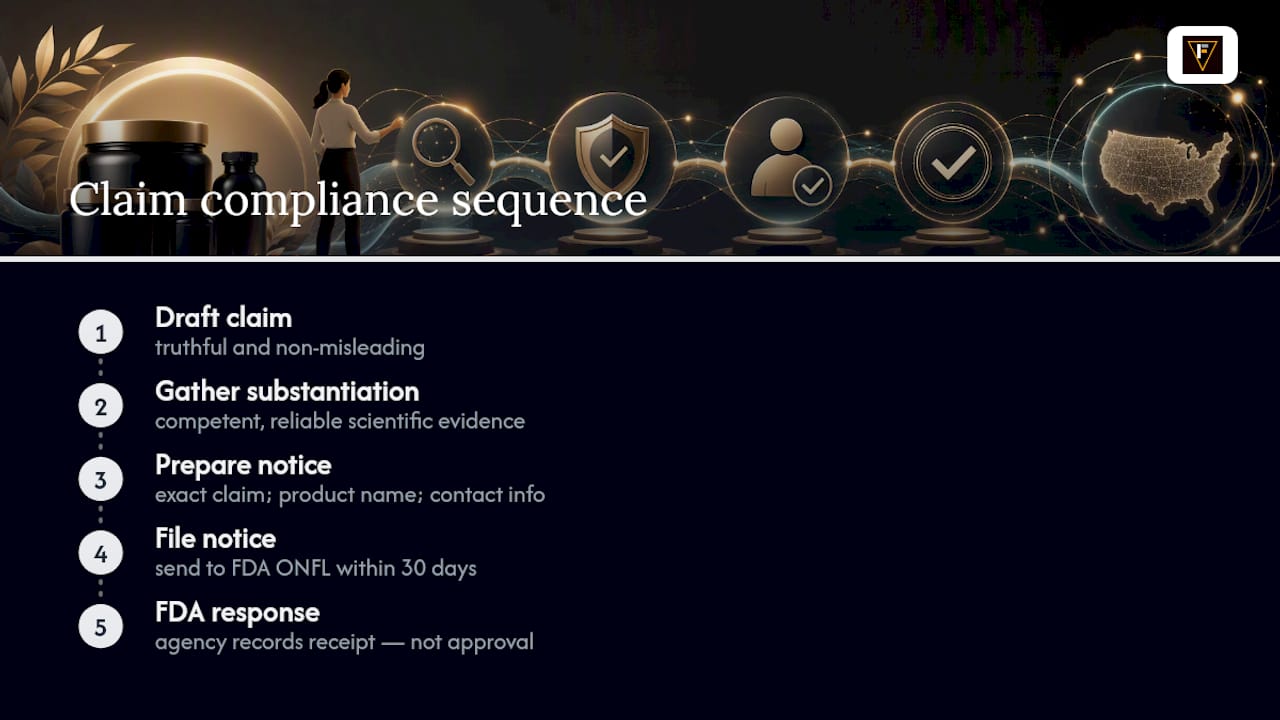
Before you ever file that notification, though, you need substantiation. FDA requires that structure/function claims be truthful and not misleading, which in practice means you need competent and reliable scientific evidence supporting the claim before the product hits shelves, not after. That evidence base can include published clinical research on the specific ingredient and dosage, mechanistic studies, or in some cases traditional use data, but it has to actually correspond to what the label says. A claim built on a study using 10 times your product's dose of an ingredient isn't substantiation. It's a liability waiting for someone to notice.
Here's the part that catches new brands off guard: notification is not approval. Filing your 30-day notice does not mean FDA reviewed your claim and signed off on it. The agency simply receives it into a public record. Nothing about the notification process implies endorsement, and labeling or marketing that suggests FDA "approved" or "cleared" the claim is its own violation, separate from whatever issue triggered the original disclaimer requirement.
Why the DSHEA Disclaimer Won't Save a Misleading Ad
Labeling and advertising run on two different regulatory tracks, and treating them as one is where marketing teams get exposed. FDA governs the physical label. The FTC governs advertising, including social media posts, influencer content, landing pages, and email campaigns. The two agencies coordinate, but their standards aren't identical, and the DSHEA disclaimer is not an advertising requirement at all.
That distinction matters because plenty of brands slap the disclaimer text into an ad's footer assuming it functions as a shield. It doesn't. The FTC has been explicit that adding the disclaimer to a deceptive ad does nothing to make the underlying claim less deceptive. If your website says a supplement "eliminates joint pain in days" while your label correctly says "supports joint comfort," the disclaimer on the label won't stop an FTC inquiry into the website copy.
- Ad language like "clinically proven to cure," "doctor recommended for treating," or "guaranteed results" invites scrutiny regardless of what your label says.
- Safer alternatives lean on qualified, specific phrasing: "in a small clinical study, participants reported improved comfort" rather than blanket cure claims.
- Testimonials implying disease treatment carry the same risk as label copy that oversteps into drug claims.
What the December 2025 FDA Letter Changes for Your Packaging
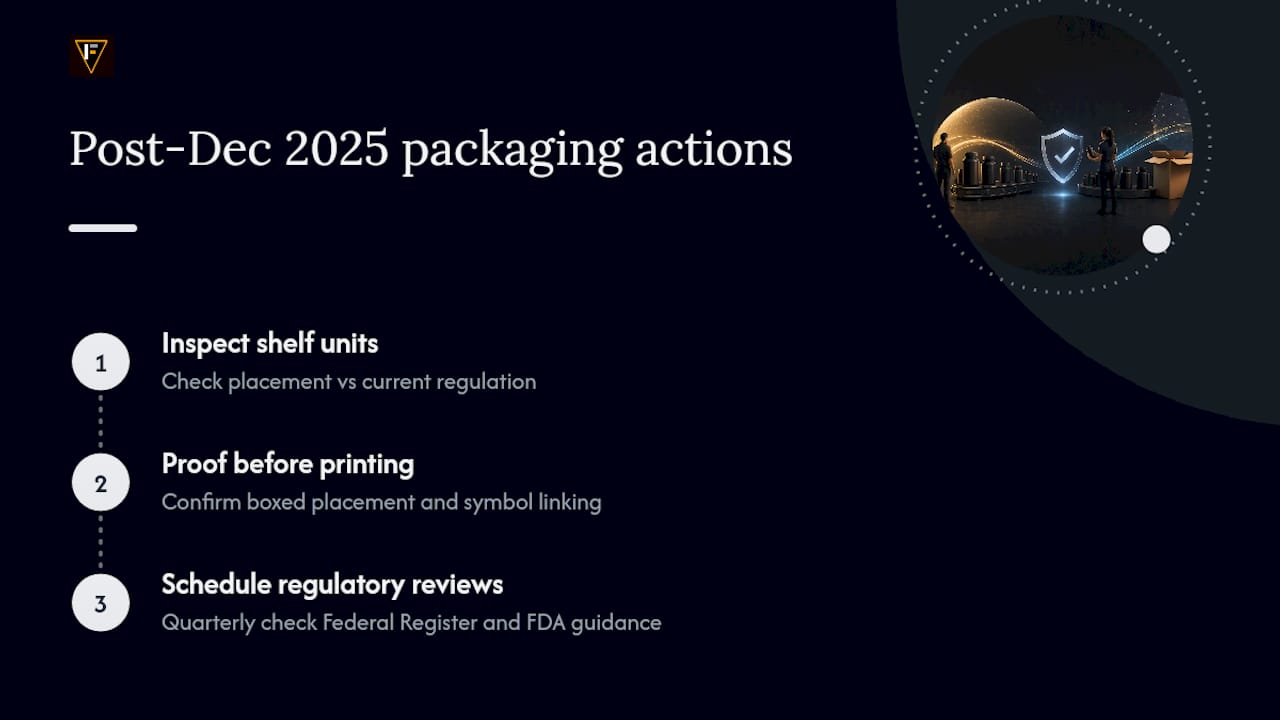
FDA sent a letter to the dietary supplement industry on December 11, 2025, addressing how the DSHEA disclaimer is placed and displayed across current packaging. The letter signals that the agency is paying closer attention to placement mechanics specifically, not just whether the disclaimer text exists somewhere on the package.
For brands with product already on shelves, this is a good moment to pull physical units and check placement against the current reading of the regulation rather than assuming last year's approved artwork still holds up. For anything heading into a new print run, treat the letter as a cue to double-check boxed placement and symbol linking before, not after, the files go to the printer. Reprinting packaging after a full production run is far more expensive than catching a placement gap during proofing.
The FDA has shown it will continue refining expectations around this disclaimer rather than leaving the 1997 regulatory language static forever. Brands that sell across multiple retailers or private-label lines should build a recurring calendar reminder, quarterly at minimum, to check the Federal Register and FDA's guidance pages for updates. Waiting for a warning letter to find out the rules shifted is the expensive way to learn this.
A Compliance Checklist and Copy-Ready Disclaimer Templates
Use this sequence any time a new claim moves from marketing copy into label artwork:
- Classify the claim. Structure/function, general well-being, or nutrient-deficiency disease, and confirm it isn't drifting into disease-treatment territory.
- Verify substantiation exists in writing before the product markets, not after.
- Prepare and file the 30-day notification with FDA, including exact claim language and contact details.
- Place the disclaimer adjacent to the claim, or box it and confirm every qualifying panel links back to it.
- Measure typesize on a physical proof and confirm boldface formatting meets the one-sixteenth inch minimum (or one-thirty-second inch under the small-pack exception).
- Retain documentation: substantiation files, notification receipts, and final print mockups, stored together as one compliance record.
Copy-ready single-claim version:
"This statement has not been evaluated by the Food and Drug Administration. This product is not intended to diagnose, treat, cure, or prevent any disease."
Copy-ready multi-claim version:
"These statements have not been evaluated by the Food and Drug Administration. This product is not intended to diagnose, treat, cure, or prevent any disease."
Symbol-link example: place an asterisk directly after your structure/function claim ("Supports healthy joint function*"), then repeat the asterisk immediately before the boxed disclaimer elsewhere on the package.
Pro Tip: Store your notification confirmation, your substantiation file, and your final approved mockup in the same folder for each SKU. When a retailer's compliance team or an FDA inspector asks for documentation, you want to hand over one folder, not reconstruct a timeline from three different departments.
For a broader look at what else belongs in an ongoing compliance program, this compliance requirements checklist for health and wellness brands and this federal and state labeling checklist cover adjacent requirements teams often review in the same pass as disclaimer placement.
Why Most Label Failures Are Preventable, Not Complicated
The failures that show up most often aren't exotic. They're a missing boxed disclaimer on a back panel, a typesize that measured fine on screen but printed under one-sixteenth of an inch, or a claim grouped with three others where only the first one got linked to the disclaimer. None of these require a legal background to catch. They require someone checking the physical proof against the regulation before the print run, not after a retailer flags it.
That's the gap FormlyPro's 8-phase development workflow is built to close, by embedding compliance checkpoints into formulation and packaging stages instead of treating them as a final review before launch.
— Ben
Building Compliance Checks Into Your Product Timeline, Not Bolting Them On After
Most disclaimer mistakes happen because compliance gets reviewed once, right before printing, instead of at every stage where a claim gets written or a layout changes. FormlyPro's platform builds compliance checkpoints into its 8-phase workflow from formulation through packaging, so label language and claim substantiation get checked while the product is still in development, not after the print files are locked.
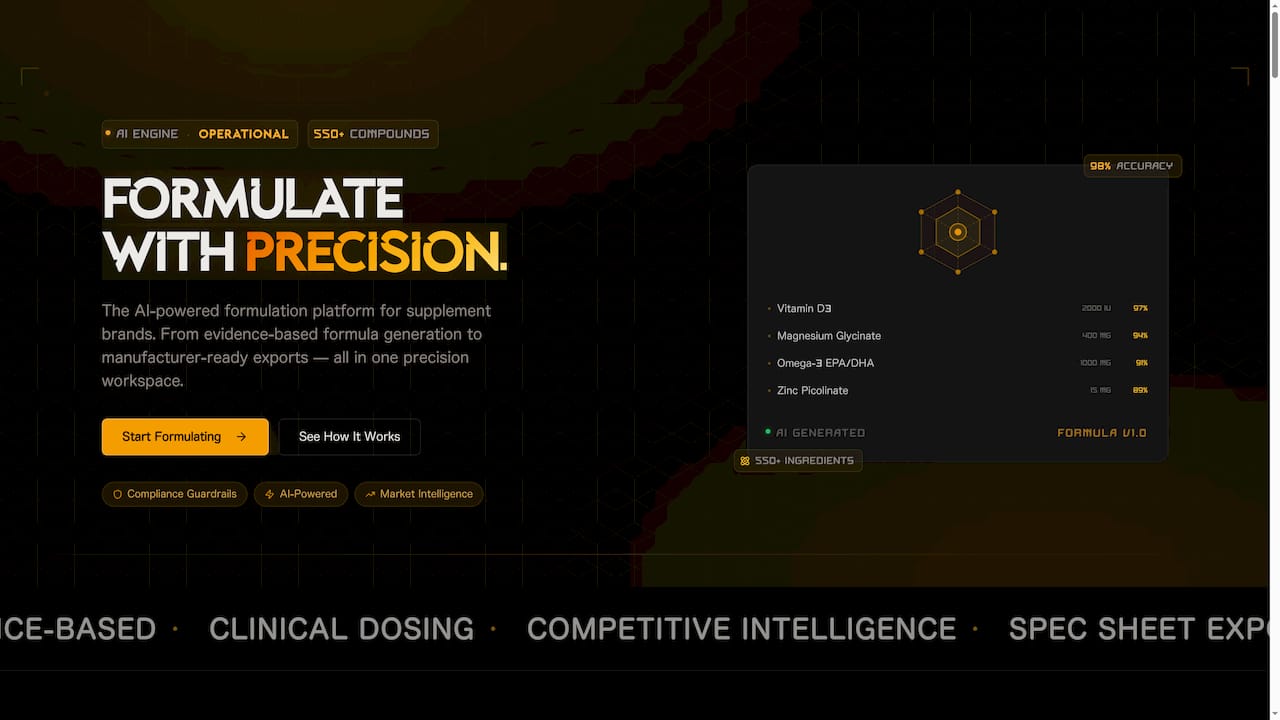
The platform includes label templates aligned to structure/function claim rules, an AI mockup designer for testing disclaimer placement and typesize before a proof ever goes to a printer, and record-keeping tools for tracking your 30-day notifications alongside your substantiation files. Combine that with the market research and competitor analysis built into the same system, and you get a workflow where compliance isn't a separate spreadsheet someone forgets to update. For related labeling considerations that often surface during the same review, teams also check country of origin labeling requirements in the same pass. If your team is prepping a new SKU or auditing an existing product line, start a compliance audit inside FormlyPro and walk through your current label against the placement and typesize requirements before your next print run goes out.
Sources
- eCFR § 101.93 — Certain types of statements for dietary supplements
- Questions and Answers on Dietary Supplements
- Dietary Supplements: An Advertising Guide for Industry | FTC