

TL;DR:
- In-house formulation allows brands to control their intellectual property, improve quality, and reduce per-unit costs at scale. It requires significant upfront investment and operational discipline but offers faster product innovation and greater regulatory oversight. This approach suits established brands with stable demand and protected formulas more than early-stage companies.
In-house formulation is defined as the practice of developing, testing, and manufacturing products entirely within your own facilities and team. The advantages of in-house formulation center on three pillars: full intellectual property ownership, direct quality control, and lower per-unit costs at scale. Brands that internalize their product development process gain the ability to modify formulas within weeks, respond to regulatory changes without waiting on third parties, and protect proprietary ingredients from exposure. The trade-off is real: setup takes 6–18 months and demands significant capital. This article breaks down exactly when those trade-offs are worth it.
1. How in-house formulation protects your intellectual property
Proprietary formulas are among the most valuable assets a brand owns. When you outsource production, your formula travels outside your walls. Contract manufacturers, co-packers, and third-party labs all handle your ingredient ratios, processing methods, and performance benchmarks. That exposure creates real risk.
In-house formulation offers complete control over proprietary IP and eliminates the risk of unauthorized use. That control matters most for brands with patented ingredients, novel delivery systems, or formulas that define their market position.
"Brands with unique or sensitive formulations prefer in-house production to maintain complete formula confidentiality. In-house manufacturing keeps the formula internal, reducing the shared exposure that is prevalent in outsourcing."
The risks of outsourcing IP are not theoretical. A co-packer who manufactures for multiple brands in the same category has access to your formula. Non-disclosure agreements offer legal recourse after a breach, but they do not prevent one. Keeping formulation internal removes that vulnerability entirely.
- No third-party access to ingredient ratios or processing parameters
- No risk of formula replication by a manufacturer serving your competitors
- Full ownership of batch records, test data, and development history
- Stronger patent and trade secret protection when IP stays internal
Pro Tip: Register your core formulas as trade secrets before bringing any external lab or consultant into the development process, even briefly.
2. What the real cost structure looks like
The financial case for internal formulation is not simple. A modest cGMP facility requires about $2M in upfront investment. Annual fixed costs for compliance, quality assurance, and lab staffing run between $150,000 and $500,000 before a single unit ships.
| Cost Category | In-House | Outsourced |
|---|---|---|
| Setup investment | $2M+ facility build | $0 upfront |
| Time to first production | 6–18 months | 1–3 months |
| Variable cost per unit (at scale) | ~$2.64 per bottle | ~$3.90 per bottle |
| Annual fixed compliance costs | $150K–$500K | Included in co-packer fee |
| IP exposure risk | Minimal | Moderate to high |
At very high volumes, in-house production saves ~$1.26 per bottle compared to co-packing. That margin improvement compounds fast across hundreds of thousands of units. The break-even point for supplement brands generally sits around 275,000 bottles per SKU annually.
The hidden risk is operating leverage. In-house formulation converts variable costs into fixed costs, which works in your favor during high-volume periods and against you during slow ones. A brand running at 60% capacity still pays 100% of its fixed overhead. That dynamic requires disciplined volume forecasting before you commit.
Pro Tip: Model your break-even at three volume scenarios: your current run rate, a 30% decline, and a 30% increase. If the downside scenario creates unsustainable losses, you are not ready for in-house production.
3. Faster innovation and real product customization
Speed is where internal formulation creates a competitive gap that outsourcing simply cannot close. When your R&D team works in the same building as your production line, formula changes happen in weeks, not months. An outsourced partner requires formal change requests, minimum order adjustments, and scheduling windows that can push a simple tweak out by a full quarter.

Operational transparency in in-house manufacturing enables brands to control every ingredient and iterate formulas quickly to solve quality issues. That speed is not just convenient. It is a direct revenue advantage when a market trend shifts or a compliance update requires reformulation.
Custom formulation benefits go beyond speed. Internal teams can build modular ingredient systems, adjusting actives, delivery formats, and dosage levels for different SKUs without starting from scratch. Industrial food manufacturers, for example, use in-house enzyme dosing systems to fine-tune product performance batch by batch. The same principle applies to supplement and cosmetic brands adjusting actives for different market segments.
Here is what rapid internal iteration looks like in practice:
- Identify a performance gap or market opportunity
- Pull existing batch records and ingredient data from your internal system
- Adjust the formula with your in-house R&D team
- Run a small pilot batch on your own line
- Test, document, and approve internally under cGMP protocols
- Scale the updated formula without waiting for a third-party slot
That cycle can run in four to six weeks internally. With an outsourced partner, the same process often takes three to five months. For brands tracking healthcare advertising trends and responding to consumer demand in real time, that speed difference is decisive.
4. Operational control and quality assurance
Quality control is the most direct benefit of keeping formulation internal. When you own the process, you own every decision from raw material sourcing through finished product release. There is no waiting on a third party to investigate a batch failure or explain a deviation.
Owning a 21 CFR Part 111 cGMP facility transfers 100% of regulatory responsibility to the brand. That sounds like a burden, and it is. But it also means your quality assurance team can investigate and resolve issues the same day they appear, not weeks later after a co-packer's internal review.
- Direct oversight of supplier qualification and raw material certificates of analysis
- Internal batch records maintained under your own quality management system
- Immediate corrective action when a process deviation occurs
- Full traceability from ingredient lot numbers through finished product distribution
- Regulatory readiness for FDA inspections without coordinating with a third party
Consumer trust follows formulation transparency. Brands that can document exactly what goes into every batch, and prove it, build credibility that marketing alone cannot create. Internal quality assurance makes that documentation possible and audit-ready at all times.
5. When in-house formulation is the right strategic choice
In-house manufacturing is a scale optimization decision, not a launch strategy. Brands that benefit most from internal formulation share a specific profile: stable high-volume demand, proven product-market fit, and the financial capacity to absorb fixed overhead during slower periods.
The brands that should not move in-house yet are equally clear. Early-stage brands, those still validating their formula or building their customer base, pay a steep price for premature vertical integration. The capital tied up in a facility could fund marketing, distribution, and product testing that would grow revenue faster.
| Brand Profile | In-House Formulation | Outsourced Production |
|---|---|---|
| High volume, stable demand | Strong fit | Less cost-efficient at scale |
| Unique or patented formula | Strong fit | IP exposure risk |
| Early-stage, validating market | Poor fit | Faster, lower risk |
| Limited capital | Poor fit | Lower barrier to entry |
| Rapid SKU expansion needed | Moderate fit | More flexible |
The right time to consider internal production is when you have consistent volume, a formula worth protecting, and the operational maturity to manage cGMP compliance without it consuming your leadership team. Brands that move too early often find that regulatory overhead crowds out the innovation work that made their product worth protecting in the first place.
For brands not yet at that threshold, the smarter path is building your formulation knowledge and documentation practices now. That preparation shortens the transition timeline significantly when volume does justify the move.
Key takeaways
In-house formulation delivers its strongest advantages at scale, where IP protection, per-unit cost savings, and quality control combine to create a durable competitive position.
| Point | Details |
|---|---|
| IP protection is the clearest win | Internal formulation eliminates third-party formula exposure and reduces the risk of unauthorized replication. |
| Fixed costs require volume discipline | Break-even for supplement brands sits around 275,000 bottles per SKU annually before in-house savings materialize. |
| Speed of innovation is a revenue advantage | Internal R&D teams can complete formula iterations in 4–6 weeks versus 3–5 months with outsourced partners. |
| Quality control becomes your responsibility | Owning a cGMP facility transfers 100% of regulatory and compliance responsibility to your brand. |
| Timing the move matters as much as making it | In-house formulation suits brands with stable demand and proven product-market fit, not early-stage launches. |
What I have learned about timing this decision
The brands I have seen struggle most with in-house formulation are not the ones that failed at manufacturing. They are the ones that moved too early. They had a great product, growing sales, and genuine excitement about owning their process. What they underestimated was how much management bandwidth compliance absorbs. Batch records, supplier audits, lab staffing, and FDA readiness do not run themselves.
The brands that thrive are the ones that treated internal formulation as a deliberate scale move, not a milestone to hit. They modeled their fixed costs honestly, including financing at current prime rates near 6.75%, and they waited until volume made the math undeniable. They also invested in their formulation knowledge before they built their facility. By the time they moved in-house, their team already understood the process deeply.
My honest recommendation: use the period before you are ready to build your internal formulation capability without the capital commitment. Document your formulas rigorously. Learn your compliance requirements. Build your supplier relationships. When volume justifies the investment, you will transition in months instead of years. The cost-saving tactics that work at scale start with the groundwork you lay before you ever break ground on a facility.
— Ben
Formlypro supports brands building toward in-house formulation
Brands that are serious about bringing formulation in-house need more than manufacturing space. They need documented formulas, compliance frameworks, market data, and a clear development process before the first batch runs.
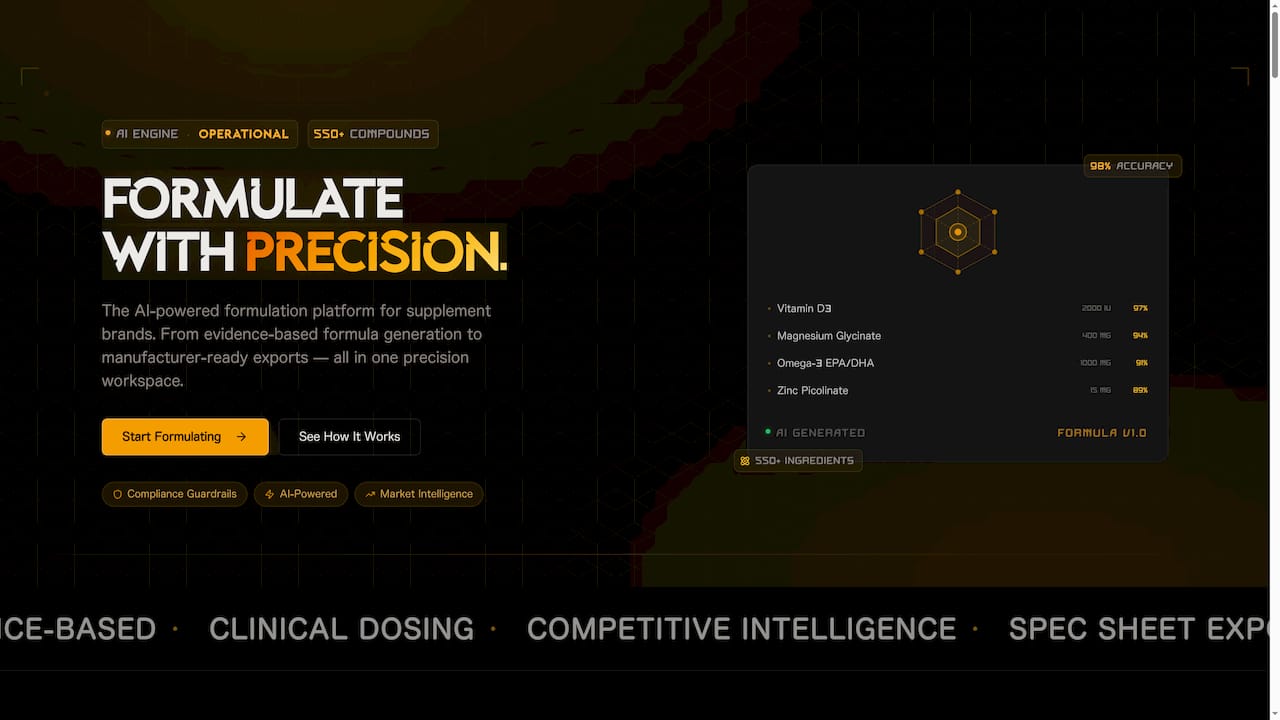
Formlypro gives brands the infrastructure to build that foundation. The platform covers every phase from ideation through production, including formula development, compliance guidance, market research, and packaging design with an integrated AI mockup tool. Brands use it to develop research-backed formulations with full documentation, so they are ready to scale internally when the volume justifies it. Whether you are preparing for in-house production or refining your current process, Formlypro gives you the structure to do it right.
FAQ
What is in-house formulation?
In-house formulation is the practice of developing and manufacturing products entirely within your own team and facilities. It gives brands direct control over ingredients, quality, and intellectual property.
Is in-house formulation better than outsourcing?
In-house formulation is better for brands with high, stable volume and proprietary formulas that require IP protection. Outsourcing is faster and lower-risk for early-stage brands still validating demand.
What does in-house formulation cost to set up?
A modest cGMP facility requires approximately $2M in upfront investment, with annual fixed compliance and quality assurance costs running between $150,000 and $500,000.
How much can in-house formulation save per unit?
At scale, in-house production can reduce variable costs by approximately $1.26 per bottle compared to co-packing, dropping unit costs to roughly $2.64 versus $3.90 with an outsourced partner.
What brands benefit most from internal formulation?
Brands with proven high-volume demand, unique or patented formulas, and the operational capacity to manage cGMP compliance benefit most from bringing formulation in-house.