

TL;DR:
- The formulation iteration process is a repeated cycle of designing, testing, and refining a product until it meets quality standards. Using AI and Bayesian Optimization significantly reduces prototype numbers and accelerates development timelines. Clear benchmarks, early material characterization, and structured decision-making improve efficiency and regulatory readiness.
The formulation iteration process is the structured cycle of designing, testing, and refining a product's composition until it meets defined standards for performance, stability, and compliance. In pharmaceuticals alone, formulation development averages 4.3 years within a 4–6 year drug development timeline. That number reflects how much work happens between a first prototype and a market-ready product. Modern tools like Bayesian Optimization and AI-assisted modeling are compressing that timeline significantly, and product developers who understand the full iteration cycle gain a direct competitive edge.
What is the formulation iteration process?
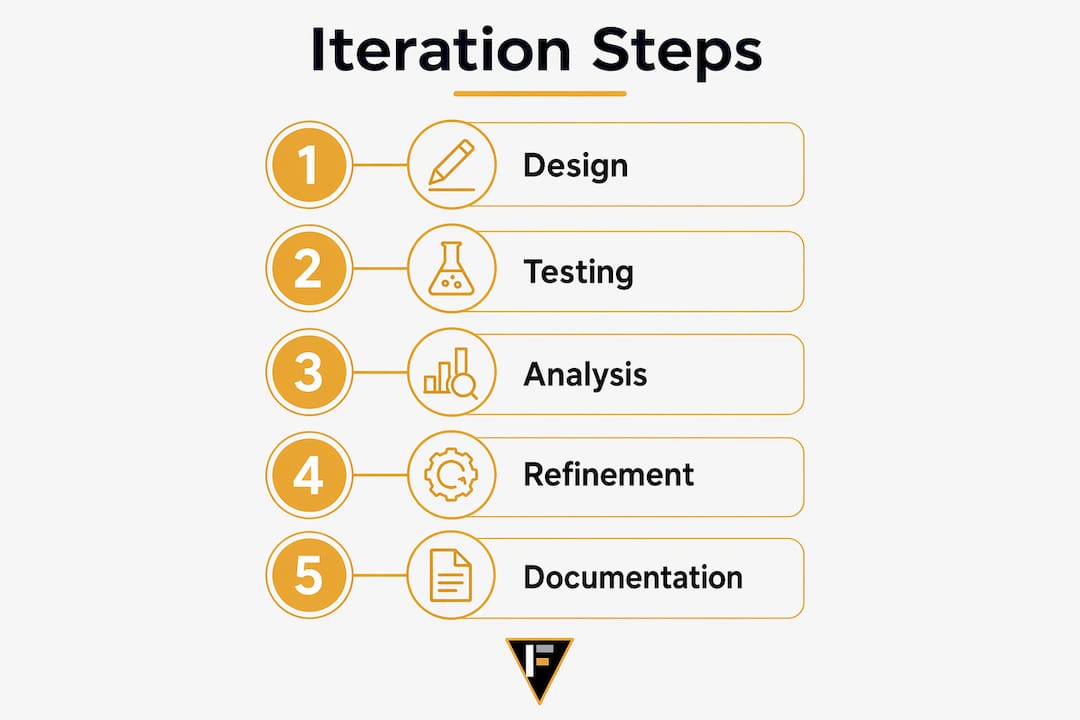
The formulation iteration process is a repeating cycle of prototype design, testing, analysis, and refinement. Each loop produces a better version of the formulation, moving it closer to a defined target profile. The process does not end after one round of testing. It continues until the product meets every benchmark for quality, safety, and usability.
The industry term for this approach is iterative formulation development. It draws from the broader concept of iterative design, which applies across engineering, software, and product development. What makes formulation-specific iteration distinct is the regulatory dimension. Every change to an ingredient, concentration, or manufacturing process must be documented, tested, and justified against standards like FDA guidance or ICH Q8 pharmaceutical development guidelines.
Product developers working outside pharmaceuticals, such as those in cosmetics, nutraceuticals, or food science, follow the same core logic. The formulation design process starts with a hypothesis about what the product should do, then tests that hypothesis against real-world data. Each failed test is not a setback. It is a data point that narrows the solution space for the next cycle.
What are the key steps in the formulation iteration process?
The formulation development cycle follows a clear sequence, though individual steps often overlap or loop back depending on test results. Here are the core iteration process steps:
-
Define the target product profile. Set specific, measurable goals before selecting a single ingredient. These include dosage form, release mechanism, shelf life, and patient or consumer usability requirements.
-
Select and characterize raw materials. Identify candidate ingredients and study their physical and chemical properties. Skipping early characterization leads to unforeseen stability failures later, costing months of delay and significant budget.
-
Design the initial prototype. Build the first formulation based on the target profile and material data. This is a starting point, not a final answer.
-
Run testing and collect data. Evaluate the prototype against stability, dissolution, bioavailability, and sensory benchmarks. Document every result with full traceability.
-
Analyze results and identify gaps. Compare test data against the target profile. Determine which variables caused underperformance and what adjustments are needed.
-
Refine the formulation. Make targeted changes based on the analysis. Adjust concentrations, swap excipients, or modify the manufacturing process.
-
Repeat until the formulation meets all benchmarks. Each cycle tightens the formulation. Iteration ends when the product passes all phase-appropriate quality thresholds.
-
Prepare for scale-up. Once the formulation is locked, transition to commercial-scale production with documented specifications.
Pro Tip: Document every iteration with a change log that records what was changed, why, and what the test result was. This log becomes your regulatory submission backbone and your fastest path through future reformulations.
The most common mistake at this stage is treating iteration as a linear checklist. It is not. Steps 4 through 6 form a tight feedback loop that may repeat dozens of times before the formulation stabilizes.
How do AI and Bayesian Optimization improve the iteration cycle?
Traditional trial-and-error methods are increasingly replaced by AI-assisted modeling and predictive analytics. The shift is not cosmetic. It changes the economics of the entire development cycle.

AI-assisted formulation reduces prototype counts by 70–90% and cuts development cycle time by 50–60%. A 12-month runway can compress to roughly 4 months. That is not a marginal gain. It is the difference between launching ahead of a competitor or behind one.
Bayesian Optimization is the most widely adopted AI framework in formulation development. Bayesian Optimization uses a learning-by-doing framework that prioritizes experiments where uncertainty or impact is highest. Unlike classical Design of Experiments, which tests a fixed grid of conditions, Bayesian Optimization adapts after each result. It focuses the next experiment on the area most likely to improve the outcome.
The practical benefits for product developers include:
- Fewer wasted prototypes. The model predicts which formulations are unlikely to succeed before you build them.
- Faster decision points. AI flags when a formulation has converged on an optimal range, so you stop iterating earlier.
- Better documentation. AI-assisted platforms log every prediction, result, and adjustment automatically.
- Reduced cost per iteration. Fewer physical tests mean lower lab costs and faster timelines.
The paradigm shift from bench intuition to predictive modeling also improves reproducibility. Human intuition varies between scientists. A trained model does not. That consistency matters when you are preparing regulatory submissions or scaling to contract manufacturing.
Pro Tip: Integrate AI tools at the prototype design stage, not after the first round of failures. The model needs early data to build an accurate prediction surface. Starting late cuts the efficiency gains in half.
Formlypro builds this AI-driven iteration logic directly into its platform, giving product developers access to predictive formulation tools without needing a data science team.
What quality benchmarks matter during formulation iteration?
Quality benchmarks are the pass/fail criteria that determine whether a formulation advances to the next phase or returns to the bench. Setting them before testing begins is non-negotiable. Testing without defined benchmarks produces data with no decision value.
The table below outlines the core test types, when they apply, and what a passing result looks like.
| Test type | Timing in cycle | Key benchmark |
|---|---|---|
| Dissolution testing | Early and mid-iteration | >80% dissolution within 30 minutes |
| Accelerated stability | Months 1–3 of each iteration | No significant degradation detected |
| Chemical compatibility | Pre-prototype and early iteration | No reactive interactions between ingredients |
| Sensory and usability | Mid to late iteration | Acceptable taste, texture, and ease of use |
| Bioavailability | Late iteration and scale-up | Meets therapeutic or functional target range |
Accelerated stability failures typically appear within the first 1–3 months of testing. Catching them early is far cheaper than discovering them in a pivotal trial or after launch. A formulation that passes dissolution but fails stability at month two needs to go back to the ingredient selection stage, not just the blending step.
Formulation must balance molecular properties with patient-centric goals to deliver stable, effective products. That balance is not automatic. It requires deliberate testing of both chemical performance and real-world usability at every phase.
Pro Tip: Run accelerated stability testing in parallel with dissolution testing during early iterations, not sequentially. Parallel testing cuts weeks off each cycle and surfaces incompatibilities before you invest in further refinement.
For developers working on formulation testing submissions, having pre-defined benchmarks also speeds up the documentation process and reduces reviewer questions.
What common challenges arise during formulation iteration?
Formulation iteration fails in predictable ways. Knowing the failure modes in advance lets you build mitigation steps into the process from day one.
Early-phase formulations can tolerate simpler compositions, but late-stage development demands commercial-ready specifications. Teams that do not map these phase-specific requirements early face what the industry calls "Phase 3 surprises." These are formulation failures discovered during pivotal trials, when the cost of reformulation is at its highest.
The most common challenges product developers face include:
- Skipping early characterization. Failing to study raw material properties before prototyping leads to chemical incompatibilities that only surface during stability testing, often months later.
- Ignoring dosage route feasibility. A technically superior delivery route that patients find difficult to use will underperform a simpler alternative. Easier administration routes often outperform technically superior ones by improving adherence.
- Iterating without a locked target profile. Changing the success criteria mid-development invalidates earlier test data and forces repeated work.
- Under-documenting changes. Formulation changes without full traceability create regulatory gaps that delay submissions.
- Scaling too early. Moving to pilot or commercial scale before the formulation is fully characterized introduces new variables that can invalidate all prior iteration data.
Pro Tip: Build a risk map at the start of each development phase. List every known variable, its potential impact, and the test that will resolve it. Review the map after each iteration cycle and update it with new findings.
The benefits of AI in formulation extend directly to risk management. Predictive models can flag high-risk ingredient combinations before physical testing begins, cutting the cost of discovering problems late.
Key Takeaways
The formulation iteration process is a structured, repeating cycle of prototype design, testing, and refinement that product developers must execute with defined benchmarks and documented changes at every phase.
| Point | Details |
|---|---|
| Define benchmarks first | Set measurable quality targets before building any prototype to give every test a clear pass/fail outcome. |
| Characterize materials early | Skipping early characterization causes costly stability failures that appear months into development. |
| Use AI to cut cycle time | AI-assisted iteration reduces prototype counts by 70–90% and compresses development timelines by 50–60%. |
| Match complexity to phase | Early-phase formulations can be simpler; late-stage demands commercial-ready specifications from the start. |
| Document every change | Full traceability at each iteration cycle protects regulatory submissions and speeds future reformulations. |
Why I think most teams iterate wrong
Most product development teams treat iteration as a sign that something went wrong. They apologize for the number of prototypes. They rush to lock a formulation before the data justifies it. That mindset is the actual problem.
The teams I have seen succeed treat each iteration as a deliberate experiment with a specific question. They are not fixing a failure. They are collecting the next piece of evidence. That reframe changes everything about how you plan, document, and communicate the process internally.
The second mistake I see constantly is waiting too long to bring in AI tools. Teams run 15 manual prototypes, hit a wall, and then ask whether predictive modeling might help. At that point, the model has to work with noisy, inconsistent data from experiments that were not designed for machine learning. Starting AI integration at prototype one, with clean, structured data collection, is what actually produces the 70–90% prototype reduction that the research shows.
The third thing I would push back on is the idea that formulation iteration is primarily a chemistry problem. The hardest part is almost always the decision-making framework. When do you stop iterating and lock the formula? When do you escalate a stability failure versus adjust and retest? Those decisions need explicit criteria set before testing begins, not judgment calls made under deadline pressure.
Platforms like Formlypro exist precisely to give product developers that decision framework, with built-in benchmarks, compliance guidance, and AI-assisted analysis. The technology is not a shortcut. It is the structure that makes disciplined iteration possible at speed.
— Ben
How Formlypro fits into your formulation development cycle
Product developers who want to apply everything covered here without building the infrastructure from scratch have a direct path forward with Formlypro.
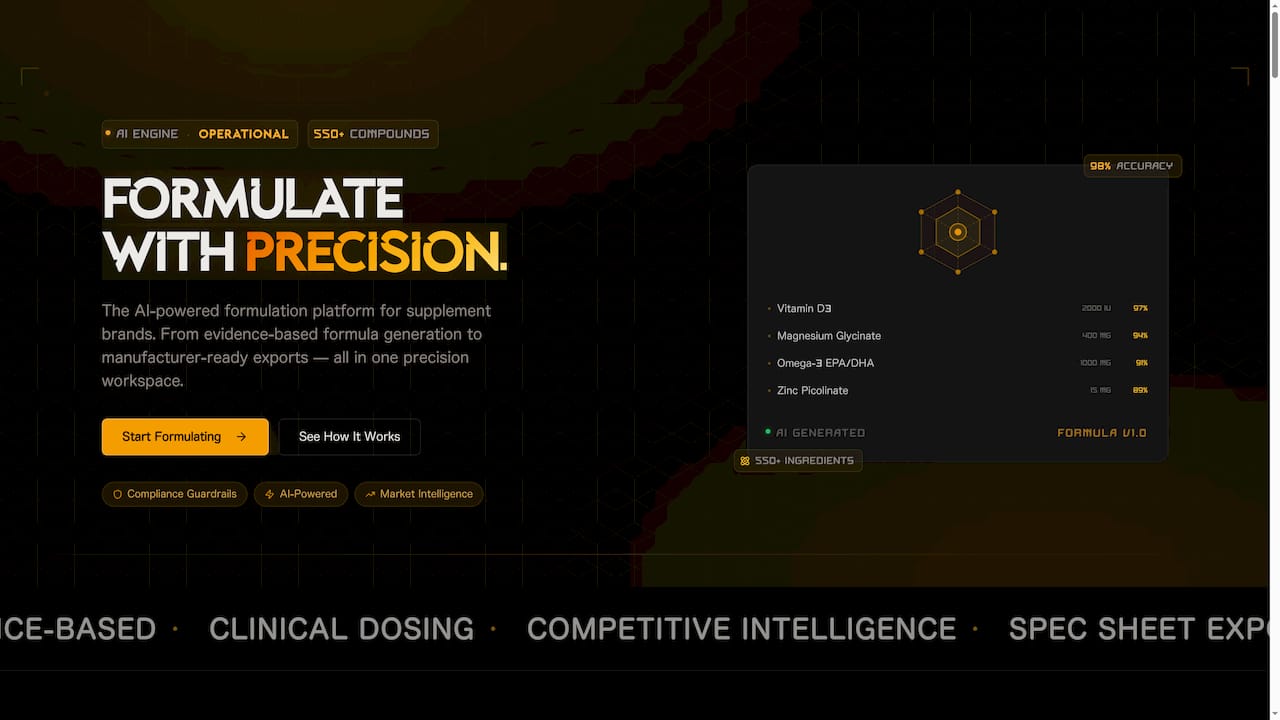
Formlypro is a subscription platform built for brands taking products from ideation to market. Its 8-phase plan covers formulation, prototyping, market research, compliance, and production in a single workflow. The AI-assisted tools reduce prototype cycles and flag compliance gaps before they become submission problems. The platform also includes competitive analytics, so you can see what formulations are selling and what ingredients competing products use. For teams ready to move from manual iteration to a structured, data-driven process, Formlypro's formulation platform is the place to start.
FAQ
What is the formulation iteration process in simple terms?
The formulation iteration process is a repeating cycle of designing, testing, and refining a product's composition until it meets defined quality and performance standards. Each cycle produces a better version of the formulation based on real test data.
How long does formulation iteration typically take?
Timeline varies by industry and complexity. Pharmaceutical formulation development averages 4.3 years within a broader 4–6 year drug development timeline, though AI-assisted approaches can cut active iteration cycles by 50–60%.
What is Bayesian Optimization in formulation development?
Bayesian Optimization is an adaptive experimental design method that prioritizes the next experiment based on where uncertainty or potential improvement is highest. It reduces the total number of experiments needed compared to classical Design of Experiments methods.
Why does early characterization matter so much?
Skipping early characterization of raw materials leads to chemical incompatibilities that surface during stability testing, often months into development. These late discoveries are significantly more expensive to fix than problems caught at the ingredient selection stage.
How does iterative design differ from traditional formulation methods?
Traditional formulation relies on trial-and-error with limited predictive guidance. Iterative design uses structured feedback loops, defined benchmarks, and increasingly AI-assisted analysis to make each cycle faster and more targeted than the last.