

TL;DR:
- Active ingredient dosage calculation ensures the correct amount of therapeutic component in formulations to guarantee safety and efficacy.
- Formulators must account for active moiety versus salt form and use dimensional analysis to reduce errors during dosage calculations.
Active ingredient dosage calculation is the process of determining the precise amount of a drug's therapeutic component needed in a formulation to achieve the intended efficacy without compromising safety. Formulators and scientists who skip rigorous calculation protocols risk producing products that are either sub-therapeutic or toxic. The industry standard term for this discipline is quantitative dosage determination, though the active ingredient dosage calculation guide framework covers the same ground in practical formulation contexts. Regulatory bodies including the FDA and ICH expect documented, reproducible calculations at every stage of product development. Getting this right from the start protects both the formulator and the end user.
What is the active moiety and why must it be considered in dosage calculations?
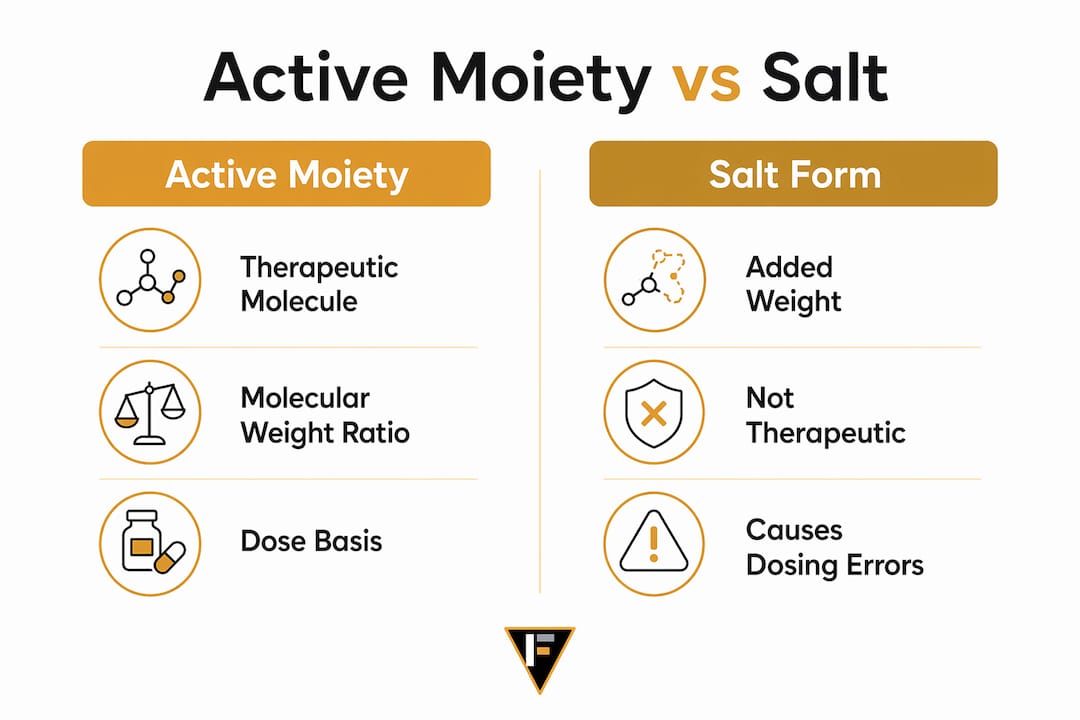
The active moiety is the molecule or ion responsible for the drug's therapeutic effect, stripped of any salt, ester, or other chemical modification used to improve stability or solubility. This distinction matters because the salt form of a drug always has a higher molecular weight than the active moiety alone. The counterion adds mass but contributes zero therapeutic activity.
Accurate bulk drug dosage requires managing this ratio explicitly. If the active moiety has a molecular weight of 400 and the salt form has a molecular weight of 550, you cannot treat them as equivalent when weighing out your batch. Doing so means you are delivering less active drug than intended, which directly affects potency and patient safety.
Here is what formulators must account for when working with salt forms:
- Molecular weight ratio: Divide the active moiety MW by the salt form MW to get the conversion factor.
- Dose conversion: Multiply the target active moiety dose by the inverse of the conversion factor to find the required salt quantity.
- Documentation: Record both the salt form quantity and the calculated active moiety equivalent in your batch record.
- Regulatory expectation: Label claims and specifications must reference the active moiety dose, not the salt form weight.
The active moiety vs. salt form distinction is not a technicality. Ignoring it produces systematic dosing errors across every unit in a batch.
Pro Tip: When sourcing a new raw material, always request the Certificate of Analysis and confirm whether the assay is expressed as the free base, free acid, or salt form before you run a single calculation.
How to perform dosage calculations using dimensional analysis
Dimensional analysis is the preferred method for dosage calculations because it works across every dosage form and problem type with one repeatable logic. You build a string of fractions where units cancel until only the desired unit remains. If the units do not cancel cleanly, the setup is wrong before you ever reach the arithmetic.

Dimensional analysis enables solving tablet doses, IV drip rates, and weight-based doses with a single approach. That consistency reduces cognitive load and the risk of applying the wrong formula to the wrong problem type.
The four-step process
- Write the order and the concentration you have. State the desired dose (e.g., 750 mg) and the available concentration (e.g., 250 mg per tablet).
- Build the fraction string. Place what you want in the numerator and what you have in the denominator. Add conversion fractions as needed to cancel intermediate units.
- Cancel units. Cross out matching units in numerators and denominators. Only the target unit should remain.
- Calculate and round. Multiply across numerators, multiply across denominators, divide. Apply facility-specific rounding rules for drops, pump settings, or tablet counts.
Worked examples
Tablet dose: 750 mg ordered, 250 mg per tablet available.
(750 mg ÷ 1) × (1 tablet ÷ 250 mg) = 3 tablets
The mg units cancel, leaving tablets as the answer.
Weight-based IV dose: 5 mcg/kg/min ordered for a 70 kg patient, drug concentration 200 mcg/mL.
(5 mcg ÷ kg/min) × (70 kg ÷ 1) × (1 mL ÷ 200 mcg) = 1.75 mL/min
The D/H × Q formula (Desired over Have times Quantity) produces the same result for simpler tablet and oral liquid problems. Dimensional analysis generalizes it.
Pro Tip: Write every unit explicitly at every step. Never drop units mid-calculation, even when the arithmetic feels obvious. Units are your error-detection system.
How to calculate dosages for weight-based and pediatric formulations
Weight-based dosing is the standard for pediatric formulations and many specialized adult therapies. The calculation always follows three steps, and skipping any one of them is the primary source of pediatric dosing errors.
Three-step weight-based calculation
- Convert pounds to kilograms. Use the fixed conversion factor: 1 kg = 2.2 lbs. Divide the patient's weight in pounds by 2.2.
- Convert kg to total mg dose. Multiply the weight in kg by the prescribed mg/kg dose.
- Convert mg dose to dosage form. Divide the total mg dose by the available concentration to find the volume or tablet count.
Example calculation
A child weighs 44 lbs. The prescribed dose is 10 mg/kg. The available suspension is 125 mg per 5 mL.
| Step | Calculation | Result |
|---|---|---|
| Lbs to kg | 44 ÷ 2.2 | 20 kg |
| Kg to total dose | 20 kg × 10 mg/kg | 200 mg |
| Dose to volume | 200 mg ÷ (125 mg ÷ 5 mL) | 8 mL |
The answer is 8 mL of the 125 mg/5 mL suspension. Each step produces a clean unit that feeds directly into the next. Skipping the pound-to-kilogram conversion and using pounds directly in the mg/kg step produces a dose that is 2.2 times too high. That error is not theoretical. It is the most common weight-based mistake in compounding and clinical practice.
A formulation scalability checklist helps formulators verify that weight-based dose calculations remain accurate when batch sizes change.
What are common errors and best practices in dosage calculation?
The most damaging errors in dosage calculation are systematic, not random. They repeat across batches and across formulators because they stem from process gaps, not individual mistakes.
- Omitting units mid-calculation. Units must cancel mathematically; if they do not, the formula is wrong. Dropping units removes the only built-in check on your setup.
- Confusing vehicle with route. The vehicle is the dosage form (tablet, suspension, IV solution). The route is how it is administered (oral, intravenous, topical). Mixing these up misapplies concentration and volume computations.
- Ignoring active moiety vs. salt form. Using the salt form weight as if it equals the active moiety weight produces a consistent potency error across every unit in the batch.
- Skipping leading zeros. Write 0.5 mg, not .5 mg. Decimal errors are catastrophic with high-alert substances, and the leading zero is the simplest prevention.
- Relying on calculators without manual verification. Digital tools catch arithmetic errors. They do not catch a wrong formula or a misidentified concentration.
"High-alert medications require double checks regardless of calculation method. Leading zeros before decimals and independent verification by a second qualified person are non-negotiable steps, not optional quality measures."
The double-check requirement for high-alert substances is not a suggestion. It is a documented best practice in pharmaceutical compounding and clinical pharmacy. Build it into your standard operating procedure before a product reaches the prototype stage. A formulation checklist for scientists provides a structured framework for embedding these verification steps into your workflow.
What tools and resources can assist formulators in dosage calculation?
No single tool covers every calculation need. The most reliable approach combines structured templates, digital verification, and manual unit-cancellation checks.
| Tool type | Primary use | Limitation |
|---|---|---|
| Calculation templates | Standardize step-by-step unit tracking | Require correct formula selection by the user |
| Digital active ingredient calculators | Fast arithmetic verification for known formulas | Do not detect wrong formula or unit errors |
| Formula checklists | Catch missing steps and document compliance | Only as thorough as the checklist design |
| Batch record software | Audit trail and regulatory documentation | Requires accurate data entry to function correctly |
Digital dosage calculators function as a secondary verification layer, not a replacement for understanding the underlying calculation logic. A calculator that returns a number without showing unit cancellation gives you no way to confirm the setup was correct.
Calculation templates work best when they are built around dimensional analysis. Each row in the template corresponds to one fraction in the unit-cancellation string. This format makes errors visible before the final arithmetic step. For formulators moving products toward production, the step-by-step formulation process at Formlypro integrates calculation documentation directly into the development workflow.
Pro Tip: Build your calculation template so that the unit in the answer row is the only unit that does not cancel. If any other unit survives, the template flags the error automatically.
Key Takeaways
Accurate active ingredient dosage calculation requires distinguishing the active moiety from its salt form, applying dimensional analysis with full unit tracking, and verifying every result with a documented double-check process before any batch moves forward.
| Point | Details |
|---|---|
| Active moiety vs. salt form | Always calculate based on molecular weight ratio; the counterion adds mass but no therapeutic effect. |
| Dimensional analysis | Use the four-step unit-cancellation method for tablets, IV drips, and weight-based doses. |
| Weight-based dosing | Convert lbs to kg first using 1 kg = 2.2 lbs, then apply mg/kg, then convert to dosage form. |
| Error prevention | Write leading zeros, keep units at every step, and never confuse vehicle with route. |
| Digital tools | Use calculators as secondary checks only; manual unit verification remains the primary safeguard. |
Why I think most formulators underestimate the active moiety problem
After working through hundreds of formulation reviews, the single most underestimated error source is not a math mistake. It is the assumption that the raw material specification and the active moiety dose are the same number. They rarely are.
Formulators who master dimensional analysis logic rather than memorizing isolated formulas solve this faster than anyone else. The unit-cancellation framework forces you to state what you have and what you want before you calculate anything. That discipline catches the active moiety error at setup, not after the batch is made.
The role of digital tools has shifted in the last few years. They are genuinely useful for catching arithmetic slips under time pressure. But I have seen experienced scientists accept a calculator result without checking whether the input concentration matched the active moiety or the salt form. The tool was right. The input was wrong. The batch failed specification.
My practical advice: treat every new raw material as a potential active moiety discrepancy until you have confirmed the assay basis in writing. Build that confirmation step into your intake SOP, not your calculation SOP. By the time you are calculating, it should already be resolved. The safety margin framework for formulation scientists covers how to build these verification buffers into your development process systematically.
— Ben
How Formlypro supports accurate dosage calculation and compliance
Formulators who need a structured system for managing dosage calculations, compliance documentation, and batch records at every development phase will find Formlypro built for exactly that workflow.

Formlypro's 8-phase product development plan takes a formulation from ideation through production, with compliance guidance and formulation documentation integrated at each stage. The platform includes market research, competitive analytics, and a packaging design tool with an AI mockup designer, so calculation accuracy and brand positioning develop in parallel. For formulators who want their dosage calculation process embedded in a full product development system, Formlypro provides the structure to get there without managing separate tools for each phase.
FAQ
What is active ingredient dosage calculation?
Active ingredient dosage calculation is the process of determining the exact amount of a drug's therapeutic component needed in a formulation to achieve the target dose. It requires accounting for the active moiety, molecular weight, and dosage form concentration.
Why does the active moiety matter in dosage calculations?
The active moiety is the therapeutic molecule, not the full salt form. Because the salt form weighs more than the active moiety, using the wrong molecular weight produces a systematic potency error across every unit in the batch.
What is dimensional analysis in dosage calculation?
Dimensional analysis is a four-step method where you write the order, build a fraction string, cancel units, and calculate. It applies to tablets, IV drips, and weight-based doses using the same logic, which reduces formula-selection errors.
How do I convert pounds to kilograms for pediatric dosing?
Divide the weight in pounds by 2.2 to get kilograms. Then multiply by the mg/kg dose to get the total dose, and divide by the available concentration to find the volume or tablet count.
When should I use a digital dosage calculator?
Use a digital calculator as a secondary check after completing your manual dimensional analysis. Calculators verify arithmetic but cannot detect a wrong formula, a misidentified concentration, or an active moiety vs. salt form input error.