

Comparing product formulation and development software that supports fast, compliant product launches is complicated by overlapping claims and unclear value for teams. Many platforms hide real pricing, restrict advanced features behind enterprise plans, or add costs for manufacturing and compliance support. This comparison sorts product formulation and development software by workflow depth, collaboration options, and pricing transparency so product teams can match a tool to their needs.
Table of Contents
FormlyPro
At a Glance
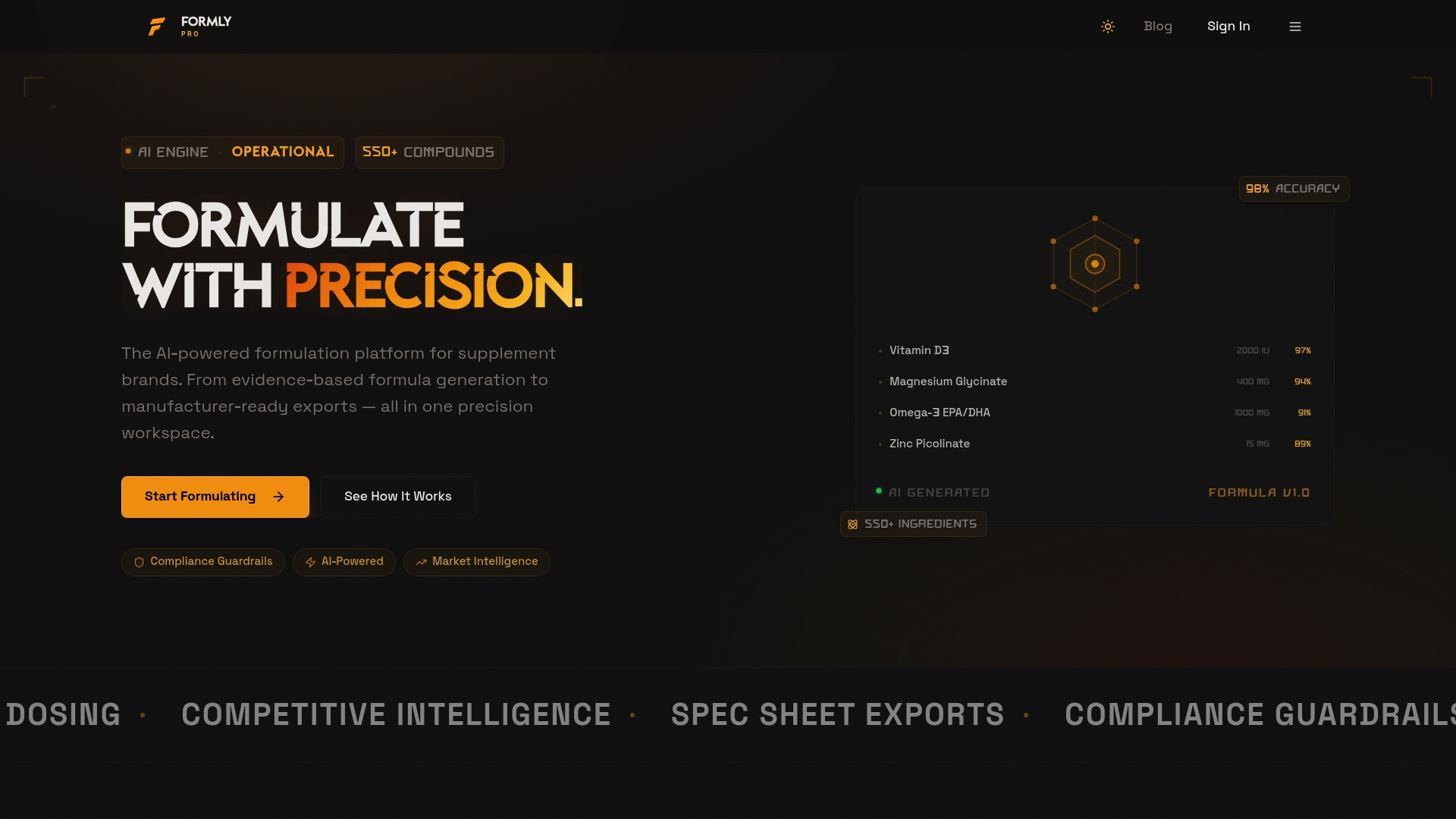
FormlyPro's marketing materials state it reduces product development time by approximately 90% according to user reports. The platform supports capsules, gummies, powders, beverages, tablets, tinctures, shots, and topicals, which helps brands with diverse product lines. Subscription tiers include tools for formulation, market research, competitor analysis, compliance guidance, and a packaging module with an AI Mockup designer.
Core Features
FormlyPro combines AI-backed formula generation with an ingredient library that lists dose ranges, safety notes, and regulatory flags to guide formulation choices. The product includes competitor ingredient parsing and comparison, a product pipeline visual planner, and exportable manufacturer spec sheets plus supplement facts labels. Team collaboration features let multiple workspaces and user seats share formulation drafts and manufacturer-ready outputs.
Key Differentiator
FormlyPro centers its workflow on AI-driven evidence-based formulas with automatic compliance guardrails and competitor analysis all in one platform. That single workflow links market intelligence to formula drafts so you can see competitor ingredient stacks while building a formulation. The platform also ties each formula to pipeline planning and exportable spec sheets for manufacturing and label production.
Pros
The platform groups formulation, market research, and competitor analysis in the same workspace, which reduces handoffs between teams and external consultants. According to vendor materials, the product includes compliance guardrails and reminders that help frame claims and prepare FDA-facing label exports. Subscription tiers and exportable manufacturer spec sheets let small teams move from ideation through prototyping to manufacturer-ready specifications without rebuilding documents in other tools.
Cons
- Detailed regulatory compliance validation for complex markets may require higher-tier plans or an external regulatory review.
Who It's For
FormlyPro fits small to medium-sized supplement brands and R&D teams that need faster, cost-effective product development. It suits product managers running multiple formats and founders who want one workspace for formulation, market research, and launch planning. Operational teams handling pipelines and manufacturers benefit from the platform's export formats and collaboration features.
Unique Value Proposition
The platform advertises an eight-phase product plan that moves a concept from ideation through formulation, prototyping, market research, compliance, and production. That structured plan links research and competitor analytics directly to output documents such as manufacturer specs and FDA-facing supplement facts labels. Teams that pay for higher tiers gain deeper regulatory reminders and expanded export options, which shortens administrative work between R&D and contract manufacturers.
Real World Use Case
A nutraceutical startup used FormlyPro to produce a pre-workout formula, cutting internal development steps and consolidating competitor analysis and label generation in one workspace. The company exported manufacturer spec sheets and supplement facts labels for its contract manufacturer and tracked pipeline milestones from prototype to production. That workflow reduced external consulting hours and kept documentation consistent across teams.
Pricing
FormlyPro offers a free testing tier with $0 access forever, followed by paid plans starting at $99/month for building, $249/month for professional, $599/month for scaling, and custom enterprise options for larger teams. Higher tiers unlock advanced compliance checks, collaboration seats, and expanded export capabilities. The pricing model targets brands that prefer predictable monthly costs over per-project retainers.
Website: https://formlypro.com
Bettrlabs
At a Glance
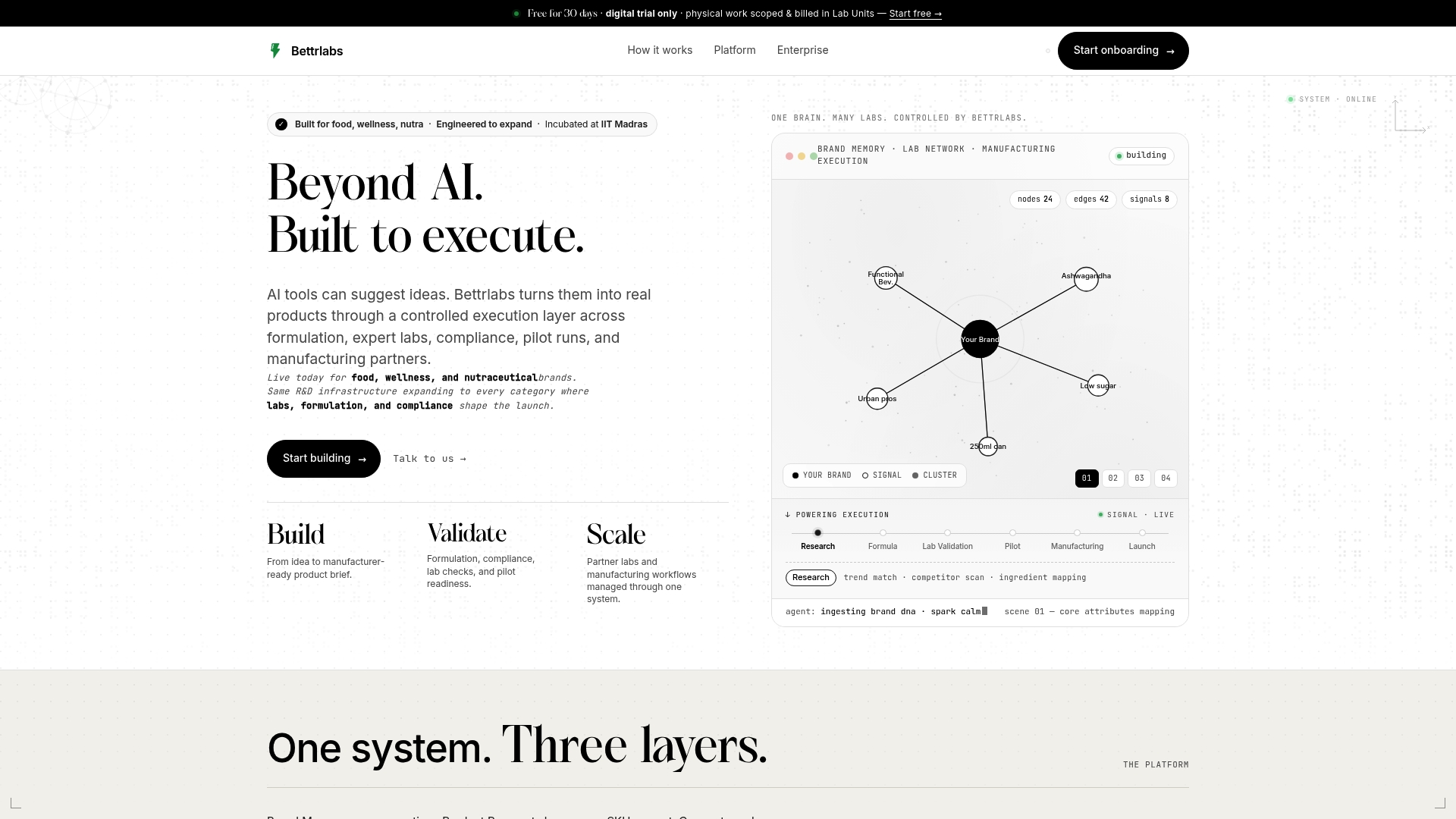
Bettrlabs charges for physical lab work in discrete Lab Units, with per unit rates listed at roughly ₹8.5–12 depending on plan. The platform combines digital trials and scoped lab work, so teams can keep a continuous record of formulations and compliance. This model fits brands that must pair lab validation with product lifecycle records.
Core Features
An AI driven workspace ties Brand DNA, market research, formulation logic, and compliance into living records called Product Passports. An always on Brand Memory captures ingredient rules, claims, and competitor signals. Connectors move data to and from Shopify, Drive, and CSV or Excel.
Key Differentiator
Bettrlabs combines Brand DNA, market intelligence, formulation, compliance, and manufacturing workflows into a continuous R&D system. That close coupling of digital Product Passports with scoped physical lab work and pilot runs lets teams track changes from ideation through manufacturing. The platform treats product development as a continuous record rather than a series of one-off projects.
Pros
The platform keeps a growing digital record for each SKU, which simplifies audit trails and label changes as products evolve. Built in compliance checks and access controls for multiple teams help brands manage launches across multiple markets. Structured, review ready outputs align with manufacturing workflows for pilot runs and scale up handoffs.
Cons
- Teams that only need basic formulation or a quick compliance check will find the platform more complex than necessary.
- Physical lab work and manufacturing are scoped and billed separately. That can raise costs for brands on tight budgets.
- The system depends on the accuracy and timeliness of integrations with external labs and manufacturing partners.
When It May Not Fit
If you sell a single SKU with simple labeling needs, Bettrlabs will feel like overkill. If you cannot budget separate lab and manufacturing fees, total cost may exceed expectations. Small teams without integration support may find setup and workflow mapping slow.
Notable Integrations
Connectors include Shopify, Drive, ChatGPT (MCP), and CSV or Excel for imports and exports.
Who It's For
Product teams in food, beverage, wellness, and nutraceutical brands that handle formulation and compliance. Teams that require lab validation, multi market compliance, and documented product records will get the most value. Companies planning multiple SKUs and manufacturing scale will appreciate the continuous R&D focus.
Real World Use Case
A food brand uses Bettrlabs to take a formula from idea to pilot runs. A live Product Passport records formulation details and FSSAI compliance for regulatory review. After pilot validation the team scales production and hands off specifications to manufacturers for multiple SKUs.
Pricing
Bettrlabs offers a 30 day free trial. Physical work is scoped and billed in Lab Units, with per unit rates at roughly ₹8.5–12 depending on the plan.
Website: https://bettrlabs.com
ENTR Technologies
At a Glance
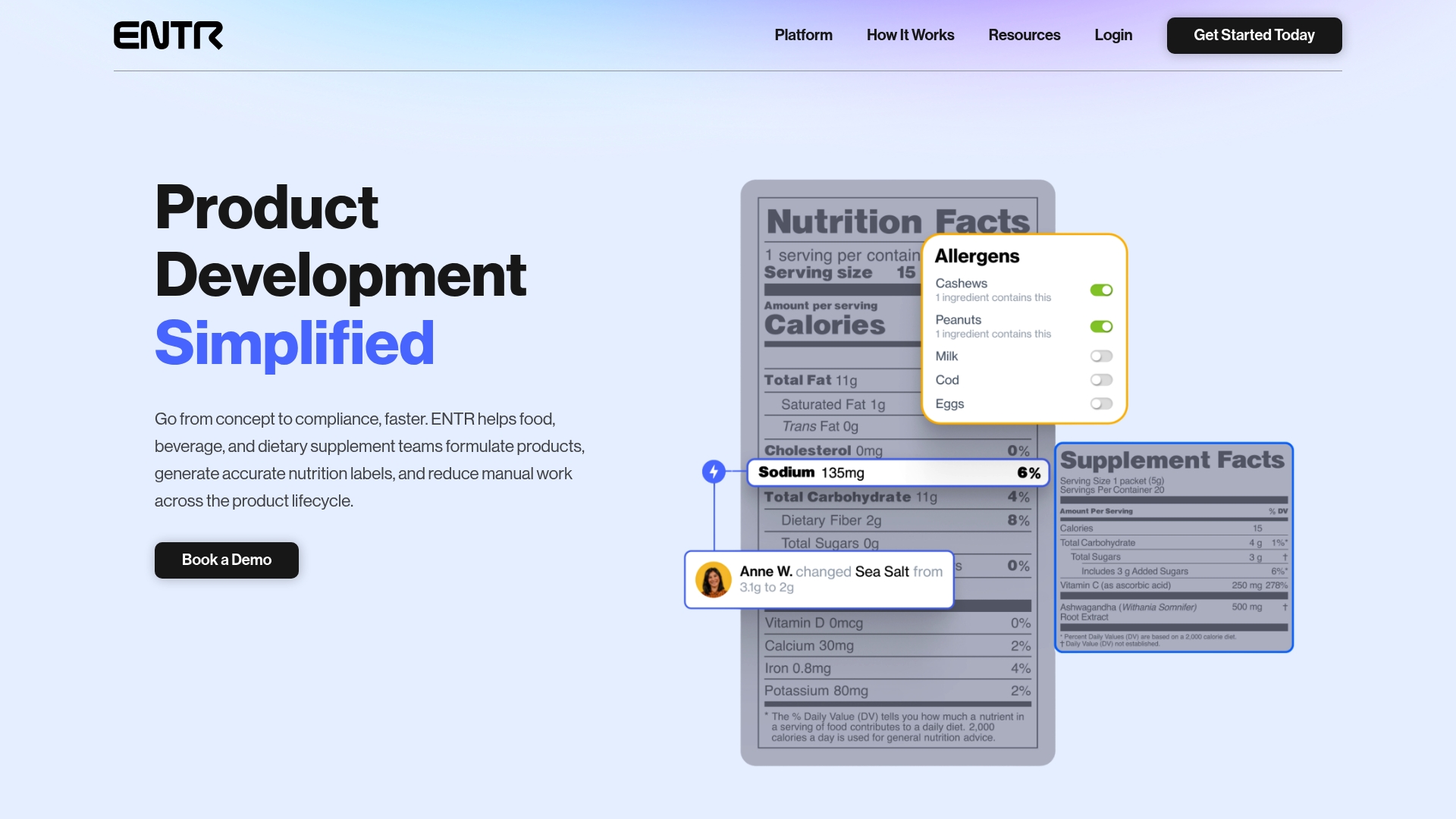
Automated extraction of nutrient data from spec sheets pulls ingredient values directly into formulas, cutting manual entry during product setup. ENTR's marketing materials state it performs compliance checks and generates labels aligned with FDA and Health Canada/CFIA standards. The platform adds proofing workflows and cost tracking so teams can manage artwork and margins in one place.
Core Features
ENTR combines formulation tools with automated nutrient extraction, label generation, and compliance checks. It includes collaborative document management, comment tagging, proofing and approval workflows, and cost and margin tracking tied to recipes. API access and integration options support enterprise systems and external data flows.
Key Differentiator
The single biggest difference is that ENTR merges formulation, compliance, labeling, and proofing into one user friendly system. That reduces handoffs between R&D, regulatory, QA, and marketing teams and keeps version history tight.
Pros
The interface reflects real world team feedback, which makes complex workflows easier to use and faster to learn. Data migration support and automated nutrient extraction shorten onboarding and product setup. Proofing, comment tagging, and cost tracking tie artwork approvals to formulation changes, and the API supports enterprise systems for downstream processes.
Cons
- Advanced regulatory customizations may require dedicated support.
- Pricing is not publicly specified and likely varies by usage scope.
- Training and onboarding assistance are often necessary to get full value from the platform.
When It May Not Fit
If your team lacks dedicated regulatory or R&D staff, ENTR's depth may be more than you need. Small startups and single person operations could find pricing and onboarding costs prohibitive. Teams that need public pricing to compare vendors will have to request a quote.
Who It's For
Mid sized to large food, beverage, and supplement companies with R&D, regulatory, and quality teams will get the most from ENTR. Consultants and co manufacturers that manage multiple clients benefit from centralized ingredient data and proofing workflows.
Real World Use Case
A dietary supplement manufacturer uses ENTR to manage ingredient specifications and automate label generation. They track formulation costs and approvals so new SKUs move from prototype to launch faster with fewer labeling mistakes.
Pricing
Pricing is not publicly specified. ENTR uses customized contracts, with quotes based on company size, feature set, and integration needs. Prospective buyers should request a demo and an estimate to see exact costs.
Website: https://entrtechnologies.com
KosmetikOn
At a Glance
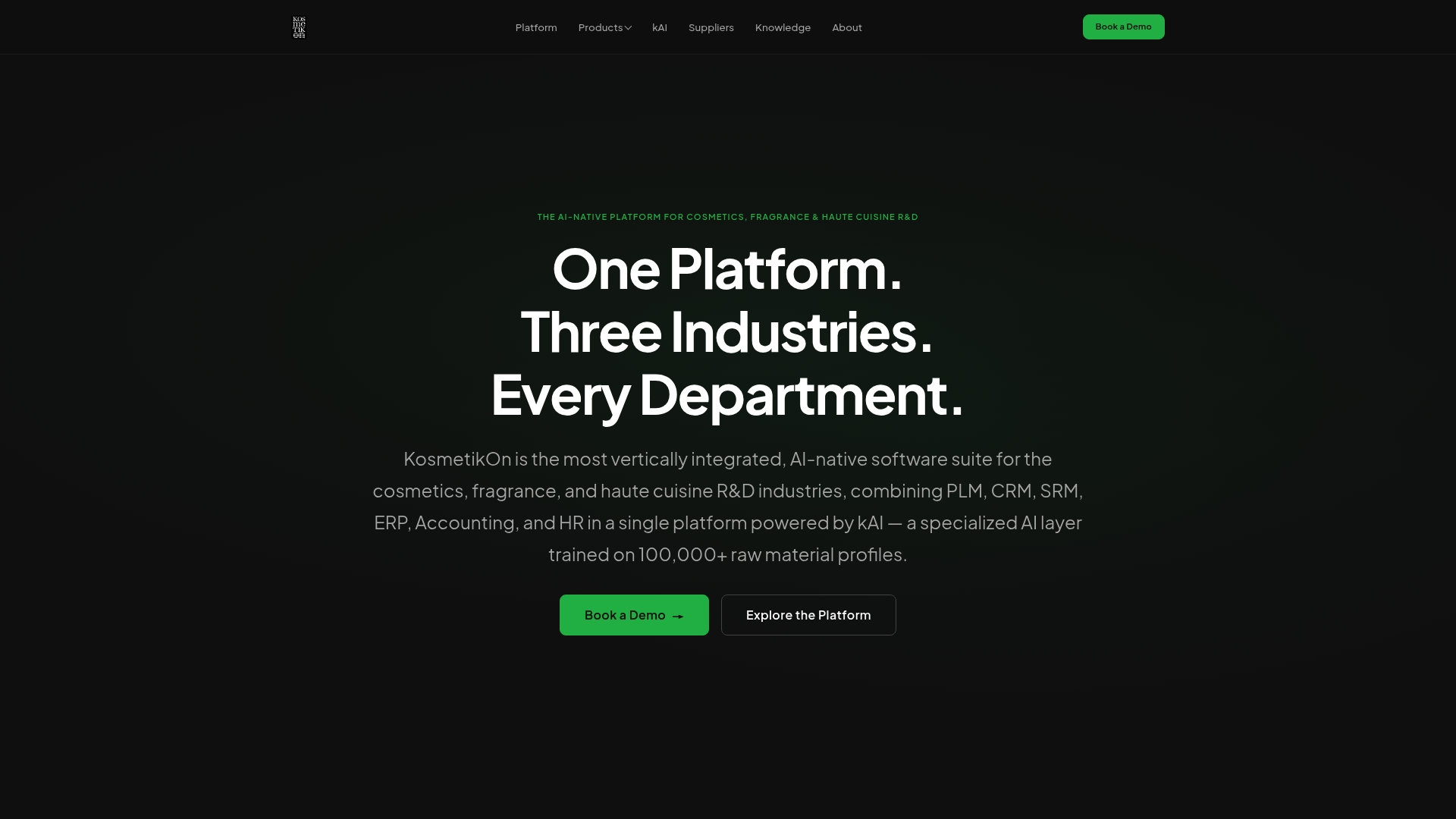
kAI is trained on over 100,000 raw material profiles and regulatory documents, according to the company. That industry training underpins formulation suggestions and allergen analysis. The platform bundles PLM, CRM, SRM, ERP, accounting, and HR on a single shared data backbone to remove separate spreadsheets and duplicate records.
Core Features
KosmetikOn delivers lifecycle management, formulation management, supplier collaboration, and manufacturing order control within a single architecture. The system automates INCI list generation and MOS calculations while offering regulatory checks for EU Cosmetics Regulation 1223/2009, IFRA, and REACH. kAI assists ingredient suggestions, trend signals, and regulatory change monitoring to speed decision cycles.
Key Differentiator
The one thing that sets KosmetikOn apart is its industry focus. It targets cosmetics, fragrance, and haute cuisine R&D with AI trained specifically on materials and compliance for those sectors. That vertical specialization shows up across workflows, datasets, and reporting templates.
Pros
The vendor reports 33+ companies worldwide and 20+ years of domain expertise, which suggests real industry focus and long product-market experience. The platform eliminates separate departmental data silos by using a shared data backbone and connected modules for R&D, manufacturing, and regulatory teams. Built-in regulatory checks and automated INCI list creation reduce manual compliance work and help speed formulation iterations.
Cons
- Implementation may be complex for organizations without a digital backbone, given the platform breadth.
- Pricing is not detailed publicly, indicating a likely enterprise focused sales model and custom quotes.
- The documentation gives limited detail on configuring nonstandard workflows for smaller teams.
When It May Not Fit
KosmetikOn may not fit small startups that need simple, low-cost tools. Organizations without an existing digital infrastructure could face lengthy onboarding and integration work. If your priority is a low-cost point solution for one workflow, the platform’s enterprise focused model may be a poor match.
Who It's For
Mid-size to large cosmetics, fragrance, and haute cuisine R&D and manufacturing teams will get the most value. Teams that must centralize formulation, supplier documentation, and regulatory validation in one system benefit most. Organizations seeking domain-specific AI support and end-to-end lifecycle control will find the platform aligned to their needs.
Real World Use Case
A cosmetics R&D team manages formulation development inside KosmetikOn, then generates INCI lists automatically for regulatory filings. The team runs compliance checks before sending a formula to the contract manufacturer and tracks batch execution in the same system. That workflow cuts handoffs and reduces documentation errors.
Pricing
Pricing is not publicly disclosed. The vendor lists custom or enterprise tier engagement as the likely commercial model, with quotes provided per client needs.
Website: https://kosmetikon.io
FastFormulator
At a Glance
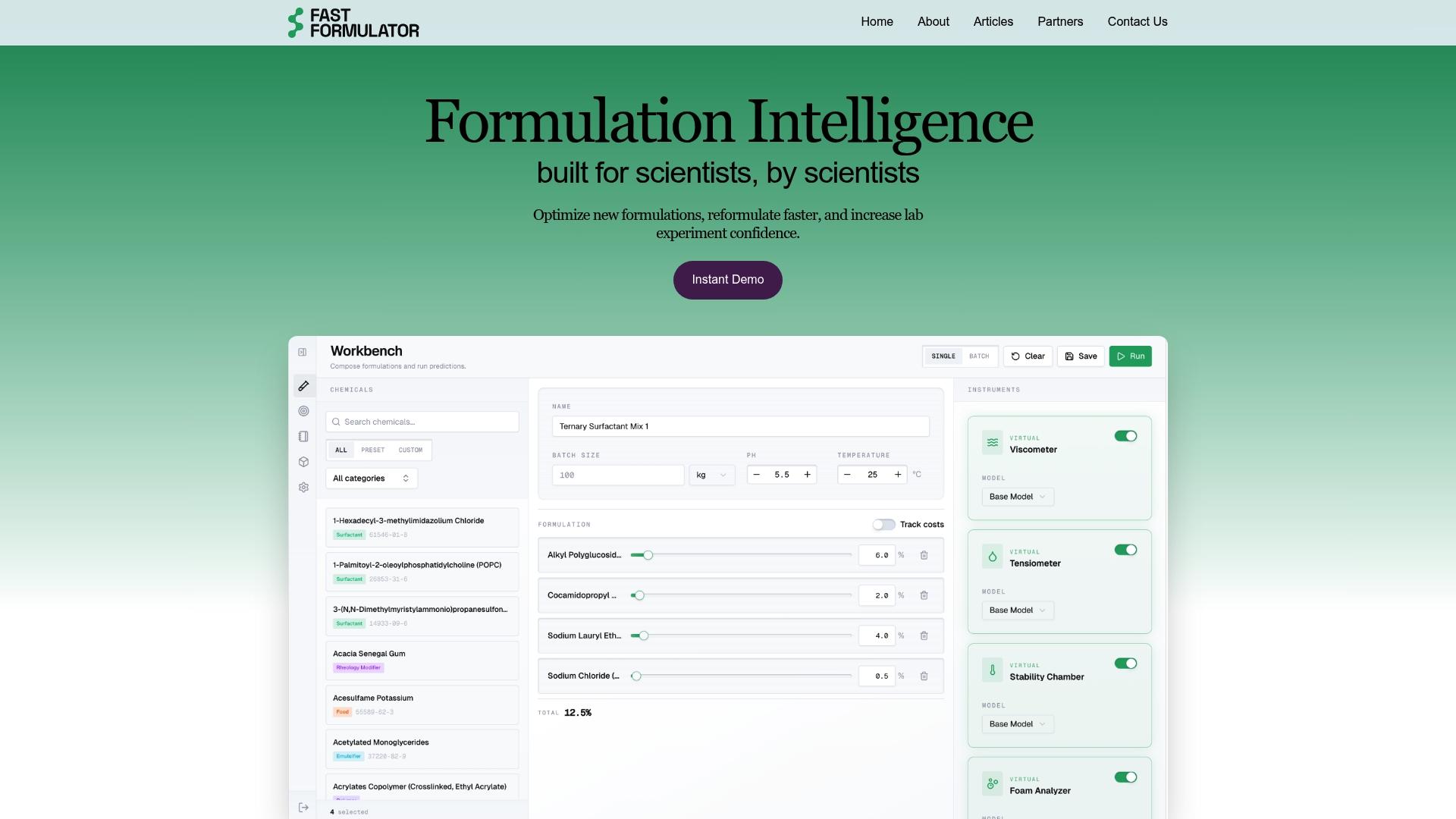
FastFormulator advertises the ability to explore thousands of formulation candidates virtually before any lab test. The platform pairs predictive models with virtual experiments to reduce the number of physical trials. Its focus spans cosmetics, foods, detergents, medicines, and agrochemicals.
Core Features
FastFormulator lets teams screen large formulation sets using historical formulation data to inform new designs and speed iteration. It predicts physicochemical properties such as viscosity, stability, surface tension, and foaming while allowing customization of models to match specific chemistries. The system also supports virtual experiments that use digital twin lab instruments to simulate formulation and testing processes.
Key Differentiator
FastFormulator centers on continuous model improvement through proprietary data and machine learning tailored to formulation science. The platform emphasizes model customization so predictions reflect a lab or ingredient set rather than a generic chemistry model. That focus targets specialists who need prediction fidelity for scale up and compliance work.
Pros
The platform speeds formulation development by enabling broad virtual screening that narrows candidate lists before physical testing. Continuous learning with new experimental results improves model accuracy over time, and customization options let you tune models for a specific ingredient set or test method. Workflow integration supports iterative optimization and early scale up planning, and the development team includes both scientists and AI experts for domain depth.
Cons
-
Limited third party review data is available to validate long term performance and adoption.
-
Getting full value requires significant historical formulation data and familiarity with chemometrics.
-
New users may face a learning curve and will likely need training or hands on onboarding.
When It May Not Fit
If your team lacks structured formulation records or analytical test data, model accuracy will lag and onboarding will be slower. Small brands that need quick templates rather than model customization may find the tool more complex than necessary. Organizations without an R and D scientist to tune models will need vendor support or consulting.
Who It's For
Research and development scientists, formulation engineers, and technical product managers in cosmetics, food, chemical, and pharmaceutical companies. Teams that run regular lab tests and maintain historical formulation records will capture the most value. Users focused on predictive property modeling and scale up planning gain particular benefit.
Real World Use Case
A cosmetics company uses FastFormulator to screen potential emulsions virtually and select a short list for lab validation. That approach reduced the number of full formulation trials and saved raw material and technician time. The team then tuned models with the lab results to improve subsequent predictions.
Pricing
Pricing is not publicly listed. FastFormulator appears to follow an enterprise subscription model typical for specialized laboratory software, and teams should contact sales for a quote and implementation scope.
Website: https://fastformulator.com
Comparison of alternatives
Selecting a product development platform requires assessing its ability to integrate your team's existing workflows while ensuring regulatory and manufacturing readiness. A perfect fit balances functionality, accessibility, and scale.
Integration vs. specificity
FormlyPro excels in offering a unified system where formulation, competitor analysis, and regulatory compliance are all accessible in the same workflow. Conversely, KosmetikOn’s kAI specializes uniquely in cosmetics-specific databases and regulations, offering insights aligned precisely with niche markets.
Scalability and onboarding
Bettrlabs provides significant benefits in scalability for multi-SKU markets. Meanwhile, ENTR focuses on integration depth, offering extensive API connectivity to enterprise systems. However, its cost structure may not suit startups needing low entry costs and rapid onboarding.
Best fit
- For teams requiring formula, market, and pipeline synergy, FormlyPro offers versatility and accessibility.
- Organizations in cosmetics requiring extensive industry-specific R&D tools can rely on KosmetikOn as a precise solution.
- Teams demanding rigorous lab-backed iterative validations for data pipelines should consider Bettrlabs.
- Rapidly scalable operations benefit from ENTR for its advanced connectivity options to external enterprise systems.
- Focused R&D teams seeking laboratory analytics as a cornerstone should evaluate FastFormulator for its predictive analytics capabilities.
Our pick
FormlyPro successfully combines product formulation, regulatory considerations, and market analysis into a single user-friendly platform. Its immediate accessibility and scalable pricing make it especially suitable for small to medium-sized teams looking for an cost-efficiency balance. However, for specialized niches, other platforms may provide more targeted features.
The following table compares alternatives in the product formulation and development software industry on their core features, key differentiators, targeted users, pricing, and notable limitations.
| Product | Core Features | Key Differentiator | Best For | Pricing | Notable Limitation |
|---|---|---|---|---|---|
| FormlyPro | AI-backed formula generation, compliance tools | Centralized workflow with competitor analysis integration | Small to medium supplement brands | Free; Paid from $99/month | Detailed compliance for complex markets requires higher plans |
| Bettrlabs | Digital trials, product passports | Continual R&D approach with scoped lab work integration | Food, beverage, wellness brands needing lab validation | ₹8.5–₹12 per Lab Unit | Complexity exceeds needs for basic formulations |
| ENTR Technologies | Nutrient data extraction, label compliance | Unified system for formulation and proofing | Midsize to large food and supplement companies | Price not published | Training and onboarding can be time-intensive |
| KosmetikOn | Lifecycle management, supplier collaboration | AI specific to cosmetics and fragrance sectors | Mid to large cosmetics and fragrance R&D teams | Price not published | Onboarding requires existing digital infrastructure |
| FastFormulator | Predictive models, virtual experiments | Model customization for specific ingredient data | Scientists in cosmetics, food, chemical R&D | Price not published | High learning curve for unstructured datasets |
How to Overcome Challenges with Product Development and Compliance
Small to medium-sized supplement brands and R&D teams often face difficulties managing multiple tasks like formulation, market research, compliance, and packaging within a single workflow. Formlypro addresses these challenges by offering an integrated platform that pairs AI-driven formula generation with market and competitor analysis. This helps brands reduce product development time and maintain compliance while managing multiple formats.
Formlypro's 8-phase product plan guides your team through formulation, prototyping, market research, compliance, and production. Plus, the AI Mockup designer helps you create custom packaging, all within one workspace. If you want to reduce handoffs between teams and keep documentation consistent from ideation to manufacturing, learn more at Formlypro.
Take the next step by exploring the platform’s features for faster product development and smarter market positioning.
FAQ
How does Formlypro support product formulation and development?
Formlypro offers AI-backed formula generation that assists users in developing personalized product formulations. Its ingredient library provides dose ranges, safety notes, and regulatory flags to guide formulation choices. Brands looking for a streamlined development process will benefit from its core features.
What is the difference between Bettrlabs and Formlypro?
Bettrlabs effectively combines digital trials and lab work, offering a continuous record for formulations and compliance. Formlypro, on the other hand, integrates AI-driven formula creation with comprehensive competitor analysis, making it ideal for brands focused on rapidly developing and launching products.
Which platform offers product pipeline visual planning?
Formlypro includes a product pipeline visual planner that allows teams to map out their formulation processes strategically. This feature enables users to see their project milestones clearly, facilitating better project management and tracking.
Can I use Formlypro if I have a small team?
Yes, Formlypro is designed to accommodate small to medium-sized supplement brands and R&D teams. Its collaboration features, including multiple workspaces and user seats, help smaller teams manage their workflows efficiently.
How much does Formlypro cost compared to its competitors?
Formlypro starts at $99 per month for its basic plan, which provides essential features for formulation and development. This pricing model allows teams to predict their monthly costs, making it a cost-effective choice as compared to others that may have variable pricing based on lab work or project scope.